1 free read left. Create a free account for unlimited reading + AI research.
Create free account
Superstar Session: The State of Play: Blockchain Gaming in 2021
Key insights
7 takeaways- 01Blockchain gaming experienced massive growth in 2021, marked by a 4,300% year-on-year increase in daily active wallets interacting with gaming smart contracts by August.
- 02The play-to-earn model, driven largely by the economic impact of Axie Infinity in emerging markets, propelled blockchain games to surpass decentralized finance applications in total traffic.
- 03The industry is currently transitioning toward a decentralized virtual layer, utilizing in-game NFTs, virtual land, and brand partnerships to establish gaming as a pillar of the decentralized economy.
- 04Traditional gaming companies are adopting a cautious approach by prioritizing the development of new titles over the conversion of existing intellectual property to minimize business risk.
- 05Significant barriers to long-term sustainability include complex regulatory environments, the tension between financial speculation and entertainment, and high entry barriers for new users.
- 06Future industry viability depends on the implementation of improved metadata standards and community-led moderation to create a more accessible and sustainable ecosystem.
- 07To improve system resilience, the industry is shifting away from centralized APIs toward decentralized data providers and direct smart contract interactions to eliminate single points of failure.
Ask AI about this video
Transcript
we have it's always good to start off i think these these are sessions with a sort of overview of the data um and that radar is all about data so schemantis is going to take us through some numbers um on the state of play blockchain gaming in 2021 i think we're gonna have a we're gonna have a lot of numbers a lot of graphs with with big spiky lines going up to the right aren't we mantis i hope the top right hand corner of the graph going to be getting a lot of action in these ones i think a long time no see it has been a while hasn't it good um yeah good uh has got an extra 25 minutes we'll try and get questions in um uh as appropriate so please put questions in the questions box but um i'll disappear and uh leave over to you okay cool thank you john so thank you for having me here now we begin with the state of play so kind of looking at blockchain gaming in 2021 what happened where are we and and what's next
who i am so john did quite a bit of introduction already um but just to repeat and give something more well i'm scared montes i'm the ceo of death radar uh which i co-founded with dragos in 2018 and so that trader was our way of giving back to community by sharing data you know three years ago that's data wasn't a thing at all and we wanted to help people to find those debts and make good investment decisions in the end the paradigm now is the world's leading depth store with nearly 7000 daps across more than 20 different blockchains and protocols and we also have a portfolio management suite i think by now it's pretty obvious that we are firm believers in the decentralized economy and so as every presentation probably nowadays in gaming it has to start with accident right so axi very well illustrates what's going on in blockchain gaming this play to earn movement basically
has been on absolute tier since the second quarter of this year it all started in may when axi moved to in an etherium sidechain that allows transactions at high speed with almost non-existent gas fees and since then axi has become the most valuable nft collection ever surpassing 1.7 billion dollars in total sales by the end of august so now it's even higher than that it surpassed two billion but almost half of this amount occurred in august uh actually generated 355 million dollar in revenues in august alone and that means they left important apps like uniswap like openc and even some you know blockchains like bitcoin behind in terms of revenue and while the games metrics are something to behold uh the biggest news come from from a political standpoint so x infinity has become relevant enough to raise attention of the philippines government a country that is basically home to more than a 500 000 active taxi gamers
and the filipino finance and their secretary they publicly stated that you know all the earnings from play-to-earned platforms will become subject to tax legislation and in axis case if you don't know players may reasonably earn from five to ten dollars per day at the current price of the trophy token so that is about 150 to 300 per month if you keep training every day and this amount is specifically significant in emerging economies so that's big money and according to recent official sources the philippine gdp increased by 11.8 percent in q2 of 2021. how much of that you know actually contributed who knows uh maybe we'll see that and so the play to earn movement is you know raising attention from a macro perspective and the state of play in this segment it sums up why this emerging category is becoming a part of bigger agenda so
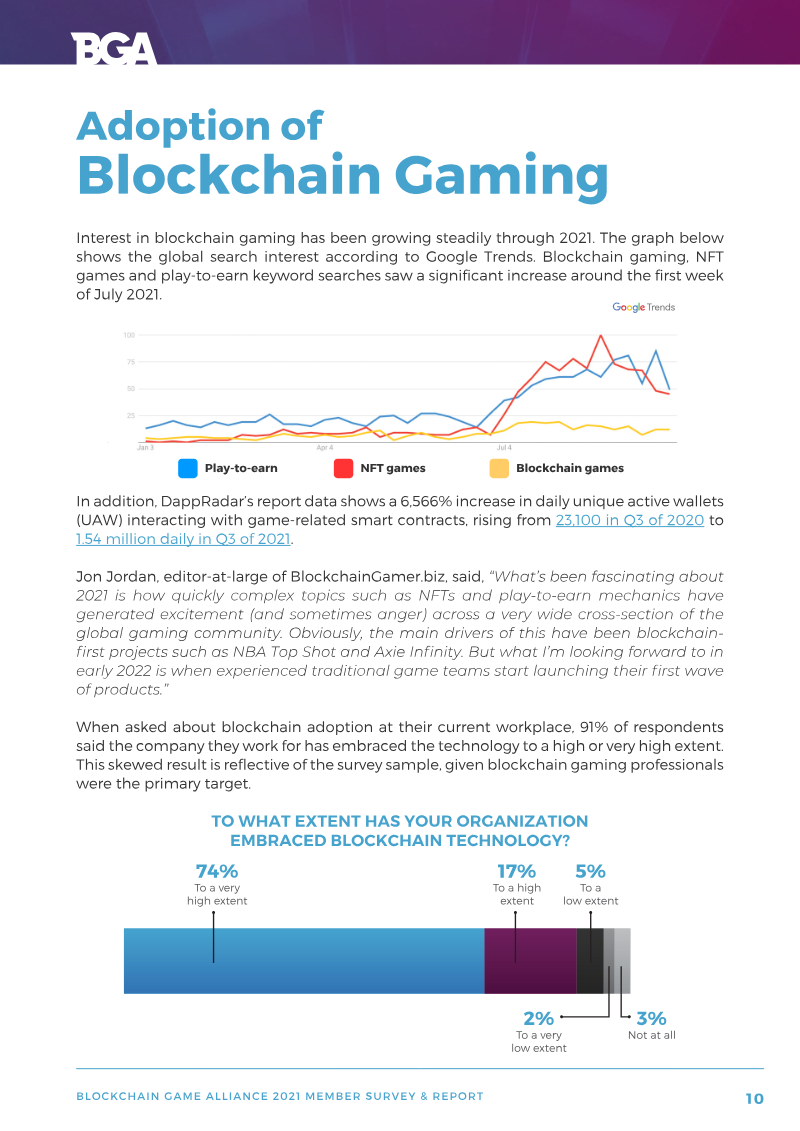
putting x aside for a while uh the whole blockchain gaming segment skyrocketed this year so just some numbers here in august the daily average of two million equal that's interacted with the blockchain down these are not necessarily users because the user can have multiple wallets but that's still a significant number and 44 of those 44 of those wallets interacted with the gaming smart contract so it's it's growing heavily and even versus july if you compare kind of end of august versus july the number increased by 17 percent so that's quite a bit of growth but then you look back a bit more when you compare to january drew by 2700 and if you look at if you look at year on year the kind of this day a year ago the growth is at 4300 percent that is an insane growth and if we keep going get the space that means next year by august we could be at 40 to 50 million gamer wallets
that's that's crazy and i hope that happens really so if we look at some chart here september has not ended yet uh but august confirmed the trend um you know we we started observing earlier this year this trend and it's about app usage is being beginning to shift heavily towards blockchain games so it's outperforming d5 and whilst nfts have been generating ever greater sales volumes it's these blockchain powered games that are carrying the load in terms of usage and the ryzen gaming popularity is also positively impacted by nfts so blockchain games game items are represented by nfts usually thus representing an important subject in nfd marketplaces across all the blockchains and protocols and in august alone the nft space generated over 5 billion dollars of total sales volume almost 20 of that or 1 billion of these recorded sales involved gaining nfds to some extent
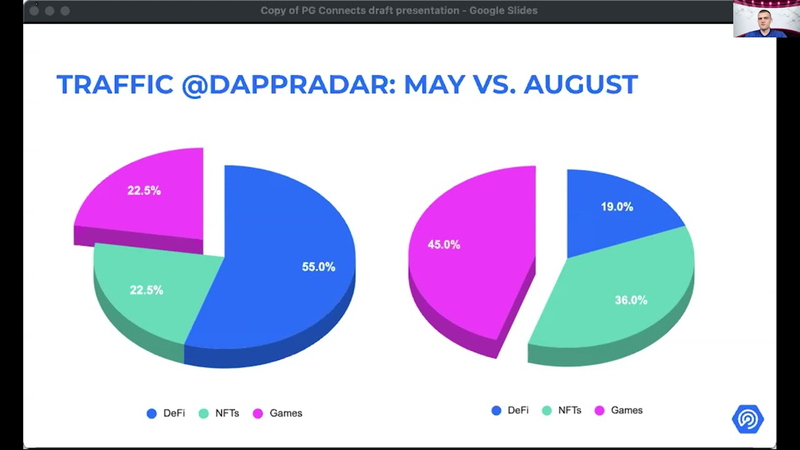
and all in all the gaming footprint is getting bigger by the day so the play to earn movement is reaching masses and we can see that those emerging economies they are adopting it as a way of living and it has become relevant enough to raise the attention from an entire government now if you look at that but from that predator's traffic perspective since the plate to earn movement and the whole nft space began to heat up in july most of the attention has remained on the side of the chain at the expense of of divide apps and in may 2021 50 55 of that prader's audience interacted with divide apps and while the other 45 percent was equally divided into nfts and games if we fast forward that to august the numbers have changed drastically so d5 dapps represented
only around 19 of traffic nft is 36 percent whereas games outperform both with 45 percent and considering tap writer is the go-to platform for all things depth related this signals a pretty significant shift in user interest now talking about specifically in-game nfts so what we can see that they're accounting for an increasing percentage of nfds being traded so in january in-game nfts were responsible for only 2.8 percent of an ft trading volume 13 of sales count and 12 of unique traders and this has changed significantly in august we now see ninety percent of trading volume belonging to in-game nfps 34 of sales and 37 of unique traders that's quite a jump so when we're talking about in-game and ft's market your growth it grew by you know 580 percent in
trading volume 160 in individual sales and 210 in unique traders between january and last month what i can say it doesn't seem that it's going to stop anytime soon let's wait and see what happens and going a bit deeper in the whole topic of you know it's not just nfds but it's also gaming tokens your c20s fungible ones so the nature of plate to earn dapsy it relies on an in-game currency uh although the tokenomics you know change from one dap to another this in-game currency is no different from other cryptocurrencies technically speaking and as a result of the play to earn revolution several game based fructose are easily outperforming their token peers access for example the x infinity governance token they showed a strong trend that relates to the game's recent success and axis has yielded great results to its token holders since the start of june
axis price has increased an outstanding fourteen hundred percent and seventeen seventy percent since last month on june 1st it traded at five dollars and on august 31st it was at 73 dollars quite a bit of a jump and whilst axis performance can be expected due to its you know strong game performance other game-based tokens are following the same line uh particularly game five related tokens like mobox and elluvium so mobox started june at 77 cents and closed the quarter at seventy 8.79 dollars ilv the eluvian token started june at 63 dollars and closed the quarter at 493 with an all-time high in early september at 639 that's again a tenfold compared to early june prices it's worth noting though that the elluvium governance token can be staked or locked for a 12-month period a nesting period within the platform and that's basically adding a
strong game file layer on the tokenomics design the game itself attracted more than 7000 unique wallets in august that's again a 70 increase month over month and in transaction volumes illidium achieved 88 increase from july it was generating more than 75 million dollars in august alone and the last uh one of the last points here uh splinterlands in late july splinterlands launch splinter shards or sbs uh the governance token helping the game record its best month ever and they saw 130 000 unique wallets in one month uh 400 increase and the spike in usage resulted in more than 58 million transactions as per the project itself the game's market cap that includes all cards and collectibles is almost 200 billion and while the token growth tokens growth doesn't seem quite as impressive compared to others the results is
helping tribe for the game they are remarkable and once the a4 mentioned tokens cannot be compared straight away due to the difference in their respective market caps game-based cryptos underline the strong trend the sector is currently experiencing even if it's not by plane individuals can make most of games you know by by simply holding their in-game currencies or governance tokens some example uh bitcoin versus access token considering the the tumble bitcoin and other established cryptocurrencies have taken as a plate game tokens are doing very very well and seem to not be as affected by macro news of course we are comparing apples to oranges to some extent here uh considering we are comparing currencies per se with governance tokens but this is very very good news if we are shifting towards a community driven economy and how about metaverse i think talking
about blockchain gaming without mentioning metaverse would be a disaster so the metaverse concept itself is a noteworthy part of the industry and the potential game changer those virtual worlds they aim to become the place where individuals from from communities they form communities to create trade and socialize and as projects in the metaverse move forward in their corresponding developments their relevance is only trending upwards for example um virtual lands within important virtual worlds are becoming more expensive like indonesia axis virtual world some plots some land that are a significant size and they're being sold for more than five hundred thousand dollars and some well-located land plots in the sandbox now actually now home to snoop dogg's virtual self have surpassed 850 000 and this trend will probably keep the same pace as several gaming devs that
involve virtual land features so the game goes for say partnerships that add an extra layer of credibility and luster to metaverses for instance blancos a high-end metaverse has partnered with burberry for exclusive in-game skins so as those virtual worlds reach their respective development milestones and more partnerships are announced expect the space to substantially increase in the upcoming months essentially you know the metavirus is being formed as a virtual environment where anybody can contribute and exchange value here's a quick look a quick look on on the virtual land sales that you know despite a slight dip between may and july which is not an unusual correction after a hype told them hi we were back on track with get a new all-time high in august so as the dust settles and the concept of metaversus becomes more commonplace we should expect to see much steadier growth and
hopefully less severe ups and downs so stringing this all together blockchain games nfts game based governance tokens and the emerging concepts of the metaverse we see a clear direction here we are likely headed towards the creation and adoption of a new virtual layer to reality that's driven and governed by the community where we'll get to trade socialize build play and much more so meta versus seem like a natural habitat for this type of reality and it's underlying underlying decentralized economy and this means that even more use cases for nfts and blockchain gaming will appear nfcs will likely be at the core of the meta versus revenue model and hence at the core of this new decentralized economy so gaming and its mechanics on the other hand you know they will be the driver of the social life that underpins and drives this economy
and i said this three years ago i said now we are very much headed towards the ready player one scenario perhaps not in the coming months and not in exactly the same way how it happens in radio player one but the next few years will certainly propel us into virtual life and besides some philosophical questions that many of us undoubtedly undoubtedly have this also raises some important more practical questions about the kind of short midterm development of blockchain gaming and some of mine are as follows so when will traditional gaming embrace play to earn i think play to earn is disrupting traditional games business models and i expect traditional gaming companies to build new games with platon elements rather than converting existing titles to blockchain games you know which would could potentially put their existing business at risk if it doesn't work well
so i think we'll have to wait for that it's going to be new titles rather than converting existing ones uh regulation is another topic that will come sooner or later and when and how my guess would be actually pretty soon i think we see that defy is on their magnifying glass right now uh from regulators and they do a deep dive into it and trying to figure out what's going on how to regulate it i think regulation isn't necessarily evil uh how people how everyone kind of trying to you know make them look but we all have to fight to get it done right and the risks of paid to earn so that also has something to do with you know with regulation um until now the absolute majority of games are we're about having fun and i believe the fun element will still stay here but fun has to be one of the core kind of it has to be one of the core elements of all of this but if you're fighting another player you know and and you put some assets some of your assets at risk which have
real money value you put those assets at risk and you lose a fight and you lose them that might be a very frustrating and depressing situation so we need to find ways we need to find balance between making money and having fun i think only when the economy only when we do that the economy will work and community will be satisfied and then we have the entry barriers and what we currently see in x infinity for example that there is a certainly high entry barrier to start playing exe it costs quite a bit of money so talking about free-to-play games that eliminate expensive entry barriers i think they will come i think there will be free to play games i mean there already are some but the point is i believe to make money you will still have to invest to get you know better items better gear to start making some money back you can look at traditional existing games that have real money economies for example entropia universe you can in
theory play without investment but that's not going to be you know very fun it's going to be very painful grinding for probably hundreds of hours at least until you achieve something and so to finish this if you you know if you wonder if there is a new axi brewing i think what actually achieved uh is much more than just building a game it's a very supportive community that consists of millions of gamers worldwide so i think building such a game is kind of easy compared to building such a strong community tied to the game itself but don't get me wrong i believe axi will still face some serious competition very soon so those are some some of the questions you know that i asked myself and i tried to answer those uh now i look forward to hearing yours thanks a lot hello sorry my camera's doing some weird things there thanks that's commanders you covered a
lot of ground there not not just numbers when we went into philosophy as well i like that too um so uh we've got some questions sort of popping up um so we'll we'll uh get round to those uh i guess it's sort of um uh one one i'd like to sort of ask i guess got a little bit behind the scenes you know um have you been surprised how um quick this sort of change has happened um i guess in some sort of context we were i guess i was sort of surprised i guess most of us at that rate i was surprised last year where we had this sort of defy um kind of situation where d5 was sort of this thing that that kind of quirky people messed around with and then suddenly within a space of you know a month or so this you know basically everyone's talking about defining we seem to have had something similar to that for games but but also games are much more accessible than boring finance so we've seen a much bigger bigger increase i mean at the start of the year were you sort of expecting games to be
the big thing that sort of blew up and how does that sort of make us think about the the future because it seems to be blockchain sort of either nothing happens or like everything happens is you know literally zero or one yeah indeed if you remember john a couple years ago a bit less than a couple years ago in new york uh you you asked me something similar in a panel and i didn't give you an answer uh so that kind of answers the first bit you know that did i expect this to blew up so quickly uh probably not but something that was two years ago yeah but something that we started working on um you know last year after beef i exploded we started thinking okay so what's next you know blockchain is going in waves we know that we saw that during those three years so last year we actually started preparing for this we kind of saw nfts not necessarily specifically gaming but kind of nfts starting to ramp up and we started preparing for that
something we saw nfts coming up and we kind of thought that yeah games should follow after uh but we didn't expect it to happen both at once i think that's the right way to say absolutely yeah no i think it's sort of thing where we we we should always be we're also expecting this sort of hockey stick growth but you never can tell exactly when it's going to going to get turned up there's always the surprise is the timing not the not not that's happening at least i guess for those of us in the space i mean you've been around even even longer than me um so let's have a look at some of the questions i mean you mentioned a bit about regulations um uh so i've got a question about that um which i guess is about uh the sort of national governments make have certain um make certain decisions we've seen that particularly in china over the last kind of months and certainly uh last week um so the question is the question is i'll pull out here yeah will it be an international sort of um do you think that'll be how it moves because governments can't really regulate or it's hard for them to regulate these
things nationally so do you think at some point it becomes a sort of uh an international sort of sort of um this is your making thing that's most people at an eu level i mean your bet you guys are based in lithuania i believe in a borderless economy i think that's when we think metaverse when we think blockchain it's i don't believe you cannot stop this train and you can try china is trying uh to a certain extent sec is also trying uh i think at some point it's gonna be obvious that you cannot stop this train i think you could a few years back that was still possible but now i think it's it's just too late and yeah as a i mean i'm living in this world uh we're unable to travel freely everywhere and i would just say i cannot have this asset or this asset because it's like on the blockchain or no my head is exploding i don't believe in that good um
so let's see what else we've got um i think there is there is a good one i want to answer actually so anonymous one is asking about uh how can you ensure children aren't accessing and using nfc and blockchain games and hopping on and using their parents card and so on uh i think the point about parents card is is valid and it but it happens with all the games so what do you refund maybe i think you can protect your credit cards better in that case but the thing about children and nfts and so on i think it's not about ensuring that they cannot access them i think it's i generally think that the blockchain and nfts they can help everyone to educate on kind of how economy works how free market works i'm coming with this from the example of steam marketplace and when we have those in-game skins like csgo and other games a ton of kids are playing there even if they are not supposed to uh but from from my past experience and
myself when i was a miner i was there so you get to know a lot about how the economy works how the market works how to buy and sell how to speculate these kind of things and i think it's not about protecting and ensuring that children don't access that it's about giving them the right tools how to understand this market how to how does it work i think it's about that and your credit card should be always with you so that's on your own now i think there's an interesting sort of point where um as you say there's all the the need the knee-jerk reaction is the wrong thing but but the sort of the the default option is how can we restrict children's access to these things which may not be helpful for them um which i think is you know it's a perfectly rightful way to think about it i mean i've got kids so um but but actually as you say you in most cases you can't you can't there's no there's no ways you can stop kids doing this um you know even in china now with their rules they find companies are setting up you know sort of pretend to be an adult sort of services
so people say children can get around these this three-hour restriction in in gaming so so the one thing with blockchain is because everything is transparent um in some ways it's you know it's better for kids because it opens it opens it up and and there is sort of the idea of you know you can have identity but that shouldn't mean the kids are restricted from it really you know because everything i think i agree probably agree with you you know everything will have value on you know with blockchains because we now have internet we have internet money everything has value and that's something you'd be better off you know getting your kids kind of into and allowing them to sort of um take the full opportunities of that rather than sort of hiding it away because you know they're going to do it anyway particularly if there's financial value attached to i guess i guess that's uh yeah i mean that's a really more personal view um but i think it and i think it's correct in the sense that you know we will see a lot of the legislation will sort of come around that route that sort of route that's what we see with games and loot boxes isn't it so often very much how can we protect children from that so i think that's sort of sort of how we'll see
governments approaching a lot of the blockchain stuff um some something just to continue on that if we in the ideal world i think one thing that can happen is that we'll move to a place where kind of let's say the where you discover those deaths where you're discovering fees and so on uh that place is kind of moderated properly and in a i don't know decentralized way this basically means that you know what your kids can access and cannot access can be also moderated by somebody else who has kids and kind of so it's we can make sure we can make it happen in this world that the the gatekeepers that community is a gatekeeper and they decide you know we all decide what's what's what to show what not to show what can be accessed what cannot be accessed so i believe in that john i think you're muted hello yeah sorry i'm just trying to also try to try to get um our next speaker
in as well so um alexandra is here we're trying to so uh let's take some more questions while we're looking at that so so here's an interesting one um do you see a dominant player emerging um for nfc integration at an api level um and i guess that's you know as you sort of pointed out um earlier on you know the interesting thing for actually was sort of when it created its own blockchain and sort of took more control of its sort of uh infrastructure that was when you know the big growth happened and um so that sort of goes towards people rolling their own technology but clearly um not all games companies and most games companies are not going to be able to roll their own blockchain um or scaling solution in the way that the axi did um how do you see that playing off um i guess in the short term oh that's a good one i think might not be exactly uh what the question is about really but
something that's related to nfts and and metadata is a kind of a problem uh and i'm talking about that it's like a lot of the metadata is centralized and that can be a big problem if you know servers go down the blockchain is still there but you know those assets are pretty much they're not useless uh they still say you own it but you don't know what you own because you cannot see it so that might be a problem and i think when we talk about the emerging players to a certain extent we have a problem with uh with openc uh because they just they're the biggest marketplace and they're collecting all those you know um orders and and they also provided some sort of a standard for how the metadata should be done i'm not blaming openstack here by no means it's it's like just that uh their order book is kind of centralized and then it's getting hard to play around with those connectives you know accessing the order book uh integrating more uh so that more projects can integrate that and so on i think we have to move towards
leaving it all open and when we say api i think that should be pretty much a non-existent thing as a centralized api it has to be either you know either just call a smart contract and get the data either use the graph uh use some other data provider that's actually decentralized otherwise we'll end up in in a situation where we have still single point of failure and we saw this in the blockchain and sometimes happens even if it's a graph with the graph was down i think last year and you couldn't just access balance there you could access some websites that was really harsh and you see the power so i think we have to move there we have to try to avoid that there is a single power of a single point of failure yeah man now i think it is one of these sort of eternal debates about sort of um this i think everyone everyone wants decentralization but but how do you sort of get there without the whole thing sort of falling apart and so as you say there's a surprising amount of blockchain infrastructure even on ethereum which is which is sort of
which are which are central points of failure and occasionally they fall over and everything everyone pulls her hair out but i i guess it's um to degree as long i guess most people have the sort of vision that they want to be more decentralized over time but won't go too far down down that route um so uh i think we are setting up for alexander next room actually so i will i will leave the question i don't know what it means alex uh do you think axi will have the same result with cryptokitties uh we'll leave that we'll leave maybe leave that once the next one i assume you're you're suggesting that um uh that quick a big had a big sort of a bubble at the start and then so went away a little bit um although crypto keys is coming back so so don't um don't write off crypto kitties yet um so anyway i think uh at that point we'll say thank you very much uh schemantis i think you're gonna be around for the panel later on as well aren't you that right yeah yes for sure thank you john so if you have any more questions uh specifically for scomantis we will be dealing with them in about an hour or so at the sort of ending uh panel um for this particular section
thanks very much you
Summary
The blockchain gaming sector underwent a transformative expansion throughout 2021, characterized by a 4,300% year-on-year increase in daily active wallets interacting with gaming smart contracts by August. This growth was primarily catalyzed by the emergence of play-to-earn models, most notably exemplified by the economic impact of Axie Infinity in emerging markets. As blockchain games began to surpass decentralized finance applications in traffic, the integration of in-game non-fungible tokens, virtual land, and high-profile brand partnerships established gaming as a foundational pillar of the broader decentralized economy.
This evolution represents a shift toward a decentralized virtual layer of reality, where community-governed economies and play-to-earn mechanics redefine social interaction. While traditional gaming entities remain cautious, favoring the development of new titles over the conversion of existing intellectual property to mitigate business risks, the industry continues to grapple with significant hurdles. These include complex regulatory landscapes, the inherent tension between financial speculation and entertainment value, and substantial barriers to entry for new users. Long-term viability depends on the establishment of improved metadata standards and community-led moderation to ensure a more accessible and sustainable ecosystem.
Technical infrastructure remains a critical focal point for the industry’s maturation. Current systems frequently rely on centralized components, which introduce single points of failure that contradict the core ethos of blockchain technology. To achieve true system resilience, the industry is prioritizing a transition away from centralized APIs toward decentralized data providers and direct smart contract interactions. This shift toward a borderless, decentralized model is essential for securing the future of gaming as a robust and reliable digital infrastructure.













Comments