1 free read left. Create a free account for unlimited reading + AI research.
Create free account
Superstar Session: Game On or Game Over: Level Up Your Gaming Strategy in the EU
Key insights
6 takeaways- 01Global gaming consumer spending remains 80 percent higher than pre-pandemic levels, indicating sustained industry momentum.
- 02Revenue generation is heavily concentrated in 4X strategy, role-playing games, and match-3 titles, despite hyper-casual games leading in total download volume.
- 03Developers can quantitatively improve retention and revenue by using analytical frameworks to correlate specific features—such as tutorial length and login rewards—with performance metrics.
- 04Battle royale titles demonstrate higher day-one retention when they prioritize streamlining tutorials and minimizing non-gameplay distractions.
- 05Growth is increasingly driven by shifting demographics, specifically an influx of female and older players, alongside rapid market expansion in regions like Turkey.
- 06Independent studios are most successful when they adopt agile development cycles, leverage hyper-casual mechanics, or partner with established publishers rather than competing directly with large-scale production titles.
Ask AI about this video
Transcript
moving uh swiftly on we're going from one great talk from russell into another one and we're going to be joined by our track sponsors at annie so jinday should be joining me any moment and from there we're going to be flowing uh into annie's talk on the global trends track our our track sponsors uh hi jinder it's great to have you with us hey how are you i'm good good thank you thank you where where are you based at the moment where are you coming from i i'm based in singapore oh wow fantastic well thank you for joining us from singapore yeah i bet you the weather's nicer there than it is here uh you guys in london i'm in liverpool we're all over the place uh but yeah we're all in different parts uh most of us are in the uk but some of us are in different locations as well i was gonna say it's the same it's just raining here so it's pretty much
well yeah it's the same then um but yeah i'm just trying to say thank you for being here i'll let you get your slides set up everything like that and i will remind everyone though i'm not sure i need to remind everyone but uh remind everyone nonetheless throw your questions into the q a i'll be back at the end to go through i'd like to say all of them but as many as i possibly can so please throw all your questions in and uh yeah uh over to you okay thank you sophia so hello everyone welcome to the apni presentation and thank you for joining us here today so my name is jinda i'm the general manager of gaming at apani i've been an athany for more than eight years so currently based out of a singapore office which is one of our 15 global offices so throughout my career i've worked with lots of game companies globally across the market data analytics space and also in social demand and monetization so really excited to be here today to share the latest insights on the world of gaming
so before we get started here is a quick disclaimer about our data and analytics and our presentation okay and here's our agenda today so we will start with a simple introduction of app banning and then we'll go through some high level market trends some marketing use cases and then we'll dive into some gaming use cases with our latest product game iq and end off with some summary of key takeaways so first a quick introduction of apani we are the mobile performance standard providing the most accurate and complete set of mobile market analytics to help companies succeed in their mobile business and these are some of the global customers who trust in our data products and teams so let's get straight into it we are in the new normal okay we are at about one and a half years since covet hit and you can see that globally
although games downloads and time spent have dipped a little bit since the peak of lockdowns they are still sustaining at a higher level which is about 25 percent higher than where we were free pandemic and if you were to look at consumer spend right in the middle this just continues to grow despite cities reopening up despite idfa we are still almost 80 higher than where we were pre-pandemic so our industry the gaming industry is growing and is moving forward next let's take a look at where this growth is coming from specifically in the emea market so in the first half of 2021 game downloads market size are led by the biggest market russia followed by turkey which is at number two and number two continues to grow at a six-month growth rate of 13 so this is downloads what about consumer spending
so consumer spend this is led by germany and the uk which are both still growing strong the highlight market here is again the turkish market which was at number two with downloads and here they are at number seven with revenue rank but with a huge six percent uh 38 percent six month growth so with that we'd like to next present the top performing emea headquartered companies gaming companies in the first half of this year so firstly top companies buy downloads most of these companies are here with huge contribution from the hyper-casual games next top companies buy revenues this features a variety of companies with different strategies for instance clerics and moon active are well known for the innovation on hybrid genre games and supercell is a pioneer that kills a ton of games and only publishes the very best games from its studios and playticker is a casino games
giant that has also been been expanding into match 3 and still front they're unique for their mma driven growth strategy okay next let's look at some of the biggest let's look at some how you can optimize your marketing performance by looking at some of the marketing strategies of other companies so first we look at some of the biggest casual games and how they advertise so it doesn't get bigger than candy crush saga and with these huge cycle huge titles we want to understand of all the creatives they've tried and tested which are some of the creatives with the biggest budgets and how are they different from other creatives so here are three video creatives that candy crush saga used in the us on admob okay so i'm going to play them where do you play candy crush i'm playing all over the house candy crush saga is free to download
sweet [Music] okay so you've seen these three video creatives which one do you think has the highest share of advertiser which also means it has the highest impressions and possibly the highest budget from the advertiser it's this one the first one the left sorry the one on the right okay and if we were to analyze the unique points about this add creative so this particular one compared to the others this has more of an explicit candy theme also it shows simple level progression without any narratives and it lets the animation do the work okay and it also has exciting stage ending
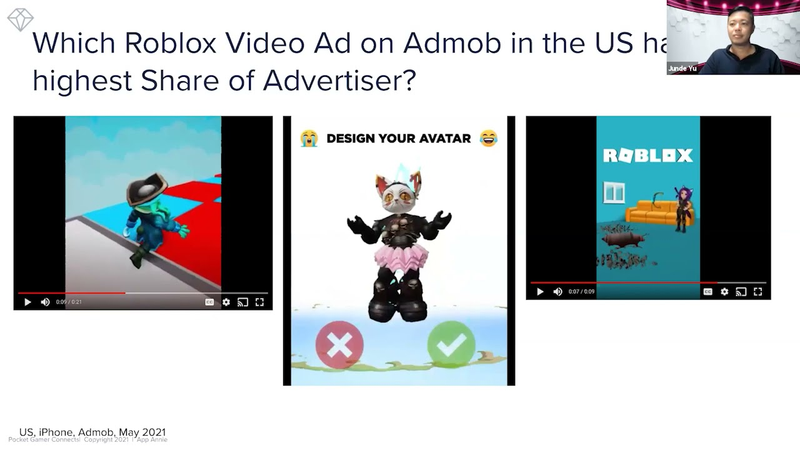
moves and each stage just last lasts around five seconds next let's try another one so from candy crush we move to roblox which is kind of two different ends of the gamer demographic all right so let's play the three three videos [Music] [Music] okay let's do this again so which one do you think has the highest share of voice it's this one and this time
there's just one simple and prominent difference this is instead of gameplay this is just focused on character customization so customization is a big theme especially for the gen z players next for marketing another way that you could optimize your marketing performance would also be to look at the popular keywords keywords are becoming an increasingly important part of user acquisition for games especially on the ios platform so here's a view of the top gaming related keywords by such volume in the uk some of these are branded keywords like roblox minecraft and even fortnite because spotlight is not even available in the apple app store right now these are keywords that you can bid for with such ads okay and others some other more organic keywords like card games among score and solitaire these are words that you can also optimize with aso so that you can rank higher amongst these search results
okay next let's dive into genre trends these genre trends are powered by appany's latest game iq product which features a granular taxonomy of games so for instance with the existing tech app stores taxonomy we we used to say that you know puzzle games are growing that's it but now with ebony game iq we are able to classify every game by its granular sub genre and this results in much more granular market sizing so for instance you used to say that you know puzzle games are growing we should build a puzzle game but what actually what puzzle game should we actually build and you know so it depends on what you are good at are you good at monetizing from ad monetization or are you getting good at uh getting in-app purchases okay so here for instance under puzzle we've broken it down further into granular substrates like this and now we can say that you know what games are the biggest by users and revenue tile matching games have the second most uses but actually they don't have high revenue they're relatively low revenue and actually the
hidden object games here they actually have some of the highest average user time spent and highest apu so with that let's take a look at the granular top sub genres in the current global and european market so firstly by downloads download so we showed the top sub genres followed by the year-on-year growth rate and some of the top games in each of sub-genre so by downloads this is globally driven by quite a number of hyper-casual sub-genres okay and also quite a number of these top downloaded sub genres are actually decreasing in h1 total volume compared to the prior six months except some like action hyper casual which is still growing very well okay there's also not too much difference between the global and the european top sub genres because most of these hyper casual gameplay transcends languages and easily appeal to a global audience next let's look at the top sub-genres by revenue
so globally this is led by 4x march battle and the rest of the top 10 they are dominated by mainly rpg and match 3 games matched games okay also noteworthy is the creative sandbox genre sub genre and number 10 with the highest growth over the past six months we also note that something unique in europe is that match three games luck battle games and farming simulation games tend to monetize better than they do globally okay so aside from a granular taxonomy game iq also features deep tagging of features inside of games so one question that we get quite often from customer product departments when they see a new top crossing game or when they see a competitor's app overtaking them in user engagement they would ask you know how exactly did they do that so we launched deep tags deep feature tags to help product teams quantitatively break down the product
features that result in the game's success now let's take a look at one use case so here we've chosen a few top strategy games in the us and we compared the day 30 retention so we see here that clash of clans has the highest numbers while this game star trek fleet command is number four amongst these top five games for day 30 retention however if we were to look at average time spent per user over the month star trek free command actually scores the highest by far and if we look at rpd revenue per download which is similar to apple it's also the same star trek fleet command here is the highest by far so what is star trek doing to result in this i think it's critical for product teams and any core games developer to learn from this if they would like to increase the engagement and increase their approval so before deep tagging we would have just stopped here and the user analyzing this have to would have to download the games and manually investigate what the differences are but now with japanese
feature tags we're able to look into the specific engagement tags inside of these games so here we can see if we compare just cuc and star trek free command that coc stops at tasks and some events so these are some of the engagement features that both of these two games share but now let's look at the differences star trek has implemented a number of other more engagement features like periodic login rewards incentivize multiple sessions per day cumulative task rewards and so on so when we correlate these features to the data we saw previously what this seems to suggest is that by implementing some of these heavier engagement features they may not retain as many newly installed they may not retain as many newly installed users after 30 days but the for the users who remain they tend to spend more time playing and spend more money as well
so this is some of the insights that we are now able to draw by combining feature tags with abandons data next let's also take a look at three of the biggest battle royale games pubg call of duty and free fire so specifically now we look at day one retention here's here our data estimates show that for most the past six months free fire had the best day one retention now what affects day one retention so here we present first time user experience videos so firstly you can see here that this is free fire and this is you can see how free fire has a different fertory firstly you can see here that the full tutorial with guided gameplay ended in just around four minutes and the player was able to finish playing the game as per normal normal gameplay without any gameplay guides just four minutes on and also the full length gameplay by our analysts who actually
managed to be the last surviving player in the round just took just 40 minutes 14 uh close to 50 minutes this is contrasting with the other games that took a lot more time so not a long time but uh pubg took around 30 minutes for the game to end okay the other apparent thing is that in free fire fatoui they skipped most of the customization and engagement mechanics and focused mainly on just gameplay while the other two games incorporated steps like account linking customization opening of chess and iep offers so these are possible case studies to look at to see how fertoy affects day one retention and how you can optimize your own game so we've gone through two examples of how apanis intelligence data could be correlated with in-game features detagging from game iq to help product teams optimize monetization retention and engagement and with that we've come to the end of our sharing today
[Music] okay so and here's a quick summary of the main points today so firstly mobile games consumer spend continues to search okay and secondly there is continued growth in turkey in both downloads and revenues although they are already number two in in email for downloads next hypercap the hyper casual sub genre dominates downloads whilst rpg match dominate revenues and finally with our new product app any game iq you can finally correlate game performance to game features so that's it for our presentation today thank you very much thank you very much for your support of appending over the years and have a great day ahead oh thank you jinder that was a really fascinating talk and we've got a lot of questions that have come in so if it's okay with you i'm gonna dive straight into the questions and we'll just see how many we can get through in
the time we've got um so the first one i've got is um you say that gen z loves character customization do you think it's worth brands incorporating this as a function into their mobile games is it a fairly easy way to entice an audience i think for genji no they have very little attention span if they don't like something this just you know it's like tick tock tick tock generation they spend a lot of time on tick tock but two seconds into one tick tock video they don't like it swipe up so i think there has to be um two two things firstly content that engages them and you need a big enough community and um like like i mean like stuff like uh minecraft roblox they're able to capture their attention and same same for tick tock so i think it's it's not so much a hardcore community like you had the hardcore games where i think our generation plays but they're a lot more about um meaningful content meaningful exchange
and yeah i think that the less about you know um differences between you and me just you know just contribution and user-generated content yeah yeah great and next one is um is this the first time playrix has surpassed supercell um well this one i have to look into the data to really look at it but i mean you think about um supercell they've been so demanding and critical of their own games they've not released anything until everyday recently right so i think they've just taken their time and because they have maybe a smaller number of games it's not surprising that they could possibly fall behind for a little bit yeah um uh is there anything happening in the market right now that is particularly exciting for you like what is it you're excited about that's happening well that's lots and i'm always trying to what's coming next you know um well you you firstly you got all the um
things that are changing in our world there was idfa and there's you know the singles acquiring companies and there's this uh you've got adjusted app 11 you got all these consolidations happening in in the in this industry so it's interesting to see what's going to happen next and also you've got the epic and apple ruling there's so many things are happening that's also nft play to earn but the one really depends on the bitcoin price next week um so yeah i think all these have the possibility of becoming huge becoming big i think we just have to stay close to stakeholders to the data stay close to our friends in the market and just see what's really taking off what's not taking off and so on yeah yeah and uh people are really interested in the uh game iq uh feature uh so we've got two here about this so chris uh steel media's very own chris well said there's some brilliant data in game iq how deep does it go obviously it's hard to cover over a million games in this way do you focus for example on
the top 1000 we definitely do we do employ a professional team of analysts so so they are all uh folks with you know at least two years of working in the uh either gaming or analyst space so we so this is done manually this is not done with ai and um so that's why we focus on the very top games so so yeah we focus on top 500 to 1000 but we do think this is representative of you know what's moving the game industry in terms of what what features affect which kpis and what new features are coming up like uh previously six months ago like multiplayer in hyper casual games maybe was maybe just five percent now it's maybe i don't know i haven't checked data but twenty percent of my casual games multiplayer these are some things that you could also take a look at so yeah we think that the top 1000 would definitely be representative yeah and and and keeping with the iq feature um another person's written this iq feature looks really powerful how is the data for things like features accumulated presumably that's not just
from raw data you know so and and talking about what you just mentioned about the teams do you have teams playing a map in each individual game or is it done as a group activity how does it work some of it we do with um so so with code with machine learning with ai like you know what sub-genre is this what theme is this and so these kind of things we try to um go faster with with code all right but um playing the game recording the videos all these are done by our team of analysts yeah fantastic um someone's putting uh you know we were talking about gen z before but another person said have you found a growing older audience in gaming is this a pen a potential market that we should be tapping into totally definitely so um a lot of them are playing in the candy crush homescapes cottonscapes kind of games and also some casino games uh these are things i can remember remember off the top of my head and not just older audience but also more females as well
and that's across generations as well um so that's something that we we saw really really becoming a trend especially during uh since the pandemic i'm not sure how many of them still play but there's definitely been a much higher low as in this much bigger uh gamer base of older genera of the gen y and also gen x gen y as well as female gamers there's also you know like if you think about a lot of uh playwrights games and and so on they're a hybrid of genres so they're able to attract you know people who are in between casual and core and also people who are in between generations yeah and and talking of like new markets to tap into someone else has written do you see any new genres breaking through in the near future from your data well that's um well there was that one slide that we showed top top global sub genres uh hyper casual especially for action hyper casual was
one of the top and still con continues to grow and in terms of the um those which is what is growing by revenue the sandbox creative sandbox games that's definitely something but of course uh not any company can come up with a huge production like uh roblox of minecraft so there are other if you we go back to look at that particular chart that there should be other sub-genres that are worth looking at as well yeah yeah um so changing topics ever so slightly um you know you talked a lot about the turkish development market and there's two questions about this um but we can sort of blend them together so basically the turkish development market is really hot right now and but it's surprising to see the consumer market is also so strong are these two factors connected and on that point uh do you think turkey can and the turkish market can take much more of the european market over as the years move on so i i do i'm not an expert on the
turkish market so i'll just try to answer this you know from what i know about market data and what i've seen happen in similar uh emerging economies in asia so firstly turkey has a big population so that's a base requirement for a big market right and these days even the android phones are very cheap and very powerful so you can you can definitely still run uh top quality games i mean even in india we see some of the battle royale games emerging in some of the top games so battle royale games you know require huge network bandwidth to play online but there are some of the top games and even in india so so that's uh these today's phones are very powerful and cheap enough to let consumers even in emerging economies uh enjoy the best games so that's not a that's no longer an issue including that network infrastructure as well so the huge market size would cater for huge potential and so other than that i think another thing is that i think i think maybe turkey traditionally has not been a gaming supply powerhouse like compared to the
us or uk or china but they do have heavyweights like peak who has done enough well enough to be acquired by a singer i believe and um so i think with that culture and they are possibly able to also uh spearhead some of the the development of the local consumer industry so that's the second thing you need some local uh recognized giant companies to to take the lead here and the third thing i see in asia is that so firstly you always first spike by downloads and grow huge downloads and then what changes the game uh for for monetization is i think generally two things one is ease of payment okay so actually in in asia in the developing economies in asia it's not so much that these guys don't want to pay for games or they don't have money paid for games they do it's just that a lot of them do not have a visa card that's it yeah so when some when google play or some other platform or apple or whatever works with more localized payment gateways uh that everyone already uses which now with the
pandemic lots of uh right hail lots of mobile payment are very very widespread right now uh then that would and that could unlock uh gaming in a huge way uh gaming payment in a huge way and the last factor i've seen happen around i mean i was actually living in china for a long time before this when gaming exploded there and i think what happened first um if initially there was just a lot of heavy and core games monetizing what happened later was that wechat was huge and wechat had wechat payment and wechat introduced first casual games casual games that everyone played everyone looked at the leaderboards together with their friends and because casual games had a huge gamer base and when wechat was able to unlock monetization even if it's very very small monetization for casual games people started playing on mobile and that was just unlocking of everything else yeah yeah it's a really good point especially with like what happened with wechat in china uh we've got time maybe for one maybe two more but um so um
someone's written a lot of games which are popular have been popular for a long time how can smaller indie games break into the top end of the market is there any i know that's a massive question that's a whole topic but from your analysis is there like and maybe one key thing you notice for those that do break into the top yep so i i think you have to look at what your strengths are uh if you're a small developer do you really want to spend three years building a roblox or building a gantry impact and i mean if you spend three years and then what happens three years later maybe some there's new big things new next big things so i think you have to look at what you're good at are you good at um you know for instance you're good at monetization or you are good at let's say uh casual games and you could you could put out a new casual game every every one month and they would just have a lifespan of long ltv of a small ltv but because you have a small and agile team you could put out new games every month so and you still leverage a little bit of cross promotion that's one potential strategy or if you're let's
say you're looking for a specific publisher look at what zynga likes look at what apple levin likes look at what uh supercell likes you know i think that's something to to also look at i mean you want to leverage the help from a bigger publisher as well but um so you have to play to what kind of metrics what kind of specific kpis they look up for they look out for your apple they look up for your d1 day three and so on so i think these are potential ones unless you are extremely creative then of course hyper casual is one area where it transcends languages you could you don't need to translate every language you can get lots of global uses yeah oh well thank you so much jinder we've got through we got through nearly all of the questions but we got through a lot so thank you for staying for this extended q a session as well and and thank you for an amazing talk and for app annie's support for the global trends track thank you yes chris in the audience as well thank you so much gender and uh i hope you enjoy the rest of your day really really great talk from gender i
mean fascinating going into all the insights and i think you'll all agree uh i'm basing that off the chat that's going on the q a that's going on and uh yeah so a massive thank you to app annie for sponsoring our global trends track and making it happen
Summary
The global gaming industry maintains robust momentum, with consumer spending currently holding at 80 percent above pre-pandemic levels. While hyper-casual titles continue to lead in total download volume, revenue generation is concentrated within 4X strategy, role-playing games, and match-3 titles. This growth is bolstered by shifting demographics, specifically an increase in female and older players, alongside rapid expansion in emerging markets like Turkey, where improved smartphone accessibility and localized payment infrastructure are driving significant adoption.
Strategic success in this competitive landscape relies on the application of granular data to optimize core gameplay mechanics. By utilizing analytical frameworks to correlate specific features—such as login rewards, cumulative tasks, and tutorial length—with performance metrics, developers can quantitatively improve retention and revenue per download. For instance, data indicates that battle royale titles achieve higher day-one retention by streamlining tutorials and minimizing non-gameplay distractions. These insights allow studios to move beyond intuition, enabling a more scientific approach to feature implementation and user engagement.
For independent developers, navigating the market requires a disciplined focus on agile development cycles and strategic positioning. Rather than attempting to challenge large-scale, long-term production titles directly, smaller studios find greater success by leveraging hyper-casual mechanics or forming partnerships with established publishers. Ultimately, the ability to synthesize market-wide trends with specific sub-genre data is the primary differentiator for studios looking to scale effectively within the European and global gaming ecosystems.















Comments