1 free read left. Create a free account for unlimited reading + AI research.
Create free accountWhitepaper DiGRA
1 free read left. Create a free account for unlimited reading + AI research.
Create free accountWhitepaperDiGRA
Distilling the key insights…
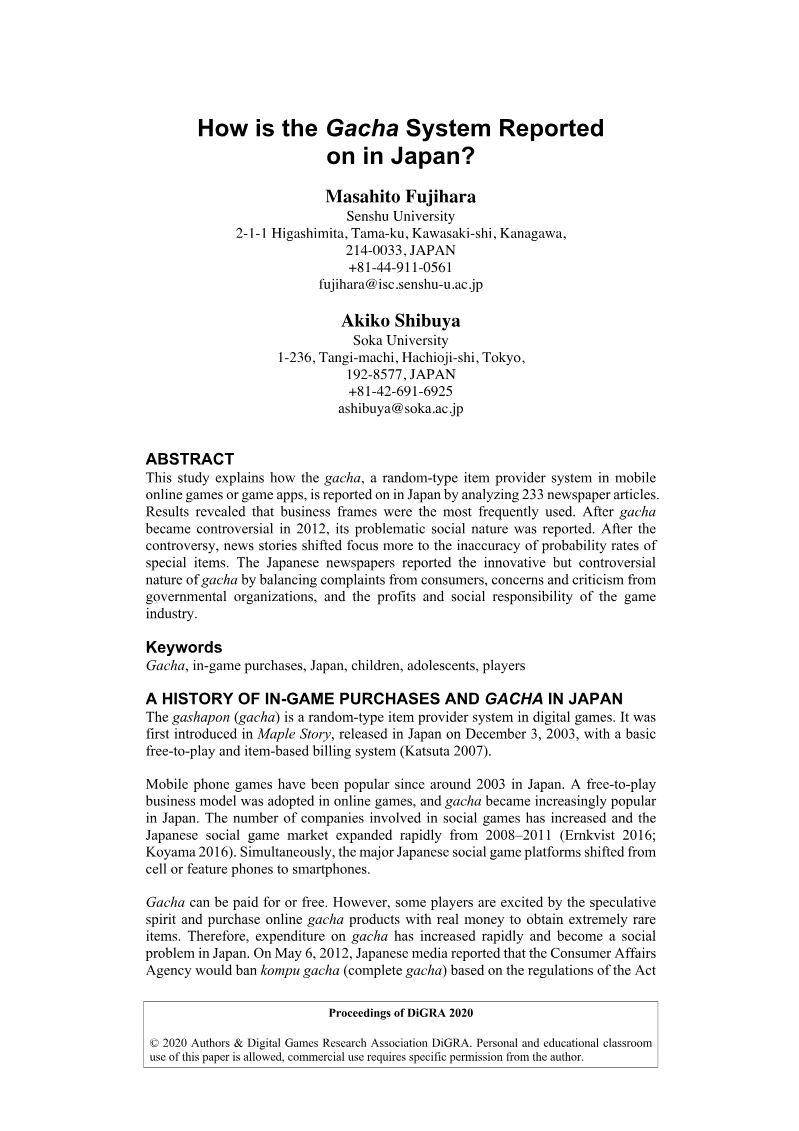
This study examines how university students' motives for playing video games relate to their motives for purchasing gacha, the randomized paid-item mechanic common in mobile and online games. Drawing on a survey of 264 university students, of whom 168 had paid for gacha, the research applies correlation and canonical correlation analyses to link gaming gratifications with gacha-purchasing motives. The sample was drawn from game-development students, a population whose familiarity with the industry limits the generalizability of the findings to university students at large.
The principal finding is that fantasy, recognition, preference, achievement, and friendship motives are positively associated with gacha motives, while study and diversion show little relationship. Three of the five canonical correlations reached significance at the 5% level, with the strongest pair at λ1 = .665, and a fourth was marginal. Strong intercorrelations among achievement-oriented items, and notable links between certain fantasy and gacha-related items, point to a cluster of motives that tend to travel together. The authors characterize gacha players as holding strong "messing around" motives, though the strength of this interpretation is tempered by the sample's narrow composition.
From these relationships, the authors derive five user types, namely competitor, collector, composite, challenger, and cooperator, each linked to distinct gacha-motivating preferences such as competitive ranking, character collection, or player-versus-environment and player-versus-player play. The authors argue that such typologies can guide gacha-based game design and help players recognize gacha mechanics that may encourage wasteful spending. Some of the supporting interpretive material is incomplete in the available text, so the specific conclusions drawn from the canonical structure coefficients should be read with caution.
DiGRA · 2023
DiGRA · 2023
DiGRA · 2023
DiGRA · 2023
DiGRA · 2023
DiGRA · 2023
DiGRA · 2023
DiGRA · 2023
DiGRA · 2023



DiGRA · 2023
DiGRA · 2023
DiGRA · 2023
DiGRA · 2020