1 free read left. Create a free account for unlimited reading + AI research.
Create free accountArticle Board Game Studies Journal
1 free read left. Create a free account for unlimited reading + AI research.
Create free accountArticleBoard Game Studies Journal
The study asks whether these stone boards represent a single standardised game or a loosely connected family of games. The authors argue for the latter.
This study reassesses Roman and Late Antique "marble lanes," rectangular stone boards with rows of circular pockets used for rolling or throwing games, and asks whether these artefacts represent a single standardised game or a loosely connected family of games. The authors argue for the latter. Scholarly identifications have been inconsistent, with proposed rulesets ranging from a mancala-type game and a target-pocket game to a point-scoring game, and the textual evidence is thin and ambiguous. Key terms such as the Greek and Latin "tropa," which may denote a family of related throwing or rolling games, and the Suetonian and Augustinian references do not clearly describe how marble games were played, leaving Waille's hypothesis linking tropa to the lanes unproven but not excluded.
Because textual sources are sparse, the analysis relies heavily on iconography, notably late second- and third-century sarcophagi depicting children rolling balls down inclined planes, alongside material evidence from the boards themselves. The material record is substantial and varied. A catalogue of roughly 57 boards, largely from Rome, Cherchell, and Timgad, is complemented by 23 clustered examples from North Africa, Greece, Italy, Spain, and Rome, typically bearing about seven to twenty pockets. Layouts fall into pyramidal, clustered, and other categories, with a minority possessing a clear goal pocket. Starting-line features, pocket size and depth, and placement within architectural settings such as open areas, steps, and intercolumniations all vary considerably.
The authors conclude that this variability argues against assuming a single shared ruleset. They propose that pockets within parallel starting lines may have functioned as privileged scoring targets, and that regional patterns, particularly the triangular layouts confined to North Africa, reflect a "glocal" dimension in which broader forms were adapted to local contexts. Many entries are poorly preserved and some identifications remain tentative, so the study's typology is presented as provisional. The work's central contribution is a reframing of marble lanes as a diverse material and social practice rather than a uniform game.
Board Game Studies Journal · 2025
Board Game Studies Journal · 2025
Board Game Studies Journal · 2025
Board Game Studies Journal · 2025
Board Game Studies Journal · 2025
Board Game Studies Journal · 2025
Board Game Studies Journal · 2024
Board Game Studies Journal · 2024
Board Game Studies Journal · 2024
Board Game Studies Journal · 2024
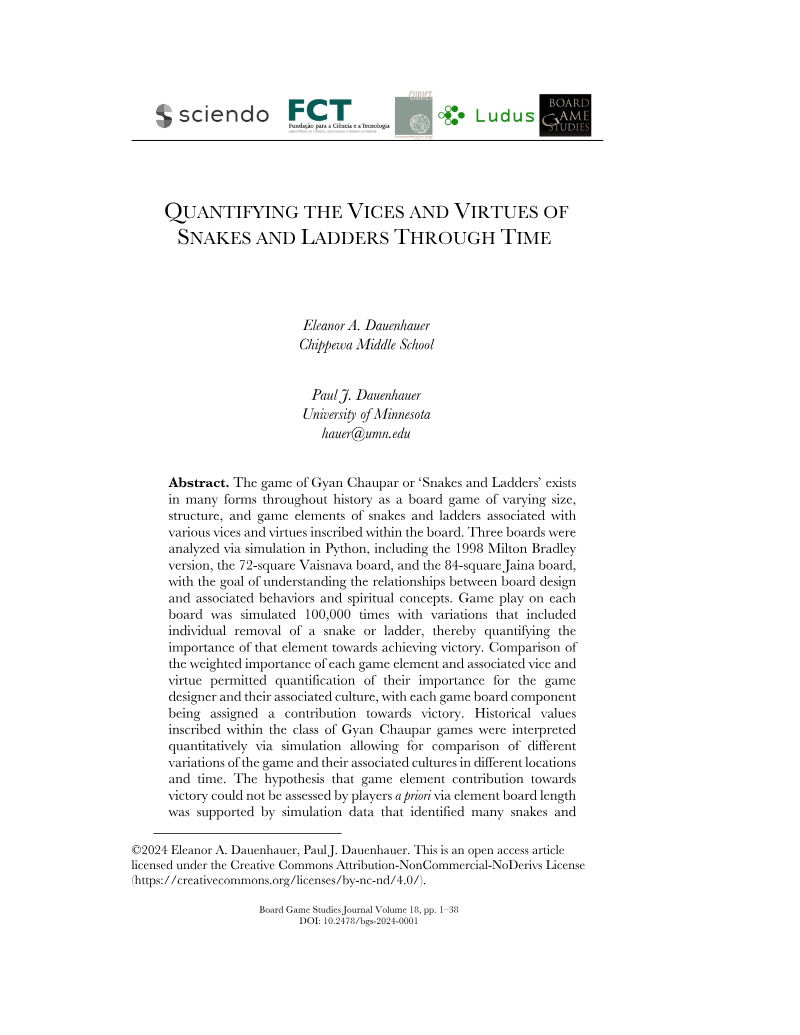
Board Game Studies Journal · 2024
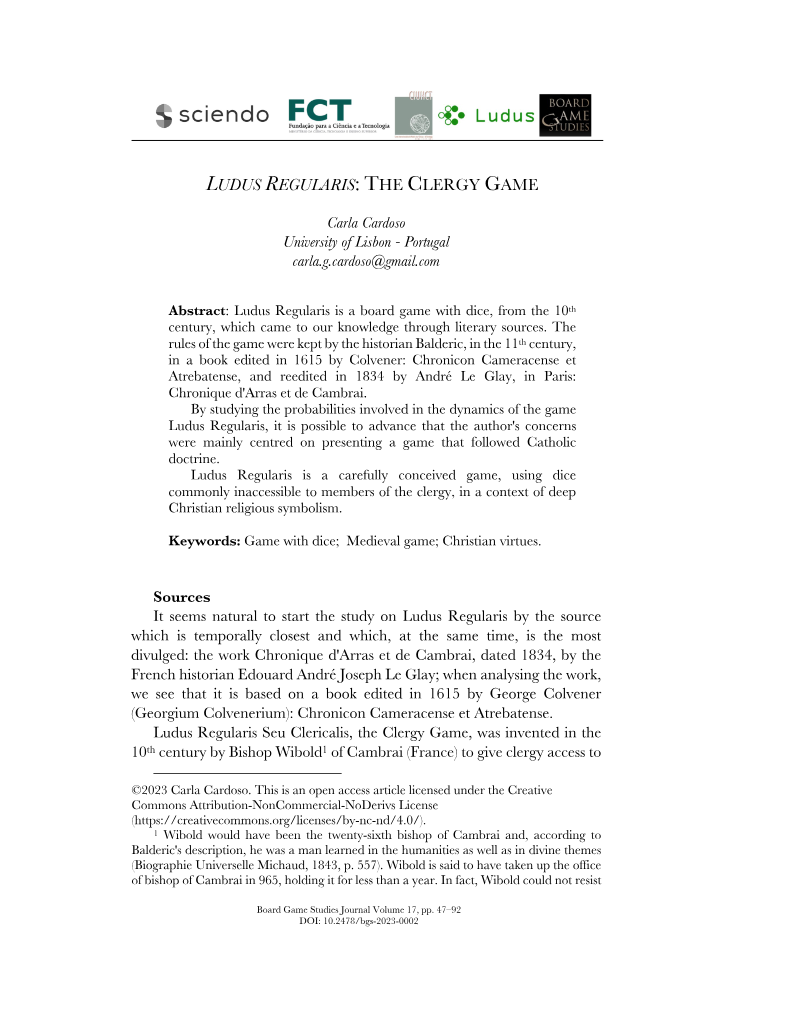
Board Game Studies Journal · 2023
European Conference on Games Based Learning (ECGBL) · 2026