Transcript
Okay, guys. Uh, I I gotta tell you, I've had a weird week where I have so many mixed feelings about the state of the indie game industry. Um, so this video is going to be kind of just sort of a raw unfiltered thought process on [sighs and gasps] AI gamedev, um, agentic gamedev, and just the inevitable, the inevitable that the anyone can make games. I I mean anyone can prompt and make games at this point. Um but but not anyone but not anyone can make a product. And there's a huge huge distinction about what a product is. And we'll talk about that um towards the end of the video which is just basically my thought process on like yes people can make concepts, yes people can make really interesting game jams. they can prompt to create pretty much anything at this point. I mean, especially with,
you know, you connect you connect codeex or you connect um cloud code to Unity's MCP server. It could create anything. Um but but but not everybody can make a product. And we're going to talk about what a product is. Um so I tweeted about this. Um let me pull this up here. Um, I tweeted about this weird feeling that I've been having, which is like sadness. Um, sadness about the whole idea of pretty much every art form, um, in the game dev world, in the indie game dev world, every art form is basically being overshadowed with AI or or made possible with AI. And of course, I'm not going to be a, you know, say that I haven't touched AI. I've used AI to fix bugs um in my own games. Um, most most indie studios have
used AI to help them fix bugs. It's very very effective at fixing bugs. Um, so I'm not going to say that I haven't done that, but uh my tweet here is um and it went semiviral. I mean, it did pretty good over the last day here. And I I didn't know how to write this, but basically I've been coding by hand since I was 12. I've been animating and illustrating by hand digitally since I was 12. From from HTML to to CSS, doing web development to ActionScript 2.0 to C. Um I I I learned all those languages and and it was a a such a challenge. It was such a challenge to learn those languages and I felt so proud that I was able to learn those languages. And by the way, if this is you where you you were younger and you learned all this and you just frankly I I didn't make any friends in high school, maybe senior year I started
making friends like real friends and mo for the most part I was just making stuff, you know, coding stuff. Um, and I learned a lot of this from my brother who's a software developer. And I learned how to animate in Flash. And um, Corell Move was another tool that I learned. And um, Paintshop Pro. Uh, then learned Photoshop. Like this whole thing was this painful process of just ignoring everybody, ignoring my social life as a teenager and in college and learning this stuff by hand and learning how to do it by hand. And then I have random people in my life and I'm not I am not jaded or angry about this. I'm so excited for them. But it's this weird weird feeling. This weird feeling of um everyone can just do it now. They just do it. Do a prompt. Boom. Everything that I learned
everything that I learned about code and digital art is just like instantly um instantly made by anybody. And so I feel sad. Okay, I'm not saying it's wrong. I don't know what the right feeling is, but I feel sad seeing it all slowly disappear in the industry. And like I said, I I said it here. I don't know what the right feeling is. Should I be? I don't know. I'm just telling you that's how I feel. I feel sadness about this. I want to encourage you really really quickly here. I want to encourage you really quickly here that just because everybody knows how to make a first-person shooter in like a single prompt with Unity um and Cloud Code. Uh number one, it it doesn't mean that they're wrong for doing it. You know, I've used AI code as well, and there's a whole future where I don't know how it fits into my studio, but there is a future for that. Um, it's just becoming
way more prominent than I ever thought. Um, but number two, number two, just because people know how to do any of this stuff with AI doesn't mean one thing, and that is it doesn't mean that they know how to turn it into a product. And look, I talk extensively about this with um with clients that I work with. Uh I I have 20 current clients that I'm working with every morning talking through like what's the difference between a a concept or something that's made with claude really really quickly where it just quickly puts together your game and god forbid you know AI art. I don't love AI art. I don't use AI art or AI music. But like if you just threw that together is it suddenly a product? Is that suddenly a product? And we talk about this in in in my my um in my group uh group coaching. That's the big um that's the big magic or the big question mark that most indie developers don't
know the answer to that AI cannot answer for them which is what is well the way to to make a turn a turn a an idea into a product. And by the way I talk all about this if you want to click below to check out the challenge that I do. I'm starting these really fun challenges where you can talk directly to me. Um, as an indie game developer who has who has done this on three separate occasions, made a profitable indie game, both profitable before I made the game so that I could go full-time and get paid by a publisher or Kickstarter or whatever or investor, but also I know how to turn it into a product and make real money. So, the question is, if you want to join this challenge, um, are you somebody who wants to make real money with with a game idea despite all the prompting, despite all the AI tools and just it's kind of scary seeing all this AI stuff. Do you want to learn how to make money, however you make that game, learn how to make money. That's a totally different thing. And that is determining how to turn an AI project
or any way you make a project really, really quickly. How do you turn that into a product? Okay. So, that link is below if you want to join me in three a three-day challenge where we do live calls where you can ask me questions, talk to me, and we can work through your game idea. There is a process of turning a game idea into a product, an actual Steam commercial game that's commercially viable. That's a whole other conversation. And I want to teach you how to do that from idea to demo to 1.0. So, click the link below. Um, there are only uh 50 or no 20 20 VIP VIP seats available and those are just basically seats where you can talk directly to me in a live Q&A. So, click the link below, check it out, see if it's something you're interested in. That said, that said, let's move to the tweet here and then we're going to also talk about the solution. The solution to this problem where pretty much anybody can make games, anybody in the world can make games. So, how do you stand out? How do you turn it into a product? Okay,
that sadness doesn't have to be there. Okay, this sadness of I did everything by hand. I know that I'm kind of being a keragin about this. Okay, so we don't have to be sad. We don't have to be scared. Let's read some of these responses though because these were super duper interesting to me. Andrew Pullan says, "I'm feeling the same way. I don't know what the right path." Man, isn't that so true? What is the right path moving forward? We'll talk about what what my theory is at the end of this video. Um the answer to this, I do not want to use AI to write code for me, but it feels like an inevitable apocalypse we are heading into. Most studios are are are using AI. I mean to to write code. It's it's just highly highly highly effective. Um are they using it correctly? Probably not. Um that's a whole other conversation. Pascal said, I went through the same with coding. I think artists still produce way better quality. But even when it becomes goated, you'll be way
better at turalizing it than me becau because you can draw sketches to promote etc etc and utilize it as a tool. Yeah. Yeah, and that's the thing, right, is all these developers realize that that that tool is there at their disposal and it's such a hard paradigm of like I learned all this from scratch, but all I got to do is press that button and it will do all of the code for me, right? James Tesa says, um, that's why I cut away once a week for at least a few hours to learn how to code stuff like this tunnel effect with no real 3D. This is very interesting what James is saying and I'm a big fan of this. So, um, one of my friends is a software developer and he says the AI has pretty much taken over just completely taken over uh, the company. Everyone's using it all the time and you know what's happening? Everyone is sort of becoming well bad at code. They're struggling to
write it. They're struggling to read it. um the the pull requests, they're not reading them, they're just merging. [snorts] And so what James is saying here is something that I actually talked about with my friend, which is there needs to be a day where AI code is turned off for indie studios, for you, for me, um for software companies, just turn it off so that we know what we're writing and we know what we're reading. Um and I'm not the perfect coder, but I still want to keep those skills alive. And so I think that's a really really good practice. So Isaiah always has good comments, good replies on my tweets. Um he said, 'I feel the same way, but also when the CNC machines came out, sculptures didn't stop sculpting. That's that's really interesting. Hang in there, bro. Art forms will always live on if we carry them. A and that's the thing, right? Um, I think I think that at bare minimum, my hope for for the game industry is that
if your forte is code, that at least stays human. If your forte is art, please God, that at least stays human, right? Where your voice and who you are as a human being is poured into um is poured into your project at bare minimum. If you're a really good storyteller, you avoid AI at all costs and you just write the story from a very human perspective. And frankly, that's what's going to make you stand out. That's going to make you stand out. Find your forte, find your talent, and be as human as you can with that. Okay, let's see here. Any other great There's just so many comments here. Adam [laughter] said, "Slowly." I think it's a great comment. Um uh he's commenting on me saying, "I feel so sad seeing it all slowly disappear in the industry." Okay, so why why should we not feel sad? I actually reached out to some friends and
advisers about this. I've been actually frankly I've been talking about this for two months with friends and advisers on Discord. Like, and these are like veteran game devs. I'm like, should we be scared? That's the first one. Should I feel scared that everybody can make games? And you know that the the the common phrase is something like a rising tide lifts all ships. Um as long as you're highly skilled as an indie developer right now, in a way you have a leg up over the next generation of hundreds of thousands of games that pour into Steam and H.IO or any other platform for that matter. If your skill level is here and someone else's skill level is here, AI tooling comes along. What happens? This that's the theory. That's the theory, right? There's also this thought process of the game industry we know now, the indie game industry that we know now
is not even close to what it's going to be. So, we keep looking back and this is the where my sadness I'm very nostalgic person. We keep looking back at how games were made, but more importantly, we look at what the infrastructure was, how games were sold. Um, think about how games have been sold. It keeps changing, right? It's selling games in boxes. It's selling games in magazines with demos. Um, it's it's you go to Best Buy and you look for your game, physical copies. Then it moves on to subscription services right on Xbox or digital copies um on Steam and Xbox. Then it moves on to subscription services and then that kind of struggles and suffers. Um so the next question is what is the next iteration of selling indie games? So when we think about hundreds of thousands of indie games, we tie that to the current infrastructure of how games are sold and it seems like they can't work. All we see is a flooded Steam page, right? when
in reality um if you kind of maybe compare this to Hollywood that imagine in the '9s if somebody said um there will come a day when anybody can become famous. In fact, people will become more famous than you and they're not even making movies. They're just dancing in front of a phone camera. And that's where we are, right? We're in that era now where anybody can become famous. Is that bad? Does that mean that suddenly it's way harder for people to become famous? No. Because we have new platforms and we have new algorithms and we have new devices. More content uh is not a bad thing in terms of your career. You could become famous in a year if you wanted to by just posting to social media and doing really good content. So suddenly the pie got bigger, right? It's not that the slice of pie got bigger or smaller. It's that the pie
itself got bigger and there was more opportunity for everybody. And so the only future I can see here is if games become or my my hope for the future of indie game development or just game development in general. My hope is that somehow new platforms emerge that basically curate hundreds of thousands of indie games in a way where everybody gets a big piece of the pie. Aka, we're consuming more games, but we're much more targeted. The algorithms are much more targeted. So that if you're making a game um let's say about an electrician who rides a unicorn, I don't know, there is a market out there and the algorithm is so good at finding 10,000 people to buy that game or play that game. So my hope is that yes, we have a lot of games coming out with the help of AI tooling. It's just inevitable, guys. But platforms,
storefronts, and algorithms help promote those. So that's that's the positive spin on this and and I do think that probably would happen. Platforms are looking for a way to sell content and my hope is that that content gets distributed in a fair way so that everybody gets a piece of the pie. Fingers crossed, right? But this is what I wanted to end with. This was the big point, okay? And this is what I teach my clients. Uh this is also what people learn in the challenge that I run. Um I'm running at the end of October. Link in the description. But what I'm learning is is that creating a product is very different than creating a fun gimmicky game that's made with AI. Okay, a product there's there's a big big word called testing. And testing is what most indie game developers are not doing. There's a process for testing your game that makes it very, very advantageous for you over most indie game developers.
So, what I mean is you start with an idea. This is what I do. This is what I recommend game developers do. This is very different than just the quick make an AI game. You have an idea and you formulate that idea and you think you test it with an audience to see if it's commercially viable. You share the idea with your friends. That's basically it. You share it privately with friends and with a group of other game developers. You share it with your mom, your dad, people you trust, right? You test that idea. If they find that idea interesting, is the are the visuals good? Like is the visual concept good? Is the development or the mechanical hook interesting? Uh is the story hook interesting? Is the loop interesting? And you just write this out in a text file and you just ask people about it. If they find that interesting and they're giving you more ideas, this is the big like uh signal that your idea is good. If they're giving you ideas in return to your idea, that means it's a great idea. It interests people. You've activated them. Then the next step is
you take that idea and what do you do? You make 1.0. No. Then you prototype it. You use simple cubes, spheres, a simple grid, and you put together the skeletal structure of the the core identity of this prototype, only the core elements. You don't create your save system necessarily. You don't create all the juice and the particle effects. Stop putting artwork in there. Just make the core basic loop done. And what do you do? You test it. You test it with players over and over and over again. And what's going to happen is they're going to confirm your idea. They'll reject it entirely. Maybe you need a new idea. Or they're going to say, "This doesn't work. Can you can you fix this? Can you change this?" And you make those changes. Boom. Boom. Boom. Boom. Boom. Boom. Make all those changes to the prototype until you've got a green light for your prototype. Let's say you test it with 20 people and they're like, "Yes, this is awesome. This is a great idea." Then you take
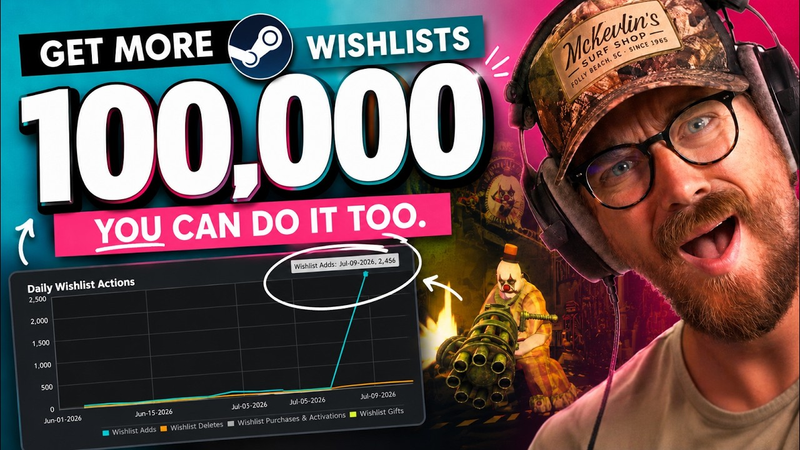
that prototype and turn it into a vertical slice or a demo. Once you've got it as a vertical slice or a demo, which is highly polished, if not more perfect in some ways than a 1.0, you put all the art in there, the music, the particles, the sound effects, the juice. Once you have that demo, you launch it. You launch the demo, you start getting wish lists. Once you get wish list, what do you have? What does that mean? It means you're building an audience. This is the key. An audience cannot be built, at least right now or effectively right now with AI. An audience is built by you and a really solid demo. Getting those wish lists suddenly separates you from all the other games, hundreds of thousands of games that just launch on Steam that are AI slop. Or maybe they're not slop, but they're just AI generated.
You have something that all those games don't have. You have a fully tested vertical slice with wish lists. It's a rockolid tested vertical slicer demo with wish lists. If you have those two things, you are far above most of these indie developers who are going to quickly put together sloppy games with AI. And then from there, you scale it into 1.0. I mean, you take the demo, people love it. You scale it, you expand it, you create derivative behaviors, you make the ch you you increase challenges inside of the loop and that's about it. That process, the whole goal with that process is two things. Proving an idea and by proving it, you have to test it and then building an audience. Those two things in my opinion, the capital A audience is the big one. A proven vertical slice with an audience is what
at least for 2027 ensures you stand out amidst frankly the inevitable onslaught of AI games that are come out going to come out really really quickly. There's a lot more there. Um, one of them is about um building an building a game or a skew that can become a platform, but that's a whole other video. That's a whole other video. But guys, I'm going to tell you something. I'm going to tell you something. I'm not really sure. Like, in recording this video, I'm like, I don't even I'm not fully sure. And I don't know if any indie game developer is sure what the perfect strategy is to stand out. It could be the indie game development is at the cusp of the event horizon and going through that black hole is not going to send us into hell but heaven. Is there is there a future where
hundreds of thousands of indie games releasing every day all the time is somehow profitable because of storefronts algorithms and discoverability in ways that we don't currently understand? could be. And that's my hope. That's where my fingers are crossed. And by the way, I have heard this from actual veteran indie game developers. The ones who are super successful, the ones that are super smart, I'm going to tell you, they're the ones telling me, "No, no, no. The future is bright." Especially especially for indie game developers. And I'm going to keep doing videos about this to sort of feel this out with you guys. Um, but regardless, hey, good luck on your journey. And look, if you want to join me, if you want to join me in a fun challenge, three-day challenge at the end of October. Um, or honestly, I'm going to probably do them at the end of every month, click the link below, check it out, see if the uh challenge is open. And if you want to get to know me with a few other a handful of other developers, ask me questions and work through this process that I just described. Um, I
would love to help you. Um, link is below for the challenge. It is a paid challenge. Um, it's part of my consulting business, but um, at least take a look and see if it's something you're interested in. Uh, I love you guys. Good luck on your game dev journey. My opinion, I'm going to put my money down that the game development future that I'm sorry, the game development industry is going to have a very bright future. It feels unknown right now, but that's my theory. Bright future for indie game developers. Cheers.
Auto-generated captions from YouTube — names and numbers may be misheard.
Key insights
6 takeaways · ~2 min read- 01The primary differentiator between a commercially viable game and low-effort AI-generated content is the rigorous process of prototyping and iterative player testing.
- 02Developers should focus on building an audience through a high-quality, polished demo rather than relying on AI to generate game assets, as audiences are built through human connection and engagement.
- 03The development workflow should prioritize testing a core, stripped-down prototype with players—ideally around 20 people—to validate the game loop before investing in art, music, or full production.
- 04While AI tools can accelerate coding and asset creation, over-reliance on them can lead to a decline in fundamental technical skills, making it essential for developers to maintain a human 'forte' in areas like storytelling, art, or core programming.
- 05The influx of AI-generated games on platforms like Steam and itch.io is expanding the total market size, similar to how social media platforms increased the number of content creators, rather than necessarily shrinking the opportunities for skilled developers.
- 06A structured development pipeline—moving from a validated prototype to a polished vertical slice—remains the most effective strategy for ensuring a game stands out amidst the increasing volume of AI-assisted releases.
Ask AI about this video
Cite this video
Citation
Generating citation…


















Comments