1 free read left. Create a free account for unlimited reading + AI research.
Create free accountWhitepaper DiGRA
1 free read left. Create a free account for unlimited reading + AI research.
Create free accountWhitepaperDiGRA
Fans understand the game through the conventions of traditional sport and through the narrative logic of anime. The study is based on nearly two years of multi-sited ethnographic work.
Competitive Overwatch is understood by its fans through two overlapping frameworks: the conventions of traditional sport and the narrative logic of anime. This study, based on nearly two years of multi-sited ethnographic work, examines forums, Reddit discussions, Overwatch League broadcasts on Twitch, early-2018 coverage in mainstream US outlets, and a survey of 428 respondents, most of them young men with French and Finnish predominating. The central argument is that anime offers an interpretive lens that challenges the "sports normativity" governing how esports are judged, capturing aspects of the phenomenon, such as character-driven storytelling, redemption arcs, fan art, and player personas, that the sports framework leaves unexplained.
The evidence for this dual framing is substantial but uneven. Franchise structures, broadcast conventions, and ties to ESPN and team owners all reinforce the sports reading, and survey data reflects this tension: 57.9 percent of respondents regarded esports as a sport, while 89.5 percent regarded it as entertainment. Mainstream coverage in the Washington Post and BBC News largely presented esports favorably by aligning it with professional athletics, while casting traditional game culture as a toxic other to be left behind. The study's qualitative evidence, drawn from fan-edited animations, critiques of "stan" behavior toward players, and subreddit praise for anime-like male competitors, suggests that fans use anime to playfully reconcile esports' status as both sport and fiction.
The analysis concludes that this framework does more than describe fan interpretation. It also disrupts stereotypes of the lonely gamer and of athletic masculinity, and it shapes public perception of the scene. Although Blizzard retains control of the intellectual property, the authors argue that fan interpretations may exert some influence on the product itself. The work's contribution is primarily conceptual and ethnographic, and its reliance on specific online artifacts rather than large-scale quantitative data means its claims are best read as an illuminating interpretive account rather than a generalizable measure of the wider esports audience.
Each row is a game or company this document names, each column a document, oldest first. A mark means that document names it. Select a row to see those documents.



DiGRA · 2023

DiGRA · 2023



DiGRA · 2023

DiGRA · 2023
DiGRA · 2023



DiGRA · 2023



DiGRA · 2023



DiGRA · 2023



DiGRA · 2023



DiGRA · 2023



DiGRA · 2023

DiGRA · 2023
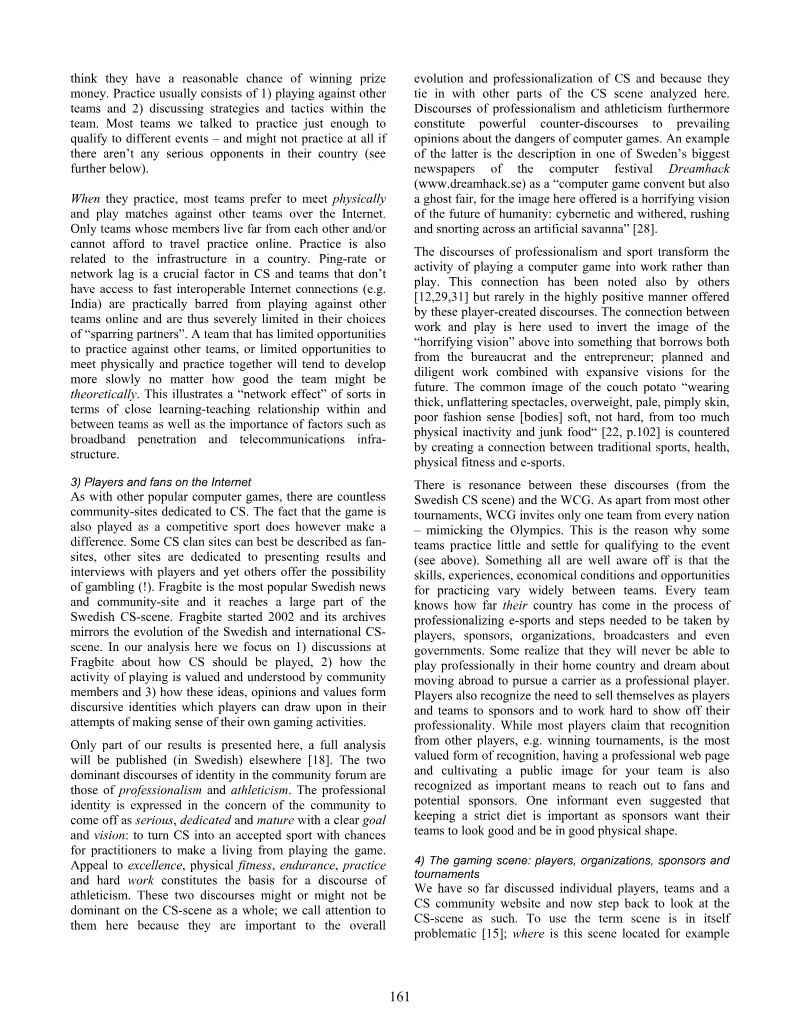
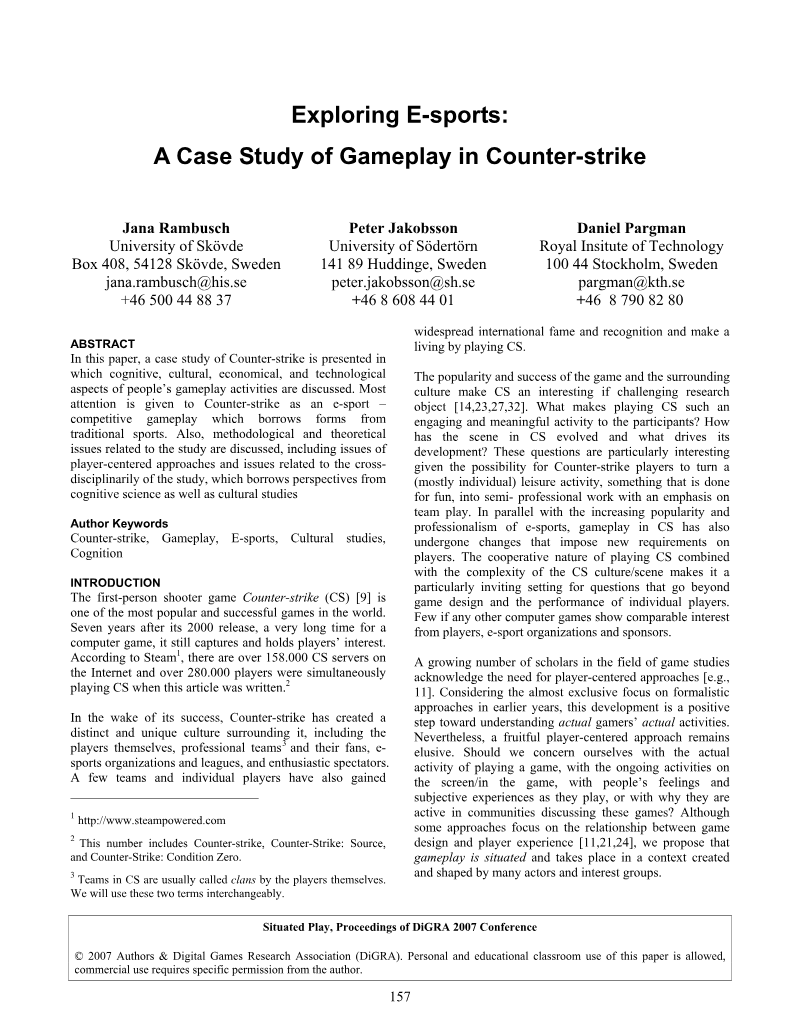
DiGRA · 2007