1 free read left. Create a free account for unlimited reading + AI research.
Create free accountPresentation DiGRA
1 free read left. Create a free account for unlimited reading + AI research.
Create free accountPresentationDiGRA
The author argues that speedrunning has shifted from purely performative activity toward producing and circulating information.
This paper traces the history of speedrunning, the practice of completing video games as quickly as possible, with a focus on how it has shifted from a purely performative activity into one centered on the production and circulation of information. The author argues that the informational dimension lies at the heart of any speedrunning community. The analysis proceeds through three phases: first, the proto-speedrunning era of the 1980s and 1990s, when performances were transcribed into magazines and newsletters and communicated through a Shannon-Weaver model of message, channel, and receiver; second, the web era, in which a performance itself became a document, shared as a file or video and accessible to anyone; and third, the contemporary period, in which platforms such as Twitch and Discord serve as infrastructures for producing and sharing knowledge.
The paper situates its argument within academic work beginning in the late 2000s, drawing on scholars who have approached speedrunning philosophically, technologically, and rhetorically. It frames speedrunning as a community of practice in which learning is a form of participation and belonging, and it extends this to viewers, for whom watching speedrun videos or charity marathons constitutes an entry point requiring active investment and resembling cultural mediation.
The methodology combines historical and documentary analysis with seventeen semi-structured interviews conducted in August and September 2022 with participants in SpeeDons 2022, a French speedrunning marathon. The study is limited in geographic and temporal scope to the French-language academic context and to the period covered by the interviews, and its conclusions rest on a qualitative rather than quantitative evidence base.
Each row is a game or company this document names, each column a document, oldest first. A mark means that document names it. Select a row to see those documents.

DiGRA · 2026

DiGRA · 2026



DiGRA · 2026



DiGRA · 2026



DiGRA · 2026



DiGRA · 2026



DiGRA · 2026



DiGRA · 2026



DiGRA · 2026

DiGRA · 2026



DiGRA · 2026



DiGRA · 2026
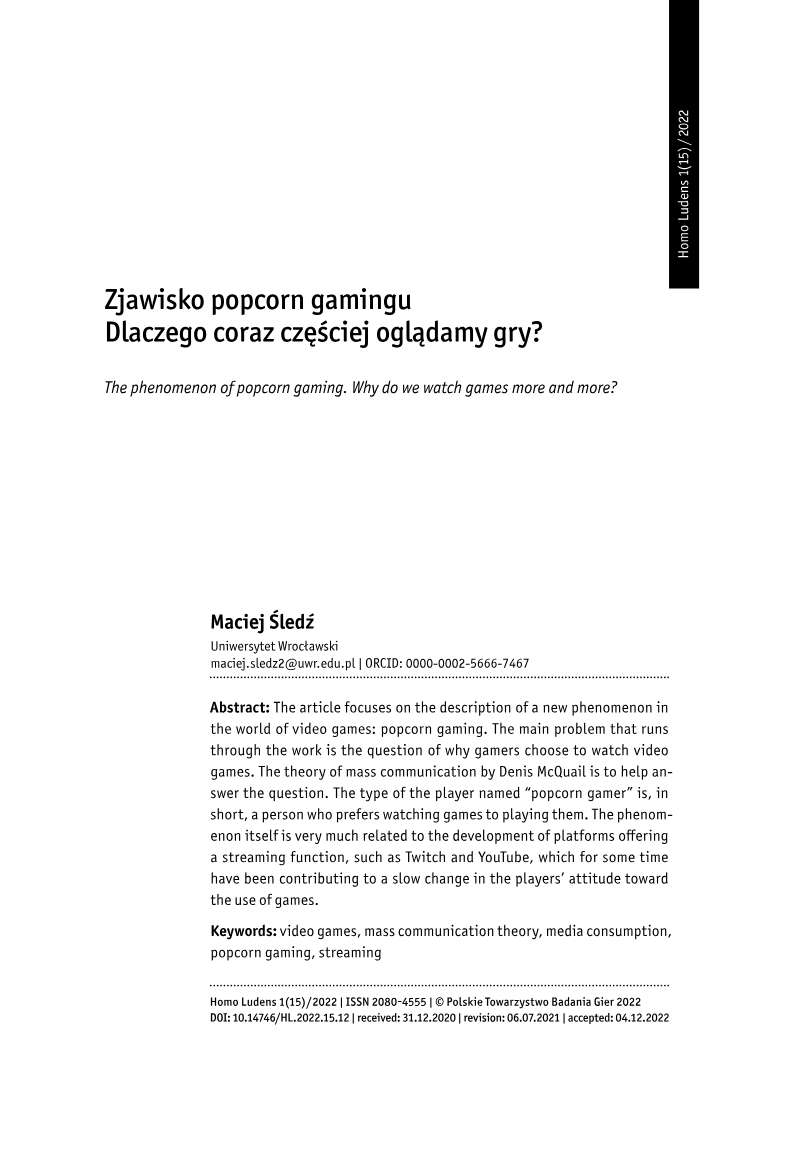
Uniwersytet Wrocławski · 2023