VideoTwo & a Half Gamers
🧠 MVP UA template: How to set up your Meta campaigns for Success by Matej Lancaric
19 Nov 202522 min video
start with like free ads. So free different concepts. I have this like core loop with game play fingers whatever else like tool like the regular stuff which is around game play but can be slightly altered you know you can use memes you can use AI hooks you can use whatever the you want just don't over complicate it [music] with a and a half gamers the midnight crew talking [music] UA adverts and game design too mate feeling shaku bringing the insight we're rocking [music] those vibes till the early daylight master eyes on the prize tracking data through the cyerspace skies feeling stacks [music] like a wizard in disguise crafter realms lift us to the high two and a half [music] gamers talking smack slow hockey sick got your back ads are beautiful [music] they light the way click it fast don't delayh Uh-huh. Uh-huh. [music] Uh-huh.
[music]
Hello everybody. This is Melanchar and this is another great solo episode. And honestly, it's been a year since we started doing this. And funnily enough, the first ever solo episode recorded was in this room and it was a complete failure. But as you know us, we keep doing things. But we heard your feedback. We changed things a little bit because the idea was us playing games and while we play while we play a game, we actually talk about an interesting topic. But then you said, you know, this. We want to hear more. You know, you use presentations, whatever else. And then you know we started doing that. So thank you very much for the support for the whole year. I hope you learned a lot. We definitely learned a lot and we're going to keep bringing these
episodes for you I hope for another year. So today I'm going to talk about a very interesting topic. Again it's all interesting and then since it's me it's going to be UA and UA related. And I have a presentation. Woohoo. How fancy. How fancy. And then I'm actually going to go through step-by-step campaign buildup. Okay, guys. So, look, step-by-step guide how to launch a successful meta campaigns because I released an MVP setup, which I think is very important when you're starting with the campaigns. And you've been asking about this for so long. You start with the campaigns, but like where should you start? So, I'm going to talk about the Facebook site and I'm going to talk about the inapp purchase campaigns and inapp ads campaigns because I just released if you want to have like the full guide like step by step in a written form. I'm going to share the links in the show notes but I want to go through this presentation and then actually build the campaign in this episode with you and then we'll see what
happens. So see again so I'm going to talk about the preparations and tracking obviously the what can we use for targeting how to think about the budgeting side of things also going to talk about the creative strategy and the execution and what kind of different creative concepts you can can start with also I mean if you didn't watch the previous episodes about creative trends you should definitely watch that episode anyway so let's let's start with the preparations and tracking and obviously I'm going to go through the the campaign buildup after the presentation. So always always super super important. You need to have everything ready in your kind of data pipeline and setup. So you need to integrate either Facebook SDK or Firebase ideally both or an MMP SDK. It's either it's singular airbridge up slayer adjust honestly doesn't matter but you have to have it in your app or in in your game and not only integrated and and obviously test it before you
start spending money but you need to have event tracking and event tracking meaning as as I have here you need to be able to track installs and attribute it into the different channels of course we are starting with Facebook only now but also additional events because you want to run purchase oriented campaigns and target payers So you need to be able to target payers as well. So that's highly recommended. I mean this is just like very like minimum viable setup. But and this is where it gets interesting because this not only works for inapp ads games or like admonetized games. This can work for any other game even games. And I'm diving deep into this topic in my newsletters very soon because this is what everybody's calling now signal engineering. and you you you want to send multiple different events into the into the UA channels to get different types of users. And I'm very proud of this, but I'm going to call this what you send is what you get. So the good old Vivic, it's what you see is what you get kind of editor within the websites. This is again what you send is
what you get. I'm very proud of myself. Hopefully not anyone came up with this uh term before, but you need to kind of combine different events to get different types of players. and or users. In this case, you know, you have all these uh these different combinations of events tracked and sent back to Facebook. So for example here I want to see who actually achieved 3 days and at the same time spent in the game at least 1 hour or I want to get the event which says or like it's it fires as soon as a player spent 30 minutes but at the same time spent $5 achieved level 20 and made two purchases and watch five ads or buy for. So you can see all these different combinations. Ideal scenario is you try to do this within first 24 to 48 hours to be able to act quickly and get as much data as possible. So like what should you start with? Well, usually these budgets are something that
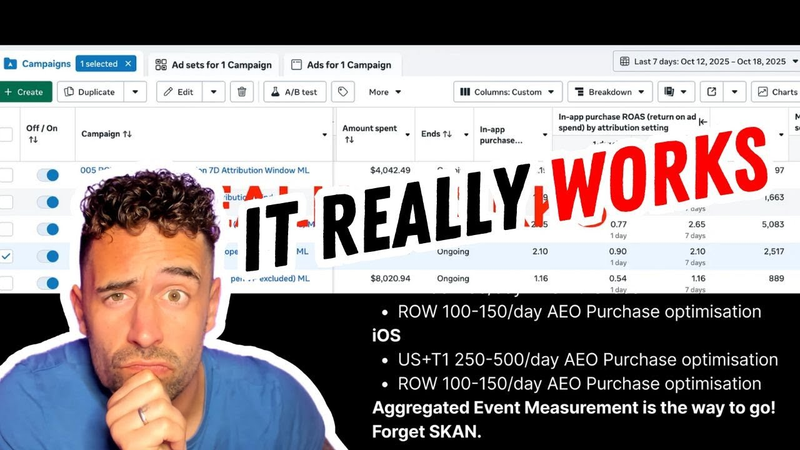
I always kind of start with. Again, up to you, but I wouldn't go below 100 per day because then it's just going to be all over the place, especially with purchase optimized campaigns. But let's say to kind of you can have some kind of data but the first setup I always try to target the whole world basically US as a standalone tier one or and the rest of the world on iOS and trying to kind of combination of US plus tier one on you can do it on iOS on Android as well up to you but you know you have more more data points. I'm now kind of not really looking into scan anymore because aggregated even measurement is the the way to go although I still see some kind of discrepancy between uh between fa what I see on Facebook and what I see in app store control connect but I mean welcome to 2025 then that was what I'm starting with with purchase oriented campaigns if I have this um ad monetize game then the setup is slightly different I'm starting with the app event optimization combination of the
events Like I mentioned to tutorial complete or the combination of the events level 10 and play 30 minutes or level 30 something which kind of identifies the user as engaged user or engaged player and then building some kind of data points to be able to go to the value optimized campaigns and address based campaigns. In ideal scenario, you run both. Depends on the actual like monetization split of your game. If it's 50/50 or if it's 7030, but still for iOS, I know it's in the beta right now. Facebook, you should definitely give me that beta access for some of the games I manage. Wink wink. But if you don't have that, then you won't be able to run the ads campaigns on iOS yet. So what you do is you basically go for the up event optimized campaigns and then just do these combi combined events or something some some events that are kind of suggesting that these players are engaged therefore they are watching more ads. So there you go. And I'm I'm talking about kind of tier
one and what does it mean? Usually this is what it means for me, US, UK, Germany, Canada, Australia, New Zealand and South Korea and Japan and then the rest of the world. But obviously if you have data then you know for example if you're Italy, Spain, France or whatever else is performing well and you're monetizing well in these countries they just put it into the tier one and then you can go even below that. You can go tier two there's another mix of play mix of countries in the rest of the world and always have the whole world covered at least from the start. Then you can narrow down the different campaigns and different geos afterwards. So I mean what can you basically use for targeting? Obviously broad targeting which works kind of well but also even I mean there are like these different kind of times and and changes over time. 5 years ago even I think the look alike still it's one of the top in UA. different type of purchasers, top
purchasers, like purchases with value and whatever else. Not that sexy anymore. I'm kind of still experimenting here and there with it. But anyway, it's still pretty good, but you need to get data. Where? How you get data? Well, you can run interest targeting, which also is kind of deprecated. It's not really the thing anymore. But I mean even even if you use the strategy or RPG or casual like type of interest and and kind of genre interest still better than broad targeting. Although we can we can kind of debate that uh nowadays creative is the targeting. Well yes and no. Uh you still need to send more like more data points and let's say for example for a soft launch you go with broad it's basically everybody. So you need to help the the algorithm to learn because then you know it takes ages and a lot of budget until you see like what exactly works. So let's say you you're running a mobile app install campaign instead of going to like broad campaign uh broad
targeting U if free install campaign you kind of use the interest and they'll be build it from there then go for app event optimize but that's a that's a topic for a soft launch episode which is actually live on this channel so you should definitely check it out. Anyway, what should you do with the budget and pacing and what can you kind of expect? You need to set some rules and goals and like how you move forward. So, for the first seven days, I mean, let's just be calm, keep plann budgets in learning and and don't really go like don't really jump the gun and just increase the budget all over the place. I think what you can do and you see here like after that I mean if you see after 3 or 5 days you are getting somewhere and the the numbers are getting better you can start scaling or like increasing the budget by 20 30% every 3 days but only if your other KPIs are kind of looking good which means if you increase the the budget then the CPI if it goes
crazy or not usually when you increase the budget the CPI spikes a little bit and then comes down I mean there's a kind like these rules like you don't really exceed the budgets for the revenues. I mean this is the old old kind of saying that you usually try to target this up to you but I kind of I try to I try to have this in my in my mind. So the like what should we start in terms of the creatives and like how how to go about it. So start with like free ads so free different concepts. So I have this like core loop with game play fingers whatever else like toolives like the regular stuff which is around game play but can be slightly altered you know you can use memes you can use AI hooks you can use whatever the you want just don't over complicate it start with free concepts that add variations variations can be again different hook it can be different length it can be different sound different pace all these different things it's just an iteration so let's start with nine nine uh different ads if
you need help, I can show you my my creative template as well. So, you can then go from there because this is also something that I will in I will show you or or just this is something I will add into the into the show notes. So, so what I'm I'm always talking about these different concepts. So, you can start with near dead experience. There are some examples obviously AI hooks which are super important. Ugly ass that you kind of record yourself with wherever we have these different things that we tried. 3D interviews are super popular these days. All of these different examples, you can also slap a wall of text on on the video which kind of is a very easy easy iteration like uh it's it's really popular within apps and some games as well. You just see or creator generated content not only talking heads but actually videos. Yeah, like why I should play these videos, right? I mean we can we can try to see. This is kind of the example of the creator generated content. We have all of these different things. It's not only in talking head
anymore. So, so that's why I'm talking about it. And there's like the beams obviously which can work quite well ideal scenarios which actually works with the sound. But who There you go. So all these different things work really well and then you can also use the dev generated like developer generated content because you kind of build this game app whatever. So people usually resonate with uh with the guys or whoever they should build it. So that that is those are a few examples uh that you can check if you need that if you need that template it's going to be in the show notes. So but yeah like what should what should be do on a day-to-day basis. Don't over complicate stuff. The work of the UA manager is not always changing something. There are days where you check the numbers and you do exactly nothing and it's completely fine. Right? Because if you start doing millions of things and changes, you're gonna up
all the campaigns. Don't do it. You check the CPIs, the whatever you want to you want to see and the like the KPIs and the goals, you check it in the morning. You check it in like during like the day and then in the evening and that's it. And even if even if everything is fine, then you just don't do anything. If something goes wrong, then again like cut the worst part, refresh creatives and leave it for another 3 days. like don't do it every day. So again like what should we do step like day by day. So first days first few days again nothing that like really major check the campaigns after we go live for like then monitor your ad creatives and watch the you try to make sense of like the CPI versus LTV equation or if you set the benchmarks if your day one day two day three ROAS is 10% but your goal is 20%. Then you need to act and you need to change creatives, you need to change the the campaigns a little bit. If you meet the goal, you know, you can then at the end of like the first week start adding
the budgets. Then you go from, you know, the creative refresh ideal scenario. Now after the first week, you you have the nine creatives, you already try to brainstorm the new ideas and go from there. Same thing. You go from from the the app event optimized purchase campaigns that I mentioned in the in the in the setup to value optimized campaigns and try to test it out against each other. If if value optimization wins like yeah just go full on into the value optimization because that's going to bring you more. And uh and then keep in mind you're not going to optimize for purchases when your game is admonetized. You're not going to stack five, 10 different campaigns in one go because that doesn't work. You really don't have like 10 small campaigns with like 20 or $30 each. It's not going to work because it's too low. You're not going to
send enough data towards the UA channels. I know it's it can be really daunting, but allocate some budget for testing. I usually try to have like 5,000 budget per month just to see like what works. I know it's for some of you it's basically a lot, but usually if you're in this stage and you're trying to get the first campaigns live, you need to have like 5 10 15k allocated for this first kind of months because you you don't you just don't know what works yet. So, if you have questions, ask in the comments, go into the Slack channel or uh yeah, I think I think that's it. That's it. That's pretty much it. So, now what do what are we going to do now? We are going to go through the campaign setup. But before before doing that, I'm going to show you the events examples. So, I was I was talking about the different combinations of events and whatever else blah blah blah. Here for example we have the identification of
plans diagnosing a plan there's a subscription obviously and now it's it's going to it's it's going to be interesting and starts to get interesting firing event when the when the user identified five plans or like another event example firing event when uh the user did a yearly subscription and identified five plans then there's diagn diagnosed five plans and and whatever else right so there's so many different combinations, daily subscription, 10 identified plans or whatever else. So this is what you should aim for and there is no limits. Although you see like here all these events are just not firing that many times which is going to be very tough to use in the campaigns. But here the plan yearly subscription and identification five ads are not bad here. This also works quite well. Okay. So let's just go here. Let's create a campaign. Let's just go up promotion. Let's see. Let's see. Let's see. Let's see. Testing
campaign. Testing campaign. Yeah. So, let's do file 150. Let's just go for the for the plant. Okay. There you go. And then we can just use it as a US plus tier one. And we definitely want to go for the the different events that I have. Yeah. adression, purchase, share, whatever else. But I actually want to go for exactly this. Let's say plan a weekly subscription and identify two ads. Uh two ads identified two plans. There you go. So all of this is set. Now we don't go to Slovakia obviously because I'm from Slovakia, but nobody cares about Slovakia. But we do care about US and we do care about United Kingdom. We do care about Germany. Germany and we do care about Japan as well. We care about Canada. Canada. So you get the point, right? You get the
point. Me placements whatever else platforms blah blah. So all of these you want to use. Don't want iPads or iPods because this is only uh and I just want to get rid of the skippable ads which nobody knows what it is but it really drags down the performance. Okay. So, US tier one app up event optimize campaign weekly plus two planified. Perfect. Okay. So, here we go. This is what we need. We have the everything we want. Okay. And now we just go with creatives. I mean, we can just test. Yes. All of this is fine. Multi advertise. No. all of this AI stuff from Facebook. Get rid of it. Okay. So, let's just go video. Thank you. Awesome. Yeah. So, I'm starting with the the 9 to6 usually and
then after I see what works, then I adding the one to one and four to four to five. There you go. Whatever. That's fine. Install. Yes. Thank you. Also, no details, not multi-image, no visual does, not text improvements, no video effects. I don't really want these. There you go. And then [snorts] you hit publish. And there we go. There we go. If you have any questions, our dear listeners, about Facebook, about UA, about this minimum viable setup, please let me know in the show not show in the comment section of the video. join the Slack channel. If you want to buy my uh soft lounge book ebook, please do so. Uh you're going to support all of this and the great videos we we are we are doing at the moment. So, thank you guys for listening. Please again, if you have any comments, share them with us. See you next time. Bye-bye.
Heat. [music] Hey, Heat. [music]
Auto-generated captions from YouTube — names and numbers may be misheard.
Distilling the key insights…
This analysis outlines a strategic framework for launching and managing successful Meta user acquisition (UA) campaigns in 2025, focusing on a "Minimum Viable Product" (MVP) approach. The core thesis posits that UA performance is primarily driven by precise event engineering, early creative validation, and disciplined budget management. By leveraging a "what you send is what you get" methodology, advertisers can optimize campaigns by feeding specific, meaningful event combinations back to the algorithm to attract high-value users.
The recommended technical setup requires a robust data pipeline, including the integration of Facebook SDK, Firebase, and a Mobile Measurement Partner (MMP). Success hinges on moving beyond simple install tracking to "signal engineering," where multiple engagement and monetization events—such as level completion, time spent, and purchase history—are combined to identify and target engaged players. For in-app purchase games, the strategy favors purchase-optimized campaigns, while ad-monetized games should utilize app-event optimization (AEO) to identify high-value users, eventually transitioning to value-based optimization as data depth increases.
Geographic targeting should initially focus on Tier 1 markets (US, UK, Germany, Canada, Australia, New Zealand, South Korea, and Japan) alongside a "Rest of World" (ROW) segment to ensure broad reach. Creative strategy is equally critical; the process begins with three core concepts, each iterated into three variations—totaling nine ads—to test hooks, pacing, and formats like AI-generated content, memes, and developer-led videos.
Operational discipline is emphasized, with a recommendation to avoid frequent manual adjustments. Campaigns require a three-to-five-day stability period before scaling, and performance should be monitored two to three times daily rather than hourly. A dedicated testing budget of approximately 5,000 to 15,000 per month is advised for initial validation, ensuring that the algorithm receives sufficient data to optimize effectively without premature budget fragmentation.

Two & a Half Gamers · 2026

Two & a Half Gamers · 2026

Two & a Half Gamers · 2026

Two & a Half Gamers · 2026

Two & a Half Gamers · 2026

Two & a Half Gamers · 2026

Two & a Half Gamers · 2026

Two & a Half Gamers · 2026

Two & a Half Gamers · 2026

Two & a Half Gamers · 2026

Two & a Half Gamers · 2026

Two & a Half Gamers · 2026

Two & a Half Gamers · 2026

Naavik · 2026

Two & a Half Gamers · 2026

Deconstructor of Fun · 2026

Two & a Half Gamers · 2026

Two & a Half Gamers · 2026

Deconstructor of Fun · 2026

Deconstructor of Fun · 2026
Two & a Half Gamers · 2025
Two & a Half Gamers · 2025
Two & a Half Gamers · 2025

Deconstructor of Fun · 2025
Comments