Updated Jun 1, 2026 by AppLovin
Financial · February 11, 2026
Published by AppLovin
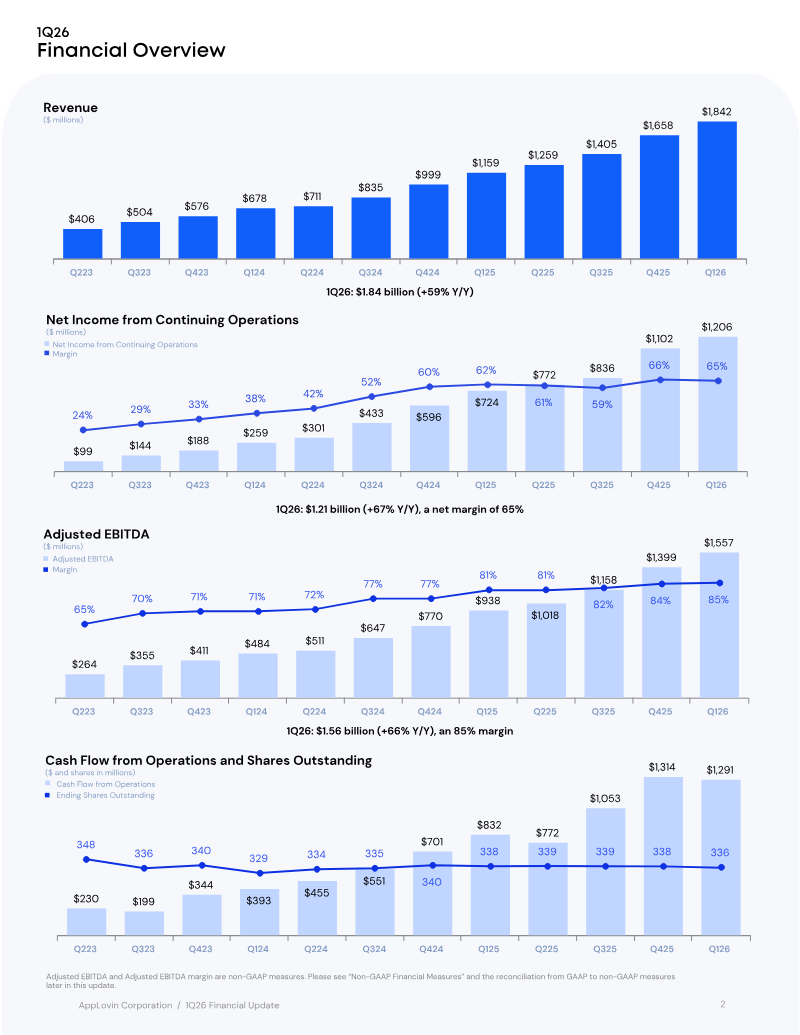
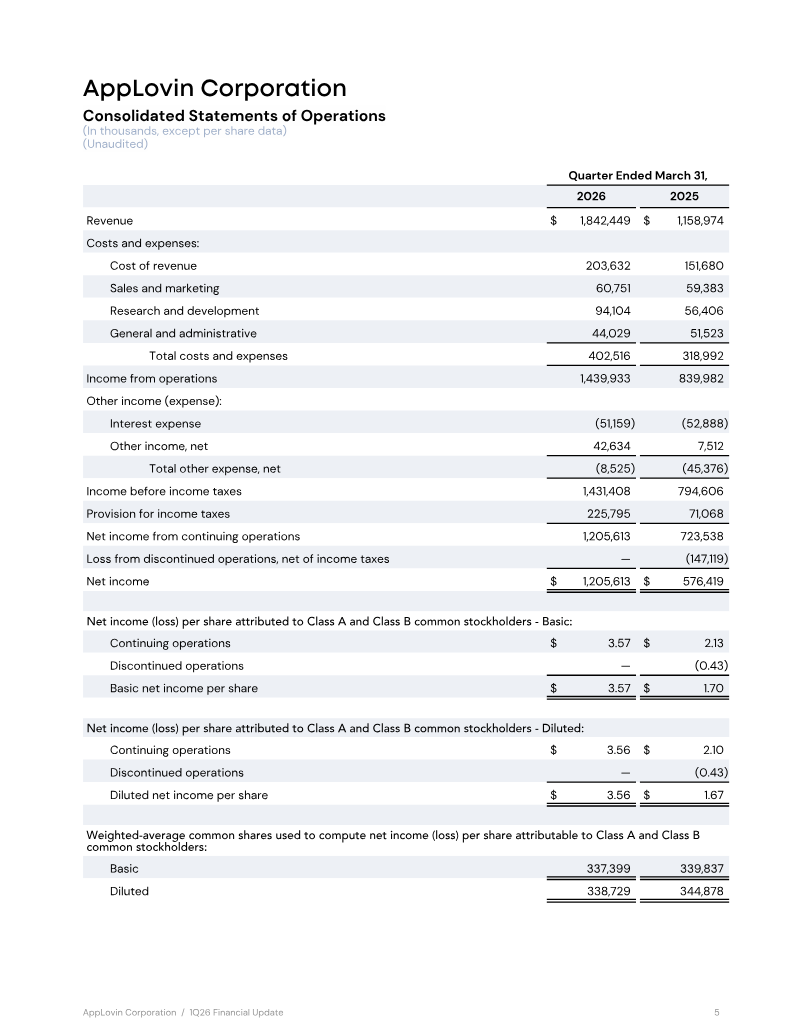
AppLovin Corporation reports a robust 2025 financial performance, driven by accelerated revenue growth and strong operating margins. Revenue for the full year reached $5.48 billion, a 70 % increase from $3.22 billion in 2024 and an 82 % year‑over‑year rise from $3.22 billion in 2023. Net income from continuing operations climbed to $3.43 billion, up 116 % from $1.59 billion in 2024 and 63 % from $1.58 billion in 2023, yielding a net margin of 63 %. Adjusted EBITDA surged to $4.51 billion, a 82 % increase from the prior year and an 87 % rise from 2023, with a margin of 82 %. Cash flow from operations grew to $1.40 billion, a 82 % increase year‑over‑year. The company’s balance sheet strengthened markedly: cash and equivalents rose to $2.49 billion from $741 million, while total assets increased to $7.26 billion against $5.87 billion in 2024. Shareholders’ equity expanded to $2.13 billion, reflecting retained earnings growth and additional paid‑in capital. Long‑term debt remained stable at approximately $3.51 billion, and operating lease liabilities decreased. AppLovin’s methodology for non‑GAAP measures is disclosed in detail, with Adjusted EBITDA defined as net income excluding discontinued operations, taxes, interest, and other non‑core items. The reconciliation tables show that adjustments total $1.08 billion in 2025, largely driven by stock‑based compensation and amortization. Geographically, the report does not segment revenue or expenses; it presents consolidated figures for the United States and global operations. The time frame covers fiscal year 2025, with quarterly comparisons to 2024 and 2023. The update is unaudited but follows standard SEC filing practices, providing a comprehensive view of AppLovin’s financial trajectory and operational efficiency.
> **[Chart page]** This page contains visual data — view in PDF for the best experience. Financial Overview ( millions) 1,1591,2591,405 1,658 5,481 Revenue 999 1,405 $3,224 ( millions)406 504 576 678 711 835 999 1,159 1,259 1,842 3,224 355 406 504 576 678 711 835 1,842 $355 Q123 Q223 Q323 Q423 Q124 Q224 Q324 Q424 Q125 Q225 Q325 Q425 2023 2024 2025 Q123 Q223 Q323 Q4234Q25: $1.66 billion (+66% Y/Y) 2023 2024 2025 Q124 Q224 Q324 Q424 Q125 Q225 Q325 Q425 4Q25: 1.66 billion (+66% Y/Y) 1,102 2025: $5.48 billion (+70% Y/Y) Net Income from Continuing Operations $3,433 ( millions) from 1,102 $3,433 Net Income Continuing Operations ( millions) from 724 772 836 Net Income Continuing Operations $836 66% 63% Margin 52% 596 724 $772 59% 66% 63% 33% 38% 42% 52% 596 62% 61% 59% 1,590 24% 29% 38% 42% 60% 62% $1,590 24% 29% 33% 259 301 $433 60% 25% 49% 8% 144 188 259 301 $433 25% 49% 8% 99 188 $458 27 99 144 458 $27 Q123 Q223 Q323 Q423 Q124 Q224 Q324 Q424 Q125 Q225 Q325 2023 2024 2025 Q123 Q223 Q323 Q423 Q124 Q224 Q324 Q424 Q125 Q225 Q325 Q425 4Q25: 1.10 billion (+85% Y/Y), a net margin of 66% 2025: 3.43 billion (+116% Y/Y), a net margin of 63% Adjusted EBITDA 1,399 4,512 ($ millions) Adjusted EBITDA $1,158 Margin 70% 71% 71% 72% 77% 77% 938 1,018 82% 84% 67% 75% 82% 58% 65% 355 411 484 511 647 770 81% 81% 1,236 2,412 207 264 355 1,236 $207 Q123 Q223 Q323 Q423 Q124 Q224 Q324 Q424 Q125 Q225 Q325 Q425 2023 2024 2025 Q123 Q223 Q323 1.40 billion Y/Y), Q225 Q325 Q425 4.51 billion Y/Y), 4Q25: (+82% an 84% margin 2025: (+87% an 82% margin
1,018 82% 84% 67% 75% 82% 58% 65% 355 411 484 511 647 770 81% 81% 1,236 2,412 207 264 355 1,236 $207 Q123 Q223 Q323 Q423 Q124 Q224 Q324 Q424 Q125 Q225 Q325 Q425 2023 2024 2025 Q123 Q223 Q323 1.40 billion Y/Y), Q225 Q325 Q425 4.51 billion Y/Y), 4Q25: (+82% an 84% margin 2025: (+87% an 82% margin Cash Flow from 4Q25: 1.40 billion (+82% Y/Y), an 84% margin 2025: 4.51 billion (+87% Y/Y), an 82% margin Operations and Shares Outstanding 1,314 3,971 ( and shares in millions) 1,314 $3,971 Cash Flow from Operations $1,053 Ending Shares Outstanding Cash Flow from Operations 832 1,053 340 340 371 701 772 340 340 338 371 348 336 340 329 334 551 701 338 339 339 338 $2,099 338 348 336 340 329 334 340 338 339 339 338 $2,099 289 230 199 344 393 455 335 340 $1,062 289 230 199 344 393 455 335 $1,062 Q123 Q223 Q323 Q423 Q124 Q224 Q324 Q424 Q125 Q225 Q325 Q425 2023 2024 2025 Q123 Q223 Q323 Q423 Q124 Q224 Q324 Q424 Q125 Q225 Q325 Q425 2023 2024 2025 Adjusted EBITDA and Adjusted EBITDA margin are non-GAAP measures. Please see “Non-GAAP Financial Measures” and the reconciliation from GAAP to non-GAAP measures later in this update.
Non-GAAP Financial Measures To supplement our financial information presented in accordance with generally accepted accounting principles in the United States (“GAAP”), this financial update includes certain financial measures that are not prepared in accordance with GAAP, including Adjusted EBITDA and Adjusted EBITDA margin. A reconciliation of each such non-GAAP financial measure to the most directly comparable GAAP measure can be found below. We define Adjusted EBITDA for a particular period as net income (loss) adjusted for loss (income) from discontinued operations, net of income taxes, interest expense and loss on settlement of debt, other (income) expense, net (excluding certain recurring items), provision for (benefit from) income taxes, amortization, depreciation and write-offs and as further adjusted for non-operating foreign exchange (gain) loss, based compensation, transaction-related expense, restructuring costs, as well as certain other items that we believe are not reflective of our core operating performance. We define Adjusted EBITDA margin as Adjusted EBITDA divided by revenue for the same period. We believe that the presentation of these non-GAAP financial measures provides useful information to investors regarding our results of operations and operating performance, as they are similar to measures reported by our public competitors and are regularly used by securities analysts, institutional investors, and other interested parties in analyzing operating performance and prospects.
tion to investors regarding our results of operations and operating performance, as they are similar to measures reported by our public competitors and are regularly used by securities analysts, institutional investors, and other interested parties in analyzing operating performance and prospects. Adjusted EBITDA and Adjusted EBITDA margin are key measures we use to assess our financial performance and are also used for internal planning and forecasting purposes. We believe Adjusted EBITDA and Adjusted EBITDA margin are helpful to investors, analysts, and other interested parties because they can assist in providing a more consistent and comparable overview of our operations across our historical financial periods. We use Adjusted EBITDA and Adjusted EBITDA margin in conjunction with GAAP measures as part of our overall assessment of our performance, including the preparation of our annual operating budget and quarterly forecasts, to evaluate the effectiveness of our business strategies, and to communicate with our board of directors concerning our financial performance.
with GAAP measures as part of our overall assessment of our performance, including the preparation of our annual operating budget and quarterly forecasts, to evaluate the effectiveness of our business strategies, and to communicate with our board of directors concerning our financial performance. These measures have certain limitations in that they do not include the impact of certain expenses that are reflected in our consolidated statement of operations that are necessary to run our business. Our definitions may differ from the definitions used by other companies and therefore comparability may be limited. In addition, other companies may not publish these or similar metrics. Thus, our non-GAAP financial measures should be considered in addition to, not as substitutes for, or in isolation from, measures prepared in accordance with GAAP.
AppLovin Corporation Consolidated Balance Sheets (In thousands, except per share data) (Unaudited) As of December 31, 2025 2024 Assets Current assets: Cash and cash equivalents . . . . . . . . . . . . . . . . . . . . . . . . . . . . . . . . . . . . . . . . . . . . . . . . . . . 2,487,096 697,030 Accounts receivable, net . . . . . . . . . . . . . . . . . . . . . . . . . . . . . . . . . . . . . . . . . . . . . . . . . . . . 1,819,366 1,283,335 Prepaid expenses and other current assets . . . . . . . . . . . . . . . . . . . . . . . . . . . . . . . . . . . . 124,330 140,470 Current assets of discontinued operations . . . . . . . . . . . . . . . . . . . . . . . . . . . . . . . . . . . . . — 191,355 Total current assets . . . . . . . . . . . . . . . . . . . . . . . . . . . . . . . . . . . . . . . . . . . . . . . . . . . . . 4,430,792 2,312,190 Property and equipment, net . . . . . . . . . . . . . . . . . . . . . . . . . . . . . . . . . . . . . . . . . . . . . . . . . . 122,445 159,970 Operating lease right-of-use assets . . . . . . . . . . . . . . . . . . . . . . . . . . . . . . . . . . . . . . . . . . . . . 25,457 36,473 Goodwill . . . . . . . . . . . . . . . . . . . . . . . . . . . . . . . . . . . . . . . . . . . . . . . . . . . . . . . . . . . . . . . . . . . . 1,539,986 1,457,685 Intangible assets, net . . . . . . . . . . . . . . . . . . . . . . . . . . . . . . . . . . . . . . . . . . . . . . . . . . . . . . . . . 396,714 472,851 Equity method investments . . . . . . . . . . . . . . . . . . . . . . . . . . . . . . . . . . . . . . . . . . . . . . . . . . . . 287,666 — Other assets . . . . . . . . . . . . . . . . . . . . . . . . . . . . . . . . . . . . . . . . . . . . . . .
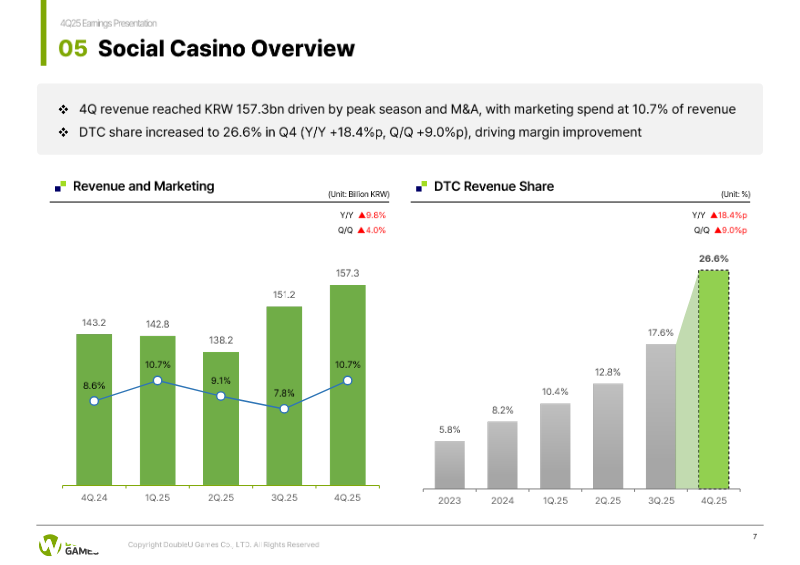
The interim filing presents the fourth‑quarter 2025 financial results for a midcore‑casual gaming group, emphasizing a record‑setting revenue run and the successful execution of a transformation agenda that includes the integration of the Plarium acquisition and the rollout of a new district structure in early 2026. Revenue reached SEK 3,123 million, reflecting 108 % organic growth year‑on‑year and a 25 % increase on a constant‑currency basis, while adjusted EBITDA rose to SEK 717 million, delivering a 23 % margin that matches the full‑year figure. Unlevered free cash flow amounted to SEK 878 million, with a cash‑conversion rate of 66 % and a leverage ratio of five times EBITDA, underscoring robust liquidity and disciplined capital management. User‑acquisition spending accelerated, representing 38 % of quarterly revenue—up from 37 % in the prior quarter—and grew 76 % on a reported basis, driven by heightened investment in original studios, new casual titles, and the racing franchise. The direct‑to‑consumer channel expanded by 600 basis points to 32 % of total revenue, reflecting a strategic shift toward higher‑margin in‑app purchases. Across the fiscal year, the company posted a 9 % organic revenue increase, with word‑games, racing, and RAID franchises delivering the strongest quarter‑end performance. Operating cash flow for the quarter stood at SEK 840 million, while adjusted net income was SEK 1,390 million, translating to an adjusted EPS of SEK 11.33. The financial outcomes exceed guidance and position the firm to meet its medium‑term outlook, with a pre‑IPO study for PlaySimple concluded and the midcore transformation progressing as planned.
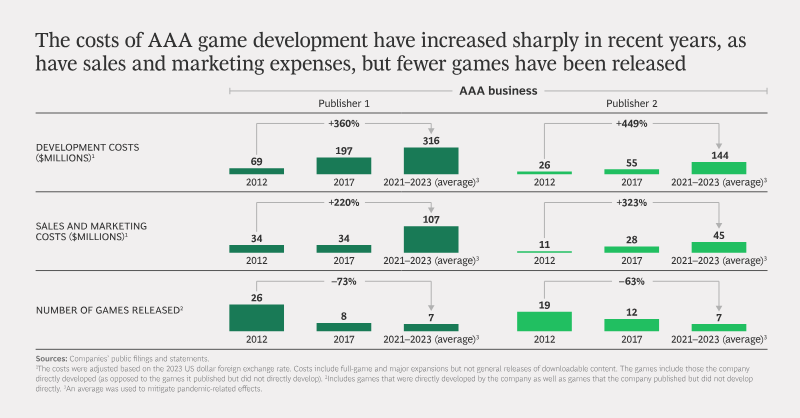
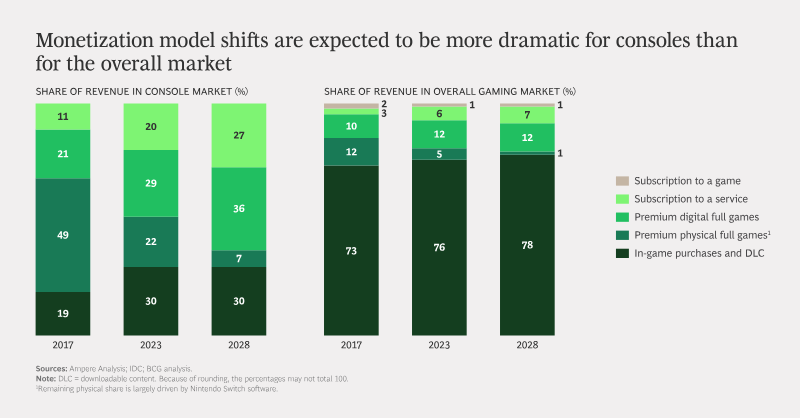
The report examines the global gaming market’s evolution from 2017 to 2028, highlighting a post‑pandemic correction that has shifted growth expectations from double‑digit rates to modest expansion. Global revenue by type rose 1 % CAGR (2017–2023), with mobile, PC, and console segments contributing $1.2 trillion in 2023; cloud/VR sales remain niche but are projected to grow at 5 % CAGR (2023–2028). Emerging platforms such as cloud AR/VR and user‑generated content show market sizes of $939 million (2024) to $1.75 billion (2028), yet infrastructure constraints limit mass adoption. Development economics reveal a widening gap: AAA development budgets increased 360 % (2012–2023 average) while sales and marketing costs rose 220 %, yet the number of AAA titles released fell by 73 %. Mobile publishers mirror this trend, with development costs up 54–92 % and releases declining. Console revenues are projected to outpace AAA budgets, with a 5 % CAGR in development spending versus 8 % in console revenue growth (2017–2028). Survey data indicate that most publishers expect to maintain or modestly increase budgets, with only 5–10 % planning reductions. Monetization shifts are pronounced in consoles: subscription services and premium digital sales will dominate, while mobile revenue increasingly relies on in‑app advertising (up to 31 % of mobile share). Consumer willingness to accept ads varies by platform, with over half of core PC/console gamers open to advertising in premium titles. Geographic analysis shows Chinese players exhibit the highest willingness to pay, and emerging‑economy gamers spend more time playing than their developed‑economy counterparts. Age segmentation reveals younger cohorts favor action/adventure, whereas older players gravitate toward puzzles and casual games. The report concludes that technological advances, particularly generative AI, may enable cost efficiencies but will likely be leveraged to fund larger, higher‑quality titles rather than reduce overall budgets.
G5 Entertainment’s 2024 performance reflects a strategic pivot toward operational efficiency and margin expansion within the global mobile gaming sector. Despite a 14% year-over-year revenue decline to SEK 1,135 million, the company achieved a 5% increase in operating profit, reaching SEK 116.8 million. This improvement is attributed to a disciplined focus on its core demographic—women aged 35 and older—and the expansion of its proprietary direct-to-consumer G5 Store, which now accounts for 16.1% of total revenue. By leveraging AI-driven development and a rigorous funnel of five to six soft launches annually, the company aims to sustain its position in the evergreen Hidden Object, Match-3, and Mahjong genres. The company maintains a robust financial foundation, characterized by SEK 276 million in available cash and an equity/asset ratio of 83%. Financial stability is further supported by a conservative approach to capital, with no external debt and a portfolio where the top ten titles generate 98% of intangible asset value. While the business remains sensitive to market volatility, currency fluctuations, and reliance on major third-party distribution platforms, auditors have provided an unqualified opinion on the financial statements, confirming that the valuation of capitalized development costs remains within reasonable parameters. Beyond financial metrics, the organization emphasizes a structured approach to corporate governance and human capital. With a gender-balanced workforce and a commitment to ethical business conduct, G5 integrates comprehensive labor policies and 360-degree performance assessments to drive organizational health. While the company has implemented energy-efficient practices, it currently lacks formal climate mitigation plans and EU taxonomy-aligned sustainability metrics. Moving forward, the board remains focused on balancing organic growth with shareholder returns, as evidenced by the proposed dividend of SEK 8.0 per share and a continued emphasis on performance-based executive remuneration.
The 2021 Fact Book presents a comprehensive overview of Bandai Namco Holdings’ strategic direction, emphasizing its transformation into a globally integrated entertainment conglomerate and its commitment to corporate social responsibility. Central to the narrative is the thesis that sustained growth across toys, video games, animation and amusement can be achieved through diversified product portfolios, expansive international operations, and proactive sustainability initiatives. The company’s evolution is traced from a collection of independent toy, arcade‑machine and media firms to a unified group after the 2005‑2007 merger of Bandai and Namco. Key milestones include the launch of flagship lines such as Gundam models (over 500 million units shipped), Tamagotchi (exceeding 20 million units), and Zatchbell Battle (300 million units), as well as the development of major video‑game franchises—TEKKEN, DARK SOULS III and Tales—collectively surpassing 50 million sales. International expansion is evident through subsidiaries and regional headquarters in North America, Europe and Asia, reinforced by repeated listings on the Tokyo Stock Exchange and industry recognitions such as Cannes Best Actor and TSE awards. Environmental and social performance data for fiscal year 2021 highlight a suite of CSR actions, including CO₂ reduction targets, supply‑chain safety measures and work‑life‑balance programmes, all framed within the “NEXT STAGE” mid‑term plan aimed at deepening engagement with a mature fan base and broadening cross‑media offerings. The Fact Book thus underscores Bandai Namco’s dual focus on market leadership and sustainable corporate practices across a worldwide footprint and multiple entertainment segments.