1 free read left. Create a free account for unlimited reading + AI research.
Create free account
Lessons from Fusebox's Love Island: The Game
Key insights
6 takeaways- 01Fusebox Games achieved top-grossing status on iOS and Android in summer 2018 by prioritizing a deep understanding of the source material's core appeal during the adaptation of Love Island: The Game.
- 02Developers should identify the 'brain, heart, and soul' of an IP and map these elements to specific narrative functions to ensure character authenticity while maintaining manageable production scope.
- 03Designing characters around specific archetypal roles, such as comic relief or antagonist, streamlines the writing process and ensures narrative consistency with the source material's tone.
- 04Rigorous project management, including detailed state-tracking and modular episode outlines, enabled the team to cut 15 episodes of content late in development without compromising the integrity of the remaining plot.
- 05Bridging the communication gap between game developers and IP stakeholders early in the process is essential to maintain production velocity and ensure the final product resonates with mainstream audiences.
- 06Stakeholders often struggle to visualize interactive experiences until they are playable, which can lead to disruptive late-stage revisions if script approvals do not align with the realized game.
Ask AI about this video
Transcript
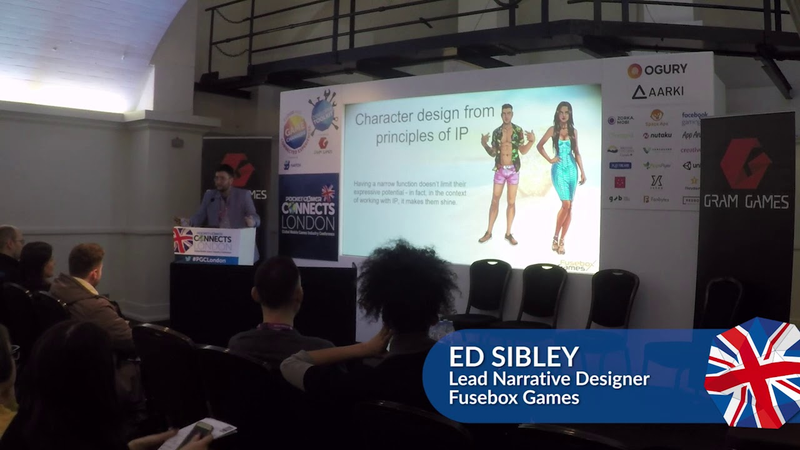
[Music] my name is Edie Sibley and I am the lead narrative designer at a studio called fuse box games we are best known for our work adapting TV formats like love an island and the X Factor into free-to-play choice based narrative mobile games basically kind of visual novels in the kind of style of games like choices or episodes anyone played any of our games Hey okay great I hope you enjoyed it so we released love island the game last summer in like june of 2018 and then we spent several weeks sitting at the top of like top grossing charts on ios and android and we got to be a finalist in in the best storage having category the mobile game awards
that are happening this evening so that's my kind of credentials here and I'm going to be talking basically about how we handled the task of turning a like a popular IP into a kind of into a mobile game it's been a hell of a trip but yes the talk is going to be like a whistle-stop tour around some observations based on my experience working with IP some things I think we did right some things that I'd do differently next time I'm a narrative designer so some of what I'm gonna say is going to focus on the implications of licensed IPS for narrative games but much of this is probably going to be generally applicable to people who are interested in sort of game design and project management around this kind of area of licensed IPs again it's only quite a short slot and I've got a lot to get through so I'm gonna get into it from a kind of like a business point to be also about my slides by the way I'm like a writer at heart I don't know how to make him like look real nice but so from a business point of view the benefit of working with an IP is kind of fairly self-explanatory I think and I won't dwell on it too long you've got like a ready-made audience of fans you get low CPI's you've got high organic traffic
there's potential for cross promotion with you know the native medium of the IP the important consideration is that your audience aren't necessarily people familiar with games they're people who might be arriving your thing having seen a TV program but might never have played a mobile game you know of any sort in their lives and that leads to all kinds of like interesting design questions I also think it's worth stating that from a creative point of view the the benefit of working with a big IP is that it has an audience but if it has an audience you can also trust that it's basically doing something right successful IP formats whether they're reality TV shows or internet comics or sporting franchises they work because they reliably produce entertainment and I feel like this is something that often gets lost in these kinds of conversations potentially because there's this this cliche of the cynical IP tie-in that looms kind of large or I don't know because people aren't used to seeing good quality IP adaptations potentially but I think it's worth stating kind of as an axiom that
big IPs are big because lots of people like them and and if people like them there must be something real in there that people like and so try to keep that in the back of your head during the rest of this talk I think kind of informs a lot of the kind of philosophy behind the methods I'm gonna talk about so here's an a here's an anecdote so a few weeks after the game came out I bumped into John Ingold who's the guy behind inkle Studios and he said something to me that I'm not ever gonna forget he said well you've certainly done something right and then he paused for a moment and then he said or at least you haven't done something wrong so those obviously will be the words on my gravestone but he was right I think the reason that the game enjoyed the success it did is at its heart because we didn't get the IP wrong the important thing I think is that if you're making a game for an IP audience they're going to come to your product with a lot of expectations it's absolutely critical that you avoid upsetting those expectations so understanding the brand and building your game around like a frank analysis
of it is critical your problem is the minute you say the phrase love island the game people already have an idea of what that is right you kind of you've already got ideas about what should be happening in that game what's going to be kind of on my screen from one moment to the next and you've got a problem if once the game arrives in someone's hands it fails to meet those expectations so I think the most important step when adapting a popular IP is to make sure that your team understand why the people who care about that IP actually liked it in our case it helped I think that I'm actually like a sincere fan of love Island I really enjoy a TV program I think it's very funny but I think that if your staff aren't taking a basically sincere pleasure in the IP that you're adapting you're going to have a much harder time making your adaptation a success because you know your creative team's assumptions about the IP aren't necessarily going to map onto the assumptions that the audience have about it or about why it's a why it's something worth being engaged with and this has like practical implications so
for that reason providing a very clear articulation of the appeal of the IP should be the starting point for your entire creative process in the case of love island I started by thinking about my experience watching the show and thinking about like the kinds of things that people had to say about it on social media and these kinds of things and this is not just an excerpt from an early design document that we produce it's not I'm not gonna read this whole thing but like the important things are that the brain of loved Island I think is in the kind of the romantic intrigues and the kind of scheming of the contestants and the kind of strategy game of how am I going to find love the heart of the show on the other hand isn't it's kind of champagne and roses kind of construction of love and sex and relationships and also the kind of yang to that is the kind of sort of arguments in the drama that emerge from that and then like thirdly the kind of soul of the show is in this kind of warm positive friendly tone that it's all wrapped up in which I think serves as a kind of a fertile ground for these moments of like real humanity the benefit of this way of defining the show and there's metaphor of a brain or heart
and soul you can give or take but like is that it tells us what people enjoy thinking and talk about when they're interacting with the IP where it's emotional impact comes from what kind of tone it ought to be striking in any given moment and I'd encourage you to think about this in your projects what is the emotional tone of the kind of moment to moment of my storyline what by contrast are like the highly charged emotional moments that are moments that are going to stick in people's minds you know and and thirdly what's the kind of mechanism by which you're format or your game raises one into the other if you get those things right and if they reflect the expectations that the audience are bringing from their experience with the IP then you can be confident that your IPs your adaptation is basically going to ring true you know it's going to kind of sound sound right it's gonna feel like it really is the thing it pretends to be you know and this allows you to answer like design questions you can use these kinds of parameters to like inform the design of more specific things like plot arcs and characters and this kind of thing I'd encourage you to apply this kind of
analysis to any kind of an IP that you're working on even if it's like your own proprietary IP to see if they give some focus to questions about your kind of narrative in your gameplay so building on that I'm gonna give you two quick case studies of how we design some characters in the game the first thing is that love Ireland is like it's a funny show and a lot of it's about kind of general sort of chat and people spend their time if you turn it on watch a random slice from the middle of any episode probably what you're gonna see is people sitting around on sun loungers having a conversation and it'll be added in such a way that someone says something funny and that's where you see so we designed this guy called Tim the basic sort of reason that Tim exists is to just kind of like make jokes and to be the butt of other people's jokes and we wanted to make sure that he'd have this function kind of continuously all the way through the game we didn't want to complicate it by having him like maybe be your ex like there's nothing worse than like hearing your ex crack like funny jokes all day long so we decided he wouldn't be able to romance him and hid instead have a kind of like a friendly relationship with the player character but yes he's
not remind scible that keeps his comic role straightforward and by having a clear sense that this was his function we were able to produce a character who was both kind of faithful to the spirit of the show but also like you have a fun person for the players to interact with and to kind of get to know as a conflicting example this is Allegra so I said that like the sort of the soul of the game is in its humor but what's often memorable about love Ireland is the moments where kind of flares up into arguments and so we wanted a character who could kind of exist to sort of provoked controversy or to kind of get into acrimonious kind of relationships with the player character and so her function is basically to call you out for making advances on her partner or to or to kind of challenge the decisions that you seem to have made you have a big argument with her quite early on in the game and I actually think that in the final implementation we got her a bit wrong we kind of went over the top with this competitive aspect of her character but this kind of had a happy side like she seems incredibly extra she's very like over the top as a person
and because this whole thing was generally kind of on brand it kind of felt like a feature rather than a bug you know she's probably one of the most talked about characters in the game in the final version and I expect anybody those in the audience that is a writer it's kind of shaking their head at this idea that you should kind of build characters around narrow functional conceptions rather than kind of things like you know deep personalities and nuanced storylines and this kind of thing but I actually think that like our first objective here is to make something that captures the feeling of the license that you're working on that's the most kind of important part of this whole design process and so by building characters around functions in this way it lets you kind of capitalize on what's appealing about the IP while still leaving yourself room to have like a fun time working on it Tim and Allegra maybe kind of built around narrow conceptions of functions that I've derived from an analysis of an IP but they're also at the center of some of the best moments in the game their characters aren't compromised by the fact that they're designed explicitly for these narrow functions they're actually kind of like energized by it it
gives them lots of room to breathe and makes them really interesting people to kind of get to know so that's the sort of first half of what I've got to say the rest of this talk is going to be about kind of how we did it the thing about working with an IP is that it's it's something going to put timers on your project that you can't predict and so there's stuff that you can do in your kind of planning and your kind of conceptualization of your project it's gonna make this bearable love Island the game season one the final script was about three hundred thousand words which is about sixty percent of the length of Infinite Jest or like if you took ten copies of Animal Farm and stack them end on end and it was written by me and one other writer and we did most of that in around six months it was a huge amount of content and more importantly we did have this incredibly heavy deadline that we knew we couldn't missed the show was going to be going on air on the first Monday of June 2018 and if the game wasn't ready the show was going to go without it you know there was no delaying it and for this reason it was really important that we designed the game in such a way that we were able to
kind of discuss B this was definitely a kind of a consideration that saved our butts and also that we were able to get the content approved by our stake holders in a kind of a speedy timely kind of a way so um firstly on this issue of kind of scope management you've got a plan smartly and you've got to keep careful track of the scope of your game it sounds trivial but especially in the case of like interactive narratives like what we're dealing with it's something that you need to plan quite carefully here's a quote from Charlie Brooker about Bandersnatch he said but I took out the f-word a bunch of times he said by the end it got so complex that we had to bring in coders to support the creative process to be able to interpret what we were trying to do and I just think you can't let your work get that complex it's a nightmare if that's what you're dealing with you need to design with this kind of hazard of complexity in mind and you need to work around it obviously the whole point of writing a choice based narrative is that choices have consequences and consequences kind of are respected later on in the story and this can make for a complicated thing with all these different
permutations but but you have to accept that this complexity is kind of inevitable and you have to find ways to kind of mediate with it if your project has become so complex that you lose a clear of what is clear for what's going on it's going to make writing and editing painful they're gonna make them slow and we knew they're hitting this in moveable TV deadlines would almost inevitably mean cutting sections of work in order to fit with our asset production pipelines and our release schedule and they're having the plot outlined very clearly in a high level of detail with all supporting documents was basically how we did it maintaining clarity on your project is essential because you're probably going to have to cut stuff unless everything in your project goes perfectly according to plan and if you've ever done that please come talk to me afterwards but you've um you know you need to be able to cut kind of decisively and with confidence the way that we did this was we kept like a careful record of all the possible states of the game we had detailed episode outlines for every episode that focused on the key choices their players could make and the way that choices from earlier episodes would sort of would impact future episodes having the kind
of statefulness of the game clearly articulated in this way that is right very efficiently but it also let us cut and edit with a lot of confidence without the fear that a cut in one place would lead to the plot unraveling somewhere else down the line and I really can't overstate the extent to which this strategy saved the project towards the end we had to cut around 15 episodes worth of content when we realized that we'd never be able to write and get it approved kind of in time but designing around this idea that content might need to be cut kind of enabled us to get the game released on schedule and then the last thing that I want to kind of get into is dealing with stakeholders if you're working with a licensed IP they're probably going to be some people that represent the owners of the IP who are going to be like dealing with your scripts who are going to be kind of approving them and like giving you feedback and making sure that you're making something that's acceptable from the point of view of the owners of the brand if your IP comes from film and cinema or even from a different corner of the games industry your stakeholders might not immediately understand what you're working on games are by their nature hard to understand it till you have them in front of you and the nature of development is often such that playable code doesn't
materialize until considerable work has already been sunk into content development and this can lead to a massive pitfall that we fell into I will describe how it happened stage 1 our stakeholders were approving scripts as we wrote them but they didn't get to actually play the game until quite a lot of time had been spent kind of getting the script so quite a lot of script had already been signed off secondly once they actually got to play the game their understanding of what they were dealing with was transformed by that and this altered the criteria that they were using to judge the scripts and then thirdly the actual pitfall was the entirely reasonably at quite a late stage in the project they no longer felt comfortable with their whole initial bracket of sign offs and had to go back over a large amount of work and request to consider on their changes right at the last minute which was a nightmare now late stage changes are probably inevitable to a certain extent when getting involved with with stakeholders and such but I think that we could have done a much better job of helping them to understand the game from an earlier stage perhaps by showing them similar games or by spending time talking to them about it or even just by
kind of phoning them up and like explaining it I don't know the problem with any kind of like client relationship management is that they're probably not going to have a lot of time for you and they're also not going to have much familiarity with games potentially at all but I nevertheless feel like a kind of a relatively small amount of time spent on this early on in the project could have saved a considerably large amount of work a later time anyway to conclude on a slightly different note at fusebox our sort of reason to be is to try and find a way to get this kind of thing a choice based narratives branching dialogue all that good stuff in front of a popular mainstream audience and it seems to me that there's so much smart design that's been honed for decades in this walled garden of interactive fiction but it's never found a way in front of a kind of a genuinely mainstream audience there's no reason why interactive storytelling needs to be relegated to the and I think the partnerships with popular IP are a really good way to expand into undiscovered markets I also think that the days when IP tines were
kind of lazy low-rent affairs are in the past audience standards going up people have been talking about that this afternoon to a certain extent and I feel like what we're doing here is we're laying some groundwork for something that's going to become a far more significant part of the cultural landscape in future years I mean that's that thanks very much any questions oh do you have time for questions cool no cool all right well that's my twitter thanks very much [Applause] [Music] you
Summary
The development of Love Island: The Game serves as a case study for successfully adapting popular intellectual property (IP) into mobile, choice-based narrative games. The project, led by Fusebox Games, achieved significant commercial success, reaching the top-grossing charts on iOS and Android during the summer of 2018. The primary thesis is that successful IP adaptation requires a deep, sincere understanding of the source material’s core appeal, coupled with rigorous project management to navigate the constraints of immovable release deadlines and complex stakeholder approval processes.
Key findings emphasize that developers must identify the "brain, heart, and soul" of an IP to ensure the game resonates with existing fans. By mapping these elements to specific narrative functions, designers can create characters that feel authentic to the brand while maintaining a manageable scope. For instance, characters were designed around specific roles—such as comic relief or antagonist—to streamline writing and ensure the narrative remained consistent with the source material’s tone.
Methodologically, the project relied on detailed state-tracking and modular episode outlines. This documentation was critical, as it allowed the team to cut approximately 15 episodes of content late in development without compromising the integrity of the remaining plot. The team also identified a significant pitfall in stakeholder management: because stakeholders often lack familiarity with game development, they may struggle to visualize the final product until it is playable. This disconnect can lead to late-stage revisions if initial script approvals no longer align with the realized game experience. The analysis concludes that bridging this communication gap early is essential for maintaining production velocity and ensuring that interactive storytelling can successfully reach mainstream audiences.

















Comments