1 free read left. Create a free account for unlimited reading + AI research.
Create free account
Keynote: Thriving in the App-ocalypse
Key insights
6 takeaways- 01Developers can maintain profitable growth by shifting from deterministic, IDFA-reliant tracking to probabilistic modeling and alternative data signals.
- 02Approximately 80% of mobile users now opt out of tracking following the implementation of Apple’s App Tracking Transparency (ATT) framework and the deprecation of the Identifier for Advertisers (IDFA).
- 03Measurement challenges in a post-IDFA environment are being mitigated by simplifying campaign structures and using aggregated data from Apple’s SKAdNetwork to establish benchmarks.
- 04Developers are driving acquisition efficiency on iOS by utilizing custom product pages and aligning ad spend with specific event-based marketing opportunities like product launches.
- 05Successful user acquisition requires customizing creative assets and messaging to match the specific nuances of individual platforms like TikTok, Facebook, and Snapchat.
- 06Purchase behavior targeting, which identifies high-value users based on transaction history rather than device identifiers, is a highly effective method for improving return on ad spend (ROAS) and reducing acquisition costs.
Ask AI about this video
Transcript
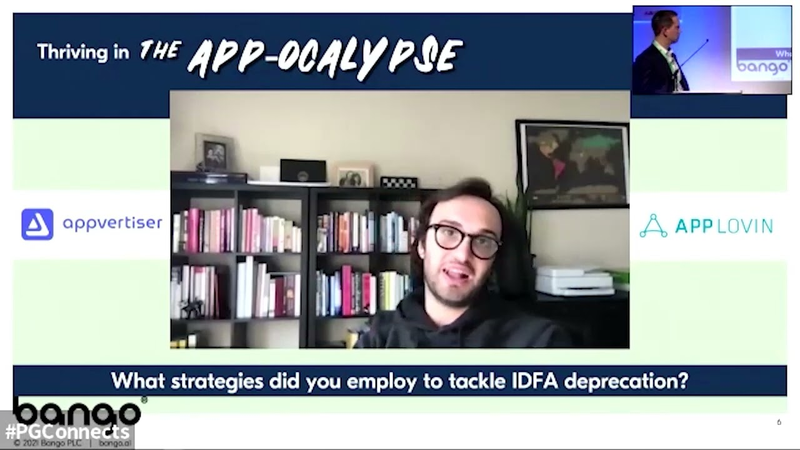
[Music] [Music] so i'd like to introduce our next speaker who's going to do a talk on thriving in the app uh ocalyx will like it uh so brett olansky from bango our track sponsor bangor come to the stage thank you brett hi everybody thank you for coming uh my name is brett orlanski and i'm the head of product and sales for a company called bango we are based here in the uk up in cambridge we make a product called the bango audience it is a custom audience built around purchase behavior data which i'll talk more about later but we're here to talk about what we especially call the apocalypse and it's sort of our tongue-in-cheek uh
sort of reality check on what's going on in the mobile app ecosystem we've printed a cute little uh cartoon comic that kind of dictates what we see is what's going on in the ecosystem and it's you know spoiler alert it has a happy ending but it's it's kind of a tricky moment and not just because of the current state of affairs in the world of the pandemic of course but specifically in mobile app marketing the move towards more privacy protections in a way from idfa has left the environment of mobile app marketing just in a really really transient and difficult place advertisers are struggling to find users who were never easy or cheap to find now we're just really struggling harder to find them make it profitable so we have fallen into the apocalypse and i guess the way we kind of just look at it is that a hard job has been made harder so so what on earth are we going to do about it how can we navigate this how can we not just survive the apocalypse but how can we thrive we asked some of our partners um just
for some recommendations what did they do what have they done last year and looking into this new year what have they done to be successful uh so we didn't bring them today but we had some video conversations with them that we recorded and i'll show today uh so i'd like to introduce two of my uh my virtual co-panelists uh we have uh jerome turnbull from app11 the company you may be familiar with and uh hagap hagopian from advertiser which is a mobile app agency representing a company called upland they're gonna be talking about two different types of games one upland is a blockchain based crypto game sort of like monopoly trading game a property trading game and apple 11 of course has a massive portfolio of games so let me introduce them in their own words i'm the founder of advertiser growth marketing agency and the app that i'm presenting is upland which is our client and we're running a user acquisition both
marketing campaigns for upland and upland is the property trading game that's based on real world addresses and it's a game that is nft related metaverse so it's built on blockchain and uh the game is focused on uh both platforms from ios and android and also web um and the target market for this game is worldwide heavy influence on the us but you can think about it like any nft or crypto related official autos and gaming uh user base is a good perfect match for this type of game app 11 is a leading marketing platform that provides solution for solutions for developers to grow their apps we also own over 18 studios and so my team supports these studios through user acquisition monetization analytics and re-engagement and we've got uh we're a global business
and over 19 offices around the world and we leverage that international footprint to market our games globally key markets obviously are the us and western europe but we also have a focus for aipac and you may have played some of our titles project makeover word escapes cooking madness final fantasy new empire or example of some of our top games so in conversation with jerome and hagop i kinda just wondered with them what did you guys do to be successful both games will you know an apple in case it's a true portfolio what did they do to be successful how were they able to grow and grow profitably uh last year in acknowledgement of the idfa deprecation that we're all going through um they shared some really really important pieces of knowledge that we'll come back to after we speak one of the um the biggest changes in the industry was related to the idfa application
therefore we had to change our approach meaning that because there was a lot of unknown uh we decided to pull back on ios and focus a little bit more on the android side with android um we have been able to scale it up and by using a variety of different channels from facebook to tick tock to um programmatic and search for facebook and we've took an advantage by using like bango audiences which paid out really well for us and in the meantime not forget about the ios and we've also leveraged some of those bang audiences because of the deprecation we've created some look-alike audiences that helped us unlock some additional growth on the ios and while we were going through those changes on ios um we've learned a little bit more about how to look into the scat network and leverage the scat network data meaning
that we started applying some probabilistic modeling on the data and using some multipliers that we're seeing with any users that are updating in into the att prompt and use that as a benchmark for scattering for report and then outside of scat network with one of the innovation i would say is looking into each channel and creative in uniquely not using one one approach that applies for all but instead customizing the creative and the messaging by channel whether it's facebook versus tick tock versus snapchat versus google and because of that we have been able to see great success of unlocking additional growth and improving the conversion metrics 2021 has been a challenging year i think idfa deprecation impacted all of us or at least those in the mobile gaming industry
fortunately we had time to prepare for it and there was a period of transition after ios 14.6's release in june where we were able to kind of make those changes apparent that's now over roughly about 80 of the users we see do not consent to sharing idfa so that's just something that we have learned to work with in the past few months it's a measurement challenge i don't think user behavior has changed as a result of this so there are a couple of ways to approach the first is that we've streamlined our buying strategy so that maybe with the campaign limits on ios simplifying a lot of our campaign structures and we've learned to operate media buying a little bit differently this past year we're looking at things on a broader basis or using some assumptions looking at android looking at other cohorts of traffic on ios where we are able to track user engagement and behavior so they said a lot a lot of good pearls of wisdom one thing i kind of wanted to just
really double down on is this confusion around you know deprecation the att prompt that is put out by the scad network i think it was jerome we said that approximately 80 of his users don't opt in so 20 do and that's roughly aligned with the data published by flurry of those who um uh the chart on the uh on the far left that uh do actually opt in my loose reading of it is that this is a group of users that are declaring themselves as open to advertising and it should be noted that it's worth doing what i got predict suggests just modeling around that creating a cohort of those users building multipliers around it and then and then taking that as your targeting cohort it means it's not quite as simple as that of course there's some some logic behind it but that's sort of a category of users that can't be ignored it's just too too important to dismiss a whole cloth and back to what jerome says is that it's fundamentally a measurement challenge we have to measure these users differently
it's not a one-to-one correlation anymore and that's what he's that's what applovin has done to be successful so that was largely last year because this is ios 14 is here it's come and gone we've kind of accepted it we've moved forward so what can we do now what success strategies can we take looking into this current new year i would call in quotation like leveraging event potting strategy in the ua arsenal meaning that any new nfts or any new events that are coming um within the metaverse we want to uh spend a lot more budget that we would dedicate that throughout the month or throughout the year so if there's a new event coming out next month we want to make sure that we're scaling the spend and running retargeting campaigns during that time a lot a lot larger quality a lot more aggressively than um um we still want to emphasize on the creatives creatives matter a lot so
still focusing this year on having unique creatives by channel is very important like not every channel is the same another factor is that localization and cultural localization you want to make sure that you are applying unique messaging for different cultures in different locations and localizing the message and with ios 15 there's a lot of opportunities from custom product page optimization in-app event promotion that's going can help us drive a lot more efficiency on the ios and i try to simplify the measurement problem without deterministic attribution on ios you can't be a surgical in your targeting or your campaign setup in general we're pretty excited about connected tv and that's something that works so again more really good pieces of wisdom and tips and tricks the easiest one i think we can come back to is creative optimization
and i think if you remove all externalities from your campaigns the thing that will have the most influence on the success the success of your ua campaigns will be creative and i know we talk about this a lot and it's everyone says they do it but i think frankly um it doesn't happen quite the right way or as often and really just making sure that your creative is of course sized to the appropriate platform making sure that it has audio if that's relevant on tick tock uh people especially without tons of creative resources will just port your facebook ad to your tic toc campaign and it doesn't quite work it just doesn't quite write doesn't play well enough this is just what these larger studios have been able to do and it's just i don't necessarily think that it requires a ton of work to to resize and and localize culturalizing that's perhaps a little bit harder but something that the successful developers have been able to um to leverage the last thing we're going to talk about is what we started with which is purchase behavior targeting it's uh something they mentioned a little bit earlier but it's uh it's a it's a signal
it's a new signal that i i like to think that van gogh as a company is pioneering we're not the only ones that do it we're not the only ones that have been successful with it but we're we like to think we're leading this charge so what have our partners been able to do leveraging purchase behavior targeting in their campaigns well you see brett without that case it's all about going after the high-level tv and the purchasing power users right users that have the purchasing power so for that reason it's all about leveraging all the value optimization or raw as optimization that's available across the different channels from facebook using the mineralization value optimization to google leveraging the trois and in order to make these work we had to make sure that we're ingesting enough data to the algorithm through the weather integrating the firebase sdk on google and facebook sending to the sdk
um and leveraging the um the mmp sdk and not to forget to mention i mean we've also seen a lot of success with the bangalore audiences because with the bangalore audience we've been able to create high value purchasing users purchase behavior targeting is important for us so any deeper font event optimization is a core part of our acquisition strategy for games that are predominantly iap driven purchase behavior is kind of our baseline we then supplement that strategy with other mid to upper funnel efforts which may not have that purchase behavior layered on and we've seen the most success by layering purchase behavior audiences on top of a buying model that goes after users that exhibit that behavior so bango's audience for example has has been helpful one because it doesn't rely on idfa to find valuable users but it also we work with the bango team to identify
key segments and that's that's the lever that we use in optimization across different campaigns so what is this what is this purchase behavior targeting well i mean it sort of is what it sounds like it is it's a signal of of inputs that we can gather of purchase behavior it's not just the amount that you purchase or what you purchase it's the frequency with which you purchase it's the it's the attempt that you've made it's predicated on a fairly simple notion that things a user who makes a purchase in an app has a higher likelihood of making a similar purchase in a similar app it's sort of purchase behavior that doesn't that translates beyond just mobile app user acquisition and behavior as it's sort of an endemic in all of our lives the notion of course is that you know 20 years ago we were all served ads based upon things that we searched for 10 years ago we were purchased ads based on things that we liked on social networks well today we can get ads served to us based on things that we
have purchased this is purchase behavior targeting these are signals that we can gather into a custom audience it can run on facebook you can run on instagram you can run on tick tock and grow on other platforms this is what a bingo audience is and it allows you to target not just new users which are of course important but those who actually pay the well-known you know fact of the 95 percent of users never pay anything it's more like you know 98 um so finding those who do make purchases has always been important and perhaps now more than ever this is a case study that we actually published with upland uh i think last year this is the the app that hog up was referring to so benchmarked against uh facebook's aaa product we can see 95 increase in roads 37 decrease in cpa and a 34 decrease in cost per unique purchaser so it's incredibly powerful incredibly effective we're not the only ones doing it um y'all can do it we can do it with you but this is a unique new signal like i said to produce
really powerful and effective audiences to find new pairs in um in your ua campaigns so that's everything i appreciate your time um and i'm happy to answer questions now or later but i do appreciate it thank you thank you very much [Applause] that was great thank you all right we've got a couple of minutes actually so if you have questions here about uh about anything they've seen about the put the apocalypse um uh for brett there we go this one here and then you next year hey um sorry if i missed this at the beginning but um could you explain a bit more about how they aren't restricted by idfa limitations with their bangor audiences so the cool thing about a bingo audience is that it doesn't use idfa as an identifier so not having it or having idfa deprecated doesn't really affect us it doesn't necessarily make our product better not having it but it doesn't make it worse which is an important distinction but it's not predicated on it so it doesn't affect performance
i'm sorry we use an msisdn yes sorry there's another question are you seeing any differences uh in geos through your targeting through uh purchase intent yeah it's a good question um yes you know western audiences tend to perform better higher purchase value highest purchase frequency so that sort of makes sense doesn't mean to say that we don't have great data or great effectiveness in in other geos that aren't western um korea for example is a very effective country for us but yeah it we do skew towards the uh the higher value tier one countries and then um and then the difference between uh you know payers and players um across genres for example hyper casual how do you how do you do event optimization targeting through uh people that don't pay just through advertising well so to
break it down it's the cool thing about this is that with apps that are built around in-app purchases this is an incredibly powerful uh targeting tool but embedded in that notion is that it has to have a lot of the apps where this works best has to have a lot of purchase frequency so what that means is like social casino apps where there's a lot of currency being transacted that's where these types of products these types of data signals work best for results um when when you have apps built around in-app purchase excuse me in-app advertising it's less relevant i know there's some some movement in that direction and has been for a while but when you're talking about in-app advertising inapp purchases with high high purchase value this is where this really has a sweet spot great thank you and if people want to catch up with you brett after this and and find out more about what van gogh can do absolutely your emails there on the screen but also i guess you're in me i'm here i'm here thank you thank you very much thank you
[Music] you
Summary
The mobile app marketing landscape has undergone a significant transformation due to privacy-centric changes, most notably the deprecation of the Identifier for Advertisers (IDFA) and the implementation of Apple’s App Tracking Transparency (ATT) framework. This shift has created a challenging environment for user acquisition, as approximately 80% of users now opt out of tracking. The primary objective for developers is to navigate this "app-ocalypse" by moving away from deterministic, IDFA-reliant tracking toward probabilistic modeling and alternative data signals to maintain profitable growth.
Successful strategies for thriving in this environment involve a multi-faceted approach to media buying and creative optimization. Rather than applying a uniform strategy across all platforms, top-performing developers are customizing creative assets and messaging to fit the unique nuances of individual channels like TikTok, Facebook, and Snapchat. Furthermore, developers are increasingly leveraging event-based marketing, such as aligning ad spend with metaverse events or new product launches, and utilizing custom product pages to drive efficiency on iOS. Measurement challenges are being addressed by simplifying campaign structures and using aggregated data from the SKAdNetwork to build benchmarks and multipliers.
A central finding is the effectiveness of purchase behavior targeting, which identifies high-value users based on their history of in-app transactions rather than device identifiers. By analyzing the frequency and nature of past purchases, marketers can build custom audiences that remain effective despite privacy restrictions. Case studies demonstrate that layering these purchase-based signals onto existing acquisition models can significantly improve return on ad spend (ROAS) and reduce customer acquisition costs. This methodology is particularly potent for apps with high transaction frequency, such as social casino games, and provides a viable path for scaling user bases in a post-IDFA ecosystem.




















Comments