VideoTwo & a Half Gamers
Influencer Marketing in mobile games actually explained by Marion Balinoff
18 Mar 202629 min video
that you're able to attribute the traffic back to the campaign because if you only look at the track traffic, you're never going to be able to reach profitability. What you want to keep in mind is that you want to have a 25% um increase in your daily organic installs in order to see a visible spike in your organic during your campaign period. If we go back to our dice [music] [music] with the two and a half gamers, the midnight crew talking UA advers and game design too. Mat Felix Shak bringing the insight. We're rocking [music] those vibes till the early day master eyes on the prize. Tracking data through the cyerspace skies. Felix stacks [music] colors like a wizard in disguise. Jacks lift us to the high. Two and a half gamers talking smack. Slow hockey sick got your back. Ads are beautiful. [music] They light the way. Click it fast. Don't delay. Uh-huh. [music] Uh-huh.
Uh-huh. [music] Okay. Real talk before we start. This episode is brought to you by Potencus. And if you're a mobile game publisher tired of leaving money on the table, listen up. Potencus is a premium ad network built by people who have actually been on both sides of this industry. Game publishers, agencies, successful exits. So, they get it. Here's the thing. Potencus has direct deals with Amazon, Apple, Coca-Cola, Vodafon. It's not programmatic. It's direct. Those budgets land in your game at premium CPMs. no middleman tax and they're handle everything with their in-house team in terms of the critics. Plus, they've partnered with playable maker ving. So, they will take brands YouTube videos or static images and actually turned into playable ad or revert video proper
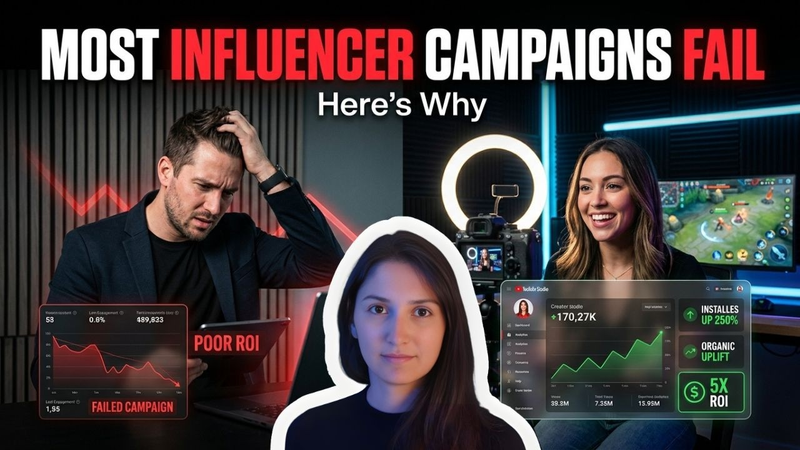
interactive format built for gaming inventory. Brands getting a gaming native creative publishers are getting a higher CPMs. Everyone wins. Head to potensus.com to get started or check their creative portfolio in the link in the show notes. Thank you very much Potencus for sponsoring this episode. Hello and welcome everyone to another episode of Two and a Half Gamers. Influencer marketing in mobile gaming is growing fast, but most campaigns still fail. Not because the creators were wrong or the game wasn't good, but just because the setup was wrong from the start. So today we're going to deep dive into how to set up your influencer marketing campaign for success. A few words about me very quickly so you know where I'm coming from. I started on the agency and platform side working directly with brands on influencer marketing. I then specialized in mobile gaming where I've spent several years building and scaling influencer programs in house. And after a few years, I moved into consulting. And since then, I've been working hands-on with mobile
studios from testing the influencer marketing for the first time to scaling it as a real growth lever. I've been extremely data focused and performance-driven throughout my career. And this really matters because everything I'm about to share comes from execution and not theory. I'm not showing those logos to impress anyone. I'm showing them to give context. These two use are very different from different genres, different maturities, different budgets, different problems. What that means is the data and the patterns that I will share are not based on a game or one setup. They come from repeated observation across very different teams. So when I talk about what works and what doesn't, it is really grounded in variety and not a single success story. And so that's what makes the learnings transferable. So, what we're going to be covering in today's episode, defining your goals, planning and budgeting your campaign, selecting the right influencers, how to find those influencers, setting the right price, writing a good brief,
measuring performance, and obviously optimizing next campaigns. So, let's jump right into it. Defining your goals. So, there's two different types of goals. Whether you want to do brand awareness, focusing on views, likes, and comments or performance where you're going to be focusing on installs, revenues, and overall ARI. We're going to be taking throughout this presentation an example from a uh cooking merge game, right? So, I can exemplify what I'm saying. So, this game wants to do performance, right? So, they want to measure installs. They want understand how much revenue was generated and overall what was the ROI for for the campaign. They're targeting an audience of females 25 years old and older. When you want to start planning and budgeting your campaigns, you need to understand obviously which markets you're going to be targeting. You want to understand the daily organic installs that your game has in the markets that you're going to be targeting. The reason for that and why we're going to be talking about organic a lot is because most of the traffic coming from influence campaigns is still organic, right? And so it is important that
you're able to attribute the traffic back to the campaign because if you only look at the track traffic, you're never going to be able to reach profitability. What you want to keep in mind is that you want to have a 25% um increase in your daily organic installs in order to see a visible spike in your organic during your campaign period. If we go back to our example, this game wants to target the US. Remember, influencer marketing campaigns are language based and not country based, right? So, if you want to target the US, you're necessly going to be targeting a little bit of the UK, Canada, and Australia because influencers speaking English will have a spread out audience. For that specific game, we have on average between 400 and 600 installs on average per day uh in the US. And so, if we want to have at least 25% increase on those organics, we need um at least 150 installs. So 25% of those 60 inst 600 installs um as a campaign uh target during the the
campaign period. I would recommend doing YouTube um and there's simple reason for that because as I was saying the traffic is mostly organic but that doesn't mean that we do not care about the the track traffic simply because this is our only chance at understanding the quality of the traffic that you're acquiring. I favor YouTube for simple reasons. You can have a link directly in the description of the video. you're going to have a link in the pin comment and you're also going to have a QR code on the screen for everyone that's watching on the second screen or on a TV. Whereas on Instagram and on Tik Tok, you cannot put a link in the description of the post. So, you have to say link in the bio. So, people are redirected to your bio if they feel like going to your bio for clicking the link, which is clearly not ideal because when you're scrolling, you don't feel like going to the influencers's profile page. And when you're in the buy, you need to find where that link is, click on it, and then identify maybe sometimes even in link tree how to get on that link. So,
it's it's really important to keep that in mind. And that's the reason why I favor YouTube. There are different ways now to leverage Instagram um and have, for example, a DM that's sent automatically if people comment a certain keyword on your reel. But that's probably topic for a different video. No, let's go back to our planning and budgeting our campaign. We said um YouTube most of the views I mean the biggest spike of the views are going to happen in in the first seven days of the video. Doesn't mean that after that there are no views. It just means that they're going to be diluted. And so if you want to see an a spike in your organic need to be as uh conservative as possible and only looking at the seven first days. So we said 150 installs per day during the campaign period. So times seven that's a total of,50 installs that you want to target. Now once you've understood that you're able to understand how many views you need to generate because what I usually do is create scenarios right based on conversion rate. So from pessimistic to
medium to op optimistic those are really standard and it's a good starting point then from your game specifically depending on your genre depending on the countries it will vary but at least it can be a good starting point. So I make different scenarios based on the conversion rate and as you can see the idea is that for the pessimistic scenario to reach at least the the the level of installs that I wanted to reach in order to spike in my organics right so in that case with a 0.15 um% conversion rate from views to installs I need 700,000 that will lead to my target installs right so then it's about budgeting the campaign right so the influencer cost is going to depend on a on a various on various factors. Social media obviously they're not going to cost all the same. The targeted markets obviously you know at the US are more expensive than Vietnam for example. The targeted audience the older the more expensive um and the infant verticals. Some verticals have a lot of options for
sponsors that might be more expensive than others. So if we look at our example from our merge uh game we said we want to do YouTube. Um, we want to target US, Canada, Australia, and the United Kingdom. We're targeting females 25 years and old. And we're going to be targeting verticals of creators. So, basically content gener, family, DIY, and we'll get back to that in a moment. Basically, with all of this, I know from experience and with working with agencies, working with consultants, working with people in the industry that the the target CPM is going to be around $50. This is going to be the the industry average. And because I know I need to generate 700,000 views from my previous calculations, I understand that my minimum budget for the campaign is 35,000. If I spend any less than that or reach any less views than that, then I'm throwing money out of the window because I'm not going to be able to see a spike in my organics. And so that means I'm
not going to be able to understand what's the full picture of my campaign performance. Now, on to planning. It's really important that you keep that in mind. As I said, most of the traffic is organic, right? So, it means you need to have your influences posting in a 3-day window in order to see all those views coming up at the same times and all those installs coming up at the same time. And ideally, it means nothing else should be impacting your organic. So, no featuring, no icon change, no TV, no podcast, no UA budget change that is going to be massive and impacting your organic. Obviously, it's not easy and there might be better countries suited for that or better periods, but that's something that's really important again to keep in mind when you're planning your campaign, selecting the right influencers, right? So, as we said, there are different social media platforms. I'm going to give you a sort of skill for you to understand what's the CPM for all of those. Tik Tok is going to be the least expensive. Then, we're going to go on to Instagram, then YouTube, and then Twitch on the higher end of the of the spectrum. Then you're
going to be selecting your influencer based obviously on audience and demographic. You want to look into the age breakdown, the gender breakdown, the language, the location. Right? It's really important that you don't stick to language only because obviously if you're targeting, you know, Spanish from Spain and you don't look at the audience location. You might end up with um audience that's based in Colombia, Mexico, um and other Spanish-sp speakaking countries from LATAM and it's not exactly going to be the audience that you're actually after. Then on to influencer verticals. There are loads of different verticals of content out there. Some that are very broad like lifestyle and fashion from something that is going to be very niche like dumpster diving or lawn mowing, right? It's important that you keep really an open mind when it comes to that. Look into the audience demographic from certain channels, certain influencers to try and see what else can you be testing that might not be an obvious fit for for your game. because we're advertising a cooking game. Obviously, you want to look into cooking, but people that might
play a cooking game are not necessarily going to only be watching cooking videos, right? They have a life outside of that. They have other hobbies. And so, that's what you really need to find out in order to target your your audience. And then, obviously, you want to look into influencer performance. Something really important. Stop looking at followers. Stop looking at subscribers. This is a vanity metric. doesn't indicate how engaged and how well the influencer is performing. So you want to look into views, you want to look into engagement rate, you want to look into posting frequency, you want to look into if they're posting on stories, what type of content, etc. And all of this helps you basically build a picture of how to to select those influencers based on all those different criteria. Now on to finding influencers, right? So there are different ways that you can find influencers depending also on your resources. So you can find influencers manually searching uh with keywords on social media. You can use self-service platforms where you can you know uh benefit from having a tool that can help
you find influencers at scale. You can find influencers through multi- channelannel network what we call MCN. So agencies that are representing influencers directly and then you can work with influencer marketing agencies that rep don't represent any talent specifically but can work with you on finding those creators. So, I've listed the advantages and disadvantages from each of them. So, you have a clear picture of what is on the market for you. Working manually is great because then you're going to have no middleman, right? So, you're going to get the best prices. You're going to have a direct line of communication with a creator means there are there are less potentially mistakes, issues, um, and that helps you really be hands on the campaign. The problem is that it is extremely time consuming. First of all, to give you an idea, when you contact a 100 influencers, you're going to end up with probably working with 10 of them. Why? Because only half of them are going to reply to you. Half of that half is going to be interested um and available at the price and the time that you want them to be. And so, it is really timeconuming to be working on influencer
marketing. On top of that, if you find the creators manually, um it can be complicated on a finance level because depending on where the influencers are, you do not pay them in the same way. you sometimes have to fill in certain forms depending on the countries. Something to really be aware of and and think in advance depending on how many influences you're going to be working with. Now, working with self-service platforms, those are great because you can also be hands-on from beginning to the end. You can access hundreds of thousands of influencers out there through a single search on their platforms. There are no hidden fees. So you pay basically the the fee of the platform and then you're going to be paying the influencers directly. It is going to be still timeconuming to find contact manage and sometimes even pay the influencers. So you will be able to find them at skill but reaching out to them negotiating with them and and sometimes even paying them might still be timeconuming. So it depends on the platform that you're picking. Use AI some don't. There are
really different opinions on the market between people that really want to have build relationship with the influencers have this sort of human touch versus people that want to do it at scale. It's two different types of opinion. So up to you what what you want to decide. Then those MCN or multi- channelannel networks you will have the best prices for the top influencers because you're talking directly to their managers. What you need to know is that nowadays even the smallest influencers have managers unfortunately and so that means that you add another layer that needs to be paid on top of obviously the influencer. It might be easier to do creative campaigns because you're talking directly to the manager of of the influencers. But then on the downside they are really limited to only the channels within their network. So that means you might have to talk to 10 different MCNs because one is going to handle three three influencers for your campaign and another one five and another one two. So that kind of multiplies the sort of point of contact for for your campaign. And then finally onto influencer marketing agencies. So
they have access to a wide range of influencers because obviously they're not tied to only the influencers in their roasters. they can really act as an extended part of your team that will be looking for the creators, managing the creators, negotiating with them, etc. The downside is that it is really important for you to find the ones that are performancedriven also that also understand your KPIs with mobile gaming because there are tons of influencers that are specialized in tons of different industries and from one industry to another obviously we don't have the same capis. So, some of them can have really high commission fees. I've seen up to 35% which obviously is not ideal when you run uh performance-driven campaigns. What I seek is agencies that have 20% of margin and I know they can operate profitably. So there are some out there. Don't hesitate to reach out. Obviously depending on on the type of influencers that you're looking for, depending on the market, depending on the vertical, there are different agencies that are better or worse at each of those. I'm happy to advise um anyone. Then setting
up the right price. And this is really important for you to understand. So there are two different ways that you can pay the influencers those are the main ones. There are going to be others but those are going to definitely definitely going to be the main ones. So flat fees which is going to be a fixed amount and then performance space which is obviously going to be variable. But then you want to understand how to offer the right price. Right? So flat fee is going to be you're going to be looking into the views per video on average and you're going to be defining the sort of period. I tend to advise around 30 days because otherwise if you look at lower, you're not going to be you're not going to be competitive with other sponsorship deals. And then on the performance side, you're going to be looking at the CPM. You're going to be looking at a performance window. So let's say 30 days, how long you want to be paying for those views. Um a maximum cap. So in case that video goes viral, what is the maximum you're willing to offer the influencer? And then the minimum guarantee, which is something that
influencers tend to ask as a minimum guarantee, so they get paid regardless of how the video performs. So let's look into an example. We have our merge game. We want to work with Natas Kitchen, which is a cooking channel. I'm looking into her audience demographic. It looks great. She's got most of her audience that is above 25 years old. I'm looking into her videos for the past 10 20 videos and how many views she has reached on average. So the lowest views that she's achieved was around 100k. On average she's around 100k and one or two videos average $230,000. Right? So if we look into the flat fee side, we understand that for the the benchmark is around $50 CPM. Okay? So that's what we're going to be basing ourselves off. she's making on average from the medium scenario 135,000 views which um times the CPM is $50. That being said, so this is going to be the fee we're going to be paying
regardless of the performance. That being said, if she was to generate fewer views, so only 100,000, our CPM would be jumping up to $69. And on the opposite side of it, she's making more views than our CPMs drop. So, we don't really have control over the CPM. Unfortunately, and as much as I wish it was different, this is the most common type of deal in the industry. Influencers now get sponsorship deals on a daily basis. They've got offers from loads of different types of sponsors. Some of them are even doing branding campaigns. And so, they're not going to be really competitive in terms of prices. And so if you end up offering really low CPM and a low offer, you're never going to get influencers to agree to partner with you. Now on the second side, performance base, right? So if you look into the views, you want to pay $50 CPM and obviously that CPM is going to remain stable. And what you want to understand is how do you build that CPM offer,
right? So we said $50 CPM. We want to look into a 30-day performance window for how long we're going to be paying for those views. We want to add a maximum cap and that's important to keep in in mind because you want to you want it to be an incentive for the creator to release a really good video. So usually what I do is that it's slightly higher than the highest potential scenario again to incentivize the creator. And then we've got the minimum guarantee, which often for me is going to be the low scenario in order for the creator to still obviously get something, but for you to try and still hit your CPM target. Moving on to writing a good brief, are three simple rules to follow. Keep it short, go straight to the point, and make it visually appealing, right? Because, as I said, influencers get tons of offers every day. They are busy individuals. Sometimes it's not even their first job and so you need to make it easy for them basically. So if we're taking an example, what I usually do is
like use slides and I make it less than 10 slides. I don't do Google Docs. I think there's too much text and it's not um appealing enough. You want to add your video details. So remind the influencers what they need to do. So what's the posting date or the posting window? Remember it's supposed to be 3 days. The integration length on YouTube, it's on average around 60 seconds or I say at least 60 seconds. You want to have the placement. Uh best practice is to have the the integration within the first 25% of the video. It means you're um going to still be visible, but at the same time, the influencer can integrate you in the most organic way possible into the flow of the content. And you want to obviously tell the influencers what's the campaign goal, right? U you want to drive installs. You want to be able to measure that that impact so people need to click the link. Then you want to have a list of the requirements. So you want the creators to play the game to show some gameplay on their own devices. You want to have an oral and written call to action to download the game using the link or the QR code
that's on the screen. You want to have maybe a 5-second reminder at the very end of the video so people are reminded to download uh the game that they have sponsored. You want to have a list of talking points. So, you want to present the main features of the game, maybe some upcoming event, but please just keep it simple. Remember, you're talking to new game users. They don't know what your game is about. You need to make it very simple and keep those talking points as short as possible because you really want to ensure that the the influencers are going to be using their own words. So, you want to have a list of dos and don'ts. So, don't quote the talking points specifically. Use your own words. Make it personal. share an anecdote or a personal story whatsoever. You sometimes legal teams can be quite picky. You don't want to have to edit the video. So, you don't want to show any miners. You want them to avoid any buzzwords or anything that sounds like I've been addicted to this game. Sounds awfully sponsored. Um, they're very much not natural. So, you want to avoid that. Um, and you want to provide the the
creators with resources. It can be trailers, game plays, logo, characters, fonts, kiosks, what whatever. It might be interesting sometimes to provide them with some gameplay because in some cases once you have advanced throughout the game, it is going to be more appealing than obviously the first few levels. So that might be something that you want to consider. Now to measuring the performance and we've talked about daily organic for a very long time at the beginning. What you want to be doing is looking into your influencer campaign window. Hopefully you see a very nice spike like this one into your daily organic um in the US in the country that you were targeting. you most likely won't see that spike in the first campaign. Why? Because your performance is not going to be great. And it's really important for you to understand that influencer marketing like any other channel needs time to be optimized for you to reach your your goal. So you will launch two three campaigns before you can get to the point where you can actually see good performance. Then you want to look into your training period. So that benchmark period before the campaign when hopefully nothing else was
also impacting your organic. And so you're going to be comparing the daily installs during the campaign period with the average installs on those same days during the training period. Very simple. And basically the uplift is the campaign performance. And what you want to do is that you want to look into the influencer share of track traffic and apply this to the total organic traffic to estimate the influencers's individual performance. And that's what's going to help you understand obviously the quality of the traffic that you've acquired both in terms of monetization but also in terms of retention. And on to the last point, optimize your next campaign. And this is really important. I usually build this kind of tables where you have the verticals of the creators, the numbers of videos from each of those verticals, how many views were generated in total, and how many videos have reach profitability within each of those vertical. I came up with a vertical assessment rule that is really important and that I follow every time I run campaigns. So the ideal ratio is more or less 30%. meaning you want to
reach at least 30% of your videos reaching profitability. You cannot expect to have more than that um overall because um most of the influencers you're going to be working with are not going to be uh delivering the the right performance. But the only 30% that are reaching profitability, they will compensate for the rest. Right? To determine whether or not a vertical is a good performing vertical for you, it needs to be around 30%. Okay, that being said, obviously if you only have three videos and 125,000 views, you cannot determine whether it is a good about performing vertical. So it's important for you to have at least 10 videos in each of those verticals and at least half a million views. Right? So if we take an example here, we see cooking 42% of the videos that have went live reach profitability. We do have volume. That's great. We can keep investing in cooking. It seems like a great vertical. If we look into family, we've got nine videos almost half a million and only 11% of
those videos reaching profitably. To me, it also indicates that this is probably not a vertical we should keep investing it. And then if we look into true crime, we do have over half a million views and we are around 22% of the videos reaching profitability. So then you want to basically be able to understand whether or not you have a chance at increasing that ratio in some of those verticals. And so that's when you do a deep dive per vertical, right? So you decompose the error, right? So how much you've paid the influencer, how did they convert in terms of from views to installs and then what was the quality of those installs that you've acquired, right? And so if we look at our examples from before, we see uh cooking was a great vertical. 42% of the videos reaching profitability um because we were paying a really good CPM uh converts really well and on top of that the LTV of the users that we required is great. We were looking into um family and we were saying that probably it's not a vertical we should keep keep investing and so what we see is that CPM
is definitely higher. So maybe there something you can work on and try and negotiate better. But the conversion rate is very poor and on top of that the LTV of those users is also very poor. So there might be very few chances for you to be able to reach uh 30% with that vertical because everything is in the red basically. And when we're looking into a true crime and that's an interesting case because we do see a really good CPM really see also a really great LTV. So we're acquiring good quality users but we're not acquiring enough of them. So then it's about how do we optimize the next campaign in order for us to increase that conversion rate. There are different ways that you can do that. It can be through gift links and gift code. It can be through improving the integration from the influencers. Maybe you're focusing on certain USPS of the game. Maybe you should try some others. Maybe it shows the different types of gameplay whether it is on the influencers's own devices or something shown on screen. There are loads of different ways to improve your campaign performance. But the video is
already long enough. So that's going to be uh it for today's episode. But please, if you have any questions, don't hesitate to put them in the comment. I'll be more than happy to answer or reach out if you have any questions. Thank you much. Thank you very much everyone for attending today's episode. It was a pleasure and hopefully it was insightful for
Auto-generated captions from YouTube — names and numbers may be misheard.
Influencer marketing in the mobile gaming sector functions most effectively when treated as a performance-driven channel rather than a branding exercise. The primary objective is to generate a measurable organic uplift, specifically targeting a 25% increase in daily organic installs. To achieve this, campaigns must be executed within a concentrated three-day window to create sufficient momentum for algorithmic recognition. YouTube remains the superior platform for these initiatives, as the ability to embed direct links in descriptions and pinned comments significantly reduces friction and enhances conversion rates compared to platforms reliant on bio links.
Success hinges on moving beyond vanity metrics like follower counts in favor of rigorous engagement analysis. Marketers should evaluate potential partners based on conversion rates and view counts, utilizing pessimistic and optimistic modeling to determine the minimum viewership required to trigger a profitable organic spike. Because influencer-driven traffic is largely organic, performance must be measured by comparing total install volume against a stable baseline, ensuring that external variables such as store featuring or shifts in paid user acquisition budgets do not distort the data.
Strategic execution requires a disciplined approach to budgeting and creative integration. Whether managing campaigns manually or through agencies, brands must provide clear, concise briefs that emphasize gameplay demonstrations and unique selling propositions. While certain verticals like true crime may offer high lifetime value, they often require iterative testing of gift codes and creative hooks to overcome lower conversion rates. Ultimately, maintaining a 30% profitability ratio across these efforts allows for the continuous optimization of influencer investments, transforming creator partnerships into a reliable engine for sustainable mobile game growth.

Two & a Half Gamers · 2026

Two & a Half Gamers · 2026

Two & a Half Gamers · 2026

Two & a Half Gamers · 2026

Two & a Half Gamers · 2026

Two & a Half Gamers · 2026

Two & a Half Gamers · 2026

Two & a Half Gamers · 2026

Two & a Half Gamers · 2026

Two & a Half Gamers · 2026

Two & a Half Gamers · 2026

Two & a Half Gamers · 2026

Two & a Half Gamers · 2026

Naavik · 2026

Deconstructor of Fun · 2026

Two & a Half Gamers · 2026

Two & a Half Gamers · 2026

Deconstructor of Fun · 2026
Two & a Half Gamers · 2026
Two & a Half Gamers · 2026

Two & a Half Gamers · 2026

Two & a Half Gamers · 2026
Two & a Half Gamers · 2026

Deconstructor of Fun · 2026
Comments