1 free read left. Create a free account for unlimited reading + AI research.
Create free accountWhitepaper DiGRA
1 free read left. Create a free account for unlimited reading + AI research.
Create free accountWhitepaperDiGRA
Far-right groups later exploited the conditions it created.
This paper, a DiGRA 2023 proceedings contribution by Pablo Romero-Medina of the University of Granada, examines how neomasculinist and alt-right ideologies have connected with segments of the video game community. Its central argument is that the videogame culture's historical hegemony of masculinist discourse, shaped during the neoliberal era in which games first emerged, created conditions that far-right groups later exploited. The author frames this through the crisis of hegemonic masculinity described by Connell, identifying three responses to that crisis: abolition, hybridization, and reactionary reconstruction, the last of which underpins neomasculinity. GamerGate is presented as a key case showing how a discourse of corruption critique evolved into hostility toward women and feminism within gaming communities.
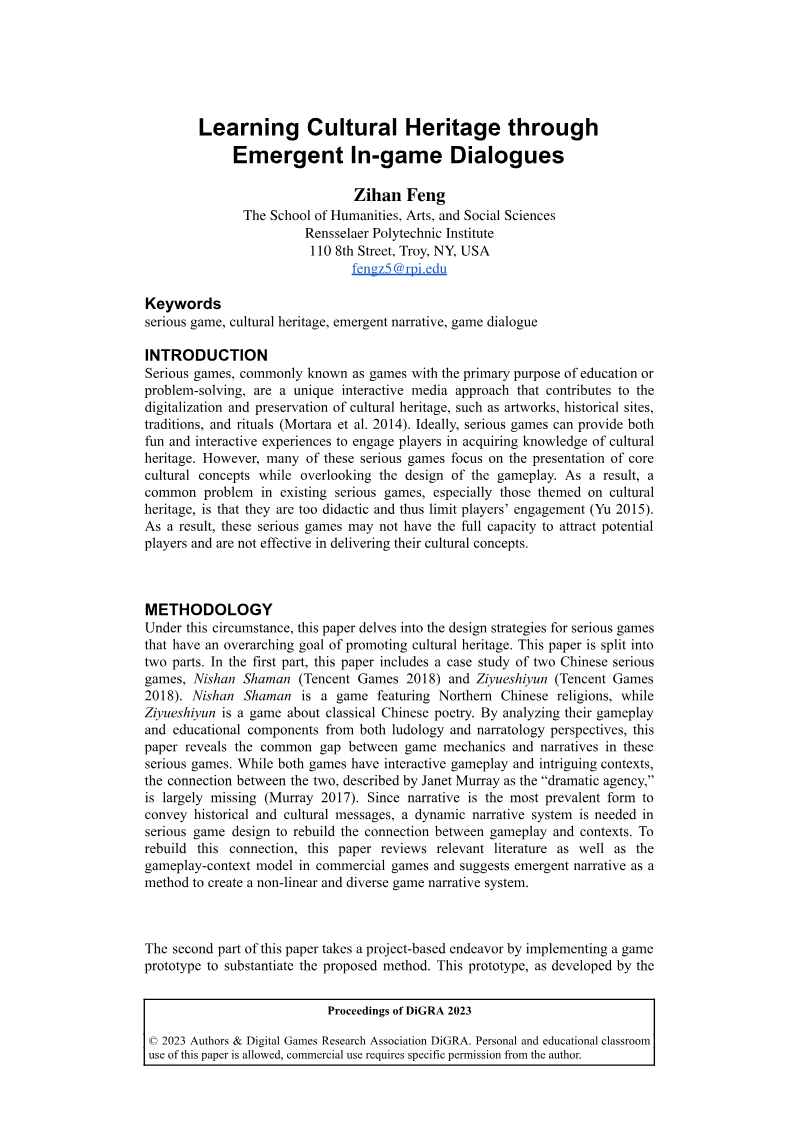
The stated objectives are to analyze how classic video game narratives contribute to constructing neomasculinist identities, through a sample of mainstream titles released between 2008 and 2016, the period spanning the 2008 financial crisis to Trump's 2016 victory. The methodology proposes building categories of archetypal neomasculinist discourse, applying them to selected games, and adding a counter-hegemonic category to capture alternative positions in the genre debate. A secondary objective examines platforms such as Twitch, where streamers are proposed as influential figures who may spread ideological messages, often neoliberal, to young audiences.
The document is a research proposal rather than a completed empirical study, so it presents no survey data or quantitative findings, and its conclusions remain hypothetical. Its scope is primarily Western societies, and its contribution lies in framing gaming culture as a site where gender politics and political radicalization intersect.
Each row is a game or company this document names, each column a document, oldest first. A mark means that document names it. Select a row to see those documents.
DiGRA · 2023
DiGRA · 2023
DiGRA · 2023
DiGRA · 2023
DiGRA · 2023
DiGRA · 2023
DiGRA · 2023
DiGRA · 2023
DiGRA · 2023
DiGRA · 2023
DiGRA · 2023
DiGRA · 2023
Extra Credits · 2024