Loading the document
1 free read left. Create a free account for unlimited reading + AI research.
Create free account
Gameloft: 20 Years of Mobile Gaming PG Connects Digital #2
Key insights
6 takeaways- 01Founded in 2000, Gameloft’s early growth was defined by the 2003–2007 period, during which the company successfully navigated the technical challenges of porting games across thousands of unique Java-enabled handsets.
- 02The mobile gaming industry has shifted from a fragmented, telecom-led distribution model in the early 2000s to a centralized ecosystem dominated by Apple and Google.
- 03Technological advancements have evolved mobile gaming from limited browser-based experiences to sophisticated 3D titles that now exceed 1GB in file size.
- 04The transition to free-to-play models has enabled global scale but significantly increased barriers to entry due to the high costs of user acquisition, platform fees, and IP royalties.
- 05The industry is currently navigating the tension between traditional free-to-play mechanics and the necessity for more sustainable, diversified business models to ensure long-term profitability.
- 06Gameloft is mitigating compressed profit margins by diversifying revenue through subscription models and cross-platform expansion, exemplified by porting mobile titles like Asphalt 9 to the Nintendo Switch.
Ask AI about this video
Transcript
we're gonna move straight on to our next speaker Alexandra from Gameloft talking about 20 years of mobile gaming as somebody who's been around that long myself I remember the earliest kind of deals that we did with Gameloft back in the day when it was Java mobile devices in fact I remember when Christian again was doing a MA when he launched we had I think we had Prince of Persia on Java at the same time as a ma did their first it's basically a Cosmopolitan magazine quiz type thing it was the first non game app we ever launched and it was funny how that was higher so the the Cosmo quiz was number one and the Prince of Persia was two as I recall but that's
a long time ago and I'm one of the spending too much time indulging myself in the past I don't know I will leave it to you over juicer travel in the past Gameloft is celebrating its 20th anniversary and we were asked by a good gamer to give some insight on those last 20 years so there's going to be a bit of a bit for gaming in the next 20 minutes I'm gonna share my presentation and I'm very happy to be there and hope this will be interesting for all of you let me share my screen there you go so far I'm CFO of gaming oft have been since
the creation of the company back in 2000 so I've been in a mobile gaming for 20 years and today the topic is 2 to 20 years of mobile gaming in 20 minutes it's not gonna be easy but we're gonna try to do this we're gonna look back at two decades in mobile games from the really very very beginning as Gameloft was one of the pioneers in this industry to the situation today and very quickly how we see the future so let's start with mobile gaming in the early 2000s the the reason why we created Gameloft back in April 2000 was that the install based of consoles seemed quite low compared to what we believed was the actual potential of mobile gaming market of gaming market as a whole back in the days in 2000 the install base total of console was a 717
million with the ps1 leading the pack with something like 70 76 million units installed based and followed by the Game Boy at 54 but we had Gameloft and that was really the reason for creating the company we believe that the videogame had a much much wider potential than just a hundred and seventy million people across the globe and what better way to reach a better audience or hire a bigger audience then then using mobile phones of course now it seems obvious but at the time it was really a crazy bet made by Gameloft because the phones were very very basics but the idea was there to say okay video game is has really a global can have a global reach and today the consoles are too expensive or at least with 170 million we're not reaching the full potential this is
really what guided the people behind Gameloft at the time in 2000 and the idea so we created this as a pure mobile gaming company we started probably to early 2000 was technology from a technical point of view technological point of view a bit early to start gaming on mobile the only games that we could do were based on the web technology so between 2000 and 2002 we created [Music] few dozens well a couple of three three dozens of games on on what and what was essentially a technology that allowed you to do browser-based gaming but a very basic experience as a browser gaming on your mobile and so clearly the company had a rough time during those two three years first three years because the markets if he wasn't there
the technology wasn't there we we kept on going though and an analyst wart or shareholders at the time who continued to believe in the company even though our revenues and we're not really flying going anywhere but we continued on and by the second half of 2002 we had very good news coming from Siemens and Nokia at the time they were the first to integrate the Java technology in their mobile phones which allowed us suddenly to get to the next level from a gaming for review on mobile phones so beginning of 2003 is really where the story begins for Gameloft as a mobile gaming company with the java technology integrated in the phones we were able to really create action games not browser-based games so games that you could download on your phone for one two three dollars between
one and three dollars depending on the countries or type of games we're selling those game through the carriers and handset manufacturers and our revenues really boomed so we went from zero revenue close to zero in 2002 to just just under a hundred million euros of revenues in 2007 so this really marks the start of Gameloft as a company and and of the industry really of the mobile gaming industry for me the real beginning is is end of 2002 being of 2003 when Siemens and Nokia starts shipping their first Java enabled phones time so Gameloft was one of the pioneers but they were others with us I remember very well Jam that being our number one competitor at the time but you had any games I owe more etc etc quite a few not
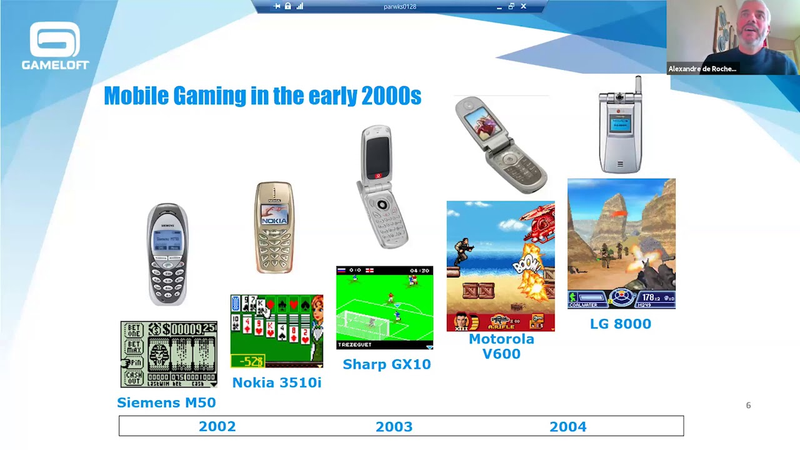
not many but quite a few few that still exists today which is shows how difficult this market is and how important has been to adapt to this ever-changing market conditions so the type of case we're doing would look like this this will bring back memories to some of you to others of you this will bring cries of horror at looking at those games but actually at the time it was pretty cool for us I mean coming from what games to DeJong against the experience seemed really incredible I I for one had a really nice experience as game experiences I recall very nice game experiences on a little carefully one ten forty five ten and on the clamshell phones so here you see a rapid evolution we went and the technology evolved very rapidly from then on we went from black and white tiny screens on the siemens and 50 then color screens were introduced if I remember well my Nokia
at least the 45 10 was very successful phones which which made color screens more popular then the clamshell phones arrived with the sharp Motorola of course Motorola became number one handset manufacturers so these guys manufacturers and telecom operators where our number one partners during those years from 2002 to 2008 Gameloft was working almost exclusively with handset manufacturers so the big guys we were talking to really the big meetings for us we're meetings with Nokia Siemens Motorola and the big meetings with the carrier side type of operators where people and rise Vodafone etc so this has changed a lot since then but these were the people that were making gaming on mobile phones
a reality and in fact I mean as you can see here on the screen the evolution of gaming was quite rapid and quite exciting for us as a company so you have a few example by 2004 we were already experimenting similarly 3d on time champ flows on the LG 8000 so the market grew quite fast because the technology was getting way better here by 2005 we had 38 million mobile players and the industry was 1.8 billion so it was quite quite significant for for us I mean keep in mind that we started from close to 0 at the end of 2002 and you can see here at the time what was the expectations from the market studies which were probably below reality after that but
really by 2005 we were becoming a real something to notice the industry the mobile gaming industry was already becoming something to notice in the video video game space as a whole even though we were representing only a small part of the of the total industry so you may ask yourself what was the market looking at from from a development and consumer perspective at the time was very very very different from what we see today Gameloft its competitors we our goal was to release as many games as possible you would play a game I mean the game had a finite gaming time you could only play the game for 2 3 4 5 hours let's say 6 hours after which you were pretty much finished with the game so of course for developers the goal was to launch as many games as possible to make sure that people the next game that
people would down would be one of your games so at the time I remember a game loft would release between 35 to 50 games free and high-quality games according to the current standards at the time 35 to 50 games per year and we grew our staff from a hundred people at the beginning of 2003 to 4,000 people at the end of 2007 so the increase in headcount was was massive and crazy but we needed all those peoples to release 50 games per year and we were always always striving to go for high quality so we needed a lot of people and we also needed a lot of hands to adapt the game to an increasing number of handsets we need to develop on the the level of fragmentation was insane and and we had to hire a lot of people especially in our studios in Asia to do QA and porting
a deployment of our games about 50 games on thousands of different handsets so that was one of the big if not the major buyers of entry in our industry is that the fragmentation was insane and you needed to develop a lot of different games the players were really discovering mobile games at the time so they were they were very open and they're still very candid in the way they were receiving the games I remember the guys at Pocket Gamer Oscar was mentioning it I mean we have very fond memories of those times where consumers were probably less cynical than they are today and and receiving all those new games with amazement each new game we presented you know replacing the previous one with new features new exciting things every every every game added something quite new because the phones were evolving quite rapidly so
very exciting times they were our marketing budget was close to zero so there was no UA there was no CPI whatsoever our sales teams goal was to be as close as possible as friends as possible with the telecom operators to convince them to push forward our games like featuring on their own platforms for our games to be put forward so we would pitch the game to the telecom operators show them how good the game was how it would change the market eccentric cetera so quite different from from today and well the games were sold for one to three dollars it was a paper download and there was no ads in the games then of course July 2008 is the turning point of the industry as you know it's the launch of the App Store in July 2008 quickly followed by Google
Play in October and quickly followed by Amazon Facebook and a lot of other digital digital's first storefronts including of course Microsoft Accenture ah so this really as you know marks a major change for the industry Apple Google took away in a sense the market from the handset manufacturers and from especially the telecom operators so a company like Gameloft was generating 90 percent of its revenues at the time through telecom operators today we generate around we still generate but it's only 15 percent of our revenues that we generate via our telecom operators and that we do this especially in developing countries like in areas so Latin America parts parts of Asia and Middle East and Africa and but
the rest is done with stores OTT stores and especially Apple and Google so this really marked a major change this is how our game started to look so if you keep in mind the games that we showed a few minutes ago you can see the step up these are a few screenshots of the first game of games on the first iPhones and votes back in 2008 2009 and so as far 5 nova modern combat zone infection and many more we're really pushing the boundaries of these phones but we were able to do games that were full 3d games on which you had PvP on which you had social interactions you have the accelerometer you had touch screens it was really a totally totally different game our Java games in terms of size
we're between towards the end we were talking of a few hundred kilobytes with the advent of the of the iPhone and Android phones we started doing games several megabytes and and today a game like a spark 9 fully fully downloaded there's probably between 1 and 2 GB byte so you can you can measure the the long path that we've gone through and of course the main difficulty here was to adapt our teams for our teams to adapt from 2d Java games of a few hundred kilobytes to full-fledged 3d PvP online games weighing one gigabyte so really our keys were incredible during those years because we adapted quite well and as you know game enough story has been
up to a couple of years ago only through organic growth so we didn't buy any Studios we just created those Studios from scratch in different locations today and have a something like 17 different Studios across the globe and which has always been the case we've always tried to have studios located across the world so yeah 2008 is really about evolving technology but also about evolving business model we went from selling games for one to two heroes to selling games for five to ten you and then in 2012 which is another big bang for industry as you know with the advance event of the free-to-play model and changing monetization so this is probably to mine my experience is that the change from the paper download model
to the free-to-play download is is as big of a change as the App Store and the smartphones were for industry because the promise we made to ourselves back in 2000 was only fully fully realized with the advent of a free-to-play because with the advent of free-to-play suddenly we accessed global audiences of hundreds of millions of people so with the advent of free-to-play the fact that the games were distributed freely it changed everything in the market it changed the way we were creating the games the way we were thinking and monetization of the games but it changed the demographics of the industry changing taste I changed the development standards and of course at the end of the day it changed the market size so we have games now that have been downloaded almost 1
billion 1 billion times sorry minion rush by Gameloft is about who has reached a billion players across the globe today 2019 we can also see how far we've got mobile gaming is 68 billion dollar industry it's been driving the growth of the video game market for the last few years we have estimated 2.5 billion video game players across the world most of which played on mobile phones so the promise we made ourselves 20 years ago is fulfilled and today mobile is the number one segment in the video game space and one of the fastest-growing segments within this space from a geographical point of view its Asia which in the past few years has been driving the growth of the mobile gaming market of course the numbers here
and I show show exactly the country but 2019 was quite a special year for Asia but overall if you look back at the last four five years clearly Asia Pacific have been fueling most of the growth a lot of the growth of the video game market and a lot of the growth of the number one region in the world by far seventy two billion versus forty four US cetera now if we if we look at Gameloft and the industry in the future we clearly figure came of that mobile gaming is today at a crossroad we can see very different trends and contradicting trends emerging of course
there's the free-to-play model which is the dominant model today which appeared in 2011 which has allowed I was saying the audience to just multiply exponentially in the last cup of in the last few years this free-to-play model is still the dominant model is based on in-app purchases and ads it has high barriers to entry in the sense that you need significant you a budgets and the metagame complexity makes it difficult for newcomers to penetrate them to be successful in this market we have become extremely complex organizations compared Gameloft in 2020 compared to Gameloft in 2005 is a very very different beast we have like all players we in the industry but we have people specialized in user quizzes that our scientists psychologists etc
etc which of course we live our life words it's simpler back in the days back in 2005 but of course and the market is way way bigger and the the the challenge is is is way way way more significant and today yeah and free-to-play monetization and user acquisitions are our key then in the past two years we've seen the hyper casual so let me take over a significant portion of the of the market there was a study by might our sensor showing that eight percent eighty percent of last year's download were related to hyper casual games so it is really taking the market by storm it's allowed new players to enter the market and to be very successful and it is a very different market and a way of
thinking mobile gaming that free-to-play we've known so far so these are 100% ad based games for for most of them the barriers of entry are to entry are lower you have tens of thousands of games available they're developed in a few weeks and there's a lot of trying and fail trial and error in the way they develop those those games user acquisition is of course key and and the ability to buy with those users with extremely low CP is is also key and then you have a another trend which has been extremely successful for the movie industry and for the music industry and which so far has not taken fully in in our market which is the subscription business model with with apple arcade
are leading the back for the moment of course with Microsoft on course over on mobile Apple is really leading the pack in terms of trying and develop a new business model buy a subscription no ads knowing that purchases Apple contributes and development cost of the developers today there were a hundred games at launch I think they're getting closer to 200 today content is highly curated and potentially it is little or no acquisition at least today on those on those models so this conflict between those free models I don't know which one will prevail I wish I could tell for sure but clearly these free are competing head-to-head against each other we strongly believe a game left in the subscription model going forward given and that's why we've been partnered with Apple since the first day on the Apple arcade we're we're we're looking at
other business models other ways to push forward subscription within our games without the help of Apple or Google it's clearly worked extremely well for the music industry and this there's something to to look into why am I saying this is that going back to the last point I probably won't have time to go on what's next from the technological point of view on 5g and gaming etcetera but if we if we spend just the last few minutes on the business model I think today we have a broken business model in the industry and I'm quite personally concerned about this we know we give as companies we have a payback of a 30% to Apple Google and the platforms and these
40 percent are initially meant to account for the downloads that those plan are bringing to the games that are featured or just included in in the stores on top of that many games a royalties to IP owners because you use third-party IPS for for your games and this model worked quite well until recently when as I was saying in the free-to-play model user acquisition has become absolutely essential and a key part of the success of a game which means that the business model is becoming quite broken because on top of the 30% you pay to Apple and Google which was meant to pay for the hosting of the game the billing of the game and of course the fact that these forms were
bringing you a lot of users you were able not to pay anything else in terms of marketing Gameloft has spent less than 5% of its revenues in marketing for many years until now with the latest change in the event of free-to-play we've had like our competitors and the whole market we spend an increasing part of our revenues in user acquisition on top of the 30 percent so the 40 percent revenue sharing that we gave to the OTT platforms has not moved but on top of that we've added 30 percent of gross revenues for most companies in the space they spend 20 30 percent of their revenues buying users buying downloads on top of the 30 percent fee they're already pay so in total when you receive when when users pay $100 spend $100 on a
game at the end of the day taking into account the OTT revolutionary 30 percent taking into account royalties that you may have to pay on on an IP 4 party APM let's say 20% of taking 30% of gross revenues paid and spending you a you've got you've got 26 dollars left the company left to pay for your production and all of your SG&A and so the companies which have benefited and most benefited from mobile gaming from my point of view in the last few years have been a Facebook Google and some of the companies which take a lot of money from from the UA spending so that's a real concern at Gameloft we that's why we're looking really into a subscription model we're also looking at diversifying our revenues we've we've
launched a spark 9 on console recently it's been a huge success on the switch still is actually making more money today than it was three months ago or six months ago or nine months ago so we'll take a lot of our games in the future to the console and we've always strived to be at a you know forefront of technology on the phones and we think we can bring this experience on free-to-play to come swamp thank you very much thank you that's awesome I think that thing you were saying about have you always been trying to produce the best quality content on the best platforms and we've had a few kind of like you know full starts along the way I remember the n-gage or amber you know things like that but I think what you've always tried to do is bring this superb quality to games and now unfortunately I've got much time I am I mean the one thing I would just say is I can you imagine you know 20 years ago when we were talking about you know mobile games that we
would ever see a point where mobile games was the biggest sector in the games industry I I just I have to pinch myself you know it's I want to wear the t-shirt saying we told you so but obviously the pain and stress that's gone to through that and I'd loved just one like one question I think we've got time for ease and is if there was one game you would be most proud of that game not for produce which game would it be I think I have two games in my behalf to even once I would say it's I would say it's minion rush created back in in in 2014 June 2014 because it's the faithful six most downloaded game in the history of video games for a small company like Gameloft to be there in the top 10 most downloaded this is I mean going back to when the company was created a few a few
people in Paris and that just seems incredible yeah Lucia is just commented in the Q&A section with us rocks which is got writing Oh No thank you so much for taking the time out and definitely taking me on a journey back in in my past and it's been an amazing journey for you guys thanks very much you
Summary
Founded in 2000, Gameloft emerged with the conviction that mobile devices possessed the potential to surpass the reach of traditional console gaming. The company’s early trajectory was defined by the transition from limited browser-based technology to the widespread adoption of Java-enabled handsets between 2003 and 2007. During this formative era, the industry operated under a fragmented landscape where success depended on porting titles across thousands of unique devices and utilizing a pay-per-download model facilitated by telecom partnerships.
The industry has since undergone a fundamental transformation, shifting from telecom-led distribution to the centralized ecosystems of Apple and Google. This evolution brought a transition from simple 2D experiences to sophisticated 3D titles exceeding 1GB in size. While the move to free-to-play models enabled unprecedented global scale, it simultaneously raised barriers to entry by necessitating heavy investment in user acquisition. Current market conditions, characterized by high platform fees, IP royalties, and escalating marketing costs, have created a challenging environment with compressed margins for developers.
In response to these financial pressures, the company is actively diversifying its revenue streams by exploring subscription models and cross-platform expansion. The success of titles like Asphalt 9 on the Nintendo Switch and the enduring popularity of Minion Rush demonstrate the viability of porting mobile-first experiences to console hardware. Ultimately, mobile gaming has solidified its position as the largest sector within the global market, and the industry is now focused on navigating the tension between established free-to-play mechanics and the need for more sustainable, diversified business models to ensure long-term profitability.




















Comments