Updated Jun 10, 2026 by Sega Sammy Holdings
Financial
Published by Sega Sammy Holdings
Sega Sammy’s fiscal year ending March 31, 2026 delivered a mixed financial picture. Net sales rose 13.7 % to ¥487,542 million, driven largely by third‑party and U.S. film production income, yet operating income slipped 2.1 % to ¥47,128 million and the group recorded a net loss of ¥5.756 billion attributable to owners of parent. Adjusted EBITDA collapsed 73.3 % to ¥16,656 million, largely due to goodwill and intangible asset impairments from the acquisitions of Rovio, Stakelogic and GAN. Despite these losses, shareholder returns remained robust with ¥55 per share in dividends and a ¥20 billion share buy‑back, totaling approximately ¥31.4 billion in returns. The Gaming segment experienced a sharp rebound in sales, with net sales up 35.9 % to ¥132.2 billion, largely from a 36 % increase in Pachislot & Pachinko and a 364 % surge in third‑party gaming sales. Ordinary income climbed 58.8 % to ¥33.3 billion, and adjusted EBITDA grew 38.8 % to ¥33.7 billion; however, the segment posted a substantial operating loss of ¥19.4 billion. Total assets fell by ¥17.4 billion, liabilities rose by ¥9.2 billion, and net assets declined by ¥26.6 billion, with cash and equivalents dropping to ¥154 million. Capital efficiency measures included a ¥20 billion treasury stock cancellation and significant goodwill write‑downs—¥31.99 billion on Rovio goodwill and ¥18.05 billion on Stakelogic assets—resulting in a total goodwill write‑down of ¥28.71 billion. Net assets per share fell from ¥1,782.73 to ¥1,750.15, and basic earnings per share swung from a profit of ¥209.79 to a loss of ¥27.36, with no diluted EPS reported due to the net loss. Looking ahead, management projects a 4.6 % revenue increase for FY 2027 but anticipates a 5.6 % decline in operating income, while maintaining its dividend policy. The company’s financial trajectory reflects a transition from growth‑driven sales expansion to a focus on restructuring and capital efficiency amid significant impairment losses.
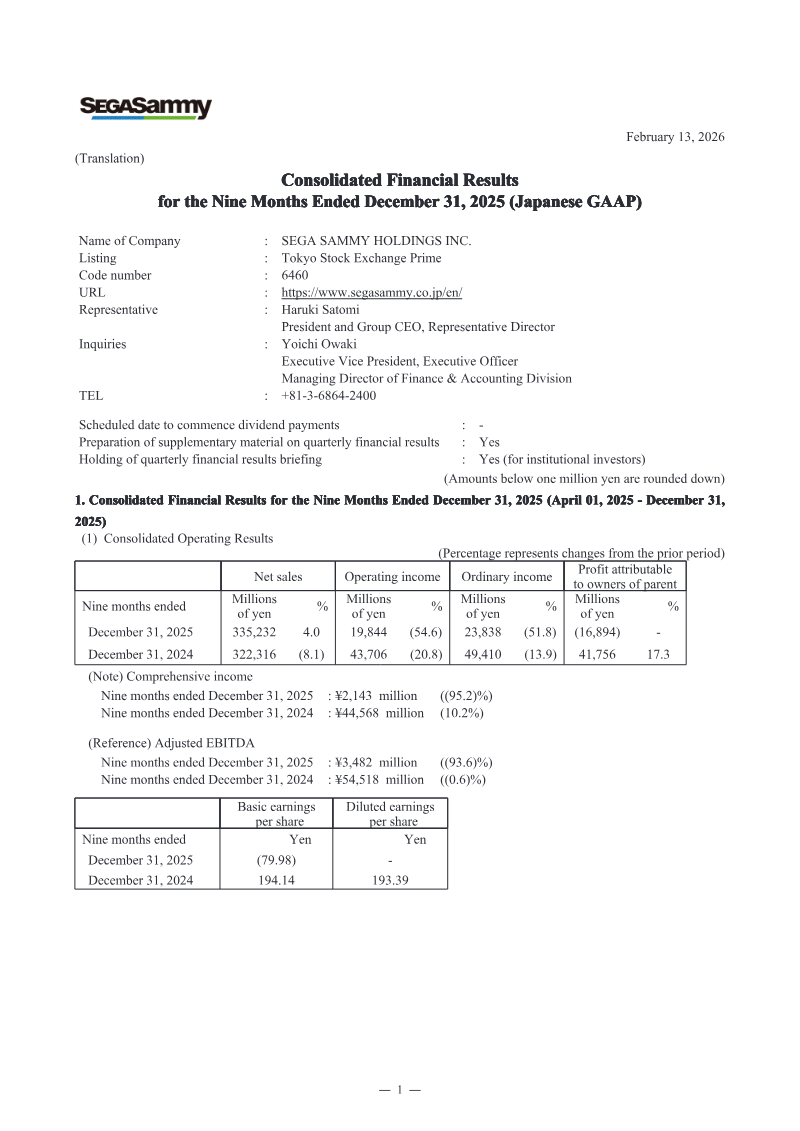
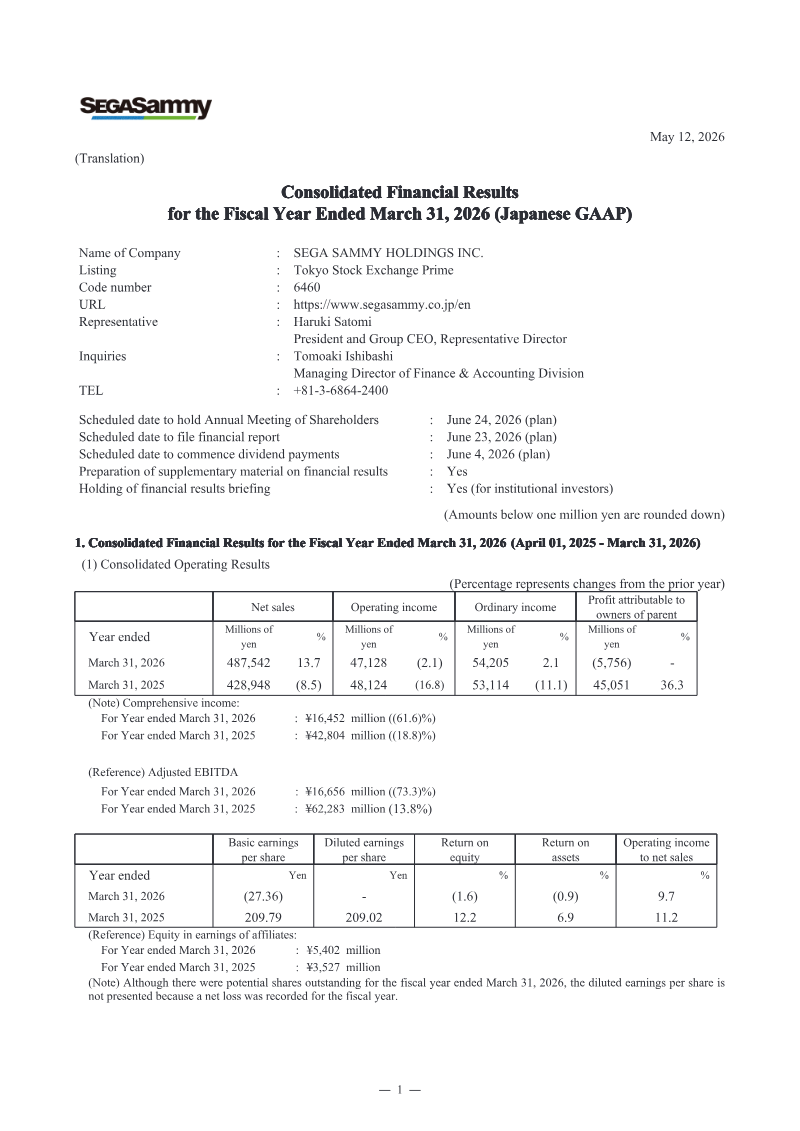
SEGASammy May 12, 2026 (Translation) Consolidated Financial Results for the Fiscal Year Ended March 31, 2026 (Japanese GAAP) Name of Company : SEGA SAMMY HOLDINGS INC. Listing : Tokyo Stock Exchange Prime Code number : 6460 URL : https://www.segasammy.co.jp/en Representative : Haruki Satomi President and Group CEO, Representative Director Inquiries : Tomoaki Ishibashi Managing Director of Finance & Accounting Division TEL : +81-3-6864-2400 Scheduled date to hold Annual Meeting of Shareholders : June 24, 2026 (plan) Scheduled date to file financial report : June 23, 2026 (plan) Scheduled date to commence dividend payments : June 4, 2026 (plan) Preparation of supplementary material on financial results : Yes Holding of financial results briefing : Yes (for institutional investors) (Amounts below one million yen are rounded down) 1. Consolidated Financial Results for the Fiscal Year Ended March 31, 2026 (April 01, 2025 - March 31, 2026) (1) Consolidated Operating Results (Percentage represents changes from the prior year) Net sales Operating income Ordinary income Profit attributable to owners of parent Year ended Millions of % Millions of % Millions of % Millions of % yen yen yen yen March 31, 2026 487,542 13.7 47,128 (2.1) 54,205 2.1 (5,756) - March 31, 2025 428,948 (8.5) 48,124 (16.8) 53,114 (11.1) 45,051 36.3 (Note) Comprehensive income: For Year ended March 31, 2026 : ¥16,452 million ((61.6)%) For Year ended March 31, 2025 : ¥42,804 million ((18.8)%) (Reference) Adjusted EBITDA For Year ended March 31, 2026 : ¥16,656 million ((73.3)%) For Year ended March 31, 2025 : ¥62,283 million (13.8%)
5,051 36.3 (Note) Comprehensive income: For Year ended March 31, 2026 : ¥16,452 million ((61.6)%) For Year ended March 31, 2025 : ¥42,804 million ((18.8)%) (Reference) Adjusted EBITDA For Year ended March 31, 2026 : ¥16,656 million ((73.3)%) For Year ended March 31, 2025 : ¥62,283 million (13.8%) Basic earnings Diluted earnings Return on Return on Operating income per share per share equity assets to net sales Year ended Yen Yen % % % March 31, 2026 (27.36) - (1.6) (0.9) 9.7 March 31, 2025 209.79 209.02 12.2 6.9 11.2 (Reference) Equity in earnings of affiliates: For Year ended March 31, 2026 : ¥5,402 million For Year ended March 31, 2025 : ¥3,527 million (Note) Although there were potential shares outstanding for the fiscal year ended March 31, 2026, the diluted earnings per share is not presented because a net loss was recorded for the fiscal year.
(2) Consolidated Financial Position Total assets Net assets Equity ratio Net assets per share As of Millions of yen Millions of yen % Yen March 31, 2026 627,388 354,967 56.5 1,750.15 March 31, 2025 644,777 381,604 59.1 1,782.73 (Reference) Shareholders’ i equ ty: March 31, 2026 : ¥354,693 million March 31, 2025 : ¥381,165 million (3) Consolidated Cash Flows Cash flows from Cash flows from Cash flows from Cash and cash operating activities investing activities financing activities equivalents at the year-end Year ended Millions of yen Millions of yen Millions of yen Millions of yen March 31, 2026 25,940 (22,514) (56,623) 153,776 March 31, 2025 20,856 (12,543) (27,981) 198,865 2. Cash Dividends Cash dividends per share Total Dividends First Second Third Year- Full- dividends Payout ratio paid to quarter quarter quarter end year ( paid l) (Consolidated) ( net assets annua Consolidated) Yen Yen Yen Yen Yen Millions of yen % % Year ended - 25.00 - 27.00 52.00 11,208 24.8 3.0 March 31, 2025 Year ended - 27.00 - 28.00 55.00 11,460 - 3.1 March 31, 2026 Year ending - 27.00 - 28.00 55.00 34.6 March 31, 2027 (plan) (Notes)1. Total dividends paid include dividends paid to the trusts to the "BIP trust" and the "Stock-granting ESOP trust" (¥103 million for the fiscal year ended March 31, 2025, ¥108 million for the fiscal year ended March 31, 2026). Payout ratio has been calculated by dividing the total dividends paid by profit attributable to owners of parent. 2. The consolidated payout ratio for the fiscal year ended March 31, 2026 is not presented because a basic loss per share was recorded.
llion for the fiscal year ended March 31, 2026). Payout ratio has been calculated by dividing the total dividends paid by profit attributable to owners of parent. 2. The consolidated payout ratio for the fiscal year ended March 31, 2026 is not presented because a basic loss per share was recorded. 3. Forecast of Consolidated Financial Results for the Fiscal Year ending March 31, 2027 (Percentage represents changes from the prior year) l i i di i Profit attributable to Basic Net sa es Operat ng ncome Or nary ncome owners of parent earnings per share Millions of % Millions of % Millions of % Millions of % Yen yen yen yen yen Full-year 510,000 4.6 44,500 (5.6) 47,500 (12.4) 32,500 - 160.36
4. Other (1) Changes in significant subsidiaries during the period: Yes New : 37 Company name : Stakelogic B.V. and its 12 other subsidiaries, GAN Limited and its 23 other subsidiaries Exclusion : - Company name :- (2) Changes in accounting policies, changes in accounting estimates, and restatements 1. Changes in accounting policies due to revisions to accounting standards and other regulations: No 2. Changes in accounting policies due to other reasons: No 3. Changes in accounting estimates: No 4. Restatements: No (3) Number of issued shares (common stock) 1. Number of issued shares at the end of the period (including treasury stock) March 31, 2026 : 221,229,476 March 31, 2025 : 241,229,476 2. Number of treasury stock at the end of the period March 31, 2026 : 18,564,547 March 31, 2025 : 27,418,879 3. Average number of shares during the period For Year ended March 31, 2026 : 210,423,003 For Year ended March 31, 2025 : 214,750,376 (Note) The Company has introduced the "BIP Trust" for directors and the "Stock-granting ESOP Trust" for employees, and the Company's shares held by these trusts are included in the number of treasury stock at the end of the period above. These shares are also included in the number of treasury stock which is subject to be excluded for calculation by the average number of shares during the period above.
loyees, and the Company's shares held by these trusts are included in the number of treasury stock at the end of the period above. These shares are also included in the number of treasury stock which is subject to be excluded for calculation by the average number of shares during the period above. (Note) - This document has been translated from the Japanese original for reference purposes only. In the event of any discrepancy between this translated document and the Japanese original, the original shall prevail. - This report is not required the auditing procedures by certified public accountants or accounting auditors. - The forward-looking statements, such as results forecasts, included in this document are based on information available to SEGA SAMMY HOLDINGS INC. (the Company) at the time of the announcement and assumptions considered reasonable, and actual results could differ materially, depending on a range of factors. For the assumptions prerequisite to the results forecasts and the points to be noted in the use of the forecasts, please see "Outlook for the fiscal year ending March 31, 2027" on page 9. - The Company plans to hold a briefing on financial results for institutional investors on May 12, 2026. The presentation materials to be used on the day will be posted on TDnet and the Company's website in advance, and the details of the briefing and the content of the explanation (video and audio) will also be posted on the Company’ b i s we s te.
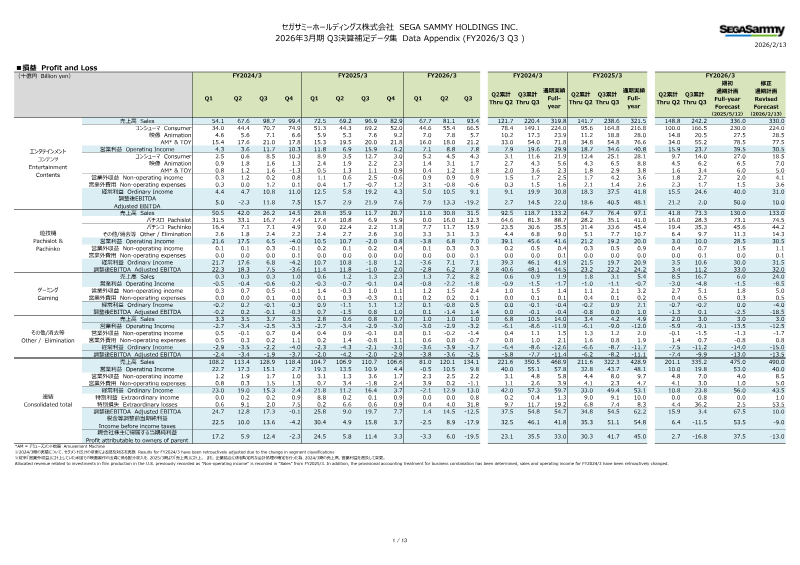
Fiscal year 2026 ended with a 13 % rise in sales to ¥487.5 bn, yet operating income swung from a ¥48.1 bn profit in FY2025 to a ¥5.7 bn loss, driven by significant goodwill impairments on Rovio and Stakelogic and a widening deficit in the Gaming segment. Adjusted EBITDA fell to ¥16.6 bn, reflecting heavy upfront development costs and impairment charges, while net equity contracted by ¥48.7 bn as cash balances were depleted following the acquisitions of GAN and Stakelogic. Within Entertainment Contents, sales edged up to ¥326.6 bn from ¥321.5 bn, but operating income declined from ¥40.8 bn to ¥32.4 bn because new Full‑Game and F2P titles underperformed, despite steady growth in licensing revenue. Forecasts for FY2027 project sales of ¥357 bn and operating income of ¥42.5 bn, contingent on successful new IP launches, repeat sales, and a planned lift in licensing income. Margin erosion from title underperformance remains a key risk. Capital allocation for FY2026/3 was restructured to focus on ¥190 bn of cumulative investment over FY2025–FY2027, allocating ¥80 bn to development, ¥120 bn to strategic acquisitions, and planning ¥70 bn in share buybacks while pausing large‑scale M&A. Shareholder returns are expected to rise sharply, with FY2026/3 projected at ¥31.5 bn (≈¥11.7 bn in dividends) and FY2027/3 potentially reaching ¥16.2 bn under a 50 % total‑return ratio applied to projected net income. Pachislot sales showed modest growth, buoyed by new titles and strong first‑week performance of flagship IPs such as “Hokuto No Ken” and “Kabaneri of the Iron Fortress.” Pachinko sales declined as the temporary lift from Lucky Trigger 3.0 Plus faded and hall utilization softened. The group plans to introduce reel‑exchangeable cabinets, expected to account for roughly 20 % of pachislot revenue, and is positioning the gaming business for a J‑curve bottom in FY2027 through intensive lease sales and B2B platform upgrades. The release schedule for FY2026/3 emphasizes a concentrated push of multi‑platform titles, including the Nintendo Switch 2 launch in March 2026 and a slate of global releases across consoles, PC, and mobile from late 2025 to mid‑2026. Key animation properties such as *Detective Conan* and *Lupin the Third* are slated for April–June 2025, with several new IPs and Netflix exclusives planned for early 2026. Pachislot and pachinko product launches are detailed with projected unit sales ranging from 8,000 to 49,000 units across varying gambling‑specification tiers.
Sony Group’s FY2025 consolidated results demonstrate modest revenue growth and a mixed profitability profile across its core business units. Total sales increased 4 % to ¥12.48 trn, largely driven by higher operating income in the Imaging & Sensing Solutions (I&SS) and Music segments. Operating income rose 13 % to ¥1.45 trn, while net income attributable to shareholders fell 3 % to ¥1.03 trn because of a larger equity‑method loss in the Financial Services arm and higher impairment charges. Operating cash flow remained flat at ¥1.97 trn, and the spin‑off of Sony Financial Group was treated as a discontinued operation from Q1 FY25 onward. Within the Music division, sales climbed 15 % to ¥277.5 billion, propelled by growth in Recorded Music and Music Publishing streaming revenues (+9 % and +14 % respectively), live‑event income, and a strong contribution from the Demon Slayer franchise. Operating income in this segment surged 25 % to ¥89.7 billion, reaching a record high even after excluding one‑time items. Sony projects flat sales for FY2026, with operating income expected to decline 11 % to ¥47 billion as streaming gains are offset by the loss of Demon Slayer’s impact. The company consolidates its Pictures and Music results on a U.S. dollar basis, translating foreign‑currency sales and costs using weighted average exchange rates while accounting for hedging transactions. Foreign‑exchange fluctuations affect both sales and operating income, with I&SS hedging gains or losses incorporated into these calculations. These disclosures supplement, but do not replace, Sony’s IFRS‑compliant consolidated financial statements.
Bandai Namco Group reported record‑high net sales of ¥1,002.2 billion for the first nine months of FY2026, up 4.9 % from ¥955.6 billion in the same period of FY2025, driven primarily by robust performance in the Toys and Hobby segment. That segment achieved ¥503.6 billion in sales, a 9.5 % increase, and contributed ¥103.5 billion in profit, up 6.0 %. Digital sales rose modestly to ¥358.8 billion, while Visual and Music and Amusement segments saw slight declines in profitability due to shifts in title mix and product launches. Operating profit fell 12.2 % to ¥157.3 billion, largely attributed to a less favorable home‑console game lineup compared with the prior year. Full‑year forecasts were revised upward: net sales are now projected at ¥1,300.0 billion (a 4.0 % increase over the previous forecast), operating profit at ¥181.0 billion (up 9.7 %), and ordinary profit at ¥190.0 billion (up 10.5 %). The company maintains a shareholder‑return policy targeting a total return ratio of at least 50 %, with FY2026 dividends set at ¥73 billion (base ¥46 billion plus performance‑based ¥27 billion) and a treasury‑share purchase program of up to 6 million shares, worth up to ¥30 billion. Geographically the results reflect strong North American sales responsiveness and global licensing from flagship IPs such as Gundam, Dragon Ball, and One Piece. Methodologically, the figures derive from consolidated financial statements covering all operating segments, with segment‑level data presented for Toys and Hobby, Digital, Visual and Music, Amusement, Other, and Elimination/Corporate units. The presentation also outlines strategic initiatives for FY2027, emphasizing balanced title portfolios in Digital and continued expansion of experiential amusement facilities.
Square Enix’s recent performance review exposes a persistent decline in revenue growth and profitability over the past three years, with operating income falling 32 % and ROE dropping 61 %. The downturn is driven primarily by weak margins in both high‑definition (HD) and small‑dungeon (SD) game segments, excessive portfolio fragmentation, sub‑optimal product design and promotion, and escalating development costs. While the MMO licensing arm remains the sole growth driver (+11 %), overall gaming revenue has slipped, with HD and SD titles declining 4 % and 5 % respectively. Operating margins for these segments hover around 35–40 %, noticeably higher than the industry average of 28 % but still lagging behind competitors, indicating inefficiencies that are not being adequately addressed. The company’s medium‑term “Reboots” plan offers only high‑level directions without concrete key performance indicators or quantitative targets. Critical gaps include a lack of clear business‑portfolio strategy, insufficient disclosure on non‑core business rationales, and no defined mechanisms for monitoring progress or maximizing shareholder value. Capital allocation disclosures are similarly weak: cost‑of‑capital calculations, ROE and ROIC targets, and hurdle rates are absent, while share‑buyback authorization remains unused despite a sharp price decline. SG&A costs exceed peer norms by 5–6 ppt, driven largely by an oversized sales force, further eroding profit margins. Geographically, SD game revenue is almost entirely domestic; the Japanese market has contracted 2 % annually since 2020, and overseas growth remains only 3 %. The company’s global SD strategy is inert, with a 7 % overseas expansion rate falling short of projected growth and flagship titles such as *FFVII Ever Crisis* deriving 70 % of revenue from Japan. Non‑core Amusement and Publishing businesses are undervalued, with a significant conglomerate discount relative to peers and declining sales and margins. Limited cross‑synergy between game and publishing arms further hampers value creation. In summary, Square Enix faces a multifaceted challenge: declining core game performance, weak strategic direction and KPI setting, high SG&A costs, and an underperforming non‑core portfolio. Addressing these issues through tighter cost control, clearer performance metrics, aggressive overseas expansion, and potential portfolio optimization is essential to restore corporate value and achieve sustainable growth.