1 free read left. Create a free account for unlimited reading + AI research.
Create free account
From Head Ball 1 to Head Ball 2: How it Became a Multi-million Dollar Game PG Connects Digital #2
Key insights
6 takeaways- 01The transition from a direct-purchase model to a Gacha-based system in Head Ball 2 drove a fivefold increase in lifetime value (LTV) and a 45% improvement in the DAU/MAU ratio.
- 02The shift to a more complex core loop and character upgrade depth was specifically designed to overcome stagnant LTV and facilitate growth in competitive tier-one markets.
- 03Implementing an in-house LiveOps infrastructure allows for real-time adjustments to matchmaking, progression, and pricing without requiring client-side updates.
- 04Maintaining long-term sustainability requires a dedicated product team focused on continuous, data-informed optimization of the game economy.
- 05Advanced player segmentation and personalized event scheduling were critical to scaling the game through aggressive paid user acquisition.
- 06Developers should utilize simulators to stress-test game economies and calibrate the balance between currency sinks and sources prior to launch.
Ask AI about this video
Transcript
I can see surtax here so welcome welcome to the show hey stuffy okay how are you I'm good thanks how are you I'm good and well good in here the summer is here we're trying to enjoy the most of it but we'll see yeah so where whereabouts are you at the moment I'm in Turkey right now is any cold isn't it is a very sunny place but we're not able to enjoy them more so to summer right now but hopefully things will get better yeah I'm sure the weather's glorious it must be ashamed to be stuck inside thank you so much for being with us in what must be your or is it late afternoon there is
late afternoon yeah yes Oh No thank you for joining us and there hopefully you're ready and yeah we're looking forward to the talk and learning more about you know how you grew your brand and your your game basically all right thank you very much and and yes everyone else pop those questions in and I'll see you at the end of your talk for some Q&A sure absolutely okay so let me just share my screen before I start my presentation so I'm hoping that everyone can see my screen so today I'm gonna be talking about how head bolts who became a multi-million dollar game on a monthly basis so before I get into the details I want to walk you through about the content of my presentation so I'll just briefly talk about Who am I who is my somo and then give some details about the game concept head ball and then since we released head ball one I'll be sharing some high-level members of Rakesh sheets with it and then what we failed that and based on those learnings why we wanted
to issue with head ball - and then how did we issue our goals so at the end of the presentation we have time for questions so as a so I started actually in free-to-play mobile games business in 2011 at EA as a product manager and then moved on to Zynga as a leaf product manager and then wrote the perfect road as director of product responsible mainly responsible from the global expansion of the company and then later I read that tilting point is aim director and now currently I am working with Massimo as VP of product and then when it comes to Massimo we are founded in 2015 we are based in Izmir Turkey and then we have around like 80 employees it's a pretty young studio actually our average employee age is around like 29 years old we were acquired by miniclip in March 2019 we do all development and production in-house and finally we are a
profitable company for now and then I'll give you some information about the game concept of head bald so headphone is basically a PvP focused real-time multiplayer casual football it is available on iOS and remit and it is using critically as the business model so while you are playing the game you need to do three things to increase your win ratio or be successful in the game first of all you should be definitely playing the game and improve your skills because it's at the end of the day it's a skill based game and number 2 you should be collecting like better characters throughout the game each and every character has their own attributes and look and finally during the matches you can use superpowers to take advantage against your opponent we have superpowers like giant character for example while you were playing the game you can use that superpower and your character becomes huge so it is easier for you to score goals against your
opponent or you can use fries superpowers so in the middle of the match you can freeze your opponent and then you can easily score goals so every match is 90 seconds and whoever scores they're not most number of goals wins the match so this basically very high level view of head ball as a game concept and when we released head ball 1 in 2015 we have got a total of 40 million players in its lifecycle and 70% of these installs were organic and it was we were very lucky that actually the growth was mainly thanks to our organic installs and then we have we had an average of around 1 million daily active users and then we have 55% Dave on retention and 20% day 7 retention which is actually quite okay when you look at the industry standards so so far we were actually having some good numbers but when it comes to our LTV we had super low LTV so it was super low that we were
not able to grow the game through a pay do a especially in like tier 1 countries so with head ball 2 what we wanted to achieve was actually we want to still continue our organic growth still maintain seven-digit more than a million daily active user base and keep on having the same retention numbers if not better and most importantly at the end of the day we wanted to increase our LTV so while we were thinking about all these things actually the competition and the market was growing super fast so based on the app any data there are like millions of games released on Google Play and Appstore but only around like 2000 of them were generating around 5 million u.s. dollars of annual revenue so for us to be part of one of those companies we had to increase our LTV so that we can be in the league of game companies or making more than 5 million
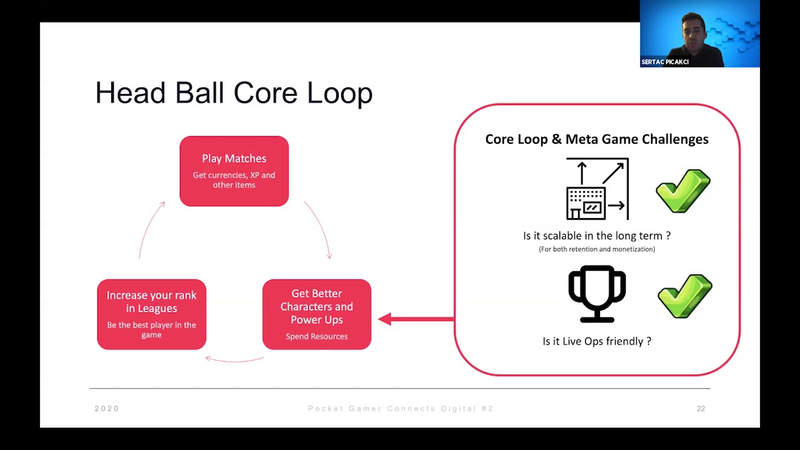
on an annual base so to increase LTV you can actually think of a lot of different stuff but when it comes to our case we wanted to list actually only the three major things that had a higher LTV impact so the first one is if you want to have a higher LTV your you need to have actually a monetization on LiveOps friendly core loop and meta game and the second component is having a flexible live of system and the third component is processing of big data so let's just start with the first item monetization and LiveOps friendly core loop and meddigan so then you look at head ball core loop it is pretty basic one actually you play matches and get some resources you spent those resources to get better characters and power-ups and then you spent those to increase in the leaks and then be the best squaring me so we did not really want to change the core loop from head ball 1 to
head ball 2 because it was working fine but we wanted to challenge the core loop and our meta game in two ways the first one is if we can actually achieve a scaleable core loop and metagame in the long term for both better late-game retention and monetization that was the first area that we were challenged of challenging our core loop and meta game and the second thing was if our core loop and meta game is live ups friendly or not so to achieve those two areas actually we had to make some significant changes in the game so regarding the part where if it is a scaleable core loop or meta game part we did some significant changes in the game when it comes to head ball - so the first biggest change that we have done was getting the characters so in head ball one if you want to get the characters it was pretty straight forward actually if you go to the market in the game and
then all characters have a price tag and then you spent that Korean sir to get those characters so when you look at the advantages of this kind of model is that it's very easy for players to understand and could be a good reason why the retention is so good but when it comes to downsides it was lacking the monetization in that and then it was super vulnerable against the economy inflation especially in the lake so we were seeing that actually no matter what we do we were not able to actually price the things in a balanced way because at the end of the game lifecycle players were getting collecting a lot of coins and the moment they were more like to spend more money into our game because they ever engaged players they were not spending anything because they were able to get those characters very cheap actually so getting those characters in head ball one had its own problems when it comes to head ball two we changed actually the way players are able to get
those characters so first of all we remove the price egg and then players actually have to collect the cards to unlock those care and to collect those cards you need to open card packages so basically we had introduced Gacha mechanic into our game when you look at the advantages of this kind of mechanic it definitely has like higher monetization potential at a very high level but on the downside it could be potentially harder for our target audience to understand how we can get those cards in etc and therefore it could be definitely a retention killer so but no matter what we made that change and then we took those risks so after you acquire those characters you unlock those characters in head ball one you are not able to upgrade them which results in you spend some money to those characters and that's it you don't have to make any additional investment
through the existing character that you have but in head ball two we have introduced character depth and we have introduced the upgrade system into the game so each upgrade giving players and characters meaningful benefits so when you upgrade the characters your attributes actually increase characters become better and then you also unlock additional skill slots which you can actually embed additional skill cards to make your characters look even better in terms of the attributes and additional benefits and finally when you max out your characters when you upgrade them to the latest level you were able to unlock new skins to have a unique look and feel so after they make all these changes like how you acquire the characters and increase the depth of the characters we are thinking that we are able to achieve
a scaleable core loot and meta gain but what about the LiveOps friends so after we introduce the gotcha mechanic in the game we actually make the life of player life of the players quite hard because Gacha mechanic is sometimes an annoying mechanic it requires more time and money investment when compared to the mechanic that we were using on high ball one so we make players life is difficult more difficult but thanks that we have live ups to make their lives easier so when you participate in the limited time events we were given away the things that the players were needing such as character card packages or the characters directly itself so it was adding the it was creating an additional value to live ups limited time events because it was making the players lives much more easy and on top of that we
were offering personalized bundles in the game so that whenever you want to have a specific character in the game you can actually benefit from those bundles and then make your life easier so more so short we wanted to create an illusion where if you don't participate in those LiveOps events things would be really hard for you but we were all the time introducing shortcuts and beginning through our live ups so that a life can actually become easy so that is why live oaks is a fundamental part of our core elite currently in head bolton you don't have to engage with it but if you engage you are going to get the benefit orbit pretty significantly so that was the first part having a core loop and meta game that is monetization and libels friendly the second component is having a flexible live of system so when we say
my box I define my box as the art of keeping the game fresh for all segments of players in a personalized way so I actually highlighted in bold letters three words in this one on purpose because those three words actually define the evolution of live ops in free-to-play game back in the days in years live ops main purpose was to keep the game fresh and that was it but after some time we all realized that actually keep we should be able to keep the game fresh in a different way the difference for different types of segments of players but those differentiation by segments is not enough right now in the future so we have to actually take this game beyond that and that is why we have started using personalization on top of segmentation in our lives and I will explain later on what that means so if
you look at our rivals infrastructure we use live ups for mainly three things game config updates in the middle time in game events management and sales bundles store merchandising and on top of art we build our infrastructure on top of a pretty advanced segmentation and personalization system and our whole system is in-house field so regarding the first part game context updates so to define the scope of game config updates through live ox we need to define the core pillars of our game so when you look at the core pillars of head ball - at the fundamental we have our matchmaking system so matchmaking should be able to create exciting and competitive matches but at the same time motivate non-payers become payers and also making sure that payers don't regret their purchase decision head ball - is a skill based game but at the same time it has patreon elements in it and the second level of the pyramid we
should be working on game balance and efforts so that we should be able to create a strong balance between efforts and rewards in the game and fine-tune the progression mechanism and finally we have to have pretty strong live ups offers to actually maximize the monetization potential of our game so after we define the core pillars of our game then we actually moved on what are the things that we should be fine-tuning remotely through our live ops 2 so currently with our reliable school we are able to change the pricing in the game on the fly we can change the progression and difficulty curves in the game again on the fly based on the data and player feedback and we can do some changes on our matchmaking system we do like country based optimizations because it's a real-time multiplayer game we don't have a lot of CCU in all the countries and all regions so we can actually make adjustments based on the
CCU of those countries and also we can make some adjustments during our matchmaking and prioritize quality over speed or speed over quality and finally we can fine-tune the rewards in the game so that we can make changes necessary without client updates on the fly so that was they came config updates we can do through our live of stool and when it comes to limited time in-game events we have a lot of different types of limited time in-game events like this one for example we have personal milestones on leaderboard you can participate in those events complete the conditions and get beautiful rewards and we couple those in-game events with event characters so whether you participate in those events if you are using that special event characters you can actually progress faster than your opponents so we showcase these event characters through our bundles and various sections in the game so we use limited time
events for both monetization increment and retention engagement improvements we have weekend tournaments that is enabled during weekends to increase the competition during the weekends with some special rewards we have challenges based on real-life matches and then we have some spend events to create additional sync opportunities in the game so these are pretty much done with all the game companies or like games in the world but we wanted to take this into the next level by personalization and segmentation so we first release those events and then we applied those events to whole audience base but after some time we realize that actually not every player segment in the game has like the same capabilities or completing those events so we realize that actually we should be segmenting those events based on player levels so we enable an
event but all of those vents requirements and rewards are differing based on the player level so you see one type of event but there are actually six different events going on at the same time depending on the players level segment so after we did this we have seen that we have increased our per da yuan match number of matches by thirty to thirty five percent and we want to take actually this segmentation thing into the next level by personalization so during our events when you see like some rewards those events rewards are actually different for every player in the game and we use some conditions to define those rewards and so in the first reward you are seeing a skeleton guy it might be something different for some other player based on some conditions and that was the limited time in-game events part
when it comes to sales and bundles and store merchandising again we have a lot of different bundle templates like this one for example we have mixed content bundle offers we have like comparison offers leveraging priced anchoring and behavioral economics we have complete accessory sets or bundles and then we have increased chance of getting certain characters limited time catch out packs and finally we have special offers that are dedicated for character upgrades just like our events we also use segmentation and then whenever we release bundles we actually define the price and content of those bundles based on the country engagement level and etc but based on our learnings and findings when you price those bundles for different countries it actually yields the highest result so we have different prices and strategies for tier 1
countries tier two countries and here three countries to maximize the revenue potential out of those countries and just like again our limited time events in our bundles we also have offers that are personalized so whenever you see a bundle why this example in this one the character that you are seeing is different for a different players based on some conditions we use some conditions like for example put the highest powerful character in the game as the blue turret we can define different like parameters and then different types of characters are shown in these examples in these bonds so that was the live ops infrastructure that we built in argument and then the final part of higher LTV component is the processing of big data so the big data is all about understanding the player patters and taking proactive actions so back in the
days we had to use like offline exile documents to analyze data it was painful process and then we moved on to read Ashe for better visualization but it also had some like negative parts in it so we had to move on different solutions and currently we are using at most on tableau as our data analysis tools so at most is mainly used for our ad mediation plus the high level KPI tracking on tableau we are using the in-game economy tracking a lot of detailed segmentation reports we are using tableau and that was the final part of higher LTV components so just because things are getting more detailed we had to actually change our increase our product team size there were only three people in a product team in 2017 but right now we have 20 people in the product team and by product team what I mean is like product managers game
designers live ups managers data analysts and etc so it's we have to increase our team size to actually deep dive into the data and create different opportunities for different segments and segments of players so after we did all those things what did we achieve it had bought two so when you look at the organic growth we were able to actually continue our organic growth we had a total of 55 moon installs so far and still 70% of those in are coming from organic sources and then we were able to increase the average da you size of our D but most importantly we increased in da u ratio of tier 1 countries by 45% when compared to head ball 1 and when you look at the day run on day 7 retention we were still maintaining those retention numbers even though we made the game more complex and more difficult for players but thanks to our live ups strategy it actually balanced
out the life and start the quality of life quality of our players life and most importantly though we were able to achieve a 5x increase in our LTV this enabled us scale the game with paid you a in tier 1 countries because we are able to compete and start against our competitors it higher bids and currently we are able to spend seven-digit you a budgets on a monthly basis thanks to the increase in our LTV so just to summarize the most important stuff that you should be doing in your game to increase your LTV at least that's what happened in our case you should have a monetization liable and coral within metagame you should have a flexible live-up system and finally you should have a great understanding of how you can process the big data so that was my presentation thank you so much for listening if you
have the questions I'll be happy hi thank you thank you for an awesome chat an awesome talk I should say and we have got some questions if there if that's ok with you so the first question from psy is did you try Trottier oh no we didn't try okay and yeah so that's that's that one is there any reason why or is it just it wasn't on your radar s pace well it wasn't on the radar I would say like it was we could give it a try because we are actually very open to try and test like new stuff because you never know what's gonna how's it going to heal so we are pretty to actually give it a try for a lot of new platforms new features actually okay great and the other question we've got is well another one popped in at the same time but I'll start with the one I was asking what is your ad revenue and AIP split so that's a good question it
is actually shifting very recently if you ask this question six or eight months ago I would say 50/50 but currently it is right now 75% purchase 25% yeah advertising yeah okay great that's fantastic and the other question that popped up as a speaking is is LiveOps so important for casual games and which are out heavy so yes for games that are out heavy how important is lime ops when compared to games that have like almost like 50/50 you know purchase an ad revenue monetization I would say it is more important for them for games that are like heavily based on ads I would say it is less important I'm not saying it's not important at all but maybe the things that you should be doing with your live ups infrastructure you can
actually get away with a limited number of features with your live oaks tool when compared to other like games that have like 50/50 monetization model it is still useful but it's still powerful but the investment that it requires might be lower yeah okay um so yeah questions keep coming as long as you've got time I think we'll ask a few more but I guess I yeah Sam is out there what is the sweet spot in the number and complexity of live ops in order to not overwhelm the players well we had really good actually learnings from that because we back in the days overdone it we actually bombarded the players with a lot of different event types every single day and then what we realized that was actually in the short term it was working out perfectly good but in the minimum it was actually not working that great because the more events you had the more
rewards you are actually giving players so it was actually inflating the economy and it was also reducing the perceived value of those events in the players eyes so that is why we realized that we were overdoing it and that is why we simplified the number of events that are live every single day yeah gosh we got a few more but well that's one or two more and then we'll let you get off but someone's asked why do you use admin stand it compared to the likes of ions source at love a normal pop is there a reason why you picked that most well the thing is that they are offering a very boutique service actually so they don't have a lot of clients and then based on my experience in the previous companies also if you are a start-up you are not all the time actually their top priority yes they are like other big game companies who are spending like millions of dollars of budgets every single day but admirals is a kind of
actually a boutique experience they are serving for us so that was the biggest reason we are actually wanted to go with them ever taking really good care of us and that is quite important if you are a company at this stage where you need a lot of help from those platforms yeah and this next question and that might actually relate in some way but you know is how do you ensure that your live ops team is not overwhelmed with too much analysis and data also and that was also one of the reasons you wanted to simplify our live events it's not from the player side on me but also on our site like managing all these different fans is quite time-consuming so that is why we wanted to simplify it and we have a lot of like templates where whenever an event is actually completed we actually see the results of them step by step but we see the whole funnel of
those events very easily so that is definitely helping us reduce the time we spend on analyzing the data but at the same time again like I said simplifying the things sometimes is more it's better than yeah and I'll ask one last question and then I'll let you get on your way but because I think it's quite an interesting one you know based on your experiences as are there any tips for Indies to start design track and balance the in-game economy well I would say for them like what I would recommend them is actually before they release their game they can actually create very simple simulators that can actually you can input some stuff and then the output is actually the economy results you can develop very easy simulators to mimic like what might happen when you go out because what I have seen is that if you're an indie developer you will not be able to get millions of installs on
day one so media that you will be collecting after you release your game will be very limited so that is why I would start with creating a simulator first and then go alive and then make sure that also before going in life I have all the economy tracking in place so that I can actually see all my sinks and sources so that I can do some small tweaks very quickly to balance the game but it is really hard to say it before you go out yeah fantastic yeah and I know there's more questions but obviously everyone can continue the chat in the discord area where we've got specific channels for each and every tracks you know hopefully if you've got time you can check it out cuz I'm sure there people are going to want to continue the conversation in some way shape or form thank you for such a fascinating talk and you know for sparing your time and coming over here and I hope you like all of us get to spend some time in the Sun at some point this year
you
Summary
The transition from Head Ball 1 to Head Ball 2 represents a strategic evolution in mobile game design, shifting from a simple direct-purchase model to a sophisticated Gacha-based system. The primary objective behind this development was to overcome the stagnant lifetime value (LTV) that limited the original title’s growth in competitive tier-one markets. By introducing character upgrade depth and a more complex core loop, the studio successfully incentivized player spending while maintaining the high organic reach and retention that defined the franchise’s early success.
Central to this growth is a robust, in-house LiveOps infrastructure that enables real-time adjustments to matchmaking, progression, and pricing without necessitating client-side updates. This flexibility, paired with advanced player segmentation and personalized event scheduling, resulted in a fivefold increase in LTV and a 45% improvement in the DAU/MAU ratio within key markets. These data-driven capabilities allowed the studio to scale effectively through aggressive paid user acquisition, supported by a significantly expanded product team focused on continuous optimization.
Long-term sustainability in the mobile sector requires a disciplined approach to game economy management. Developers are encouraged to prioritize the creation of simulators to stress-test mechanics prior to launch, ensuring that the balance between currency sinks and sources is well-calibrated. By establishing these analytical foundations early, studios can maintain the agility required to make rapid, data-informed adjustments once a title is live, ultimately securing a more stable and profitable player experience.




















Comments