1 free read left. Create a free account for unlimited reading + AI research.
Create free account
Fighting mobile apps piracy
Key insights
6 takeaways- 01Piracy is a pervasive threat across all platforms, with pirated installations accounting for between 20% and 95% of a developer's total install base.
- 02Security research indicates that 97% of top Android premium apps and 87% of top iOS apps have been compromised, while 80% and 75% of top freemium titles are similarly affected.
- 03The financial impact of mobile app piracy is substantial, with projected losses reaching $14 billion by 2021.
- 04Emerging markets, specifically China, India, Brazil, and Russia, serve as the primary global hubs for mobile application piracy.
- 05Technical safeguards such as code obfuscation, encryption, and server-side transaction verification are essential, though they cannot guarantee absolute prevention of piracy.
- 06Developers should shift from purely defensive measures to a strategy that includes detecting pirated versions and converting those users into revenue through targeted advertising or redirection to legitimate stores.
Ask AI about this video
Transcript
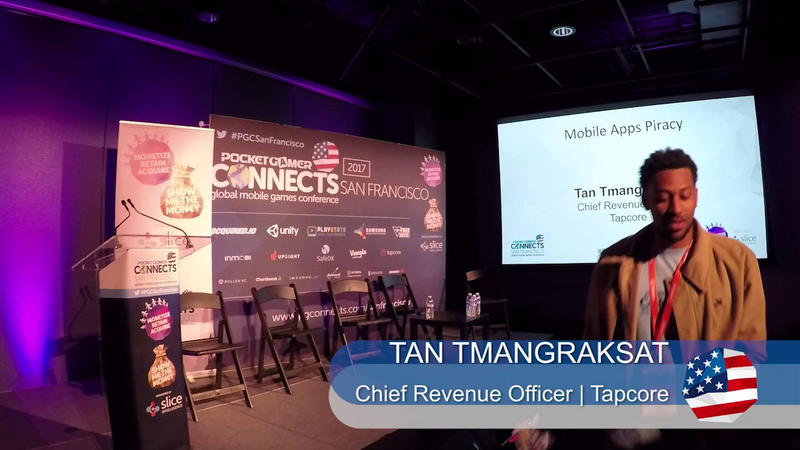
[Music] awesome thanks everyone so switching up gears here for everyone on the audience and going to discuss mobile apps piracy the current war slight technical difficulties here stand on button nope eSports let's talk about eSports yeah well they got this title signed right
but sure obviously we will talk about parties as an issue in particular I think traditionally we've been looking at Google Apps being the kind of larger area of concern is that still the cake that that is definitely still the case of the most prevalent but as I'll show you in our sights it's also an issue with jailbroken iOS applications as well obviously in emerging markets but it is a global phenomenon that affects everybody and I guess I hope instead born here but another common misconception I would say it's not just for premium apps but also for free-to-play apps a lot of people are trying to hack games and get around things like in-app purchases virtual currency getting cool shields or items and games etc etc so definitely a growing concern you know piracy is something that's been around forever not just with mobile applications and I
think you know as as game developers you guys already have to worry about producing a game and and your concept and keeping the integrity that how do you deal with user acquisition and growth monetization and that purchases the mobile ecosystem is very complicated and complex well the tool for the whole area of you know that you've got the client and whether you trust the plan on all right and then you've got the server but also how do you make sure there's a sufficient security between the handshake between the client and the service of everything so avoid man-in-the-middle attack and how many of these guys will be familiar with that kind of language so maybe it's worth for other there if we're still today yeah thanks to waiting oh no we are there with you're working ok I don't yeah there there a slew of ways for pirates to hack your application and figure out how to a certain vent whether it be an app purchases and validating different purchases or even getting refunds that they're not supposed to because of new
policies that was in place whether it's on iOS or Google so the point is it is a rampant issue yeah and the math I'm really fascinated again just because I think it's an interesting area while we're waiting for their suffering and the gold farming side of things so is that an issue you look into at all this intimate is that kind of the opposite problem it's an opposite problem so I I'd consider morons sort of on the fraudulent side yeah exactly of virtual currency that becomes interesting people who are relying on ad revenue correct yeah particularly I think there's been the Wall Street Journal talked about banner ads in particular bits I mean so fraudulent campaigns and how those tie back into your user growth and acquisition is already that is complicated and complex and the fraudsters are extremely intelligent and have even managed to reproduce retention an LTV to a certain level and going on
to certain key young KPIs that you're looking for for your attention I'm not even talking about piracy when I'm talking about that I think that Congress is a whole other issue in addition to this and my background has always been in mobile app monetization and dealing with fraud but piracy is also something new I bring to light it was just figuring out their prime difficulty finding the slide sure you haven't had them on a stick I have them on my laptop well do we have a connection so we can just look Blackfin sure it's right there yeah let's describe that this is always the fun with them setting up events very easy for a slides to get mislaid Rolo but I mean how many of you guys are familiar with the whole pirate issue how many people are actively looking apart in their apps anyone they're only looking at that so this is all very new I'm able to split piracy yeah so if you are actively engaging in this kind of area
yeah is it a big issue for you do you think yeah and then itself so really you guys planning the rest of you have you had makes various time look at this before how you knew to it so if you haven't looked into it yet is anyone who's who's had any concerns for their app no so it sounds like you love you're fairly new to the area anyone looking at from a service infrastructure so for example how many of you are using servers to manage contents or inventory and things like that are you poor people doing that you have a few of you does that make you feel safe that you're using a server yeah and that at the end of the day that the client itself is still vulnerable and and I think that's really hopefully we'll find from tan when we comes back up but you know when we know that there are app can be downloaded and dissected we can't guarantee that even when we have so their authority because they can
just hook that up to errors over to serve their own and potentially but of course when we have things like an inventory system how do you sustain the integrity of the game and tell had happy to take over topic when when there's a delay a tenon issue so please you know take me on dawn on face value and but he was saying that you were investigating the issue so into q1 file what company you work with oh you have no case oh but so in your area what what are the things that you found most compelling in terms of the books we were there so I'll come back and ask you that question liked it okay ten I hope you we good
maybe that I can see it yeah we okay probably alright well thanks for that so as I was explaining how many of you are familiar with the Loomis gave mobile slide here in US and I've seen it obviously it's a very vast and complex landscape that we're in and if we're just going to talk about monetization in general and how you connect brands or marketers to your content that is also very very complex and convoluted as well obviously the mobile apps market is huge 2.3 billion users worldwide over 80% on Android 61 point nine billion dollars and 82 percent of that revenue all comes
from gaming as you all may or should know also a lot of that is international a lot of growth is in a pack forty five percent of those users are all from asia-pacific China counts for seven hundred seventeen million followed very closely by India u.s. Brazil and Russia 33 percent of the Chinese market have shared global mobile apps and over 60 percent mobile gaming revenue in Asia but what about piracy as mentioned I mean piracy has been around forever whether it's pirating video tapes and with the advent of computers and software floppy disk CDs and of the internet obviously you know pirating content and obviously with smartphones coming in 2007 apps have been no different as well so this is something that's been going on for a long time and something that people may or may not want to mint as an issue so was it in general I mean essentially copying games and titles to remove certain
restrictions or creating ways to take in-app purchases jailbreaking on iOS obviously to circumvent certain Apple restrictions cracking or just simply cloning the app itself before as I mentioned you know a lot of people believe this is only a problem for paid apps but actually it is a major problem for premium apps as well / arcs in the state of mobile security in 2014 97% of and top android apps are pirated their premium followed by 87% of iOS apps concurrently for freemium apps 80 percent and 75 percent of the top hundred have been hacked or pirated in some way shape or form what does that mean from a revenue perspective you know some of this data from a penny 2017 we predict that there was gonna be a forty billion dollar market for iOS and a forty 1 billion if
you can find Google Play and other third-party Android stores by 2021 this is to be much higher priority metz piracy will probably account for 6 billion last year 7 billion this year and 14 billion in 2021 that's a conservative estimate from our part of what the opportunity is here and how much money you're either losing or leaving on the table so what drives piracy on Android obviously Google Play is an open source market they're fragmented markets for app distribution China is obviously one of the hugest contributors to this there's lack of efficient legislation and due to the open source nature it is easy to clone your apk and strip out whatever you want our estimates are around 20% of your total install base could represent the pirated install base in some cases this could be up to upwards of 95% plus so
common piracy practices once again removing SDKs from your current monetization and/or analytic strategies and manipulation of virtual currency copying in app purchases injecting malware etc etc these are things that affect both premium maps and premium apps to a large extent piracy is global like I said the BRIC countries in emerging markets Brazil Russia India China or where this is highly prevalent due to a variety of reasons followed very closely by Latin America and Southeast Asia these are the largest markets that we are seeing but once again it is global so it's not to say that the US and Western Europe are not affected by piracy issues as well and you know these are some just publicly disclosed cases of piracy it's rampant people be on certain titles and then developers have admitted to this being a problem so it is the new normal it affects every market every player
everywhere there's no efficient way to stop it now how to find out your pirated do a simple search there are dozens if not hundreds of various sites that offer apks for free it's no easier than just googling the name of your app apk and you know pirated version or download it's rampant all over the world so how to protect your apps from piracy so there's a variety of tools and ways you can either develop land or use you know cob code appreciation with ProGuard to make it a lot harder to sort of reverse engineer your here apk code encryption I think a transaction verification and Google Play is really important there are a variety of ways that people can attack or mimic those calls to the server you should have your own sort of safeguards in place to be able to validate those purchases accordingly other sdk solutions in-house development
of your own protection there's an interesting case that we saw where a developer actually uploaded their own pirated version of the game onto the pirated portals to try to pull at the heartstrings of pirated users and tell them hey we're losing money here did it work no not really but it's a really interesting use case and last but not least not to toot our own horn tap core which is the company I work for we're not necessarily trying to fight piracy outright but detect and monetize it so tap core you know we're the only mobile security and monetization solution up there for app developers to help detect these pirated install users I think the the main difference with us is we we know who they are and instead of you know trying to fight the Pirates we actually monetize those users with advertising and/or convert them back to your Play Store user this is something that was developed by our CEO
and Founder Stephan kites because he himself as a developer and realized this was a huge problem though spreading rapidly and you know we would like to provide that leadership to everyone around how big piracy is and you're already busy dealing with developing your title user acquisition growth monetization and app purchases validating those fraudulent advertising piracy is just another thing that you have to keep top of mind as well and is going to grow more and more as the emerging markets grow and are looking for content yeah that's that's basically a well we still managed to get some time in there but if you guys have any questions for me or like to assess more about piracy let me know my email is right there otherwise are there any questions right now you [Music]
Summary
Mobile app piracy represents a significant and growing threat to the global mobile ecosystem, affecting both premium and free-to-play titles across Android and iOS platforms. The primary thesis is that while piracy is difficult to eliminate entirely, developers must shift from purely defensive postures to strategies that include detection and monetization. The industry faces a complex landscape where open-source distribution, fragmented app stores, and sophisticated hacking techniques—such as bypassing in-app purchase validation and cloning APKs—allow pirates to compromise application integrity and revenue streams.
Data indicates that piracy is a pervasive, global phenomenon, with emerging markets like China, India, Brazil, and Russia serving as major hubs. Estimates suggest that pirated installations can account for 20% to over 95% of a developer's total install base. Financial projections highlight the scale of the issue, with losses attributed to piracy estimated to reach $14 billion by 2021. Furthermore, security research shows that 97% of top Android premium apps and 87% of top iOS apps have been compromised, while freemium titles face similar risks, with 80% and 75% of top apps being pirated, respectively.
To combat these threats, developers are encouraged to implement technical safeguards such as code obfuscation, encryption, and robust server-side transaction verification. However, because absolute prevention is often unattainable, alternative approaches involve identifying pirated versions and converting those users into revenue streams through targeted advertising or by redirecting them to legitimate app stores. Ultimately, the industry must recognize that piracy is a persistent, evolving challenge that requires continuous monitoring alongside standard user acquisition and monetization efforts to protect long-term profitability.



















Comments