1 free read left. Create a free account for unlimited reading + AI research.
Create free account
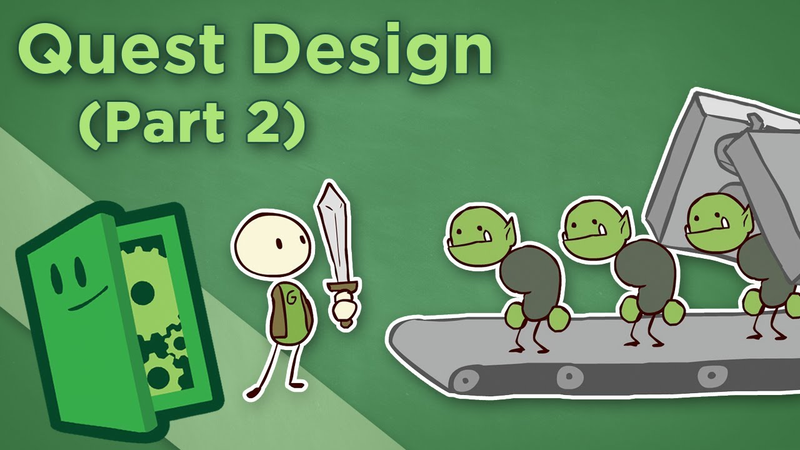
Quest Design - II: How to Create Interesting MMO and RPG Quests - Extra Credits
Key insights
6 takeaways- 01Deepen emotional investment by incorporating mechanics that require external research, the use of in-game emotes, or character-specific titles for milestones like survival streaks.
- 02Leverage existing game assets to create high-impact, narrative-driven experiences without increasing overall development costs.
- 03Shift quest design away from repetitive combat grinds by utilizing environmental storytelling, puzzles, and non-combat challenges to foster deeper player immersion.
- 04Limit the number of active quests players can hold simultaneously to prevent cognitive overload and maintain focus on current narrative objectives.
- 05Replace traditional hub-based quest delivery with environmental triggers—such as notes, corpses, or damaged objects—to encourage organic exploration and a more holistic game flow.
- 06Implement a dedicated task system, similar to the model used in Lord of the Rings Online, to track and reward minor, diverse activities that validate various playstyles.
Ask AI about this video
Transcript
Last week we talked about how quest could be used to encourage exploration and curiosity rather than to simply push the player through an MMO treadmill. Today we'll dive deeper into the concept and talk more about how to get players to think through all the aspects of your game rather than perceiving it as a series of unending combat encounters. So first let me tell you about a quest in The Secret World. I apologize guys if this is a minor spoiler for anyone. This story will spoil one quest in the game but I think it's useful to demonstrate how broadly you can get the player to think about your MMO through your quest system. The quest begins at a church. A priest tells you that there's an ancient secret hidden in this town. He tells you that there's a secret path that will guide you on your way and gives you a number of hints regarding Illuminati sigla. Then he points you to the sewer caps outside. Emblazoned on all the sewer caps in the town is the Illuminati pyramid and if you follow where they point moving always in the direction of the eye you'll find the next part of the puzzle. Now this first moment already
has many of the hallmarks of quality quest design because it not only gets the player to look more closely at the world and to care about what's actually there but it also gives the player a moment of wonder. Something they took for granted, these sewer cap textures that they've run over a hundred times, are suddenly imbued with meaning and are part of the lore of the world. The world isn't just a wrapper for the grind, it's a magical living place. That's a great feeling in a game. Okay, so after they follow that path they get to a placard that reads in the seat of power the navigator immortalized illuminating the path to the sleeping priest and fletcher in memory of Frans Hals who perished in light 1580 to 1666. Now there is a puzzle. First the player has to figure out that the seat of power means the town hall. This causes them to start looking at the map and thinking about the places in the world as actual places rather than simply reference points for spawn locations or quest givers. Next they have to find the painting of a navigator in the town hall. To throw in some tangential learning, Frans Hals, the person quoted on the plaque, was a famous Dutch painter. If the player thinks to look
that up while trying to figure out this puzzle, that should clue them in that they're looking for a painting. Sadly, the painting you find in the game isn't actually one of his, but yeah, anyway. When you find the painting, the bottom of it says, "Time is the province of kings and gods. The hands of time point to truths written by kings and the words of God. The path is open to the enlightened." Here's where it gets bonkers. The player next has to realize that the hands of time mean the hands of the clock in the town hall, which point to 10:10. No problem so far, but after that, they have to realize that the truths written by kings and the words of God means they have to go crack out a Bible and open it to Kings 10:10, which reads, "And she gave the king 120 talents of gold and of spices very great store and precious stones. There came no more such abundance of spices as these which the Queen of Sheba gave to King Solomon." Which tells you the code of the vault you're trying to get into, 120. And while the difficulty on that last part ramps up far, far faster than it should, and in truth, the difficulty between steps in Secret World missions often fluctuates too much, you can see how the Secret World designers have
gotten the player to buy into their world of weird mystic paranoia by the end of this. They've let the reality of the game bleed into the reality of the player's world and made every texture, every part of the environment hold the promise of meaning. And they did it all while presenting a set of challenges that exist outside the realm of combat or traversal. Yes, the player has to fight and run their way through the town while on this quest, but the quest wasn't to kill X number of enemies or to get to Y place. In fact, the mission can be completed entirely without fighting if the player is adept enough. And this sort of alternate challenge doesn't cost the developer any more to create either. I mean, those sewer caps have got to be textured either way. Having their texture also be a surprising part of the design doesn't cost any more money. It just takes a little forethought. Missions can either be boring and routine or a magic entry point for your world. Having them be the latter just involves a little bit of a shift in how we think about design. And in fact, The Secret World goes even farther than this. They really make sure to utilize all the elements of the game. There are times where you have to use emotes to pray or applaud in the right place at the right time in order to complete a quest. There are also a number of
stealth missions which, while clunky at times from a design perspective, simply involve placing incredibly hard enemies that will kill the player if they aggro them and placing them in such a way that the player is able to move around them without pulling aggro if they think it through. It requires no new assets to develop it, nor does it require the implementation of new systems, and yet it still delivers a new experience simply by moving mindset away from seeing quest design simply as a method for guiding the player through the combat grind. And that brings us to a few other points. First, if you want quests to feel organic, they can't just be one of two dozen things that the player accrues every time they rush through town. By bombarding the player with a quest, you overwhelm them with text and essentially create a scenario where the player is incapable of really caring about the quests individually. The player's thoughts just boil down to, "All right, which one of these is closer on my mini map?" The Secret World limits you to one main storyline quest, one big quest, and three minor quests, so you can only ever have five at a time. That's a manageable number, and it allows the player to think a little bit more about each quest and invest a bit more in each one. This also lets you get rid of the ridiculous town hub that many
MMO players know so well. That safe part of the zone that the player blazes through trying to find the 12 guys who have exclamation points over their heads. Instead, constraining the player to a small number of active quests allows for environmental quests. You find an overturned car? That could be a quest giver. You find a note on the ground? That's a quest giver. Find a corpse in the woods? That's a quest giver. Environmental quests make the world feel much more holistic and alive by having quests tied to small scenes or moments within the world. Environmental quests also create a much better flow to the game. Wherever you are when you finish a quest, there's something else interesting to do. And if you really run out of quests, just explore the world and you're sure to find a quest that pushes you to explore it even more. That's way better than the flow-breaking return trip to town to drop off quests or get new ones. Lastly, most of what we call quests these days, I think should be reduced to what I call tasks. The idea of tasks is a system used heavily in Lord of the Rings Online. In that game, basically everything has a task associated with it that functions sort of like an achievement. So, kill 20 rats, task complete. You find all the
major landmarks of this zone, task complete. You kill 20 corrupted denizens of the lower abyss, yep, task complete. But what made these tasks interesting is that they all, in the loosest of senses, conferred a small permanent bonus to your character if you did them. Not enough to actually make you feel like you have to do all of them, but enough for you to feel like it's really worth doing the ones you felt like doing. And this is the key. They created tasks for everything. I mean, seriously, there was a task associated with almost every monster in the game. And this is essential because what do these tasks do? They encourage the player to play how they want. Maybe today I want to grind the nekkers breakers. Maybe tomorrow I want to explore all of Weathertop. Maybe the next day I want to see how many barrow-wights I can take down because those are super hard for me to fight at this level. Well, in Lord of the Rings Online, you can do all of that, and the game encourages you to. It lets you track your progress and rewards you for playing however you want to play. This is a powerful thing. You can augment your quest system by putting in these types of tasks and essentially letting the player choose when they want to create differences in kind for themselves. Oh, and in Lord of the Rings Online, they did throw in one really
manipulative task that I just loved. All it provided the player with was a title, but it changed the whole experience. Say James gets to level five without dying once. That would earn him the title, James the Wary. If he got to level 10 without dying, he'd be James the Undefeated, and so on. Now, I'm not saying that this is a good way to go, but it really makes you feel like your character's life has meaning, which helps you to really sink into the world of Middle-earth. And there's plenty more on quest design that we could talk about, and maybe we will eventually. But one last thing before we go. World of Warcraft has evolved a lot over the years, and Blizzard has clearly tried to branch out and build more than the treadmill FedEx quest and kill quests that WoW launched with. But many of WoW's clones and the free-to-play games of today seem not to have learned this lesson, which is tragic because especially in the free-to-play age, just because a game is an MMO does not mean that it has to feel like a grind. See you next week.
Summary
Effective quest design in MMO and RPG titles requires moving beyond repetitive combat-focused grinds to foster player curiosity and deeper immersion. By treating the game world as a living environment rather than a mere backdrop for tasks, developers can transform mundane assets into meaningful narrative elements. Successful quest design encourages players to interact with the environment through puzzles, environmental storytelling, and non-combat challenges, often utilizing existing assets to create high-impact experiences without increasing development costs.
Key strategies for enhancing player engagement include limiting the number of active quests to prevent cognitive overload and replacing traditional hub-based quest delivery with environmental triggers. By placing quest starters in the world—such as notes, corpses, or damaged objects—developers create a more holistic flow that encourages exploration. Furthermore, distinguishing between narrative-driven quests and mechanical tasks is essential. Implementing a task system, similar to the approach in Lord of the Rings Online, allows players to track progress and earn minor rewards for diverse activities, effectively validating various playstyles and personal goals.
Ultimately, the goal of quest design is to bridge the gap between the player’s reality and the game world. Techniques such as requiring external research, utilizing in-game emotes, or incorporating character-specific titles for milestones like survival streaks can significantly deepen the player's emotional investment. While many modern titles remain tethered to traditional, repetitive quest structures, the industry has the potential to move toward more organic, player-centric designs that prioritize discovery and agency over the standard treadmill of combat encounters.















Comments