1 free read left. Create a free account for unlimited reading + AI research.
Create free accountWhitepaper European Conference on Games Based Learning (ECGBL)
1 free read left. Create a free account for unlimited reading + AI research.
Create free accountWhitepaperEuropean Conference on Games Based Learning (ECGBL)
The paper frames the work around the underrepresentation of women and other groups in computing courses. It also notes limited scientific evidence that educational games improve learning outcomes.
This paper describes the design and early development of an educational game intended to teach fundamental Python programming to students aged 10 to 16, with a particular focus on attracting girls and maintaining an inclusive, non-violent design that still appeals to boys. The work is framed around the Design Science Research approach, and the authors position the game as a response to two persistent problems: the underrepresentation of women and other groups in computing courses, and the limited scientific evidence on whether educational games actually improve learning outcomes. The guiding research question concerns how a motivating and inclusive programming game can be created with minimal prerequisites for students and teachers.
The requirements phase draws on a systematic literature review and testing of three existing programming games by girls aged 10 to 15. The resulting design recommendations emphasize creativity and character customization, exploration and collaboration rather than violence, flow aligned with player competence, and frequent rewards and feedback that allow failure and retry. The resulting game, built in Unity, centers on collecting and training fantasy creatures ("critters") by writing short Python-style command scripts that govern their performance in obstacle-course races against bots or other players. A difficulty-matching algorithm pairs players with comparable opponents, and tutorials gradually introduce predefined functions before custom functions, loops, and conditionals. An alpha version tested by academic game developers at two universities in April and May 2023 revealed several bugs but received positive feedback on graphics and concept.
The authors acknowledge that formal evidence of effectiveness is still lacking. They propose game-based learning analytics using the xAPI serious games profile, with pseudo-anonymized data collection compliant with EU GDPR, to assess instructional design and learning progress. The paper concludes that the formative results are promising but that a larger, more heterogeneous, girl-inclusive evaluation with learners is the essential next step within a two-year Erasmus+ project.
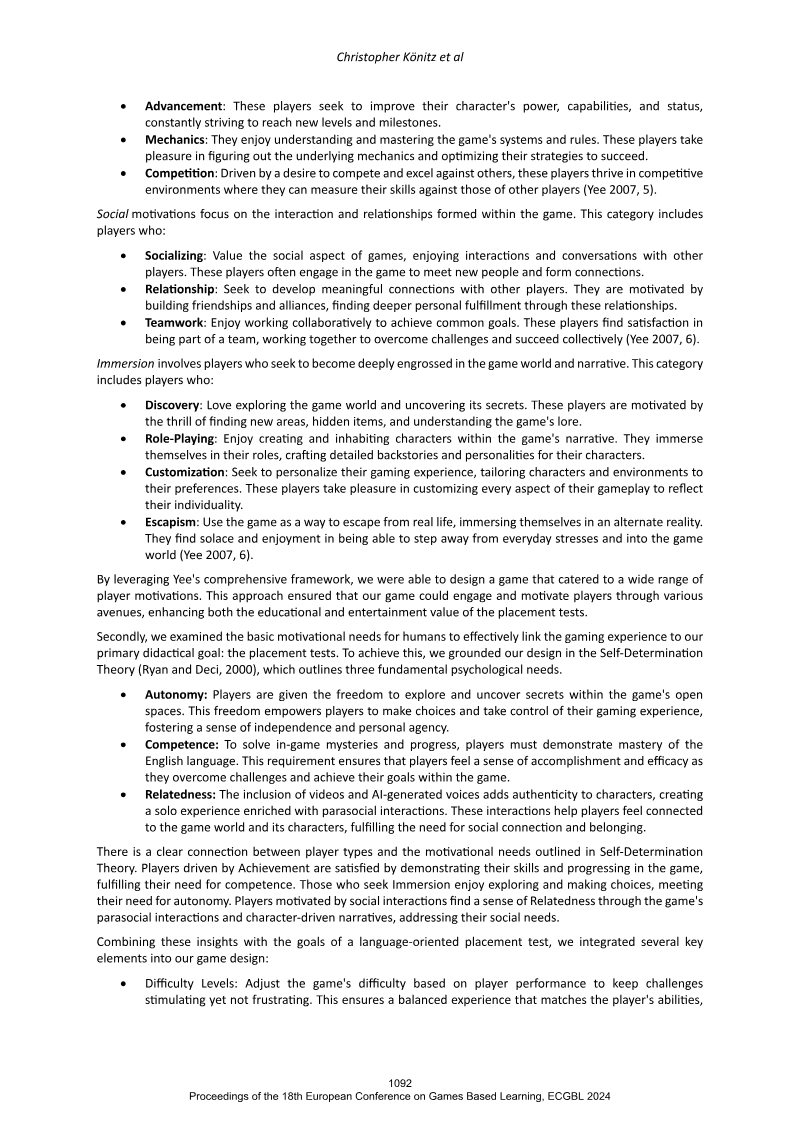
Each row is a game or company this document names, each column a document, oldest first. A mark means that document names it. Select a row to see those documents.
European Conference on Games Based Learning (ECGBL) · 2024
European Conference on Games Based Learning (ECGBL) · 2024
European Conference on Games Based Learning (ECGBL) · 2024
European Conference on Games Based Learning (ECGBL) · 2024
European Conference on Games Based Learning (ECGBL) · 2024
European Conference on Games Based Learning (ECGBL) · 2024
European Conference on Games Based Learning (ECGBL) · 2024
European Conference on Games Based Learning (ECGBL) · 2024
European Conference on Games Based Learning (ECGBL) · 2024
European Conference on Games Based Learning (ECGBL) · 2024
European Conference on Games Based Learning (ECGBL) · 2024
European Conference on Games Based Learning (ECGBL) · 2024
DiGRA · 2009