1 free read left. Create a free account for unlimited reading + AI research.
Create free accountWhitepaper European Conference on Games Based Learning (ECGBL)
1 free read left. Create a free account for unlimited reading + AI research.
Create free accountWhitepaperEuropean Conference on Games Based Learning (ECGBL)
Engagement with challenges has been difficult to sustain in serious gaming, despite years of problem- and challenge-based education.
This study examines how to raise student engagement with challenges in serious gaming, motivated by persistent difficulty sustaining engagement despite years of problem- and challenge-based education. Working with a cohort of 35 third-year students in a ten-week minor on serious gaming at the University of Twente, the authors combined a systematic literature review, a motivational survey, a general evaluation, and a focus group. From the literature they propose a working definition of student engagement as a multi-faceted concept shaped by the interplay of behavior, motivation, challenges, and autonomy, and they argue that these elements must be kept in balance.
The empirical work centered on two interventions: a gamified business modelling workshop and direct, personal feedback loops with student groups. Attendance was tracked weekly and motivation was measured at three points using the Situational Motivation Scale. Intrinsic motivation was high at the first survey (5.29 on a 7-point scale) and declined modestly to 4.65 by the second, while external regulation rose from 4.07 to 4.45, and the Self-Determination Index fell from 6.63 to 4.22. Attendance dipped in weeks three and six, recovered after the gamified workshop, and the course evaluation rose to an average of 8.0 from 7.5 the previous year. Students in the focus group most often proposed rewards as a gamification element, though the authors could not implement rewards in this cohort.
The authors conclude that challenges are the most important engagement element in gamified serious games, that challenge-based learning combined with gamification can strengthen learning, and that immediate, specific feedback is a powerful lever. They also find that high autonomy coincided with high engagement, while noting that the rise in external regulation suggests a tension between freedom and teacher guidance. The small sample, single course, and absence of rewards limit generalizability, and the authors call for future studies in courses with lower autonomy.
European Conference on Games Based Learning (ECGBL) · 2024
European Conference on Games Based Learning (ECGBL) · 2024
European Conference on Games Based Learning (ECGBL) · 2024
European Conference on Games Based Learning (ECGBL) · 2024
European Conference on Games Based Learning (ECGBL) · 2024
European Conference on Games Based Learning (ECGBL) · 2024
European Conference on Games Based Learning (ECGBL) · 2024
European Conference on Games Based Learning (ECGBL) · 2024
European Conference on Games Based Learning (ECGBL) · 2024
European Conference on Games Based Learning (ECGBL) · 2024
European Conference on Games Based Learning (ECGBL) · 2024
European Conference on Games Based Learning (ECGBL) · 2024



Breda University of Applied Sciences · 2026
DiGRA · 2026



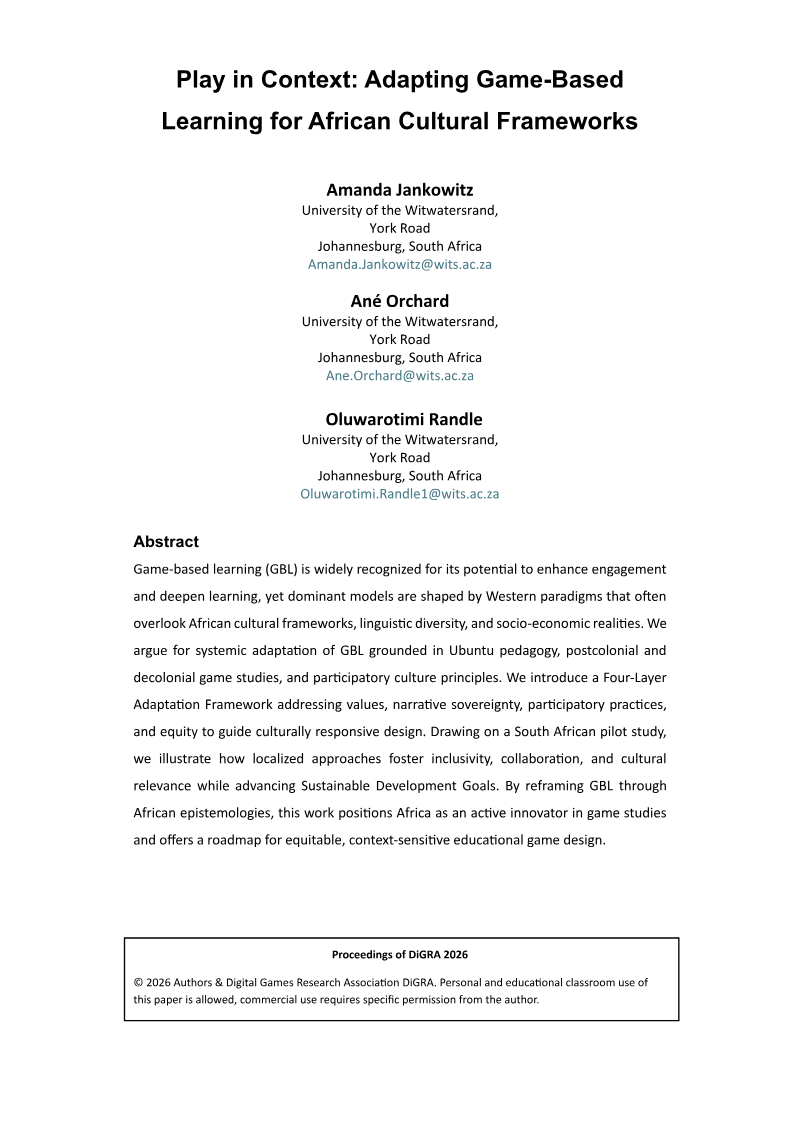
DiGRA · 2026