1 free read left. Create a free account for unlimited reading + AI research.
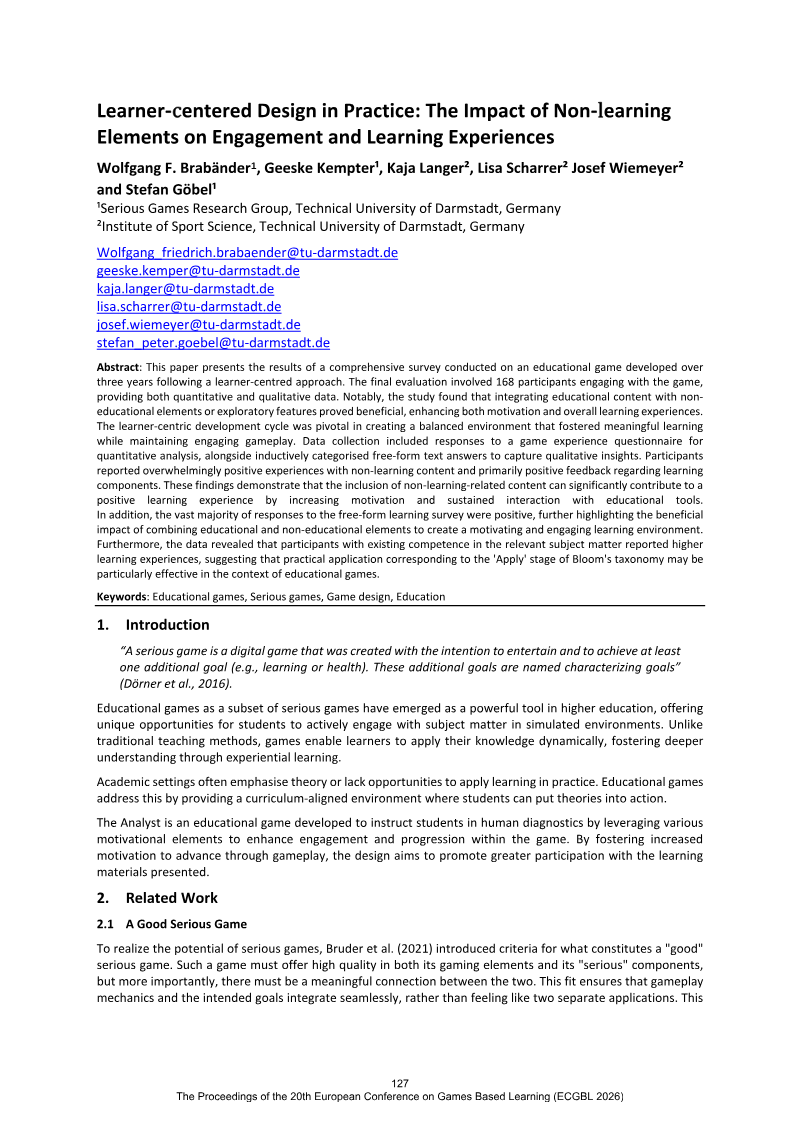
Create free accountWhitepaper European Conference on Games Based Learning (ECGBL)
1 free read left. Create a free account for unlimited reading + AI research.
Create free accountWhitepaperEuropean Conference on Games Based Learning (ECGBL)
The research frames climate adaptation as an economic challenge. It argues that companies recognizing risks and opportunities early, with learning-conducive structures, become more climate-resilient.
This doctoral research examines how companies adapt to climate change and whether their organizational structures support the strategic learning needed to do so. Framing climate adaptation as an economic challenge, the work argues that organizations which recognize their risks and opportunities early, and which possess learning-conducive structures, become more climate-resilient and less vulnerable to negative impacts. The study pursues two linked aims: to analyze the elements that promote or inhibit organizational learning around climate change, and to use those findings to design a serious game that raises decision-makers' awareness and helps them derive their own adaptation measures.
The empirical groundwork draws on a regional study in an industrialized Bavarian area. A grounded theory analysis of 13 expert interviews with manufacturing firms identified three core categories: economic efficiency, a dynamic organizational environment, and change management. A subsequent survey of 288 valid questionnaires, comprising 52 manufacturing, 80 non-manufacturing, and 155 handicraft companies, found that indirect impacts such as shifting legal requirements and supply-chain transparency currently dominate firms' concerns. Intangible factors, including a sense of responsibility, leadership attitudes, and shared values, emerged as having a significant influence on how companies respond. The authors note a methodological limitation: it remains unclear whether learning-conducive structures such as error culture and innovation openness relate specifically to climate adaptation or reflect broader organizational characteristics.
Building on these results, the researchers are developing a narrative, team-based serious game called "MainKassandra," designed for manufacturing executives. Players assume functional roles within a fictional company, make decisions across several rounds, and respond to simulated climatic events such as flooding and heavy rainfall, with outcomes measured through indicators like profitability and corporate image. The design emphasizes low-threshold use, independent deployment with minimal moderator training, and a combination of analog and digital materials. At the time of reporting, the game was in its development phase, with a planned group interview with six to seven executives still pending, and its didactic effectiveness had yet to be evaluated.
European Conference on Games Based Learning (ECGBL) · 2026



European Conference on Games Based Learning (ECGBL) · 2026
European Conference on Games Based Learning (ECGBL) · 2026



European Conference on Games Based Learning (ECGBL) · 2026



European Conference on Games Based Learning (ECGBL) · 2026



European Conference on Games Based Learning (ECGBL) · 2026



European Conference on Games Based Learning (ECGBL) · 2026
European Conference on Games Based Learning (ECGBL) · 2026
European Conference on Games Based Learning (ECGBL) · 2026



European Conference on Games Based Learning (ECGBL) · 2026
European Conference on Games Based Learning (ECGBL) · 2026



European Conference on Games Based Learning (ECGBL) · 2026
European Conference on Games Based Learning (ECGBL) · 2026
European Conference on Games Based Learning (ECGBL) · 2026
DiGRA · 2026