1 free read left. Create a free account for unlimited reading + AI research.
Create free accountWhitepaper European Conference on Games Based Learning (ECGBL)
1 free read left. Create a free account for unlimited reading + AI research.
Create free accountWhitepaperEuropean Conference on Games Based Learning (ECGBL)
The authors argue that MDA, DPE, and The Art of Serious Game Design focus on evaluation or assume a finished concept.
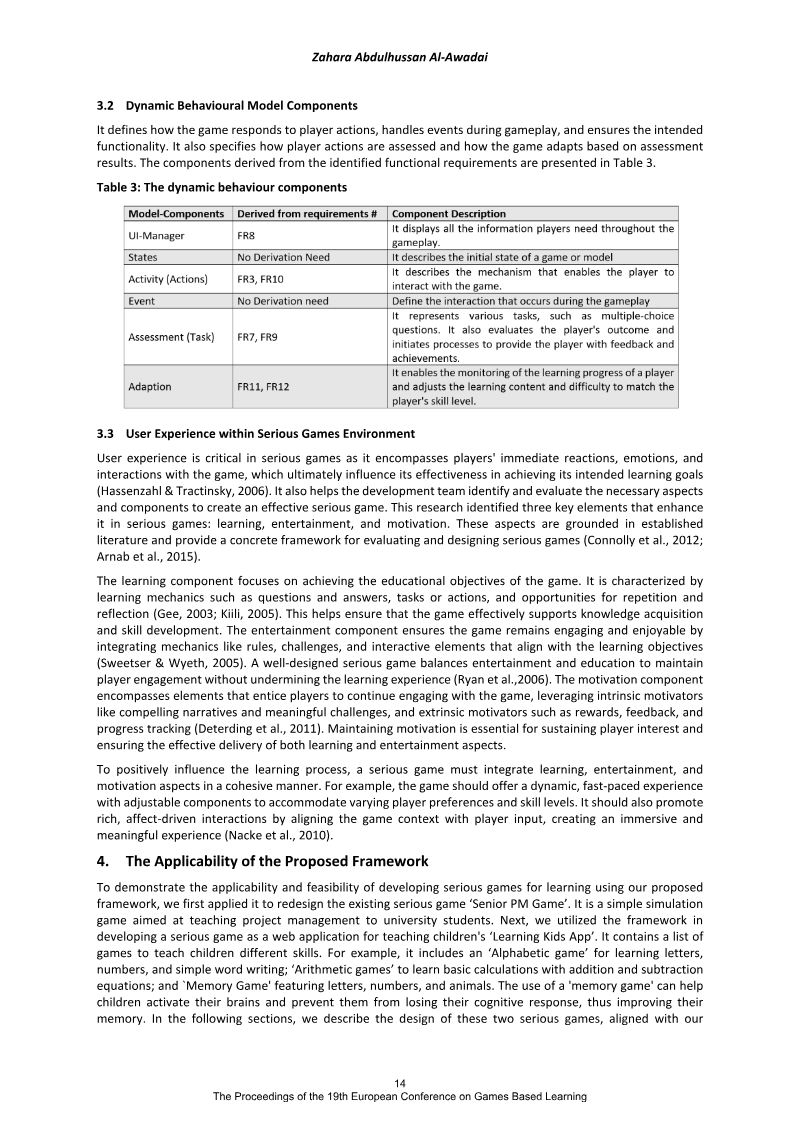
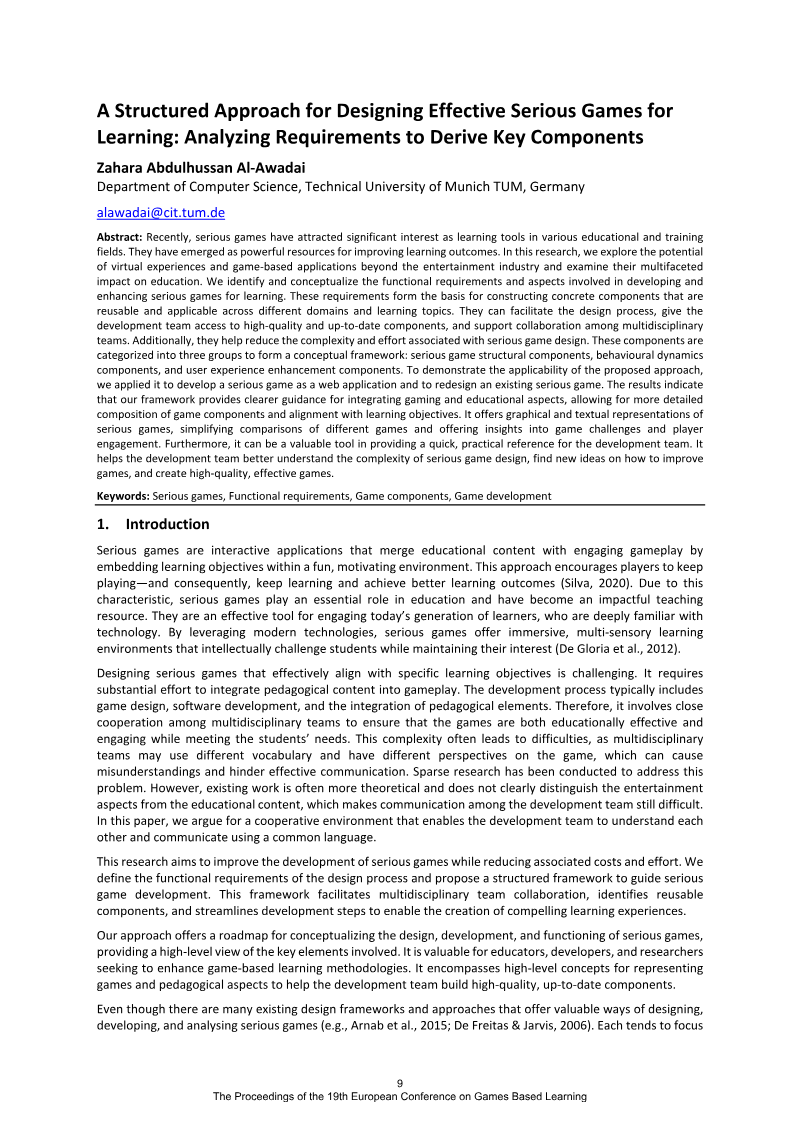
This paper presents a four-phase workshop method that helps educators, who often lack game development experience, move from a curriculum or learning goal to an initial educational game concept. The approach combines Björk et al.'s catalogue of 633 game design patterns with Anderson and Krathwohl's revision of Bloom's taxonomy. Learning goals are first broken into atomic sub-goals tagged with cognitive action verbs, and each verb is then linked to suitable game design patterns through a lookup matrix. A companion app supports browsing, filtering, and random pattern generation. The authors argue that existing frameworks such as MDA, DPE, and the Art of Serious Game Design address evaluation or assume a finished concept, leaving the ideation phase underserved.
The workshop structure proceeds through instruction, learning goal atomization, pattern exploration, and game conceptualization, with the goal of producing outputs that improve communication between educators and game developers. The method was piloted with 40 students at the Technical University of Darmstadt, who worked in groups of 2 to 4 over a two-hour session to design concepts for "The Analyst," a serious game for teaching diagnostic processes in sport, psychology, and pedagogy. Participants rated the experience on a five-point scale, with a mean score of 3.25 and 37 of 40 rating it good or very good. Qualitative feedback, categorized with LLM-assisted inductive coding, was strongly positive about creativity and freedom (19 positive versus 1 negative statement) and motivation, while clarity of instructions and time management drew mostly negative comments.
The authors acknowledge limitations, including the assumption that participants understand Bloom's taxonomy, the omission of narrative and aesthetic design, and a pilot sample composed of students rather than practicing teachers. Future work plans to develop educator-oriented educational design patterns to complement the Björk et al. catalogue.
European Conference on Games Based Learning (ECGBL) · 2025
European Conference on Games Based Learning (ECGBL) · 2025

European Conference on Games Based Learning (ECGBL) · 2025
European Conference on Games Based Learning (ECGBL) · 2025

European Conference on Games Based Learning (ECGBL) · 2025
European Conference on Games Based Learning (ECGBL) · 2025
European Conference on Games Based Learning (ECGBL) · 2025
European Conference on Games Based Learning (ECGBL) · 2025
European Conference on Games Based Learning (ECGBL) · 2025
European Conference on Games Based Learning (ECGBL) · 2025

European Conference on Games Based Learning (ECGBL) · 2025
European Conference on Games Based Learning (ECGBL) · 2025
European Conference on Games Based Learning (ECGBL) · 2025
European Conference on Games Based Learning (ECGBL) · 2024
DiGRA · 2024