1 free read left. Create a free account for unlimited reading + AI research.
Create free accountFinancial report Capcom
1 free read left. Create a free account for unlimited reading + AI research.
Create free accountFinancial reportCapcom
This May 2002 corporate profile outlines Capcom’s strategic roadmap, financial standing, and operational objectives within the global video game industry. The company’s primary thesis centers on achieving market leadership by transitioning into a premier multi-platform content provider, leveraging high-value intellectual property, and optimizing research and development through rigorous, title-based profit controls.
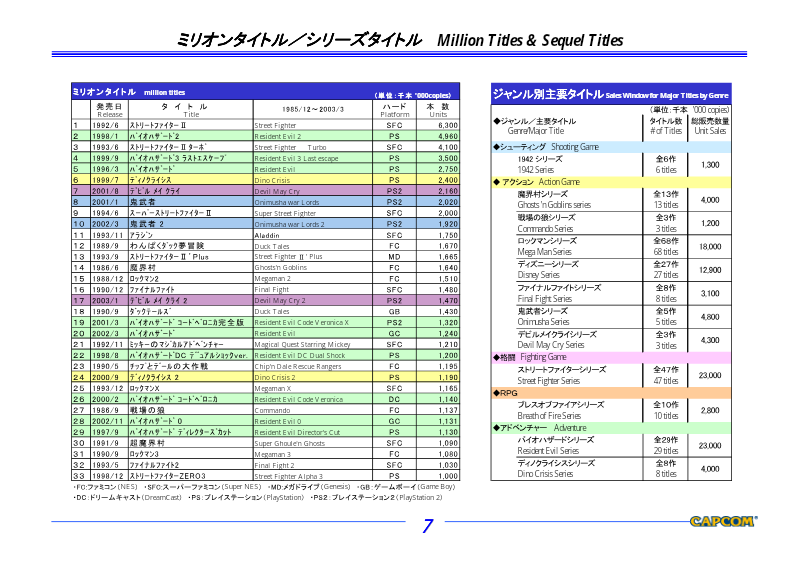
Capcom’s financial performance for fiscal year 2001 reflects a competitive position among major Japanese publishers, reporting net sales of 62.7 billion yen and an operating profit of 9.7 billion yen. Market data from the period indicates that Capcom held a 7.85% share of the Japanese consumer software market and a 3.20% share of the U.S. market. The company’s growth strategy relies heavily on its "million-seller" franchise model, exemplified by the long-term success of the Resident Evil, Onimusha, and Devil May Cry series. These brands are supported by a multi-platform development approach, utilizing proprietary middleware to facilitate efficient porting across hardware such as the PlayStation 2, GameCube, and Xbox.
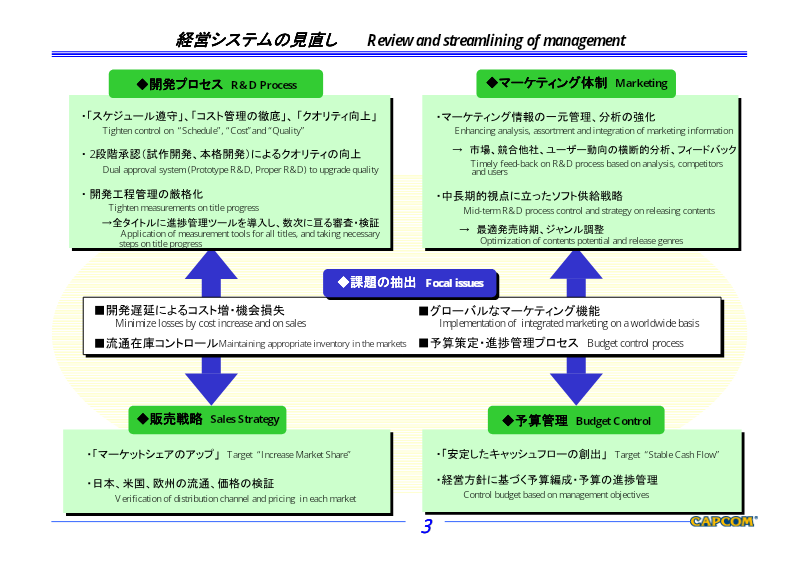
The company’s operational scope extends beyond consumer software into arcade management and emerging sectors like board games and mobile content. To sustain this expansion, management has implemented a centralized R&D control system that mandates strict title-based profitability assessments and incentivizes staff through performance-linked programs. Looking toward fiscal year 2004, the company has established ambitious targets of 100 billion yen in net sales and 21 billion yen in operating profit. The strategy emphasizes global distribution, with plans to strengthen direct sales channels in Korea, Germany, and Southeast Asia, while simultaneously enhancing corporate governance through the integration of external board members and auditors.

Capcom · 2026
Capcom · 2026


Capcom · 2026
Capcom · 2026
Capcom · 2026
Capcom · 2025
Capcom · 2025

Capcom · 2025
Capcom · 2025
Capcom · 2025
Capcom · 2025
Capcom · 2025
Capcom · 2001