1 free read left. Create a free account for unlimited reading + AI research.
Create free accountWhitepaper DiGRA
1 free read left. Create a free account for unlimited reading + AI research.
Create free accountWhitepaperDiGRA
Nearly all players recall frustrating or tedious gaming experiences. Most consider the effort to overcome those challenges worthwhile.
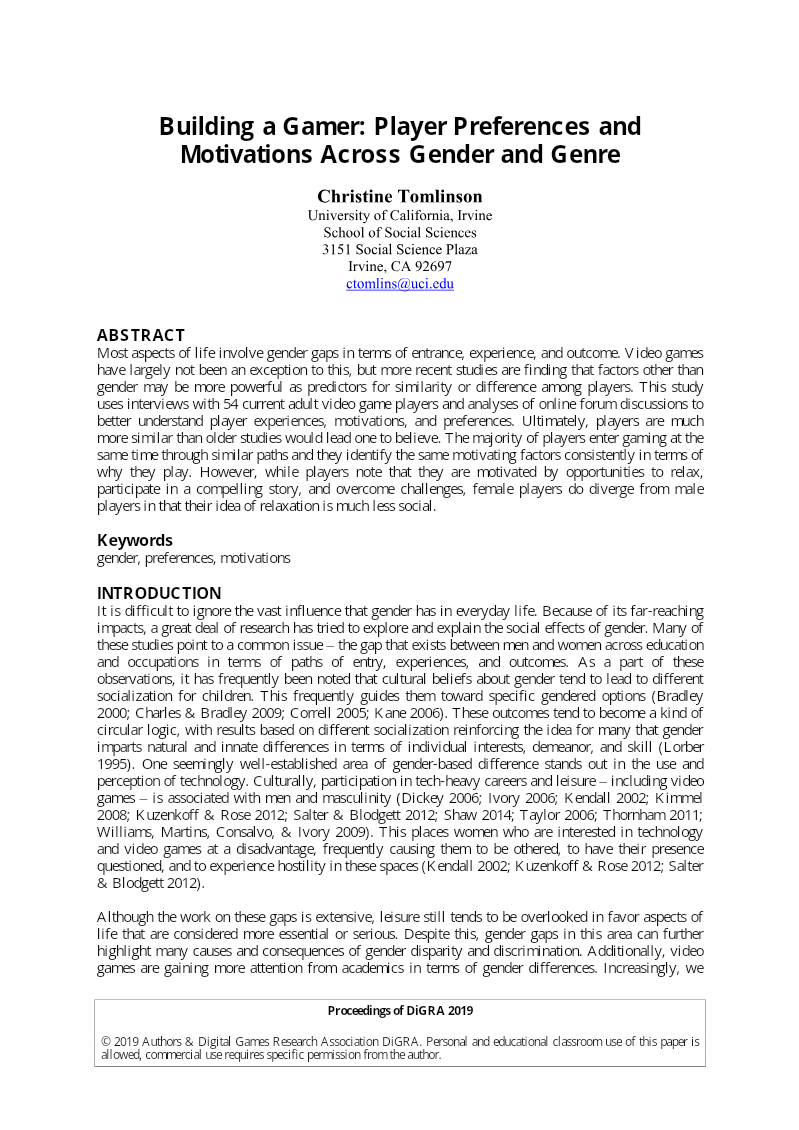
This study examines how gender shapes the sources of stress and the ways video game players respond to it. Its central argument is that while stress is a common experience across gaming, men and women differ in how openly they discuss it, which kinds of situations they avoid, and how persistently they continue to engage despite frustration. The work draws on roughly 50 interviews, about half with women and most conducted with U.S.-based players, alongside approximately 1,000 posts gathered over a month from five online forums, two general and three aimed at women gamers. Themes were identified through coding and cross-case comparison, with gender in the forum data inferred from users' self-reporting.
Findings indicate that men are less forthcoming about their gaming stress, often deflecting to frustrated friends and hedging before acknowledging anger or frustration, while women readily describe specific stressful episodes. Women are more inclined to avoid genres and situations likely to provoke stress and to adopt protective strategies in multiplayer settings, such as concealing their gender. Playing with friends does not reliably reduce stress for women, who report concerns about harassment, scheduling, perceived skill, and pressure to meet team expectations, which in turn can intensify harsh self-assessments. Men, by contrast, more often persist with games or genres that produce prolonged stress.
Across both genders, nearly all players recall frustrating or tedious gaming experiences, and most consider the effort to overcome challenges worthwhile. The authors conclude that while gender shapes specific stressors and coping approaches, many stress experiences are shared, and that women's greater tendency to walk away from persistently negative situations reflects distinct patterns of engagement. The study's modest, non-random sample and its reliance on self-reported gender limit the generalizability of these conclusions.

DiGRA · 2022

DiGRA · 2022



DiGRA · 2022



DiGRA · 2022

DiGRA · 2022

DiGRA · 2022



DiGRA · 2022

DiGRA · 2022

DiGRA · 2022



DiGRA · 2022



DiGRA · 2022

DiGRA · 2022
GameMakers · 2021