1 free read left. Create a free account for unlimited reading + AI research.
Create free accountWhitepaper European Conference on Games Based Learning (ECGBL)
1 free read left. Create a free account for unlimited reading + AI research.
Create free accountWhitepaperEuropean Conference on Games Based Learning (ECGBL)
The authors state that live-fire exercises carry safety risks, logistical burdens, and environmental impacts. Simulation has historically lacked the realism and sensory immersion needed to prepare soldiers.
This paper describes the development of a VR and AR simulator designed to teach joint fire support principles to artillery students at the University of Defence in Brno, developed in collaboration with the private firm YORD. The authors position the simulator as a safer, lower-cost alternative to live-fire artillery training, aiming to bridge theoretical instruction and practical application while offering gamified, realistic training environments. Its stated motivation is that live-fire exercises carry safety risks, logistical burdens, and environmental impacts, while simulation-based training has historically lacked the realism and sensory immersion needed to prepare soldiers effectively.
The system architecture consists of two primary applications: a Windows-based control module for scenario loading, target definition, and real-time tracking of field users, and a mobile and headset field module that supports augmented reality viewing. These are supported by a Node.js and Express backend, a shared networking module built on Socket.IO, and a file synchronization approach that reduces bandwidth use by caching large 3D terrain and target models locally. Terrain realism draws on UAV-acquired LiDAR point clouds from a DJI M300 RTK platform with a Zenmuse L1 sensor, while elevation accuracy was improved to centimetre-level precision by using Mapbox's Raster Tiles API in place of Unity's less accurate altitude data, which errors of more than 10 meters.
The paper devotes considerable attention to practical development problems, including GPS inaccuracy and positional drift, the absence of a compass on the Meta Quest 3 headset, unreliable device pairing, rangefinder replication, and the unnatural appearance of trees in LiDAR-derived terrain models. Solutions included limiting location measurements to AR mode entry and dual-device orientation calibration. The authors conclude that the simulator represents a meaningful advance in military training methodology, though the paper offers no formal evaluation of training outcomes, user testing, or comparative effectiveness data.
Each row is a game or company this document names, each column a document, oldest first. A mark means that document names it. Select a row to see those documents.
European Conference on Games Based Learning (ECGBL) · 2026



European Conference on Games Based Learning (ECGBL) · 2026
European Conference on Games Based Learning (ECGBL) · 2026



European Conference on Games Based Learning (ECGBL) · 2026



European Conference on Games Based Learning (ECGBL) · 2026



European Conference on Games Based Learning (ECGBL) · 2026



European Conference on Games Based Learning (ECGBL) · 2026



European Conference on Games Based Learning (ECGBL) · 2026



European Conference on Games Based Learning (ECGBL) · 2026



European Conference on Games Based Learning (ECGBL) · 2026



European Conference on Games Based Learning (ECGBL) · 2026



European Conference on Games Based Learning (ECGBL) · 2026

European Conference on Games Based Learning (ECGBL) · 2026
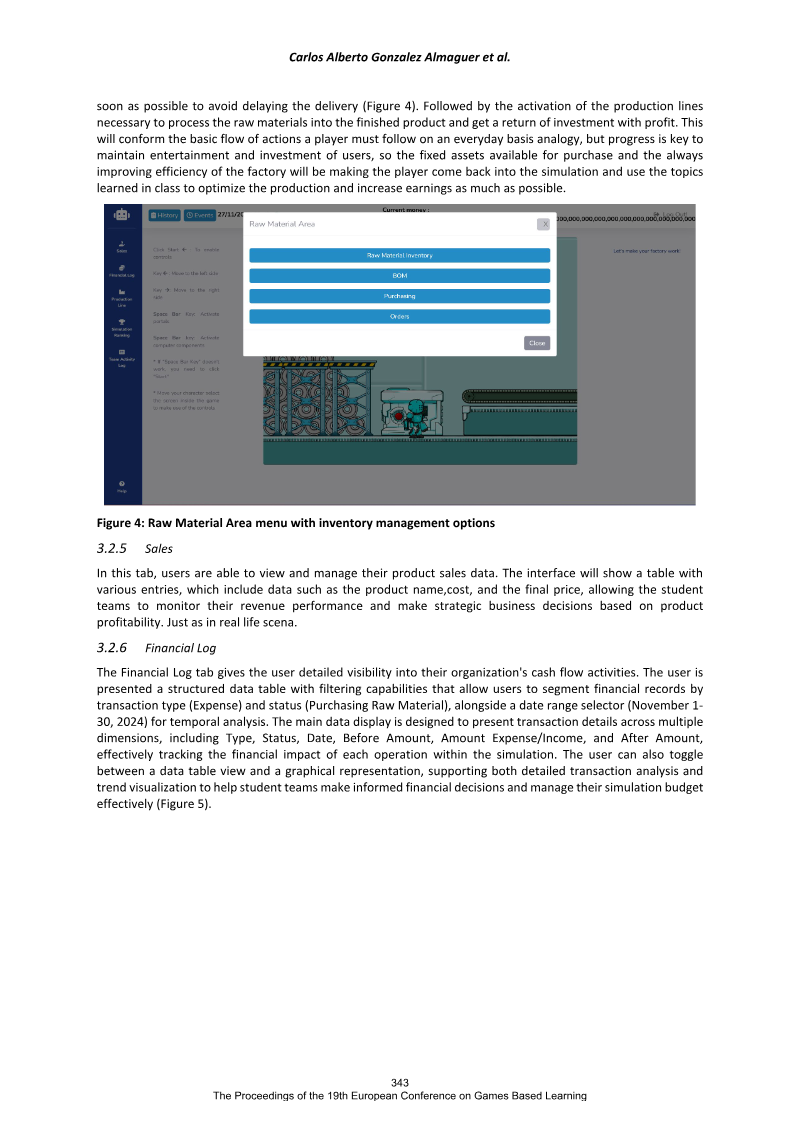
European Conference on Games Based Learning (ECGBL) · 2025
European Conference on Games Based Learning (ECGBL) · 2023