1 free read left. Create a free account for unlimited reading + AI research.
Create free accountWhitepaper European Conference on Games Based Learning (ECGBL)
1 free read left. Create a free account for unlimited reading + AI research.
Create free accountWhitepaperEuropean Conference on Games Based Learning (ECGBL)
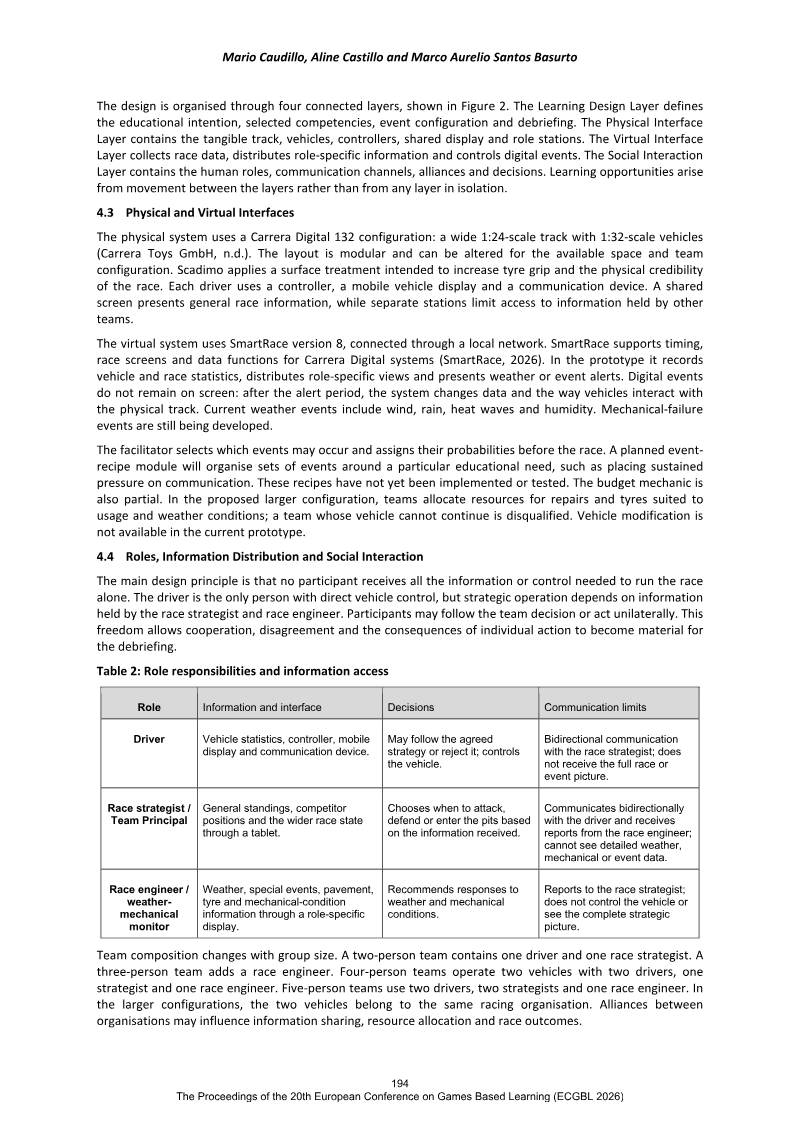
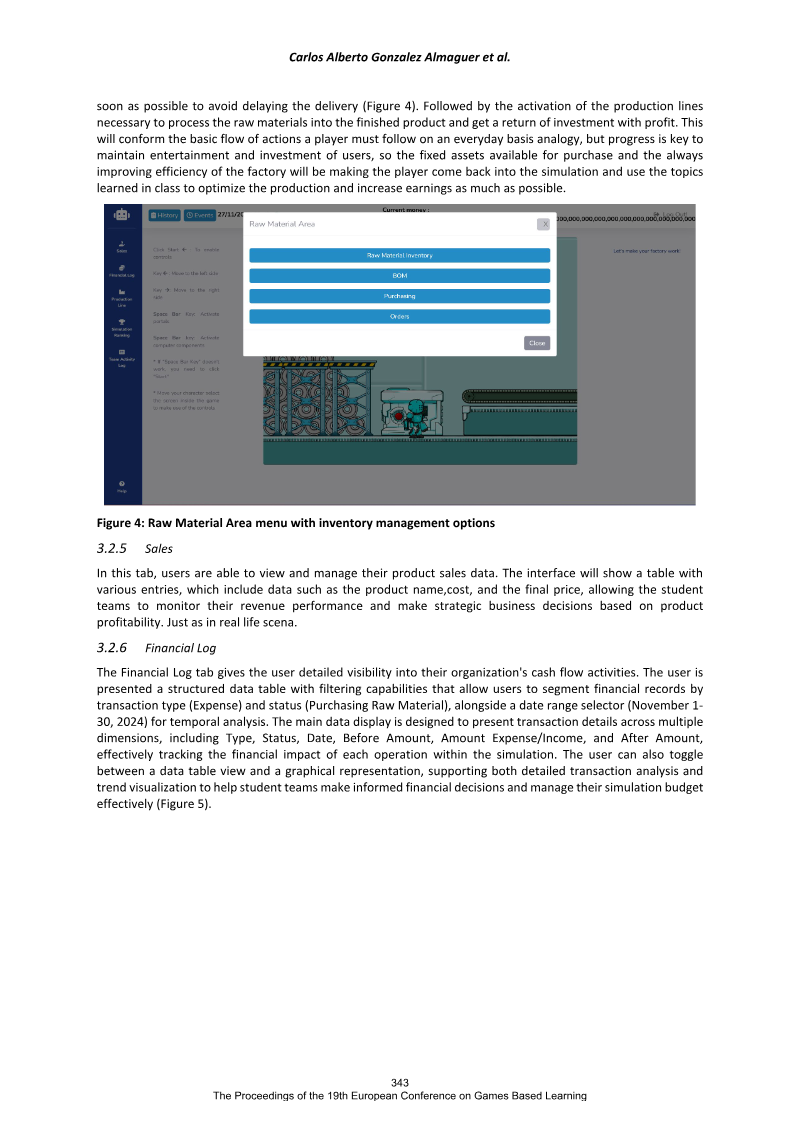
Sortica is a prototype immersive serious game teaching FIFO and LIFO scheduling to undergraduate students. Learners role-play a robot worker rebuilding town buildings in virtual reality.
Sortica is a prototype immersive serious game designed to teach undergraduate students scheduling algorithms, specifically first-in-first-out (FIFO) and last-in-first-out (LIFO) logic. Learners, none of whom had previously been taught these concepts, role-play a robot worker rebuilding town buildings in a virtual reality environment. The central argument is that translating abstract scheduling concepts into concrete, storified tasks can make algorithm instruction more engaging and effective, addressing persistent conceptual difficulties in computing education.
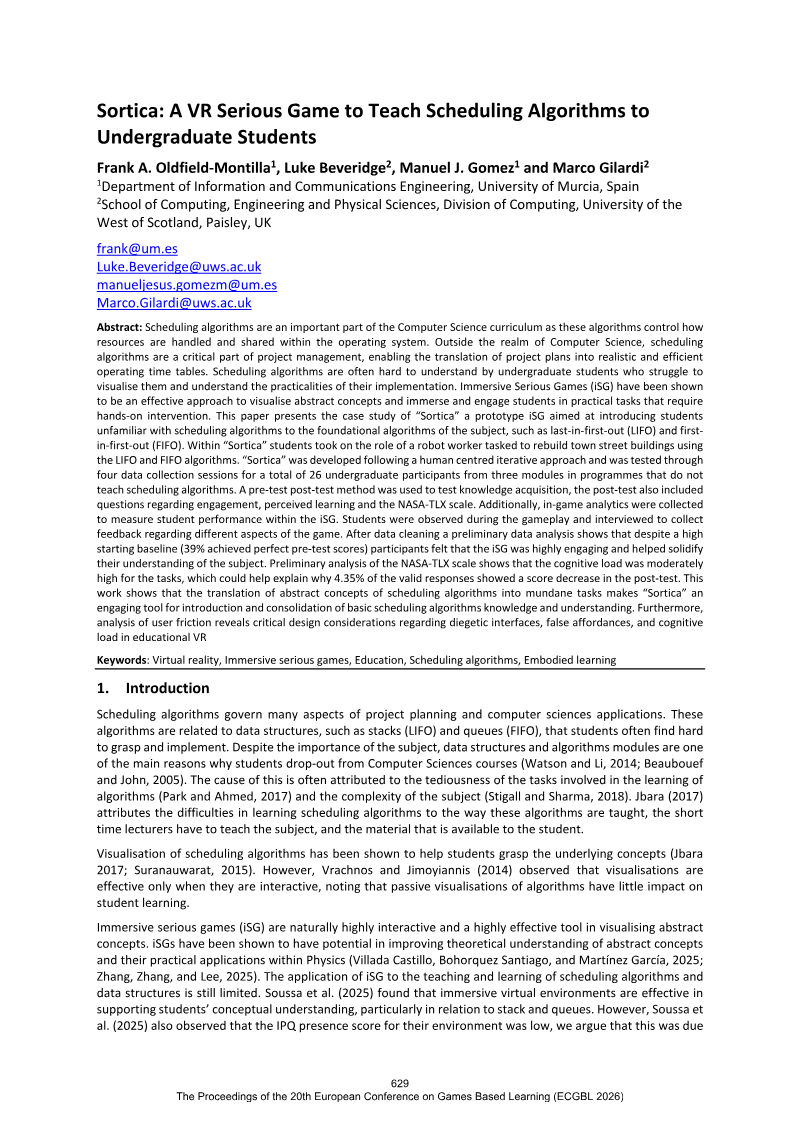
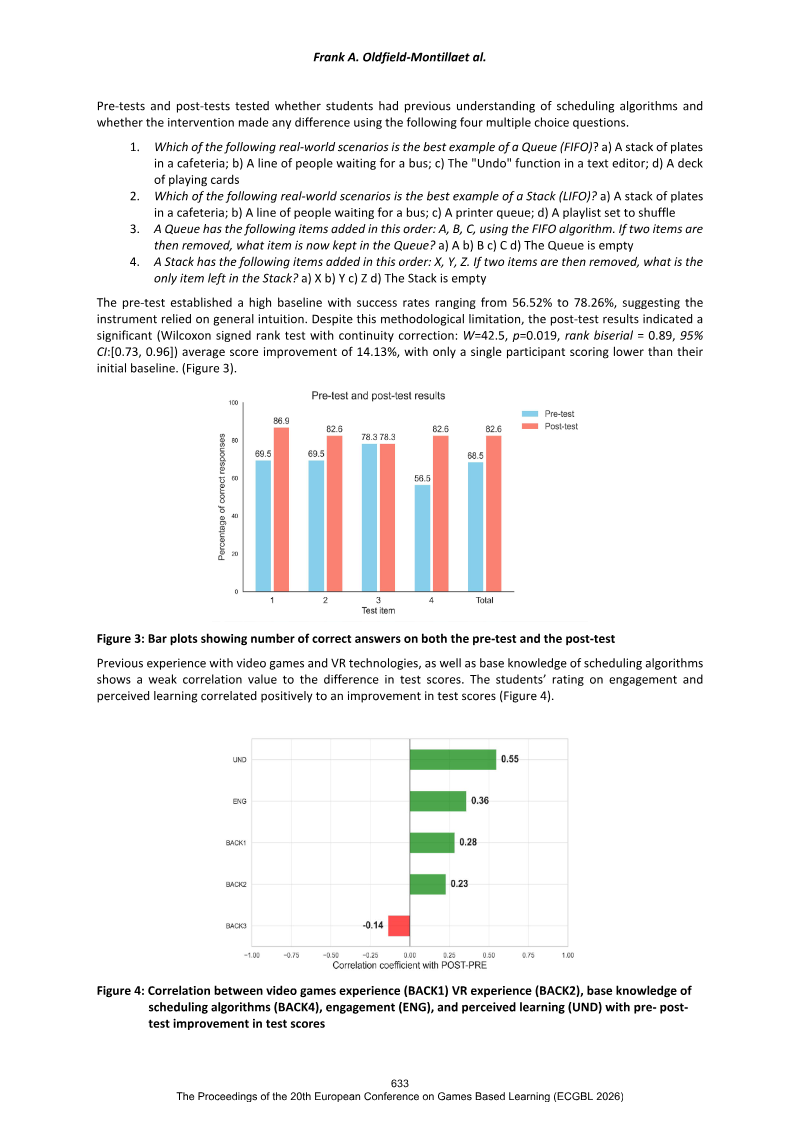
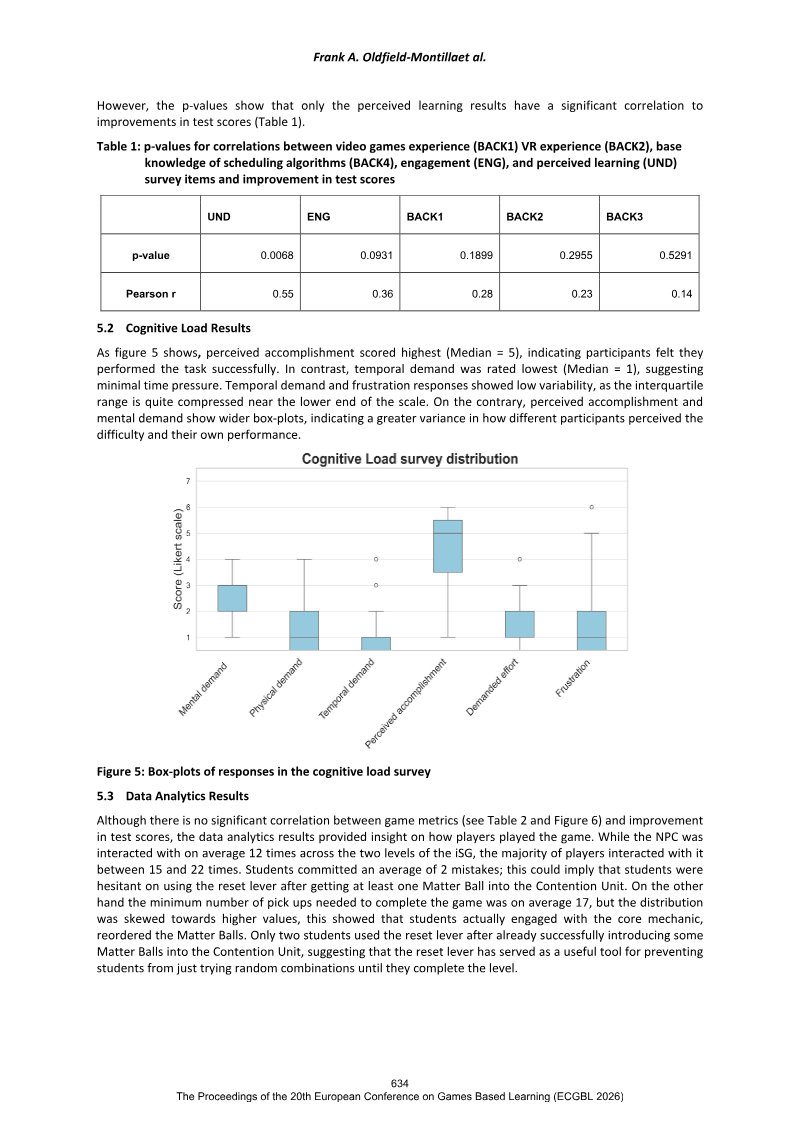
The initial evaluation involved 23 valid participants across four sessions and yielded encouraging results. Pre- and post-tests showed a statistically significant average score improvement of 14.13% (Wilcoxon W=42.5, p=0.019, rank biserial=0.89), though the high pre-test baseline, with scores ranging from 56.52% to 78.26%, and the fact that 39% of participants achieved perfect pre-test scores limit the strength of inferences that can be drawn. Perceived learning emerged as the only measure significantly correlated with score gains (p=0.0068, r=0.55), while engagement, prior experience, and in-game metrics did not show significant associations. Participants rated the game as highly engaging, but NASA-TLX results indicated moderately high cognitive load, and 4.35% of valid responses showed a post-test score decrease.
Qualitative feedback identified usability concerns, including unintended interaction cues and onboarding friction. Based on these observations, the authors draw design lessons concerning diegetic interfaces, the role of feedback, and the management of cognitive load in immersive educational environments. The study's grounding draws on prior research in algorithm visualization for novices, immersive VR in physics education, and the high failure rates in introductory programming courses, situating the work within broader efforts to improve algorithm instruction through immersive, game-based approaches.
European Conference on Games Based Learning (ECGBL) · 2026



European Conference on Games Based Learning (ECGBL) · 2026
European Conference on Games Based Learning (ECGBL) · 2026



European Conference on Games Based Learning (ECGBL) · 2026



European Conference on Games Based Learning (ECGBL) · 2026



European Conference on Games Based Learning (ECGBL) · 2026



European Conference on Games Based Learning (ECGBL) · 2026
European Conference on Games Based Learning (ECGBL) · 2026
European Conference on Games Based Learning (ECGBL) · 2026



European Conference on Games Based Learning (ECGBL) · 2026
European Conference on Games Based Learning (ECGBL) · 2026



European Conference on Games Based Learning (ECGBL) · 2026
European Conference on Games Based Learning (ECGBL) · 2022