Key insights
7 slides
Scaling up
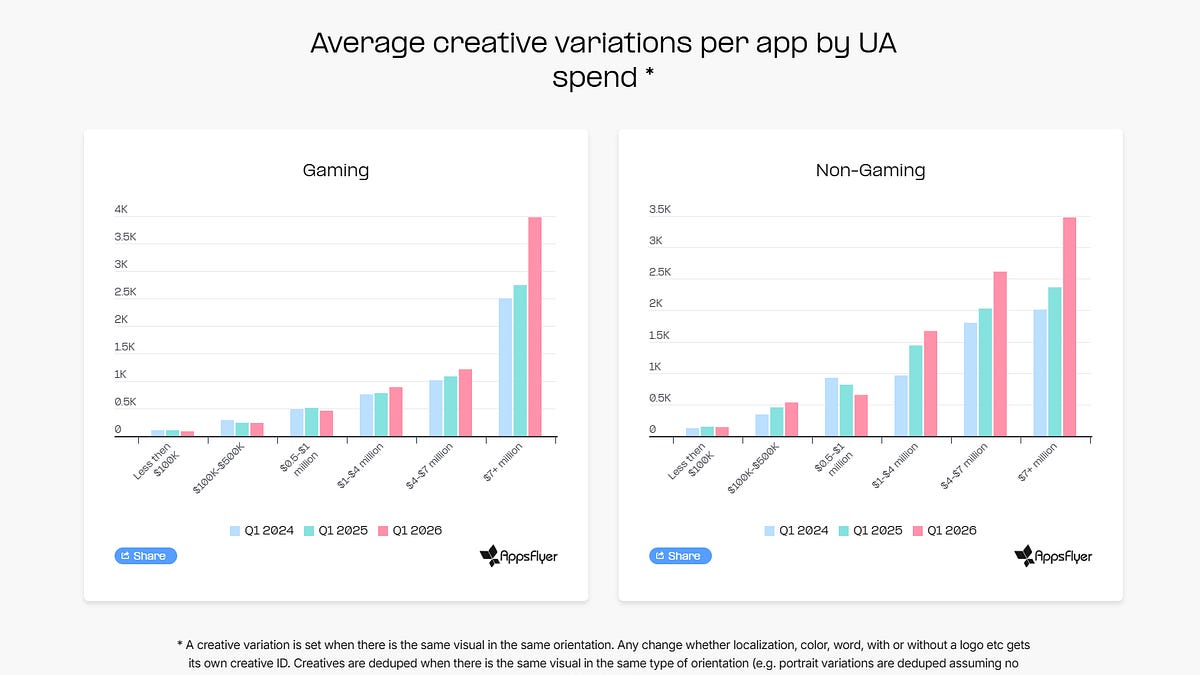
Large advertisers are significantly increasing their creative output.
Apps spending over $7 million per quarter increased their creative variations by 45% year-over-year. They now average 3,977 variations per app.
Increased Output. Large-scale UA spenders increased their creative output by 45% year-over-year.
Mid-tier growth
Mid-sized game studios are also expanding their creative variations.
Apps spending $4–7 million per quarter increased their creative variations by 29% year-over-year. They now average 2,615 variations.
Smaller budgets
Smaller advertisers are reducing their creative output.
Budgets under $1 million per quarter saw a 2% to 20% decline in the number of creative variations produced.
High concentration
Marketing spend is highly concentrated in a small fraction of video creatives.
The top 2% of video creatives in games account for 60.7% of total spend in Q2 2026. This is an increase from 53.5% in Q1 2025.
Like a few star players dominating a team's scoring, a small number of creatives capture most of the ad budget.
Dominant formats
Animated videos and 'Play Now' calls to action dominate video creative strategy.
Animated videos capture 69–75% of marketing spend. 'Play Now' is the primary call to action, used in 60–77% of all video spend.

Channel themes
Player motivation themes vary significantly across different advertising channels.
'Challenge' themes capture 47.3% of spend on Ad Networks. 'Progression' themes lead on Social & Search at 23.4%.

Genre specifics
Casino genre video creatives heavily favor showing a 'win' outcome.
Showing a 'win' accounts for 83.2% of spend on Ad Networks for Casino genre video creatives. Urgent calls to action dominate static creatives.
83.2%
Share of spend for 'win' outcomes in Casino genre video creatives on Ad Networks.
- Share of spend for urgent CTAs in static creatives on Social & Search.
- 92.9%
1 / 7
Ask AI about this report