Reports in the Market (Mobile) category.
The global mobile gaming landscape has entered a period of stabilization following pandemic-era surges, with quarterly downloads maintaining a steady baseline of 14 billion. Although total revenue experienced a 6% year-over-year decline to $21.2 billion in early 2022, the market remains significantly larger than its pre-pandemic state. Casual games continue to lead in volume, representing 80% of all downloads, yet Mid-Core titles remain the primary economic engine, generating 60% of total player spending. While the United States maintains its position as the leading consumer market, the Asia-Pacific region exerts increasing influence, evidenced by Taiwan’s rise to the fifth-largest global market and the region's dominance in high-monetization genres like MMORPGs and Card Battlers.
Strategic advertising and intellectual property integration have become essential for navigating this competitive environment. Strategy and RPG titles are increasingly prioritizing YouTube for share of voice, while the acquisition of MoPub by AppLovin has shifted the advertising landscape for strategy games. Success in the rapidly growing Card Battler sub-genre, which earns 62% of its revenue from the APAC region, is largely driven by high-performing titles like Yu-Gi-Oh! Master Duel and the effective use of Live Ops and Season Passes. Furthermore, cross-media synergies, such as the impact of the Netflix series Arcane on game downloads, demonstrate the power of multimedia IP in driving user acquisition.
The market outlook suggests a temporary correction phase with a projected return to growth by 2023. While Asian markets currently account for 80% of MMORPG revenue, Western interest is growing, as seen with the successful U.S. launch of Diablo Immortal. Similarly, the Real-Time Strategy sector is seeing a geographic shift, with China overtaking the U.S. as the top market for the sub-genre. Future expansion across these segments will likely depend on localized IP collaborations and sophisticated user acquisition strategies tailored to specific regional preferences.
This analysis examines the evolving landscape of the casual mobile gaming market as of March 2022, focusing primarily on the United States iOS market. The central thesis posits that the casual sector has become increasingly competitive, forcing developers to move beyond simple core gameplay by integrating sophisticated meta-elements, hybrid mechanics, and social features to maintain chart positions and drive player retention.
Key findings indicate a massive shift in the Match3 genre, where the presence of meta-elements in top-100 grossing games rose from under 10% six years ago to 70% by early 2022. Renovation and construction mechanics have emerged as the dominant trend; notably, every top-100 grossing casual game released in the two years preceding the report utilizes renovation elements. Construction features specifically appeared in 49% of top Match3 games, a significant increase from 7% in 2016. These elements are prized for providing visual progression and satisfying psychological "completionist" motivations without disrupting core game balance.
The scope of the research covers the casual genre hierarchy—including subgenres like Match3, Solitaire, and Time Management—with a specific focus on top-grossing titles on the US iOS platform. Data points highlight the stability of the top three casual games between Q4 2020 and Q4 2021, while noting that newer titles like Royal Match and Project Makeover successfully captured market share by leveraging episodic design and deep customization.
Methodologically, the insights are derived from the GameRefinery SaaS platform, utilizing a proprietary three-layered taxonomy (Category, Genre, Subgenre) developed with industry experts. The analysis concludes that successful casual games are increasingly adopting midcore-inspired features, such as social hangouts, competitive tournaments, and diverse minigames, to broaden their motivational appeal and create new monetization sinks in a post-IDFA marketing environment.
The casual gaming landscape is undergoing a significant transformation driven by the rise of hybrid designs that blend core puzzle mechanics with complex meta-layers. This shift is most evident in the Match3 genre, where 70% of the top-grossing titles now incorporate elements such as renovation, collectibles, or RPG mechanics to enhance long-term engagement and monetization. Data indicates a dramatic pivot in player preferences over the last six years, with construction mechanics in top Match3 games surging from 7% to 49%. Currently, every top-100 casual game released within the past two years utilizes renovation elements, highlighting their role in providing visual progression and psychological satisfaction.
Beyond permanent gameplay features, developers are increasingly leveraging renovation and construction layers within limited-time events across diverse genres, including card games and puzzle RPGs. This strategy allows studios to introduce new monetization sinks and broaden motivational appeal without disrupting core gameplay balance. Furthermore, the industry is moving toward a model of digital togetherness by integrating social and competitive features into traditionally solitary experiences. Features such as guilds, chat functions, and communal hangout areas are becoming standard tools for improving player retention and fostering cooperative environments.
Competitive elements have emerged as a primary differentiator between market leaders and lower-performing titles. Top-tier games like Candy Crush Saga are successfully attracting players motivated by rivalry through the integration of leaderboards and head-to-head challenges. While the highest-grossing titles in the casual segment have aggressively adopted these social and competitive frameworks to distinguish themselves in a saturated market, underperforming titles have been slower to adapt. This evolution reflects a broader industry trend toward multifaceted gaming experiences that prioritize social connectivity and diverse motivational drivers to maintain a dominant market position.
The mobile gaming landscape in the United States is defined by a complex interplay between game mechanics and player psychology, categorized through a framework of twelve distinct motivational drivers. Analysis of the top 200 grossing titles reveals that while broad categories like Excitement and Thrill account for nearly a quarter of the market, the specific implementation of these drivers varies significantly across demographic lines. Younger male audiences typically engage with high-action PvP environments to satisfy mastery and competition, whereas players aged 45 and older gravitate toward progressive jackpots in social slots.
A significant shift in the casual gaming sector demonstrates the universal appeal of renovation and customization mechanics. Every top-100 grossing casual title released within the last two years has integrated renovation elements, signaling that Expression—the desire to customize and decorate—has become a fundamental requirement for modern engagement. This trend is particularly pronounced among female players, who show a strong preference for tycoon games and creative customization, while male players remain more focused on role-playing elements and reaction-based skill mastery.
Strategic drivers such as Management and Exploration show varying levels of market penetration. While Exploration is widely utilized through gacha mechanics and sandbox discovery, Management remains a specialized niche dominated by 4X strategy titles, which account for 70% of that segment. These findings underscore the necessity for developers to align specific gameplay features with the nuanced motivational profiles of their target age and gender groups to achieve commercial success in the competitive US mobile market.
The Israeli mobile gaming sector has solidified its position as a premier global hub, characterized by a robust ecosystem of approximately 200 companies and 14,000 employees. Generating $9 billion in annual revenue, the industry has experienced extraordinary growth, with total earnings increasing by 760% since 2016. This expansion, accelerated by pandemic-era shifts in consumer behavior, is anchored by major developers such as Playtika, Plarium, and Moon Active, who maintain a strategic focus on the social, casual, and hyper-casual genres.
Despite this financial success, the advertising landscape underwent significant volatility in 2022. Total ad creatives declined by 17.8% year-over-year, even as the number of active advertisers grew by 4.2%. This contraction was most pronounced within the RPG segment, while casual and puzzle titles maintained dominance. A pivotal shift in platform strategy has emerged, with Android now capturing 70% of all mobile game advertising, a trend largely attributed to Apple’s IDFA privacy changes. Video content remains the industry standard, accounting for over 86% of all creative output.
Global marketing strategies have become increasingly localized to meet regional preferences, ranging from live-action influencer content in the United States to character-centric assets in Japan and high-fidelity technology showcases in South Korea. Furthermore, creative trends are evolving away from traditional failure-based hyper-casual tropes toward more positive, success-oriented gameplay. While the Israeli market continues to demonstrate immense scale and innovation, the industry faces ongoing structural challenges, specifically regarding the availability of venture funding and the persistent shortage of skilled human resources required to sustain long-term growth.
The mobile app and gaming landscape underwent a significant strategic pivot during the first half of 2022, characterized by a transition from high-volume advertising to a quality-focused, data-driven methodology. Faced with rising user acquisition costs and the restrictive post-ATT environment, marketers reduced the total volume of mobile game creatives by nearly 30% year-over-year. This contraction reflects a broader industry shift toward precise traffic optimization, where performance metrics like Cost Per Purchase and In-App Purchase Return on Ad Spend have superseded raw install volume as the primary indicators of success.
Geographically, the United States remains the dominant market, commanding the highest share of traffic and the most expensive advertising costs. CPMs surged significantly during this period, rising 18% for mobile games and 64% for non-gaming applications. In response to these economic headwinds and privacy-related tracking limitations, advertisers have increasingly pivoted toward the Android ecosystem, which now hosts approximately 70% of mobile game creatives. Simultaneously, growth is being sought in emerging Tier-2 and Tier-3 markets to offset the saturation and high costs found in traditional Western strongholds.
To maintain performance, publishers are diversifying their acquisition channels, moving beyond traditional social media giants to include incentive-based traffic sources and search-driven discovery. App Store Optimization and Apple Search Ads have become critical components of visibility strategies, while the adoption of predictive analytics and first-party data collection allows developers to navigate the loss of IDFA-based targeting. By prioritizing user-generated content styles and optimizing opt-in prompts, which have reached success rates as high as 51% in certain hyper-casual segments, the industry is successfully recalibrating its approach to sustain long-term growth despite a challenging macroeconomic climate.
The 2022 global mobile gaming landscape underwent a significant transition toward quality and strategic refinement, characterized by a 2% decline in total advertisers and a 27.83% reduction in ad creatives during the first half of the year. This contraction in mature markets was offset by robust growth in emerging regions such as the Middle East, South America, and South Asia, where increasing smartphone penetration and young demographics present substantial expansion opportunities. The industry’s primary thesis centers on the necessity of localized, narrative-driven content and creative optimization to navigate a post-IDFA privacy environment that has increased advertising costs and shifted focus toward Android platforms.
While casual, puzzle, and simulation genres dominate download volumes, RPGs and strategy titles remain the primary revenue drivers, commanding the highest advertising costs with average CPMs reaching $21.58. Video remains the dominant creative format, accounting for over 86% of all advertisements, as marketers increasingly leverage dramatic storytelling and influencer-led content to boost engagement. Despite the industry’s fascination with emerging technologies, consumer sentiment remains grounded; only 16% of players express interest in NFT-based gaming, whereas up to 39% show interest in metaverse-integrated experiences. Most users continue to prioritize mobile games as accessible tools for relaxation and time-killing.
To sustain growth, publishers are pivoting toward programmatic channels, OEM integrations, and culturally relevant marketing strategies. Success in this competitive landscape requires a dual approach: maintaining high-frequency engagement through playable and video-based ads while simultaneously adapting to regional preferences, such as the demand for vernacular content in India or MOBA-focused titles in Southeast Asia. Ultimately, the market is moving away from broad-spectrum advertising toward highly targeted, immersive, and quality-focused campaigns that align with the core motivations of diverse global player bases.
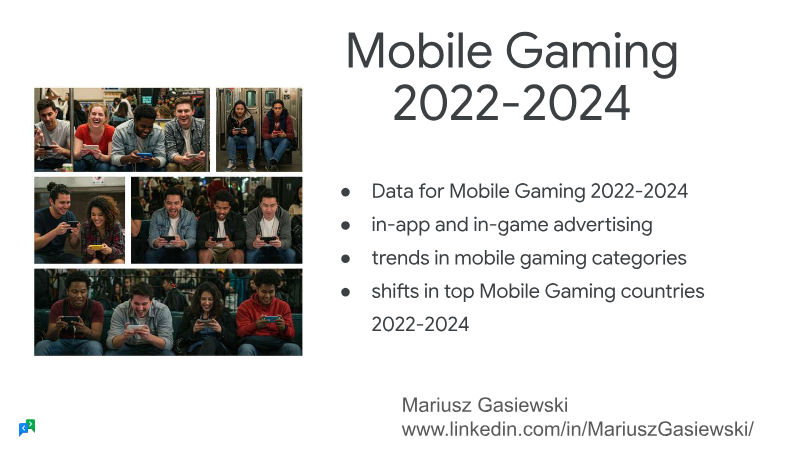
Mobile gaming maintains its position as the primary driver of industry expansion, fueled by widespread smartphone adoption and consistent engagement across both emerging and established markets. Between 2022 and 2024, the sector has demonstrated a clear trend where revenue growth consistently outpaces download volume on both iOS and Android platforms. This financial trajectory is increasingly supported by a strategic shift toward in-game advertising, which is currently outpacing traditional in-app purchases as a primary revenue stream.
Global market dynamics remain anchored by the United States, China, and Japan, which continue to serve as the most significant revenue generators. However, emerging markets are playing an increasingly critical role in the industry’s growth, particularly in regions like Brazil, where smartphone gaming penetration has surpassed 90% across all demographics. In these regions, player behavior is heavily influenced by free-to-play accessibility, narrative depth, and social recommendations. Furthermore, data from the U.S. and U.K. confirms that younger demographics prioritize smartphones over consoles and PCs, solidifying the mobile device as the central hub for modern gaming.
Despite the proliferation of available titles, the global player base exhibits a preference for focused engagement, with many users choosing to dedicate their time to a single game rather than managing multiple titles simultaneously. While market concentration among top-tier publishers remains stable, the rapid expansion of the advertising sector suggests a fundamental change in how developers monetize their audiences. Ultimately, the industry is transitioning toward a model that prioritizes long-term retention and diversified revenue streams over simple volume-based growth, ensuring that mobile gaming remains the most influential segment of the broader interactive entertainment landscape.
The analysis demonstrates that the global mobile‑gaming market entered a contraction phase in early 2022, with revenue falling 6 % year‑over‑year and the first decline since 2019. The United States and Japan, historically dominant markets, experienced double‑digit drops in consumer spending—particularly a 22 % decline on Google Play in the U.S.—while emerging APAC regions such as India, Brazil, and Vietnam captured growing market share. Download volumes remained steady at roughly 14 billion worldwide; India retained the largest install base but is losing ground to Brazil, which is poised to overtake it.
Regional dynamics reveal divergent trends. Europe’s spending rose 18 % to $8.6 B, driven largely by hyper‑casual titles and rapid growth in Turkey (6 % YoY) and Poland (8 % YoY). In contrast, Asia’s revenue fell 7 % to $11.2 B, with China and Japan maintaining top positions but India’s spending accelerating despite lower monetisation rates. Genre‑level data shows a decline across the five largest categories, yet strategy games remain the strongest, generating over $4 B quarterly since late 2020. Hyper‑casual installs surged to 3.5 billion, accounting for 32.5 % of all downloads, while puzzle and arcade titles saw double‑digit revenue drops.
Monetisation strategies continue to evolve. Gacha mechanics dominate the mid‑core segment, often combined with season passes, subscriptions, or live‑ops to boost spend. Season passes have proven effective beyond shooters, doubling weekly revenue for titles such as Lords Mobile and revitalising legacy games like Hay Day. The data underscores the necessity of flexible, hybrid monetisation models—particularly in markets where overall genre revenues are contracting—to sustain profitability across diverse player bases.
Global mobile‑app consumer spending is projected to reach $233 billion by 2026, reflecting a rise of more than $100 billion from 2021. The App Store will drive a 14 % CAGR ($161 billion), while Google Play will grow at 9 % ($72 billion). Worldwide downloads are expected to exceed 180 billion, with Google Play contributing 143 billion (5.2 % CAGR) and the App Store about 38 billion (3 % CAGR). The United States remains the largest market, expanding at a 16.5 % CAGR; non‑game spending is set to rebound and equal game revenue by 2026.
In Europe, mature markets show limited upside. The United Kingdom’s growth is projected at only 1 %, and Germany and France are expected to decline slightly. The bulk of regional growth—about 5 %—will come from eastern European countries such as Ukraine, Romania, Poland and Russia. No other top European market is expected to exceed 10 % growth by 2026, underscoring saturation in Western Europe.
Across Asia and the Americas, the United States will continue to outpace China on both App Store spending and downloads. India remains the leader in Google Play adoption. Mobile‑game revenue is projected to decline on both platforms, with non‑game apps surpassing games in consumer spending by 2024. Overall app revenue growth will outpace game growth (CAGR 23% vs. 6%). The pandemic’s legacy is evident, with business‑app installs doubling and travel apps still lagging behind pre‑COVID levels.
The forecast emphasizes the importance of data‑driven decisions for organic growth, strategic benchmarking and financial analysis. Sensor Tower’s suite of tools—Top Charts, App Intelligence, Store Intelligence, Ad Intelligence and Usage Intelligence—provides competitive insights into app performance, store optimization, ad spend, SDK usage and user demographics. Daily market intelligence is available through the Sensor Tower blog, with demos offered for deeper engagement with its analytics platform.
Indonesia’s mobile ecosystem expanded rapidly in 2021, with users downloading 7.31 billion apps and spending 532 million hours gaming—a 33 % rise in downloads and a 38 % jump in playtime over two years. Daily mobile usage climbed to 5.4 hours per user, while gaming apps alone accounted for 325 million downloads and generated $1,000 per minute of waking‑hour engagement. The overall market grew 20 % YoY, driven largely by hyper‑casual titles and a surge in app‑store consumer spend.
Gaming remained the dominant category, with hyper‑casual action and puzzle games surpassing 5 B downloads worldwide in 2021. The most lucrative genre, 4×‑march‑battle strategy games, produced $10 B in consumer spend. Finance apps also experienced explosive growth; Indonesia’s finance‑app downloads rose 82 % YoY to 400 M, and neobanks such as Jenius saw a 12 % increase in monthly active users, indicating deeper penetration into underbanked populations.
Mobile video‑streaming and food‑delivery apps surged, driven by exclusive content and rapid delivery models. Netflix achieved over one million local downloads in more than 60 countries, while Indonesia’s food‑delivery sessions grew 480 % YoY to roughly six billion, with a ninefold increase in app usage. Grab Eats and Gojek dominated the market, underscoring the importance of localized programming and ultra‑fast delivery for capturing highly engaged consumers.
Travel, dating, and sports apps rebounded strongly after pandemic restrictions. Travel app downloads reached 1.95 billion in H2 2021, nearly pre‑pandemic levels, with Traveloka leading the market. Global dating spend hit $5 billion, driven by growth in the US, Japan, UK, and China. Sports app engagement rose 30 % worldwide, with Indonesian time‑spend up 90 %, reflecting a broader shift toward lifestyle, social, and health‑related mobile services as consumers return to pre‑pandemic behaviors.
The market was dominated by casual and social‑gaming titles such as Higgs Domino, Free Fire, and Mobile Legends: Bang Bang, which topped downloads, spend, and MAU charts. Leading publishers were primarily Chinese (ByteDance/TikTok, Tencent) and US‑based Meta/Facebook, while local brands like Shopee and Lazada drove spend. Overall, the data highlight a strong preference for free‑to‑play games and social media apps, with significant consumer spending concentrated in a handful of high‑profile titles.
The 2022 Casual Gaming Report demonstrates that mobile gaming dominates the global market, accounting for more than sixty percent of total industry revenue. Despite this dominance, overall user spend declined in the first quarter of 2022 after reaching a pandemic‑era peak of $22.6 billion, indicating a shift in consumer behavior and heightened competition for monetization.
Key performance metrics reveal that the average cost per install (CPI) rose to $1.10, with iOS users costing $2.27 and Android users $0.75. Return on ad spend (ROAS) remained stable, with 7‑day and 30‑day figures at 7.31 % and 17.81 %, respectively; lifestyle titles delivered the highest 30‑day ROAS at 22.56 %. Regional analysis shows that Asia-Pacific and Latin America offer the most cost‑effective acquisition opportunities, each maintaining CPIs below $1 while delivering ROAS comparable to other markets. Conversely, North America remains the most expensive segment with a CPI of $3.32.
The report underscores that creative content is the pivotal factor in successful user acquisition, as it effectively communicates value and propels users through the funnel. Liftoff’s GameRefinery platform, backed by a dataset of 76.1 billion impressions, 3.4 billion clicks, and 58.5 million installs from May 2021 to May 2022, provides developers and publishers with granular insights into pre‑production and LiveOps performance drivers. These findings collectively inform strategic decisions across acquisition, creative development, and regional targeting for casual game stakeholders worldwide.