Reports in the Financial Reports category.
The snapshot presents a mid‑year overview of mobile gaming advertising activity, emphasizing the scale of creative assets, audience composition, and platform performance in the second quarter of 2025. Leveraging MarketIQ’s ad‑intelligence engine, which indexes more than three billion ads, the analysis groups campaigns by image, video, and playable formats to surface benchmark performance and creative inspiration for marketers. A core finding is the gender split of the active audience, with males accounting for roughly 61 % and females 38.5 %, while an insignificant 0.8 % remain unclassified. Google Ads dominates the network landscape, followed by Facebook Ads, reflecting the primary channels through which gaming promotions are delivered.
Creative trends highlighted include senior‑focused Mahjong titles, free‑to‑play shooters, and swipe‑based games, illustrating a diversification of themes and monetisation cues such as “No Wifi Needed” and “Get Free Robux.” Campaign metrics reveal a typical lifecycle of 13 million impressions expanding to 47 million, underscoring the rapid scaling potential of high‑performing assets. The data set draws from approximately 250 000 active campaign ads, providing a robust sample for benchmarking.
Overall, the snapshot underscores the importance of data‑driven creative optimisation in mobile gaming, recommending that advertisers exploit MarketIQ’s extensive repository to identify top‑performing formats, refine copy, and align with the prevailing gender distribution and platform preferences observed in Q2 2025.
The primary aim of the presentation is to convey KRAFTON’s financial performance and strategic direction for its PUBG intellectual property and related franchise initiatives during the first quarter of 2025. Consolidated results prepared under Korean IFRS show record quarterly revenue of KRW 874.2 billion, a 31.3 percent increase year‑on‑year, driven by strong growth across PC, mobile and console platforms. Operating profit reached KRW 457.3 billion, up 47.3 percent YoY, while adjusted EBITDA rose to KRW 505.1 billion, reflecting a 33.4 percent improvement. Net profit improved modestly to KRW 371.5 billion (+6.6 percent YoY) but fell 24.4 percent quarter‑on‑quarter due to foreign‑exchange effects and higher non‑operating expenses.
Platform‑level analysis reveals mobile revenue of KRW 532.4 billion, up 32.3 percent YoY and 47.0 percent QoQ, while PC revenue climbed to KRW 323.5 billion, a 32.8 percent YoY rise. Console contributions increased 14.2 percent YoY to KRW 13.1 billion. The “Others” category declined sharply, falling 39.2 percent YoY, indicating a shift toward core PUBG services. Personnel costs grew 22.2 percent YoY, reflecting expanded development and publishing activities.
Strategically, KRAFTON emphasizes expanding the PUBG franchise through new titles across diverse genres, including a life‑simulation spin‑off and an extraction‑RPG, with early‑access releases targeting 1 million copies sold within a week. The company is integrating advanced AI features such as on‑device language models to enhance gameplay, and it is strengthening its publishing foothold in India via collaborations on the BGMI platform and acquisition of a leading cricket game IP. These initiatives aim to sustain long‑term fan engagement, diversify revenue streams, and position PUBG as a globally influential, evergreen IP.
CD Projekt Group presents its FY 2024 earnings, outlining financial performance, operational milestones and a long‑term growth outlook for the studio and its portfolio. The report emphasizes the commercial impact of The Witcher 4, which captured 53 % of press coverage in the 72 hours after The Game Awards 2024, generating 2 150 articles and becoming the most discussed title among peers such as Elden Ring and Final Fantasy. Development capacity expanded to 411 staff, with 650 developers allocated across The Witcher 4, Orion, Sirius, Hadar, the Witcher Remake and several unannounced projects.
Revenue for the year fell 20 % year‑on‑year to PLN 1.23 billion, while cost of sales decreased to PLN 377.9 million, delivering a gross profit of PLN 852.2 million and EBIT of PLN 469.0 million. Net profit reached PLN 481.1 million, reflecting a net‑profit margin of roughly 39 % in 2023 and an expected rise to 47.7 % in 2024, with a target of 58.5 % by
The quarterly briefing delivers a concise assessment of the global gaming ecosystem during the first quarter of 2025, emphasizing activity trends, revenue dynamics, and merger‑and‑acquisition (M&A) patterns across the principal platform segments. It argues that, despite lingering macro‑economic pressures, the industry remains resilient, with growth driven by new content releases and strategic consolidation.
During the period, personal‑computer engagement surged, highlighted by Steam’s record‑high concurrent user count, while mobile spending rebounded by roughly three percent year‑on‑year, a recovery largely attributed to publishers operating in Asian markets. The console segment held steady, buoyed by anticipation of the Switch II launch and the forthcoming release of GTA VI, suggesting that flagship titles continue to anchor consumer demand across hardware categories.
M&A activity reached a two‑year peak, generating approximately $6.6 billion across 42 transactions, with mobile‑focused deals accounting for about $4 billion of that total. Strategic consolidators and private‑equity firms intensified portfolio reshaping, even as later‑stage private financing grew more constrained. Although the number of deals contracted by roughly sixty percent over the preceding six months, the aggregate upfront value remained robust, indicating a shift toward fewer but larger transactions.
Overall, the analysis concludes that the gaming market’s core segments are sustaining momentum amid tighter financing conditions, and that forthcoming hardware and software launches are likely to reinforce this stability. Stakeholders are advised to monitor the evolving deal landscape, where strategic scale
The analysis highlights a rapid maturation of the hybrid‑casual segment in the mobile gaming market, showing that the top ten titles generated $87 million in net in‑app‑purchase (IAP) revenue in the first quarter of 2025—a 67 percent year‑over‑year increase from the same period in 2024. Puzzle games dominate the revenue mix, contributing 48 percent, while arcade titles account for 45 percent; together they represent more than 90 percent of total earnings. Within puzzles, block‑puzzle titles lead with 71 percent of puzzle revenue, followed by screw‑puzzle (20 percent) and sort‑puzzle (9 percent), the latter posting a 5.6‑times YoY growth. The report covers a global scope of 60 countries, focusing on the period from Q1 2023 through Q1 2025 and concentrating on the hybrid‑casual niche that blends hyper‑casual mechanics with deeper casual‑style monetisation and live‑ops.
Methodologically, the study isolates hybrid‑casual games by filtering the hyper‑casual tag for top‑grossing apps, then examines revenue, download, and release data for each title. Key case studies include Color Block Jam, which achieved $25 million in Q1 2025 after a modest Q4 2024 start, All in Hole, whose eat‑and‑grow model drove a nine‑fold YoY revenue surge and now accounts for 84 percent of its sub‑genre’s earnings, Mob Control, which posted 27 percent revenue growth and introduced “skip tickets” to balance ad and IAP streams, and Screwdom, whose shift to 3D puzzle design generated $3.6 million and set a new benchmark for screw‑puzzle games.
The findings suggest that successful hybrid‑casual titles combine a highly clickable core loop with layered progression, strategic live‑ops, and nuanced monetisation—often leveraging high‑budget user‑acquisition campaigns and viral social media exposure. This convergence of design and marketing is reshaping sub‑genres, lowering acquisition costs, and establishing hybrid‑casual as a dominant, profit‑rich trend in the mobile gaming ecosystem.
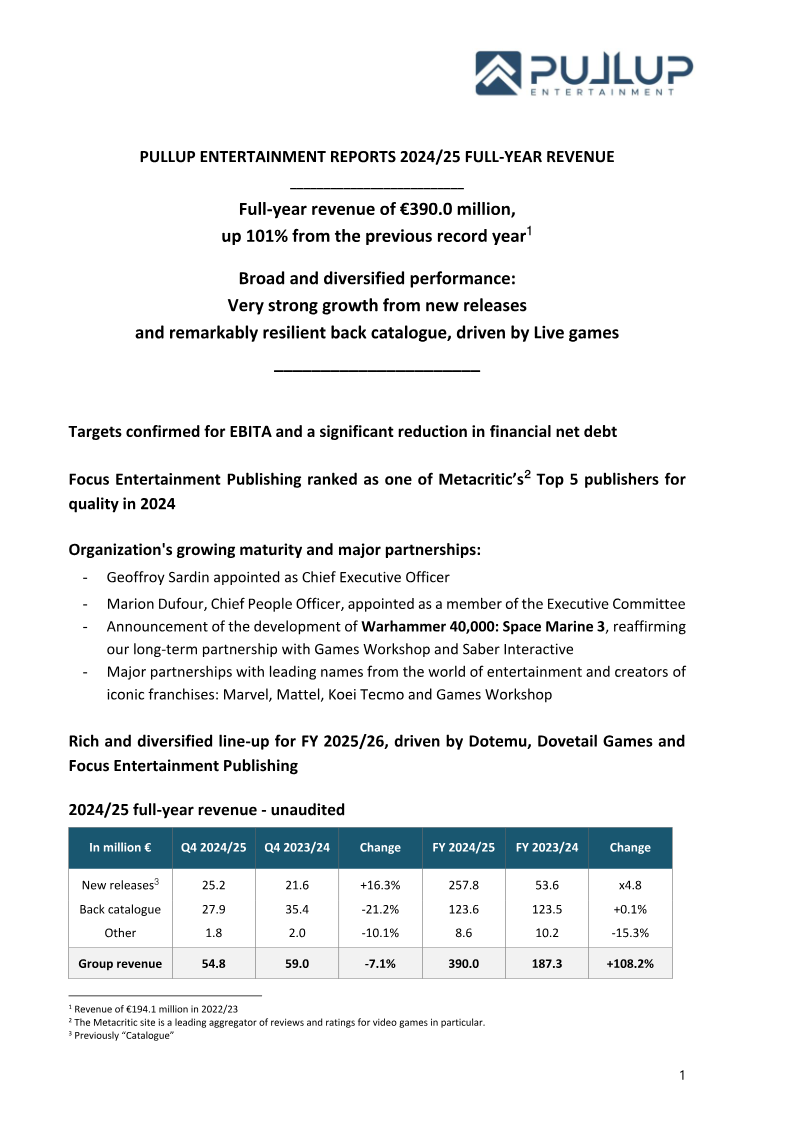
Pullup Entertainment announced a full‑year revenue of €390 million for FY 2024/25, representing a 108 % increase over the prior year and a 101 % rise compared with the previous record of €194 million in 2022/23. The surge was driven primarily by new releases, which generated €257.8 million—four‑fold growth year‑on‑year—while the back‑catalogue remained stable at €123.6 million, underscoring the resilience of live‑service titles such as SnowRunner and Insurgency: Sandstorm. Quarterly revenue fell 7.1 % to €54.8 million, reflecting a modest dip in Q4 sales despite strong performance from recent launches like Warhammer 40,000: Space Marine 2 and Train Sim World 5.
The company confirmed EBITA targets of €55‑60 million, roughly doubling the best result from FY 2022/23, and highlighted a significant reduction in net debt achieved through robust operational cash flow. Strategic positioning in the AA and independent segments, coupled with high‑quality, distinctive titles, was cited as the foundation of the growth, while partnerships with marquee brands—including Marvel, Mattel, Koei Tecmo and Games Workshop—expanded the pipeline of licensed and original IPs. Leadership changes reinforced governance, with Geoffroy Sardin appointed CEO and Marion Dufour joining the executive committee as Chief People Officer.
Looking ahead to FY 2025/26, the firm outlined a diversified slate of upcoming releases across its Focus Entertainment Publishing and Dotemu divisions, featuring new IPs such as Memories in Orbit, Roadcraft, Ninja Gaiden: Ragebound and Marvel Cosmic Invasion, alongside continued live‑service support. The outlook emphasizes exceeding the record revenue and EBITA levels set in 2022‑23, leveraging both fresh titles and the enduring strength of its back‑catalogue. The report covers Pullup’s European operations, encompassing over 600 employees and six development studios, and reflects data drawn from unaudited financial statements for the fiscal year ending 31 March 2025.
The financial results for the third quarter of 2024 reveal a period of stabilization and shifting cost structures within the gaming portfolio. Revenue for the quarter reached $111 million, reflecting a 5% increase from the previous quarter but an 8% decline compared to the same period in 2023. Profitability showed significant recovery from a net loss of $3 million in the first quarter of 2024 to a profit of $15 million in the third quarter, while Adjusted EBITDA remained steady at $16 million.
Operating metrics indicate a transition in user engagement and monetization. Monthly Paying Users (MPUs) grew to 381,000, a 21% increase year-over-year, though Average Bookings Per Paying User (ABPPU) declined by 11% to $92. Total bookings for the quarter stood at $108 million, showing a 6% year-over-year decrease but remaining relatively flat compared to the first half of 2024. The geographic distribution of revenue remains concentrated in the United States at 53%, followed by Europe at 22% and Asia at 14%.
The product portfolio is led by the Hero Wars franchise, with Hero Wars: Alliance and Hero Wars: Dominion Era accounting for 37% and 34% of revenue, respectively. Island Hoppers has emerged as a significant contributor, growing its revenue share from 4% in Q3 2023 to 7% in Q3 2024. Platform distribution remains dominated by mobile at 62%, with PC contributing 38%. Cost management efforts are evident in the reduction of total costs and expenses (excluding depreciation and amortization) to $94 million, down 13% from the prior year, driven largely by a decrease in selling and marketing expenses which now represent 25% of the cost base.
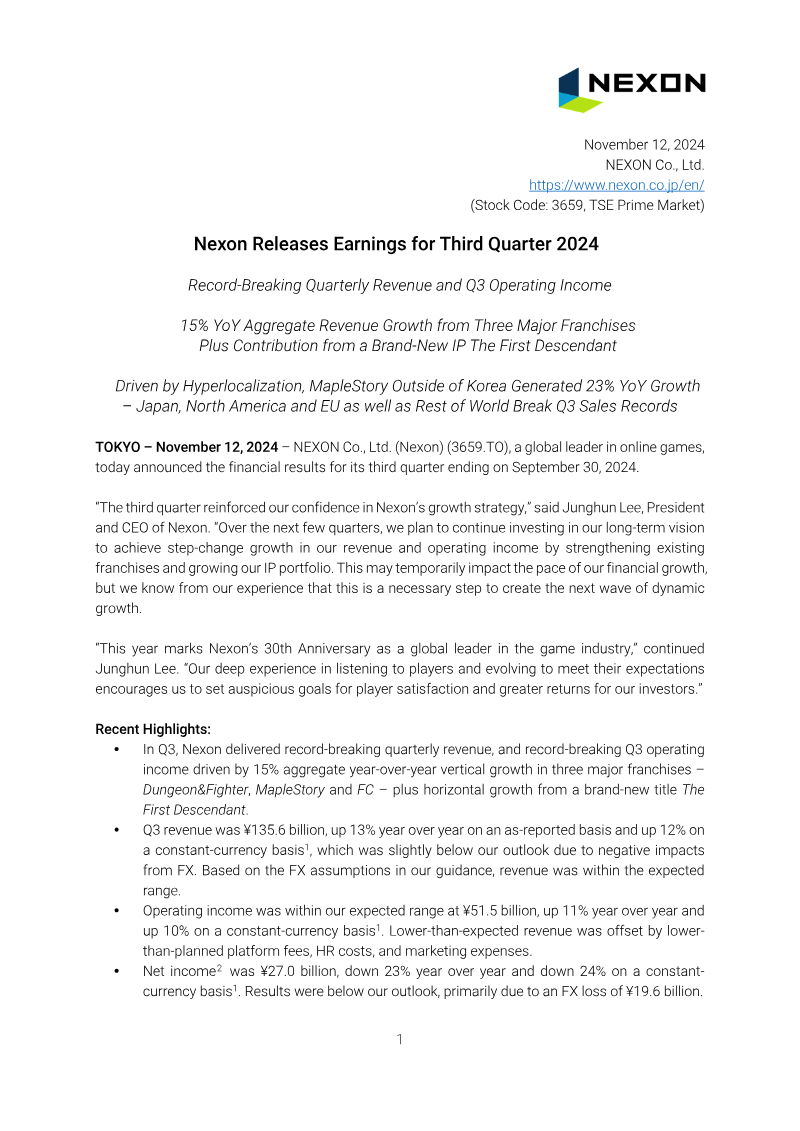
Nexon Co., Ltd. – Q3 2024 Earnings Press Release (Nov 12 2024)
1. Core Financial Results (Q3 2024, ended Sept 30 2024)
| Metric | FY 2024 Q3 | YoY Change | Constant‑Currency (CC) | |--------|------------|------------|------------------------| | Revenue | ¥135.6 bn | +13 % (as‑reported) / +12 % (CC) | Slightly below outlook (FX headwind) | | Operating Income | ¥51.5 bn | +11 % (as‑reported) / +10 % (CC) | Within expected range | | Net Income | ¥27.0 bn | ‑23 % (as‑reported) / ‑24 % (CC) | Impacted by ¥19.6 bn FX loss | | FX Impact | – | Revenue hit by adverse yen movements; FX loss drove net‑income decline |
All figures are in Japanese yen (¥).
2. Growth Drivers & Franchise Performance
| Franchise | Q3 2024 Growth | Highlights | |-----------|----------------|------------| | Dungeon & Fighter (DnF) | +142 % YoY (overall franchise) | • Launch of DnF Mobile in China (May 21) <br>• New updates & “New Year” content for both mobile & PC in China (Q4 2024 / Q1 2025) <br>• Upcoming titles: The First Berserker: Khazan, DnF: Arad, Project OVERKILL | | MapleStory | +23 % YoY (outside Korea) | • Outside‑Korea revenue > 40 % of total <br>• Record Q3 sales in Japan, NA, EU & Rest‑of‑World (hyper‑localization) <br>• Soft‑launch of MapleStory Worlds (NA & SA) <br>• Large Q4 test for MapleStory N (PC MMORPG with blockchain) | | FC (Fighting‑Club) Franchise | Slight decline YoY (tough comparison to record Q3 2023) | • Expect double‑digit YoY growth in Q4 2024 <br>• Full‑year revenue projected near 2023 record | | New IP – The First Descendant | Strong start (July launch) | • ~75 % of global revenue from Western markets <br>• Ongoing updates planned to cement it as a “consistent contributor” |
3. Strategic Initiatives
| Initiative | Focus | Key Actions | |------------|-------|-------------| | Vertical Growth Initiative | Deepen existing franchises | • Product extensions, new platforms, regional expansion, hyper‑localization <br>• New titles & major content updates (see DnF & MapleStory) | | Horizontal Growth Initiative | Add new pillars to the portfolio | • Shooters – The First Descendant, THE FINALS (Season 5 in Dec), ARC Raiders (public test Oct, release 2025) <br
The first half of 2024 presents CD Projekt Group’s financial performance as a blend of solid top‑line growth and heightened cost pressures. Total sales revenue reached 99.6 million PLN, a 31 percent increase over the comparable period in 2023, driven primarily by a resurgence in back‑catalogue sales and expansions of flagship titles such as The Witcher series. Revenue from products and services climbed to 45.9 million PLN, while sales of goods for resale and materials grew modestly to 87.4 million PLN. Gross profit on sales improved to 218.0 million PLN, reflecting a healthier margin despite a 16 percent rise in cost of sales to 170.0 million PLN.
Operating expenses expanded notably, with total operating costs rising to 120.1 million PLN, up from 107.2 million PLN a year earlier. Selling expenses fell to 85.1 million PLN, yet research and development outlays surged, with new development expenditures of 45.9 million PLN and depreciation of 52.9 million PLN. EBIT contracted to 97.9 million PLN from 140.2 million PLN, while net profit after tax declined to 29.3 million PLN, reflecting the impact of higher tax liabilities and a 24 million PLN increase in deferred tax adjustments.
Liquidity indicators show a reduction in cash, deposits and bonds from 1.31 billion PLN at year‑end 2023 to 1.37 billion PLN at the end of June 2024, alongside a 5 percent drop in trade receivables. Total assets grew modestly to 2.66 billion PLN, while equity rose to 2.40 billion PLN, indicating a stable capital structure despite the cash outflow associated with intensified R&D spending and dividend distributions.
The reporting covers CD Projekt Group’s global operations, focusing on its core gaming business, shared services, and ancillary projects such as Polaris, Orion, Sirius and Hadar. All figures derive from the company’s internal financial statements prepared in accordance with Polish accounting standards, with no external survey or sampling methodology applied. The presentation is intended solely as an informational overview and does not constitute investment advice or forward‑looking forecasts.
Electronic Arts presented its first‑quarter fiscal 2025 financial performance, outlining both actual results and outlook for the full year and the subsequent quarter. Net bookings fell 20 % year‑over‑year to $1.262 billion, driven by a 58 % decline in full‑game sales and a modest 7 % drop in live‑services revenue. Platform‑level data show console bookings down 25 % to $677 million, PC and other platforms down 21 % to $295 million, and mobile slipping 4 % to $290 million. Live‑services contributed $1.094 billion of the total bookings, representing 75 % of the quarter’s revenue mix.
GAAP net revenue for the quarter was $1.660 billion, yielding a GAAP operating margin of 21.9 % and earnings per share of $1.04. Non‑GAAP operating margin, which excludes acquisition‑related costs, stock‑based compensation, restructuring charges and capital expenditures, stood at 32.5 %. The company forecast FY25 net revenue of $7.1‑$7.5 billion, GAAP EPS of $3.34‑$4.00, and a non‑GAAP operating margin of 29.6‑31.7 %. Q2 guidance projects net revenue of $1.9‑$2.0 billion and GAAP EPS of $0.76‑$0.93. Free cash flow for the quarter was $53 million, down sharply from $314 million a year earlier, while operating cash flow fell to $120 million.
The release also detailed the FY25 title slate, highlighting new releases such as “EA SPORTS FC 25,” “Madden NFL 25,” “EA SPORTS NHL 25,” and upcoming titles in the Sims, Battlefield and Dragon Age franchises. Constant‑currency adjustments and a foreign‑exchange hedging program are incorporated, with net‑booking guidance reflecting a roughly 2 % currency impact. Financial metrics are presented on both GAAP and non‑GAAP bases, with a 19 % internal tax rate applied for performance evaluation. The scope covers global operations for the quarter ending June 30 2024 and forward‑looking expectations through the end of FY25, reflecting the interactive entertainment industry’s competitive, regulatory and macro‑economic risk environment.
The analysis presents a snapshot of the U.S. public‑equity environment for the gaming industry in the second quarter of 2024, contrasting overall technology strength with sector‑specific performance. While the S&P 500 Information Technology index surged 14 percent, the broader gaming segment failed to keep pace, delivering only modest gains for most publishers. In contrast, the gambling sub‑category generated a robust 29 percent year‑to‑date return, underscoring divergent dynamics within the industry and suggesting that betting‑related businesses are currently the primary drivers of market outperformance.
A parallel valuation component evaluates three publicly listed gaming‑related entities—Guild, Simplicity Esports, and EBET—using multiples sourced from PitchBook and Morningstar as of June 30 2024. The data reveal a scarcity of reliable pricing metrics, with several multiples either unavailable or markedly negative. EBET, in particular, exhibits extreme negative multiples (‑62.7×, ‑5.0×, ‑8.1×, ‑3.8×), reflecting either severe earnings shortfalls or market skepticism about its valuation. These anomalous figures highlight the challenges of applying conventional valuation frameworks to niche or underperforming gaming firms.
Overall, the findings suggest that, despite a bullish backdrop for U.S. technology equities, the gaming sector’s heterogeneous performance and the paucity of credible valuation multiples limit investors’ ability to benchmark and price companies effectively. The evidence points to a need for more granular analysis of sub‑segments, especially gambling, and for alternative valuation approaches when traditional multiples prove unreliable.
The presentation delivers CD Projekt Group’s financial and operational results for the first quarter of 2024, emphasizing revenue growth, profitability improvements, and development activity across its flagship titles. Sales revenue reached 174.8 million PLN, a 30 % increase year‑on‑year, while sales of products and services climbed 42 % to 131.0 million PLN. The Cyberpunk 2077 expansion contributed 75.4 million PLN, offset by a 41 % decline in Witcher‑related sales. Gross profit rose to 120.5 million PLN, and EBIT improved to 71.0 million PLN, delivering a net profit of 86.0 million PLN and a net profitability margin of 44.1 %, up from 39.7 % in the prior quarter.
Balance‑sheet metrics show total assets expanding 4 % to 2.72 billion PLN, driven by a 10 % rise in cash, bank deposits and bonds to 1.45 billion PLN. Equity increased by 4 % to 2.51 billion PLN, while liabilities grew modestly. Development resources intensified, with the number of active developers rising from 403 to 630 across Cyberpunk 2077, Polaris, Orion, Sirius, Hadar and shared‑services projects. Steam data indicate that 95 % of Cyberpunk 2077 reviews were positive as of 30 April 2024, reflecting strong post‑release sentiment despite earlier review‑bombing linked to external events.
The analysis draws on internal financial statements prepared in accordance with Polish accounting standards, supplemented by Steam review statistics and head‑count records. Geographic coverage is global, with all monetary figures reported in Polish złoty, and the time frame spans Q1 2024 compared with the corresponding quarter of 2023. Overall, the quarter demonstrates robust revenue expansion, heightened profitability, and increased development capacity,