Reports in the Esports & Streaming category.
The global esports industry has matured into a significant economic force, reaching an estimated 640 million fans and generating $3 billion in annual revenue by 2026. This ecosystem functions as a primary cultural touchpoint for Generation Z, a digitally native demographic that views competitive gaming with the same level of emotional investment and community identity traditionally reserved for professional sports. Because this audience is currently in a formative stage of brand loyalty, the industry represents a critical environment for companies seeking to establish long-term relationships with high-value consumers.
Engagement within this space is driven less by the games themselves and more by social connectivity, the influence of professional players, and high-quality production standards. Fans demonstrate a high propensity for commercial activity, with over 76 percent having made esports-related purchases within the past year. This demographic is particularly receptive to brand integration, as 85 percent of fans actively notice esports branding, and nearly three-quarters report that these sponsorships directly influence their purchasing decisions. The effectiveness of this channel extends across diverse sectors, including electronics, fashion, and food and beverage, proving that esports serves as a highly efficient gateway for cross-industry marketing.
Ultimately, the esports landscape offers a unique opportunity for brands to leverage the intersection of gaming, music, and streaming to capture a highly engaged audience. By prioritizing authentic engagement strategies that respect the publisher-driven nature of the ecosystem, brands can successfully convert digital interest into tangible loyalty. As these fans continue to prioritize in-game spending and subscription-based services, the industry remains a proven, high-value environment for sustained commercial growth and brand association on a global scale.
Live streaming viewership reached 8.5 billion hours in the second quarter of 2024, marking a 10% year-over-year increase and the industry's first significant growth surge since the post-pandemic decline. This resurgence is characterized by a diversifying platform landscape and a shift in creator influence. While Twitch remains the market leader, its share of hours watched dropped from 70% in Q2 2023 to 60% in Q2 2024. YouTube Gaming capitalized on this shift, growing its share to 23.4%, while newer competitors like Kick and the South Korean platform Chzzk secured spots in the top five.
The competitive landscape for creators is also evolving toward a more decentralized model. The market share held by the top 5% of streamers fell from 98% in 2019 to 86% in 2024, suggesting increased visibility for smaller broadcasters. Content trends highlight the massive impact of major updates and DLCs; for example, Elden Ring saw a 331% viewership surge following its expansion release. While Grand Theft Auto V and League of Legends maintain their positions as the most-watched titles, traditional esports genres like First-Person Shooters and MOBAs have seen their total viewership share decline in favor of Action and RPG categories.
Geographic and niche platform trends show Rumble emerging as a significant player for political content, particularly in North America, where debate-related streams accounted for nearly a third of its weekly viewership. In the creator space, KaiCenat claimed the top overall spot, while Mira led the female creator rankings. The report, produced by Stream Hatchet using data from major global streaming platforms, indicates that the industry is moving away from a "winner-take-all" dynamic toward a more fragmented and diverse ecosystem of platforms, genres, and creators.
The global game streaming market experienced a 10% year-over-year growth in the first quarter of 2024, with the top 500 titles on Twitch generating 3.8 billion hours of watch time. While industry mainstays like Grand Theft Auto V and League of Legends continue to lead the market with 479 million and 379 million hours watched respectively, the landscape is showing signs of gradual diversification. The market share held by the top ten developers decreased from 63% to 59% compared to the previous year, driven in part by breakout successes like Palworld, which secured the eleventh position with 76 million hours watched shortly after its release.
The streaming ecosystem maintains a robust long tail of engagement that spans various genres and eras. Beyond the top-tier competitive titles, significant viewership is distributed across a mix of recent AAA releases, such as Rise of the Ronin and The Legend of Zelda: Tears of the Kingdom, and enduring legacy games like Skyrim and Pokémon Red. Even titles at the lower end of the top 500 rankings, including older entries like L.A. Noire and Morrowind, consistently command over 328,000 hours watched per quarter. This indicates that community interest remains high for both modern indie simulations and classic console franchises long after their initial launch windows.
Methodologically, this analysis focuses strictly on video game content by excluding non-gaming categories such as Just Chatting and filtering out inactive streams to ensure data integrity. The findings highlight a healthy balance between the dominance of established live-service giants and the sustained relevance of a diverse catalog of titles. This trend underscores a maturing market where niche audiences and retro communities contribute significantly to the overall growth and stability of the global streaming audience throughout the early months of 2024.
The live-streaming industry experienced a significant resurgence in the first quarter of 2024, with global viewership reaching 8.2 billion hours watched. This represents a 10% year-over-year increase and marks the first Q1 growth since 2021, signaling a recovery from the post-pandemic decline. While Twitch remains the dominant platform with a 69% market share, its lead narrowed as competitors like YouTube Gaming and Kick gained ground. Notably, Steam emerged as a breakout platform by doubling its hours watched, largely driven by developers using the service to market new releases.
Geographic shifts were prominent in South Korea following Twitch’s exit from the market. Local platforms AfreecaTV and the Naver-backed newcomer Chzzk successfully absorbed the displaced audience, with Chzzk showing rapid growth and high creator retention. In terms of content, Palworld dominated as the top game launch of the quarter, generating 95 million hours watched in its first 30 days and outperforming 2023’s major hits. Grand Theft Auto V reclaimed the overall top spot among games, while the First-Person Shooter (FPS) genre led all categories due to high-profile esports tournaments for Counter-Strike and VALORANT.
The analysis highlights a diversifying creator landscape where co-streaming major events remains a primary driver for top talent like Gaules and Jynxzi. In the female and VTuber segments, established names like Amouranth and Pekora Ch. reclaimed top rankings, while new entrants leveraged trending titles like Palworld and GTA V to achieve triple-digit growth. This data, compiled by Stream Hatchet, utilizes metrics such as hours watched and average concurrent viewers across all major global streaming platforms to provide a comprehensive overview of the current state of digital broadcast media.
The live streaming industry in 2024 underwent a fundamental transformation characterized by decentralization and the diversification of content beyond traditional gaming. As platforms like Kick experienced explosive growth and new services emerged to fill regional voids left by Twitch’s departure from Korea, the ecosystem shifted toward a multi-platform approach. Creators increasingly utilized simulcasting to expand their reach, while high-production marathons and global IRL content became the primary drivers of audience engagement. This evolution reflects a broader move away from platform exclusivity toward a creator-led model where individual influence dictates viewership patterns.
Esports and competitive gaming remained central to the industry’s success, though the nature of consumption changed significantly. Co-streaming emerged as a dominant force, accounting for nearly 45 percent of all esports viewership, while mobile esports solidified its status as a global powerhouse, particularly during the Esports World Cup. Simultaneously, the industry benefited from a strong synergy between transmedia adaptations and gaming, as film and television projects like Fallout revitalized interest in specific titles. The rise of VTubers and the enduring popularity of RPGs and nostalgia-driven remakes further sustained high levels of viewer retention throughout the year.
Beyond gaming, the landscape expanded to include political commentary, music-focused programming, and massive independent events that rivaled traditional broadcast media. Large-scale spectacles, such as La Velada del Año 4, demonstrated the potential for creators to command millions of concurrent viewers outside of established gaming frameworks. Brands successfully capitalized on these shifts by integrating directly into the viewer experience through strategic initiatives like Twitch Drops. Ultimately, the industry in 2024 proved that long-term growth is now tethered to the ability to blend interactive community engagement with diverse, multi-genre content that transcends the traditional boundaries of the gaming sector.
The live‑streaming landscape in 2024 was defined by rapid platform diversification and the rise of cross‑platform broadcasting, which together reshaped how audiences consume both gaming and non‑gaming content. Kick surged by 176 % to deliver 1.7 billion hours of viewership, propelled by marquee events such as the 1.4 million‑viewer “Stream Fighters 3.” New entrants from Korea, including Chzzk and SOOP Korea, contributed tens of millions of hours and helped elevate titles like League of Legends and Minecraft to the top of platform charts. Simulcasting became the dominant distribution model, generating concurrent‑viewer gains ranging from 148 % to 491 % for leading creators, while the majority of top streamers now broadcast on multiple services simultaneously.
Co‑streaming emerged as the primary driver of esports engagement, accounting for 44.4 % of all esports viewership and roughly 1.2 billion hours watched. Signature events such as the Twitch Rivals “Hunt & Run” derived nearly all of their watch time from co‑streams, prompting organizers and brands to allocate substantial budgets toward high‑profile personalities who add commentary and community interaction. This collaborative format has become a cornerstone of audience growth and monetisation strategies across the sector.
Creator influence extended beyond traditional gaming, with Kai Cenat’s 185 million‑hour IRL marathon on Kick and IShowSpeed’s 47 million‑hour output highlighting the power of individual personalities. The year also saw a surge in VTuber viewership, exemplified by Usada Pekora, and strong performance from legacy titles such as Dragon’s Dogma 2, which amassed
The gaming industry experienced record-breaking engagement in 2023, with the top 500 titles on Twitch generating nearly 15 billion hours of watch time. This viewership was characterized by extreme concentration at the top of the rankings, as a mere 11 titles accounted for half of the total watch time. Grand Theft Auto V led the industry with 1.3 billion hours watched, while Fortnite demonstrated the highest level of creator engagement, boasting 2.8 million unique channels—more than double its nearest competitor.
The streaming landscape across 2023 showcased a diverse mix of modern AAA releases, indie sensations, and enduring legacy titles. While competitive staples like VALORANT and League of Legends dominated the upper echelons, the rankings revealed significant staying power for older franchises. Titles such as Super Mario 64, Age of Empires II, and various entries from The Legend of Zelda series maintained millions of hours of watch time, often outperforming newer releases. This trend highlights a bifurcated market where viewers gravitate toward both high-stakes competitive play and nostalgic speedrunning or retro content.
The data, which excludes non-gaming categories like "Just Chatting" and tabletop games to focus strictly on video game performance, indicates that even titles at the bottom of the top 500 maintain substantial audiences. Games ranked between 400 and 500, such as Tekken 8 and PICO PARK, still commanded approximately 1.8 million to 2.2 million hours watched each. This comprehensive analysis across PC, console, and mobile platforms underscores a resilient ecosystem where niche indie horror, classic RPGs, and modern shooters coexist, maintaining high viewer retention despite broader economic volatility within the development sector.
The East Asian videogame livestreaming market is a mature and culturally distinct ecosystem where competitive esports serve as the primary engine for audience engagement. During the first half of 2023, MOBA and Battle Royale titles accounted for over half of the region's most-watched content. While established franchises like League of Legends maintain a dominant presence, the market is increasingly shaped by the influence of Key Opinion Leaders and VTubers. These creators contribute up to 15% of total viewership for major titles and have demonstrated the power to revitalize older games such as Minecraft and Escape from Tarkov.
Regional preferences reveal a bifurcated landscape where specific titles command massive scale. In China, Honor of Kings remains the undisputed leader with 5.67 billion views, while VALORANT and Apex Legends dominate the Japanese and Korean markets, each surpassing 100 million hours watched. The barrier to entry for new releases is high, as only high-profile 2023 titles like Diablo IV, Honkai: Star Rail, and Street Fighter 6 managed to break into regional top-ten rankings. The rapid ascent of Honkai: Star Rail in China notably came at the expense of Genshin Impact, which saw a 31% decline in viewership as audiences shifted toward the newer release.
The integration of granular streaming analytics and market intelligence is essential for navigating this complex environment. By tracking metrics across platforms such as Twitch, YouTube, and AfreecaTV, stakeholders can monitor audience retention and demographic shifts. This data-driven approach highlights the volatility of the market, evidenced by the 68.5% decline in Splatoon 3 viewership following its launch period. Understanding these dynamics—ranging from the professional esports circuit to the rising prominence of virtual avatars—is critical for identifying growth opportunities and executing successful market entry strategies across Asia.
The primary aim of the analysis is to map the state of global video‑game streaming in the first quarter of 2022, linking audience behavior to platform performance, game releases, and advertising potential. While overall viewership growth has begun to temper—total hours watched fell 6 % from the previous quarter—it remains 66 % higher than the same period in 2020 and 140 % above Q1 2019, underscoring the sector’s continued expansion despite pandemic stabilization.
Twitch retains overwhelming dominance, delivering roughly three‑quarters of all streamed hours and accounting for 80 % of esports viewership, which itself showed only a 0.3 % dip year‑over‑year but rose 63 % since 2019. Emerging competitors such as AfreecaTV, Trovo and NaverTV posted double‑digit growth, yet YouTube and Facebook together contributed less than 10 % of total hours. Core viewers—just 7.8 % of the audience—generated two‑thirds of watch time, averaging 276 minutes per day and proving 24 times more receptive to repeated advertising than casual viewers, who average 12 minutes daily.
Game‑level insights reveal that legacy titles like Grand Theft Auto V and League of Legends remain top‑draws, while new releases such as Elden Ring and Lost Ark captured strong core‑viewer engagement, each accounting for over half of their streaming hours. Mobile game streaming is heavily core‑oriented, with 78 % of hours coming from core fans despite casual dominance in downloads. Content creators mirror these patterns: xQcOW led live streams with 62.8 million hours, while VOD‑first creators like Rubius generated twice as many video‑on‑demand views per concurrent viewer, highlighting divergent monetization pathways.
The global esports and live streaming industry is undergoing a period of robust expansion, with total esports revenue projected to reach $1.38 billion in 2022 and an audience base of 532 million people. This growth trajectory is expected to continue, with market valuations potentially hitting $1.86 billion by 2025. While sponsorship remains the dominant revenue stream, accounting for nearly 60 percent of total earnings, the industry is actively diversifying its financial models. Organizations are increasingly pivoting toward direct-to-fan strategies, including digital merchandise, loyalty programs, and educational initiatives, to mitigate risk and transition toward sustainable, lifestyle-oriented business models.
The live streaming sector serves as a critical pillar of this ecosystem, with its audience projected to grow to 1.41 billion by 2025. Market dominance is currently split between major platforms like Twitch, YouTube Gaming, and Facebook Gaming, each leveraging distinct regional strengths. Twitch maintains a stronghold in Western PC and console markets, whereas YouTube and Facebook are capitalizing on the rapid proliferation of mobile gaming in emerging economies. These platforms are further evolving by integrating non-gaming content and interactive features to enhance user retention and broaden monetization opportunities.
Despite the positive outlook, the industry must navigate potential volatility stemming from shifting media consumption habits, evolving publisher investment strategies, and the lingering economic effects of the pandemic. Nevertheless, the sector remains highly attractive to stakeholders due to its core demographic of young, high-income professionals. As the market matures, the integration of co-streaming and the expansion into emerging regions—supported by localized platforms—will be essential for maintaining long-term growth and fostering deeper engagement with a global, digitally native audience.
The Consumer Insights: Games and Esports 2022 report provides a comprehensive analysis of global gaming behaviors, motivations, and market engagement. The primary purpose of the research is to equip game developers, publishers, and industry stakeholders with actionable data to benchmark titles, understand player demographics, and identify growth opportunities across 36 diverse international markets. By examining over 100 key performance indicators, the analysis offers a granular view of how players interact with PC, console, and mobile platforms.
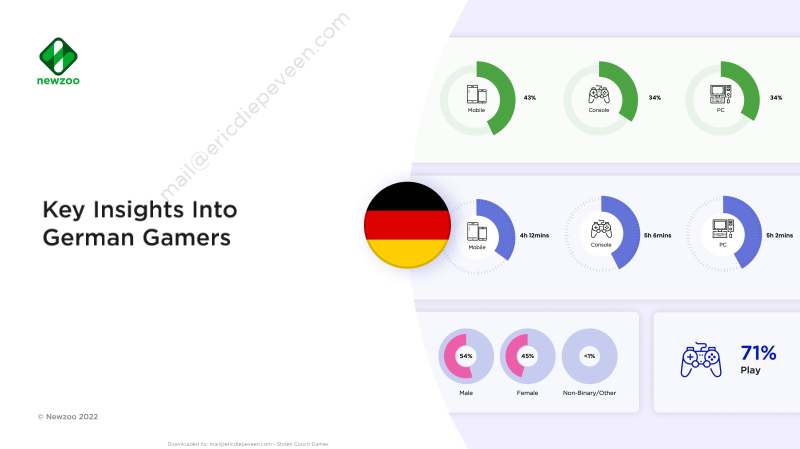
The research is underpinned by a robust methodology, drawing on survey data from over 75,000 consumers worldwide. The findings highlight distinct engagement patterns, such as the prevalence of specific gaming personas—notably Time Fillers and Mainstream Gamers—and the interplay between playing and viewing habits. For instance, data from the German market indicates that while playing remains the dominant activity, a significant portion of the population also engages with gaming video content and esports. Furthermore, the report identifies key drivers for consumer spending, noting that price sensitivity, the desire for exclusive content, and social connectivity are primary motivators for financial investment in games.
Covering a broad geographic scope that includes North America, Europe, Latin America, the Middle East, and the Asia-Pacific region, the report serves as a strategic tool for navigating the complex global gaming landscape. By synthesizing metrics such as monthly active users, daily active users, and lifetime player value, the analysis facilitates a deeper understanding of the motivations driving player behavior. Ultimately, the findings emphasize that a nuanced approach to audience segmentation and platform-specific engagement is essential for companies seeking to reach and retain diverse gaming populations in an increasingly competitive entertainment market.
The global gaming industry is currently undergoing a structural transformation characterized by the integration of emerging technologies and a pivot toward cross-platform accessibility. Central to this evolution is the expansion of cloud gaming, which serves as a critical bridge to overcome hardware constraints, allowing publishers to reach broader audiences on mobile devices and legacy consoles. Simultaneously, the metaverse is maturing into a robust commercial ecosystem, fueled by significant venture capital investment, the proliferation of virtual real estate, and the integration of digital fashion. These developments signal a broader industry shift toward enhanced creator-viewer interactivity and the adoption of Web3.0 business models.
Monetization strategies are diversifying as companies experiment with blockchain-based player trading and fan engagement tools, despite notable consumer resistance toward non-fungible tokens. This period is also defined by a surge in high-quality cross-media intellectual property adaptations and a crowded release calendar, which intensifies competition for consumer attention. Furthermore, regulatory and consumer pressures are forcing a transition toward more open app store ecosystems, challenging traditional distribution gatekeepers.
Within the esports sector, organizations are actively diversifying revenue streams by prioritizing mobile-first titles and leveraging co-streaming to maximize viewership reach. These trends, observed throughout 2022, reflect a strategic effort to sustain growth across global markets. By synthesizing market intelligence and tracking key performance metrics, the industry continues to navigate the complexities of digital transformation, balancing the pursuit of innovative monetization with the necessity of maintaining user trust in an increasingly interconnected virtual landscape.