Ubisoft
Game Co.40 documents
Documents
Report9 pages
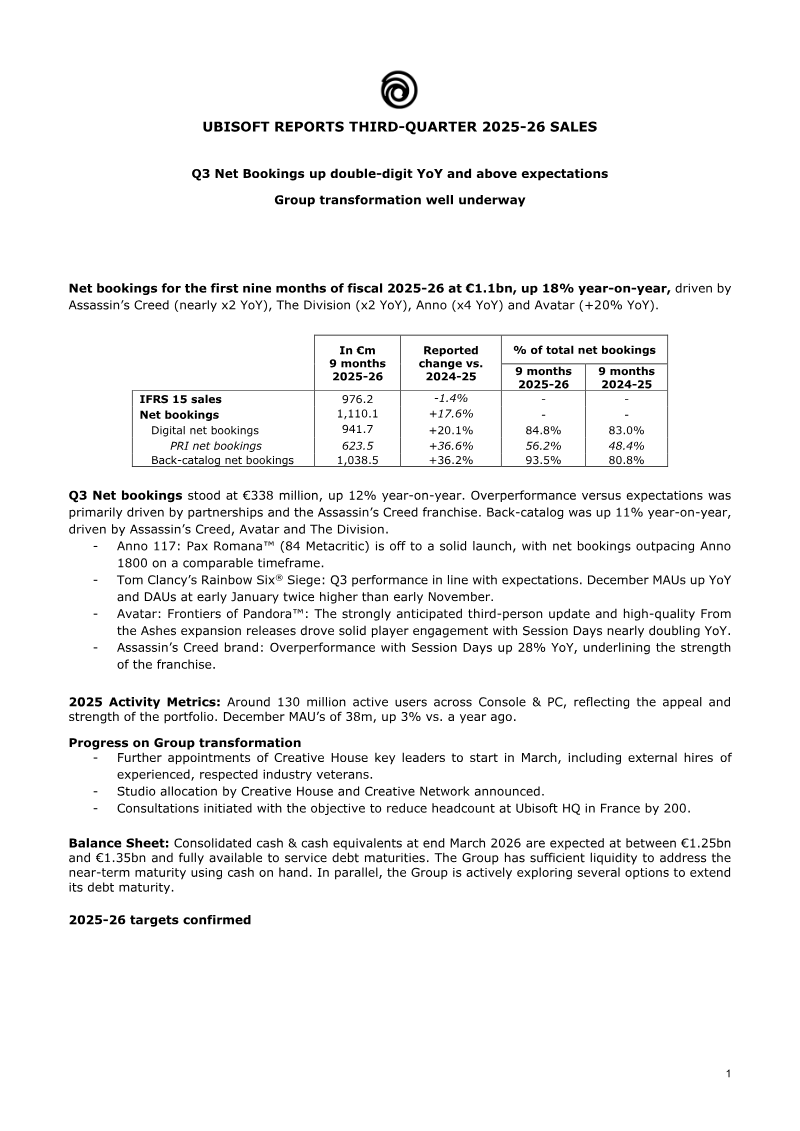
Ubisoft Reports Third-Quarter 2025-26 Sales
Ubisoft announced that net bookings for the first nine months of fiscal 2025‑26 reached €1.11 billion, an 18 % year‑on‑year increase driven by strong performance from Assassin’s Creed, The Division, Anno 117: Pax Romana and Avatar. Digital net bookings rose 20 % to €941.7 million, while back‑catalog sales grew 36 % to €1.04 billion, reflecting sustained demand for legacy titles and new releases such as Assassin’s Creed Shadows on Switch 2 and the Avatar: Frontiers of Pandora expansion. The third‑quarter figure of €338 million exceeded guidance by 12 %, with partnerships and franchise sales contributing most to the lift. Player activity metrics remained robust, with 130 million unique active users in 2025 and December MAUs at 38 million, up 3 % YoY.
The Group’s transformation continues, with the new Creative House operating model taking shape through studio reallocation and senior leadership appointments. Headcount reductions of 200 positions at Ubisoft HQ France are underway to streamline operations. Financially, consolidated cash stands between €1.25 billion and €1.35 billion, sufficient to cover near‑term debt maturities while the Group explores extensions of its debt profile.
Outlook for 2025‑26 confirms net bookings near €1.5 billion, non‑IFRS EBIT around –€1 billion, and free cash flow between –€400 million and –€500 million. Q4 launches include Rainbow Six Mobile, scheduled for February 23, and The Division Resurgence, with additional content planned across the franchise portfolio. Geographic revenue shares show Europe at 40 %, Northern America 46 %, and the rest of the world 14 %. Platform distribution remains dominated by consoles (55 %) and PCs (28 %), with mobile contributing 7 %.
- Ubisoft reported nine-month net bookings of €1.11 billion, an 18% year-on-year increase, with third-quarter results of €338 million exceeding guidance by 12%.
- Back-catalog sales grew 36% to €1.04 billion, driven by sustained demand for legacy titles and new releases like the Avatar: Frontiers of Pandora expansion and Assassin’s Creed Shadows.
- The company maintains a consolidated cash position between €1.25 billion and €1.35 billion while undergoing a restructuring that includes 200 headcount reductions at its French headquarters.
- Full-year 2025-26 outlook projects net bookings near €1.5 billion, with non-IFRS EBIT expected at –€1 billion and free cash flow between –€400 million and –€500 million.
- Player engagement remains strong with 130 million unique active users in 2025 and December monthly active users (MAUs) reaching 38 million, a 3% year-on-year increase.
+1
Ubisoft
Report7 pages
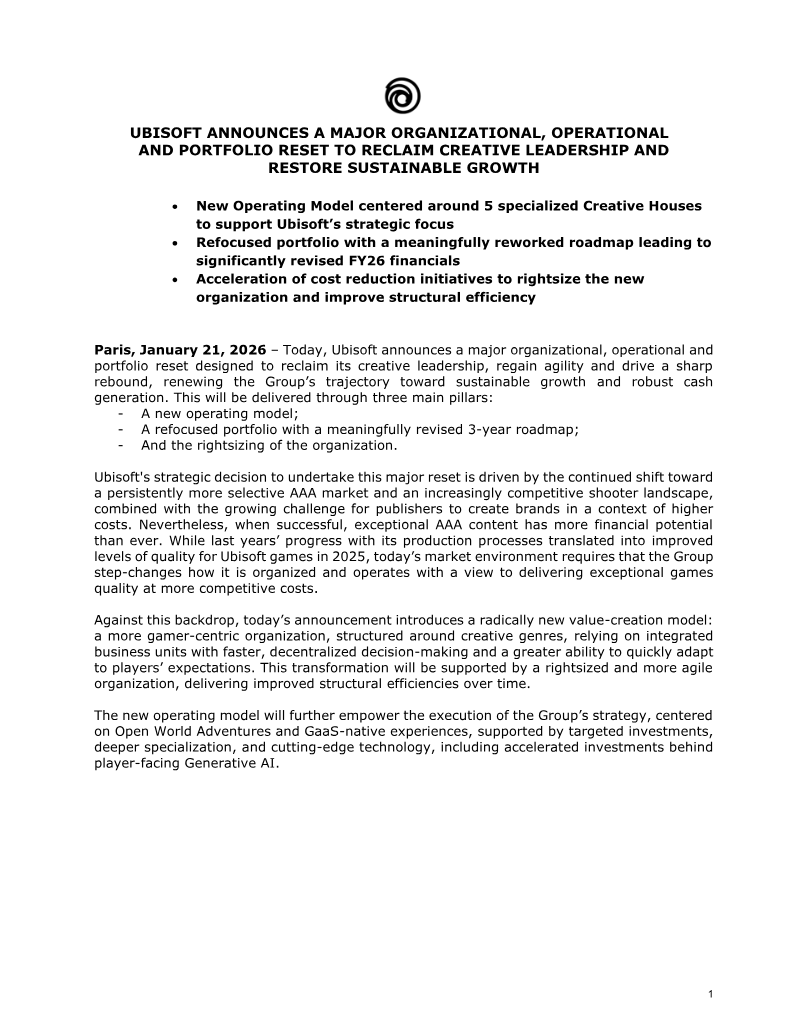
Ubisoft announces a major organizational, operational and portfolio reset to reclaim creative leadership and restore sustainable growth
Ubisoft announces a comprehensive reset aimed at restoring creative leadership and sustainable growth amid a more selective AAA market. The strategy centers on three pillars: a new operating model, a refocused portfolio with an updated three‑year roadmap, and organizational rightsizing. The operating model introduces five Creative Houses—each genre‑focused, fully responsible for development, publishing, and financial performance—supported by a Creative Network of studios and shared Core Services. This structure is intended to accelerate decision‑making, deepen specialization in Open World Adventures and GaaS‑native experiences, and embed generative AI initiatives.
Portfolio adjustments include discontinuing six titles that fail new quality thresholds, extending development timelines for seven games to meet higher standards, and reallocating resources toward high‑potential IPs such as “March of Giants.” These changes are expected to reduce net bookings for FY26 by roughly €330 million and push non‑IFRS EBIT into the negative, reflecting one‑off depreciation costs. Free cash flow is projected between –€400 million and –€500 million, with net debt rising to €150–250 million.
Cost‑reduction efforts target a total fixed‑cost savings of approximately €500 million since FY22, with an accelerated €100 million cut already achieved by March 2026 and a further €200 million planned over the next two years, bringing fixed costs to about €1.25 billion by March 2028. The reset is set to take effect in early April, with a revised FY26–27 financial outlook to be released in May.
- Ubisoft is restructuring into five genre-focused 'Creative Houses' to accelerate decision-making and specialize in Open World Adventures and GaaS-native experiences.
- The company is discontinuing six titles and extending development timelines for seven others to meet new quality thresholds, resulting in a projected €330 million reduction in FY26 net bookings.
- Financial projections for FY26 include negative non-IFRS EBIT, free cash flow between –€400 million and –€500 million, and a net debt increase to €150–250 million.
- Fixed-cost reduction targets aim to bring total costs to approximately €1.25 billion by March 2028, with an additional €200 million in cuts planned over the next two years.
- The organizational reset includes the integration of generative AI initiatives and a strategic resource reallocation toward high-potential IPs such as 'March of Giants.'
+1
Ubisoft
Financial9 pages
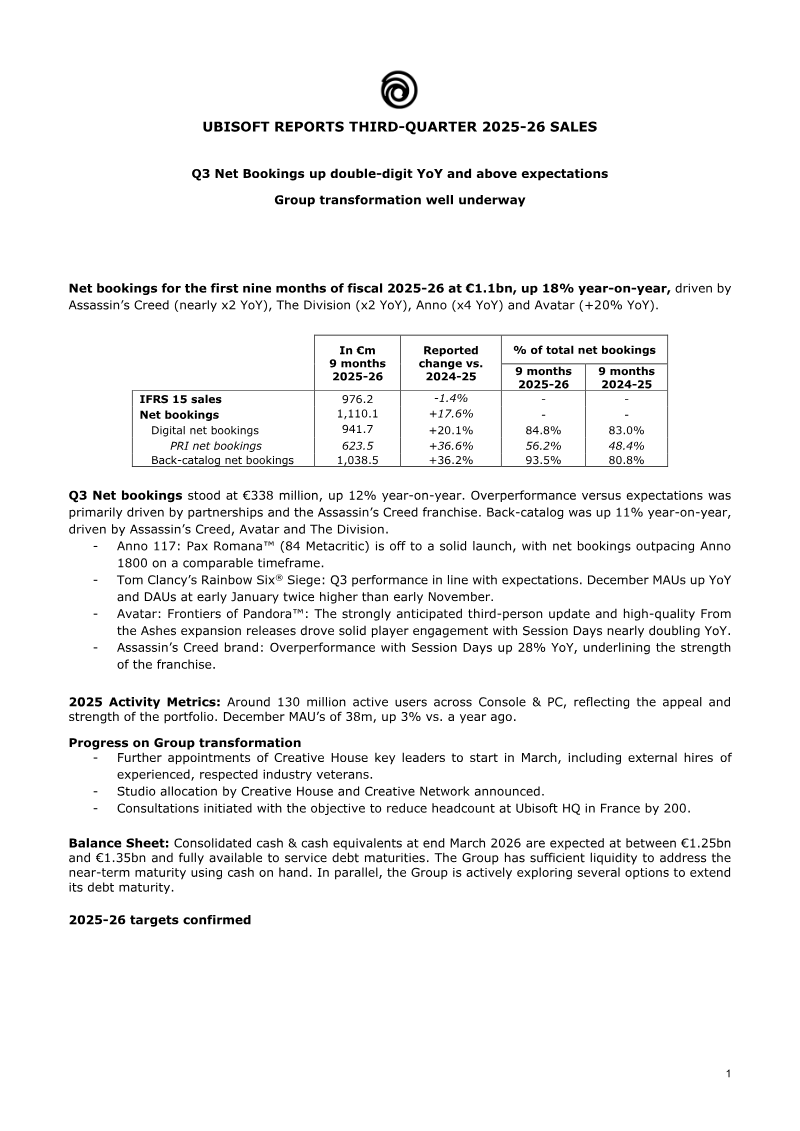
Ubisoft Third-Quarter 2025-26 Sales Report
Ubisoft’s third‑quarter fiscal 2025‑26 results show a double‑digit year‑over‑year rise in net bookings, reaching €338 million (12% YoY) and €1.11 billion for the first nine months, surpassing guidance and reflecting strong performance from its flagship franchises. Net bookings grew 18% YoY, driven by Assassin’s Creed, The Division, Anno 117: Pax Romana and Avatar: Frontiers of Pandora. Digital bookings increased 20%, while back‑catalog sales rose 11%, supported by successful live‑content releases and expansion updates. The Group’s active user base remained robust, with 34 million console‑and‑PC monthly active users in Q3 and a cumulative 130 million unique users for the calendar year, indicating sustained engagement across its portfolio.
Geographically, Europe accounted for 40% of bookings, Northern America 46%, and the rest of the world 24%. Platform mix shifted slightly toward PC (41%) from 26% in the prior year, while console bookings held at 55%. Ubisoft confirmed its full‑year targets: net bookings of €1.5 billion, non‑IFRS EBIT around –€1 billion, free cash flow between –€400 m and –€500 m, and net debt of €150‑250 m. The Group’s balance sheet remains healthy with €1.25‑€1.35 billion in cash, sufficient to cover near‑term debt maturities.
The transformation initiative continues, with the new Creative House operating model taking shape and leadership appointments underway. Key studio allocations have been announced, and a voluntary departure plan aims to reduce Ubisoft HQ headcount by 200 positions. Recent strategic moves include Tencent’s €1.16 billion investment in Vantage Studios, the launch of generative‑AI experience Teammates, and acquisition of March of Giants to enter the MOBA segment. These actions reinforce Ubisoft’s focus on creative ambition, financial flexibility, and long‑term growth in a selective market.
- Ubisoft reported Q3 fiscal 2025-26 net bookings of €338 million, a 12% year-over-year increase that contributed to a nine-month total of €1.11 billion.
- Growth was driven by an 18% year-over-year rise in net bookings from flagship franchises including Assassin’s Creed, The Division, Anno 117: Pax Romana, and Avatar: Frontiers of Pandora.
- The company maintained a robust engagement level with 34 million monthly active users on console and PC during Q3 and a cumulative 130 million unique users for the calendar year.
- Platform distribution shifted significantly toward PC, which now accounts for 41% of bookings compared to 26% in the prior year, while console remains the primary driver at 55%.
- Full-year financial guidance remains unchanged, targeting €1.5 billion in net bookings and a non-IFRS EBIT of approximately –€1 billion, supported by a cash position of €1.25–€1.35 billion.
+3
UbisoftFeb 2026
Legal1 pages
Information Relative au Nombre Total de Droits de Vote et d’Actions Composant le Capital Social
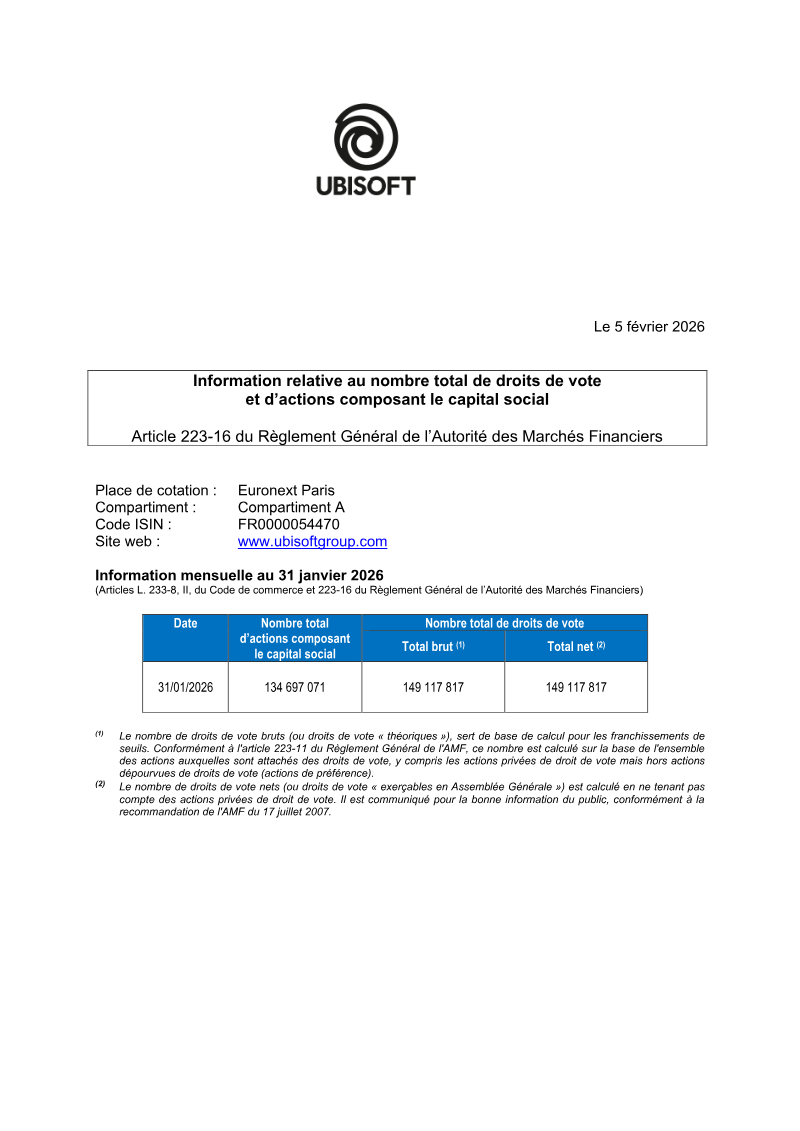
Ubisoft Entertainment SA released its monthly regulatory disclosure regarding its share capital and voting rights as of January 31, 2026. This mandatory filing, submitted in accordance with the General Regulations of the Autorité des Marchés Financiers and the French Commercial Code, provides transparency for investors and regulatory bodies regarding the company's ownership structure. The data pertains specifically to Ubisoft’s listing on Euronext Paris under the ISIN code FR0000054470.
As of the end of January 2026, the total share capital of the company consisted of 134,697,071 shares. The disclosure identifies two distinct categories of voting rights: gross and net. The total number of gross, or theoretical, voting rights reached 149,117,817. This figure serves as the official basis for calculating threshold crossings by shareholders. It includes all shares with attached voting rights, even those temporarily deprived of such rights, while excluding preference shares that lack voting rights entirely.
The total number of net voting rights, which represents the actual votes exercisable at General Meetings, was also recorded at 149,117,817. This net figure is calculated by subtracting shares deprived of voting rights from the gross total. The alignment of gross and net figures suggests that, at the time of the report, there were no significant holdings of treasury shares or other instruments that would typically result in the suspension of voting rights. This monthly update ensures that the public remains informed of the company's capital composition and the precise metrics required for legal compliance regarding shareholder influence.
- As of January 31, 2026, Ubisoft Entertainment SA reports a total share capital of 134,697,071 shares.
- The total number of theoretical (gross) voting rights for the company stands at 149,117,817.
- The total number of exercisable (net) voting rights is 149,117,817, matching the gross figure.
- The alignment of gross and net voting rights indicates that no shares were deprived of voting rights, such as treasury shares, as of the reporting date.
- The reported figures serve as the official basis for calculating shareholder threshold crossings for Ubisoft’s listing on Euronext Paris (ISIN FR0000054470).
UbisoftFeb 2026
Presentation8 pages
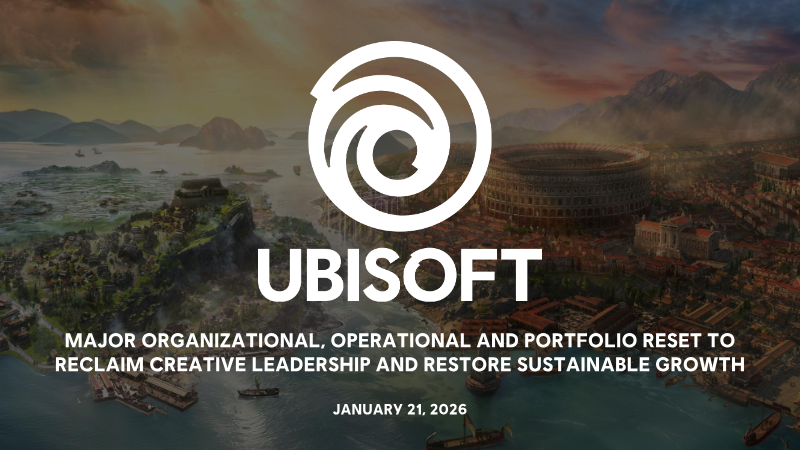
Major Organizational, Operational and Portfolio Reset to Reclaim Creative Leadership and Restore Sustainable Growth
Ubisoft has initiated a major organizational and operational reset designed to reclaim creative leadership and restore sustainable growth in an increasingly selective AAA market. This strategic pivot addresses rising development costs and the competitive challenges of establishing new intellectual properties. The transformation is built upon three primary pillars: the implementation of a new operating model, a refocused game portfolio with a revised three-year roadmap, and a significant rightsizing of the global organization to improve agility and reduce fixed costs.
The new operating model decentralizes production into five distinct Creative Houses supported by a centralized Creative Network and Core Services. These houses are specialized by genre and business model, focusing on billionaire brands like Assassin’s Creed and Far Cry, competitive shooters such as Rainbow Six and Ghost Recon, live-service experiences, immersive narrative universes, and casual family-friendly titles. To support this focus, Ubisoft has discontinued six games—including the Prince of Persia: The Sands of Time remake and four unannounced titles—while allocating additional development time to seven other projects to ensure higher quality standards.
Financial restructuring is a critical component of this reset, with the company targeting a total reduction in fixed costs of approximately €500 million by March 2028 compared to FY23 levels. This includes the closure of studios in Halifax and Stockholm, alongside restructurings in Abu Dhabi, RedLynx, and Massive. For FY26, the group anticipates net bookings of approximately €1.5 billion and a non-IFRS EBIT loss of around €1 billion, largely due to a €650 million one-off accelerated depreciation from canceled and delayed titles. Moving forward, the group aims to reach a run-rate fixed cost base of €1.25 billion by 2028, prioritizing robust cash generation and a more disciplined approach to capital allocation.
- Ubisoft is targeting a €500 million reduction in fixed costs by March 2028 compared to FY23 levels to restore sustainable growth.
- The company is restructuring into five specialized Creative Houses to focus on core franchises like Assassin’s Creed, Far Cry, and Rainbow Six while improving operational agility.
- Ubisoft has canceled six projects, including the Prince of Persia: The Sands of Time remake and four unannounced titles, while extending development timelines for seven others to prioritize quality.
- The company projects an FY26 non-IFRS EBIT loss of approximately €1 billion, driven by €650 million in one-off depreciation charges from canceled and delayed games.
- To achieve a target run-rate fixed cost base of €1.25 billion by 2028, Ubisoft is closing studios in Halifax and Stockholm and restructuring operations in Abu Dhabi, RedLynx, and Massive.
+1
UbisoftJan 2026
Article
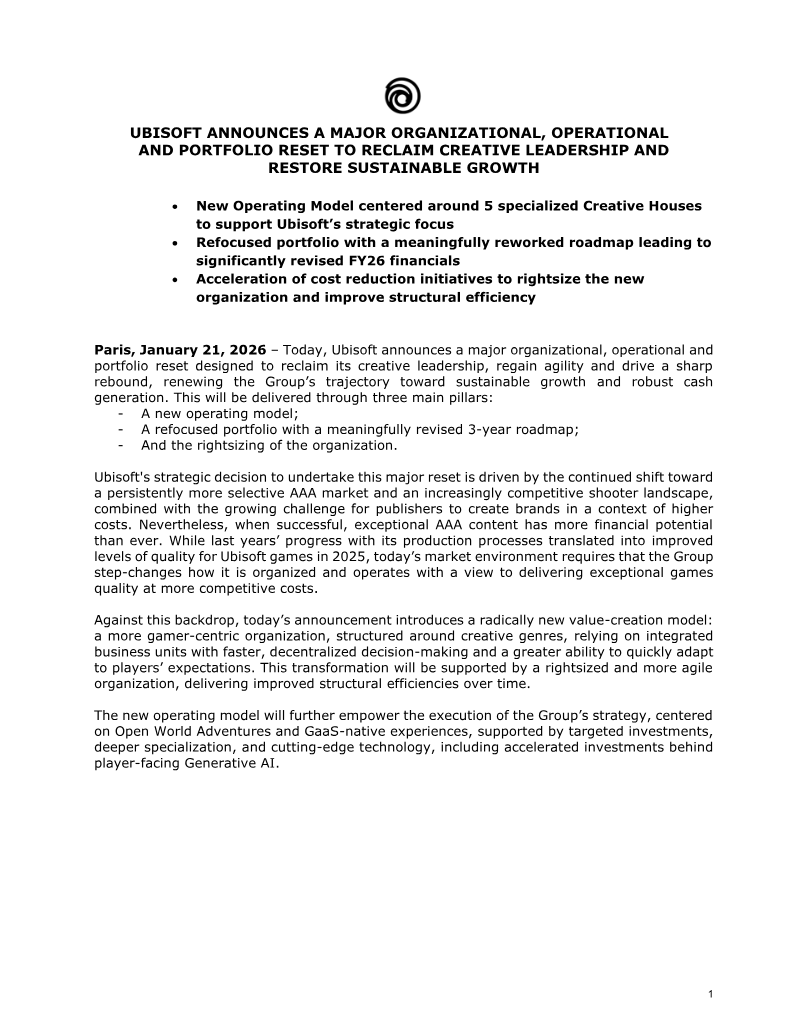
Ubisoft Announces a Major Organizational, Operational and Portfolio Reset
Ubisoft has announced a comprehensive organizational and portfolio reset aimed at reclaiming creative leadership and restoring sustainable growth. This strategic pivot responds to an increasingly selective AAA market, rising development costs, and a competitive landscape for shooter and live-service games. The transformation is built upon three primary pillars: a new decentralized operating model, a refocused product portfolio, and an accelerated cost-reduction program designed to rightsize the company for long-term efficiency.
The centerpiece of this reset is the establishment of five specialized Creative Houses, which will operate as integrated business units with full financial and creative ownership over specific genres. These units include Vantage Studios, focused on flagship franchises like Assassin’s Creed and Far Cry; a house for competitive shooters; one for live-service experiences; a division for immersive fantasy and narrative universes; and a final house dedicated to casual and family-friendly titles. This structure is supported by a centralized Creative Network for production capacity and a Core Services division providing shared technology, including increased investment in generative AI. To bolster collaboration, the company is also mandating a return to five days per week on-site for all teams.
The portfolio reset involves the discontinuation of six games, including the Prince of Persia: The Sands of Time remake, and the delay of seven other titles to ensure they meet higher quality benchmarks. These changes have led to a significant revision of financial outlooks for fiscal years 2026 and 2027. For FY2026, Ubisoft expects net bookings of approximately €1.5 billion and a non-IFRS EBIT loss of around €1 billion, largely due to a €650 million one-off accelerated depreciation. To mitigate these impacts, the company is accelerating its cost-saving initiatives, targeting a total fixed cost reduction of €500 million since FY2023, with the goal of reaching a run-rate of €1.25 billion in total fixed costs by March 2028.
- Ubisoft is restructuring into five specialized Creative Houses—Vantage Studios, competitive shooters, live-service, immersive fantasy, and casual/family—to grant units full financial and creative ownership over their genres.
- The company is targeting a total fixed cost reduction of €500 million since FY2023, aiming for a run-rate of €1.25 billion in total fixed costs by March 2028.
- Financial outlooks for FY2026 project net bookings of approximately €1.5 billion and a non-IFRS EBIT loss of roughly €1 billion, driven by a €650 million one-off accelerated depreciation.
- The portfolio reset includes the cancellation of six games, such as the Prince of Persia: The Sands of Time remake, and the delay of seven additional titles to improve quality.
- To support the new decentralized operating model, Ubisoft is mandating a return to five days per week on-site for all employees.
+1
UbisoftJan 2026
Article
Ubisoft Appoints Valentine Piedelievre-Eman as Chief Communications Officer
Ubisoft has appointed Valentine Piedelievre-Eman as Chief Communications Officer, effective February 2, 2026. Operating out of the company’s Paris headquarters, Piedelievre-Eman is tasked with leading the development and implementation of a global communications and corporate brand strategy. This role focuses on aligning the company’s narrative with its creative vision and long-term goals while fostering engagement across international teams and player bases. Reporting directly to Cécile Russeil, Executive Vice President of Communications, Corporate Affairs, DIA, Human Resources, and Legal, the appointment is positioned as a strategic move to support Ubisoft’s ongoing comprehensive business transformation.
The selection of Piedelievre-Eman brings significant experience from the entertainment and technology sectors to the gaming industry. She previously served as Vice President of Corporate Communications for Western Europe and Africa at Warner Bros. Discovery, managing publicity and corporate messaging for major brands including HBO Max, Eurosport, and Warner Bros. Pictures. Her professional background also includes senior leadership roles at SAP and Expleo, as well as foundational experience in journalism with Bloomberg and the Associated Press.
This leadership change occurs as Ubisoft manages a diverse portfolio of global franchises such as Assassin’s Creed, Far Cry, and Tom Clancy’s Rainbow Six. The company reported net bookings of €1.85 billion for the 2024–25 fiscal year, underscoring the scale of the operations Piedelievre-Eman will now oversee from a communications perspective. By elevating communications to a strategic function, Ubisoft aims to better define its corporate narrative and support its business objectives during a period of organizational evolution.
- Ubisoft has appointed Valentine Piedelievre-Eman as Chief Communications Officer, effective February 2, 2026, to lead global corporate brand strategy and narrative alignment.
- Piedelievre-Eman will report directly to Cécile Russeil, Executive Vice President of Communications, Corporate Affairs, DIA, Human Resources, and Legal.
- The appointment is a strategic move to support Ubisoft’s ongoing comprehensive business transformation and organizational evolution.
- Piedelievre-Eman joins Ubisoft from Warner Bros. Discovery, where she served as Vice President of Corporate Communications for Western Europe and Africa, with additional experience at SAP, Expleo, Bloomberg, and the Associated Press.
- Ubisoft reported net bookings of €1.85 billion for the 2024–25 fiscal year, reflecting the scale of the operations the new CCO will support.
UbisoftJan 2026
Legal1 pages
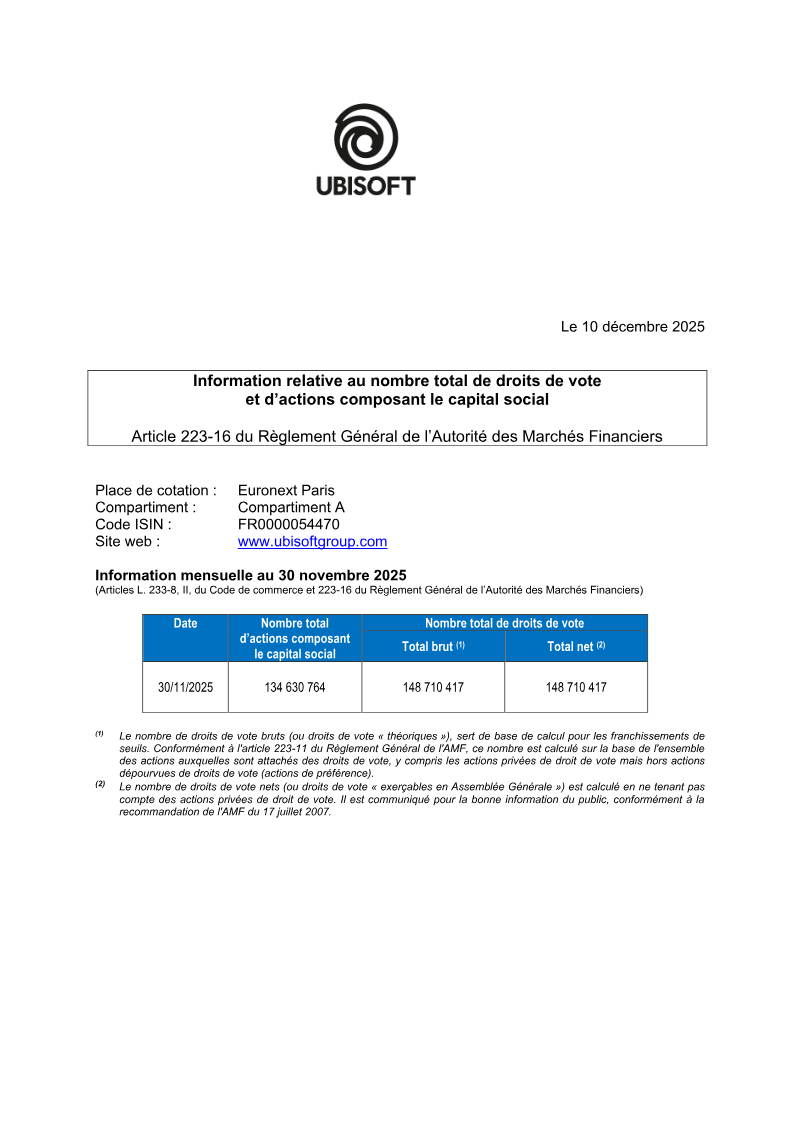
Information Relative au Nombre Total de Droits de Vote et d’Actions Composant le Capital Social: 2025
Ubisoft Entertainment SA provides a formal disclosure regarding its share capital and voting rights structure as of November 30, 2025. This regulatory filing, issued in compliance with the French Commercial Code and the General Regulations of the Autorité des Marchés Financiers, serves to inform the public and regulatory bodies of the company's current equity composition. The data is specifically relevant for stakeholders monitoring threshold crossings and corporate governance within the Euronext Paris Compartment A market.
As of the end of November 2025, the total share capital consists of 134,630,764 individual shares. The disclosure distinguishes between theoretical and exercisable voting rights to provide a comprehensive view of shareholder influence. The total gross, or theoretical, voting rights are recorded at 148,710,417. This figure includes all shares with attached voting rights, even those temporarily deprived of such rights, and serves as the official basis for calculating legal threshold notifications.
The net voting rights, which represent the actual votes exercisable at General Meetings, also total 148,710,417 for this period. This indicates that there are currently no treasury shares or other instruments held by the company that would result in a discrepancy between gross and net voting power. By maintaining this transparency, the company adheres to the AMF recommendation of July 17, 2007, ensuring that investors have accurate data regarding the distribution of power and the potential for influence within the organization's capital structure.
- As of November 30, 2025, Ubisoft Entertainment SA has a total share capital of 134,630,764 individual shares.
- The company reports 148,710,417 total theoretical voting rights, which serve as the official basis for legal threshold notifications.
- Net exercisable voting rights are identical to the theoretical total at 148,710,417, indicating no discrepancy between the two figures.
- The absence of a gap between gross and net voting rights confirms that Ubisoft currently holds no treasury shares or other instruments that would suspend voting power.
- This disclosure is issued in compliance with French Commercial Code and AMF regulations to provide transparency regarding corporate governance and shareholder influence on Euronext Paris.
UbisoftDec 2025

Article
Ubisoft Accelerates in Fast Growing MOBA Market by Acquiring 'March of Giants' Game from Amazon
Ubisoft has strategically expanded its presence in the competitive multiplayer landscape by acquiring the rights to March of Giants from Amazon. This acquisition includes the integration of the Montreal-based development team into Ubisoft’s creative structure. The move is designed to capitalize on the high-growth multiplayer online battle arena (MOBA) market, which is projected to see total revenues roughly double by 2030. By bringing this project in-house, Ubisoft aims to establish a long-term, live-service competitive title that differentiates itself through a blend of lane-based combat and hero coordination.
The project is led by industry veterans Xavier Marquis and Alexandre Parizeau, both of whom previously held senior leadership roles at Ubisoft on major franchises like Rainbow Six Siege. Their return signals a focus on leveraging proven expertise in tactical depth and community-driven competitive gaming. Early indicators of the game’s potential are strong, with internal data showing that 98% of closed alpha participants believe the title introduces innovative elements to the genre. Players have specifically highlighted the game’s art direction and focus on team-based strategy as key differentiators.
The transition includes a continued partnership with Amazon, which will provide marketing support via Twitch to bolster the game’s visibility. While the financial terms of the deal remain undisclosed, the acquisition is positioned as a primary driver for Ubisoft’s growth in a segment that currently engages hundreds of millions of active players globally. Development is now focused on a major update scheduled for 2026, which will expand the game’s competitive modes and foundational systems to ensure sustainable long-term engagement.
- Ubisoft has acquired the MOBA title 'March of Giants' from Amazon, including the Montreal-based development team, to capture growth in a market projected to double its revenue by 2030.
- The project is led by former Ubisoft veterans Xavier Marquis and Alexandre Parizeau, who previously held senior leadership roles on the Rainbow Six Siege franchise.
- Internal data from closed alpha testing indicates that 98% of participants believe the game introduces innovative elements to the MOBA genre.
- Amazon will maintain a role in the project by providing marketing support through Twitch to increase the game's visibility.
- Development is currently focused on a major update scheduled for 2026 that will expand competitive modes and foundational systems to support long-term live-service engagement.
+1
UbisoftDec 2025
Financial1 pages
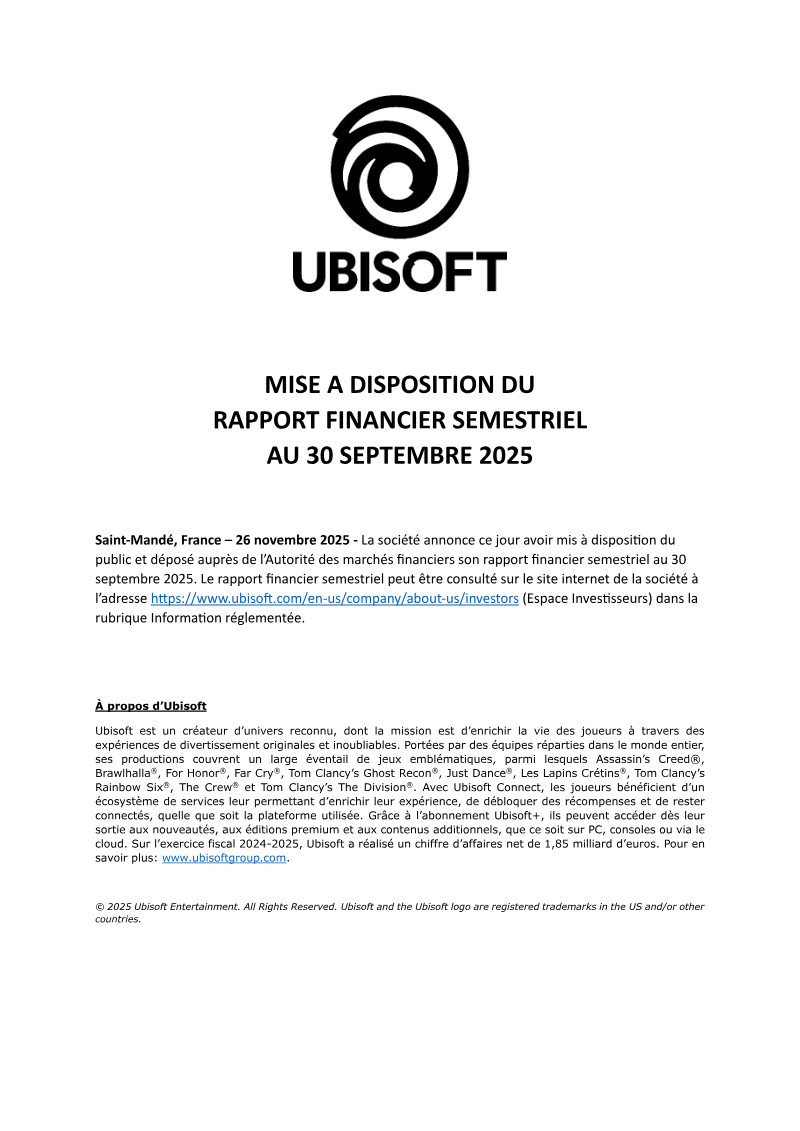
Rapport Financier Semestriel au 30 Septembre 2025
Ubisoft Entertainment SA confirms the formal publication and filing of its semi-annual financial report for the period ending September 30, 2025. This regulatory disclosure, submitted to the Autorité des marchés financiers, serves as a primary update on the company’s fiscal health and operational standing midway through the 2025-2026 fiscal year. The announcement emphasizes the company's ongoing commitment to transparency for its global investor base and stakeholders within the interactive entertainment sector.
The financial data highlights a net turnover of 1.85 billion euros for the preceding 2024-2025 fiscal year, establishing a baseline for current performance evaluations. Operations remain focused on a diversified portfolio of established intellectual properties, including major franchises such as Assassin’s Creed, Far Cry, and Tom Clancy’s Rainbow Six. The strategic scope encompasses multiple distribution channels, including traditional PC and console platforms, alongside an expanding presence in cloud gaming and subscription-based services via the Ubisoft+ model.
The organizational structure relies on a global network of development teams to maintain a competitive edge in the high-budget gaming market. Central to the current business strategy is the Ubisoft Connect ecosystem, which aims to drive player engagement and retention through cross-platform services and loyalty rewards. This integrated approach to software and services is designed to stabilize revenue streams across various geographic regions and industry segments as the company navigates the remainder of the fiscal year.
- Ubisoft recorded a net turnover of 1.85 billion euros for the 2024-2025 fiscal year, establishing the baseline for the current 2025-2026 reporting period.
- The company is currently operating under a semi-annual financial reporting cycle that concluded on September 30, 2025.
- Strategic revenue generation relies on a portfolio of established intellectual properties, specifically Assassin’s Creed, Far Cry, and Tom Clancy’s Rainbow Six.
- Ubisoft is diversifying its distribution strategy by expanding beyond traditional PC and console platforms into cloud gaming and the Ubisoft+ subscription model.
- The Ubisoft Connect ecosystem serves as the primary tool for driving player engagement and retention through cross-platform services and loyalty rewards.
UbisoftNov 2025
Financial19 pages
Ubisoft Reports First-Half 2025-26 Earnings Figures
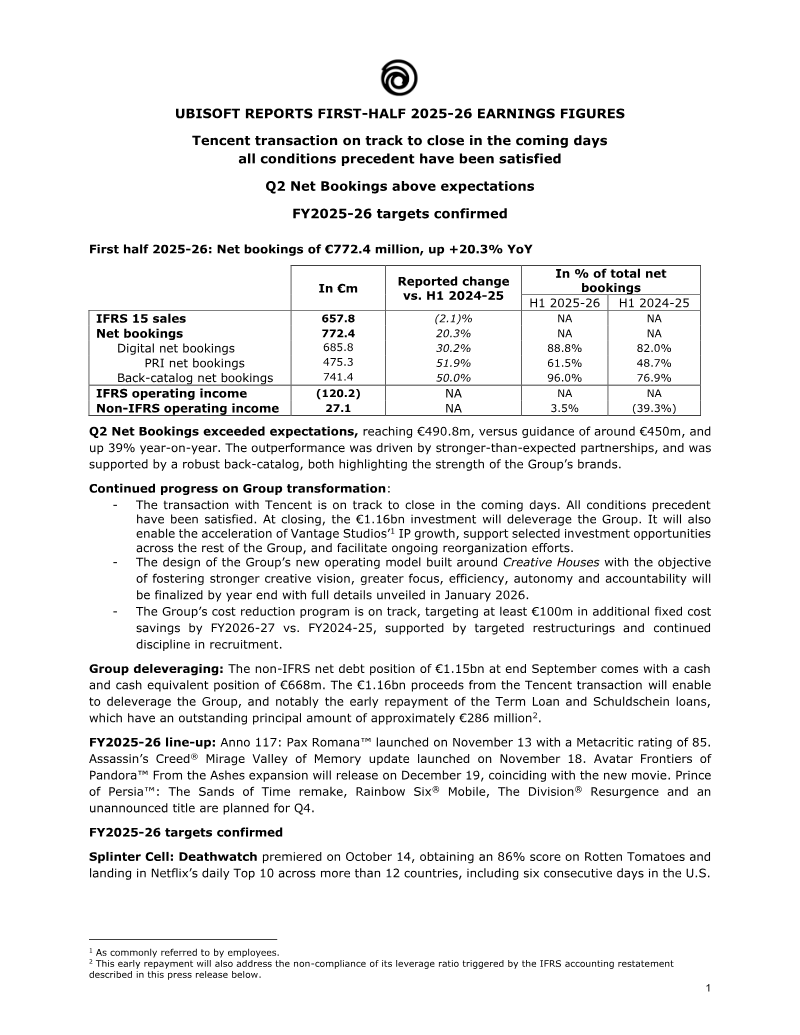
Ubisoft’s financial performance for the first half of fiscal year 2025-26 reflects a period of aggressive strategic transformation and operational restructuring. Net bookings reached €772.4 million, representing a 20.3% year-over-year increase fueled by a resilient back-catalog and strategic partnerships. While the company reported a consolidated net loss of €161.4 million, this figure marks a notable improvement from the €246.5 million loss recorded in the prior year. Furthermore, non-IFRS operating income returned to positive territory at €27.1 million, signaling that cost-efficiency measures are beginning to stabilize the bottom line.
The organization is currently executing a comprehensive cost-reduction program aimed at achieving €100 million in savings by fiscal year 2026-27. This initiative has already resulted in a 9% reduction in the fixed cost base and a headcount decrease of approximately 1,500 employees over the past twelve months. To address a net debt position of €1.42 billion and technical breaches of leverage covenants, the company is securing a €1.16 billion investment from Tencent through the newly formed Vantage Studios subsidiary. This capital injection is intended to deleverage the group and facilitate the repayment of roughly €286 million in debt, providing the liquidity necessary to support ongoing internal and external game development.
Looking ahead, the company is transitioning to a new "Creative Houses" operating model to streamline production across its global studios. The upcoming release schedule remains a critical driver for future growth, with major titles such as Anno 117: Pax Romana and Assassin’s Creed Shadows slated for the third quarter. These launches, combined with sustained live-service updates for core franchises like Rainbow Six Siege, are expected to bolster revenue as the group works toward long-term financial stabilization and a more efficient development pipeline.
- Ubisoft is securing a €1.16 billion investment from Tencent via its new Vantage Studios subsidiary to address a €1.42 billion net debt position and repay €286 million in debt.
- Net bookings for the first half of fiscal year 2025-26 grew 20.3% year-over-year to €772.4 million, driven by back-catalog performance and strategic partnerships.
- The company narrowed its consolidated net loss to €161.4 million from the previous year’s €246.5 million, with non-IFRS operating income reaching a positive €27.1 million.
- A cost-reduction program has cut the fixed cost base by 9% and reduced headcount by approximately 1,500 employees over the last twelve months, targeting €100 million in total savings by fiscal year 2026-27.
- Ubisoft is shifting to a 'Creative Houses' operating model to streamline global production and improve development efficiency.
UbisoftNov 2025
Financial1 pages
Information Relating to the Release of First-Half 2025-26 Figures
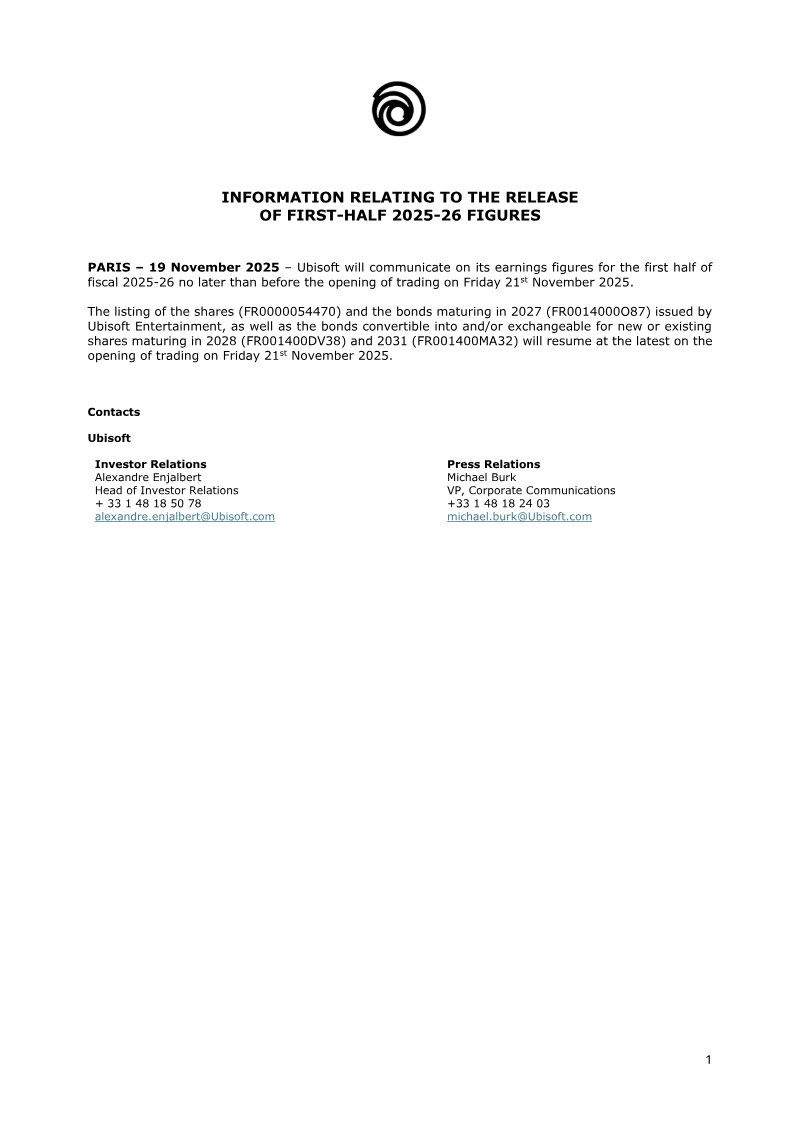
Ubisoft Entertainment has scheduled the release of its financial earnings for the first half of the 2025-26 fiscal year to occur no later than the opening of trading on Friday, November 21, 2025. This announcement serves as a formal update to the financial markets regarding the timing of key performance data for the initial six months of the company's fiscal cycle. The communication originates from the company’s Paris headquarters and provides specific administrative details regarding the availability of these figures to investors and the public.
In conjunction with the earnings release, the company will resume the listing of several key financial instruments. This includes Ubisoft’s primary shares as well as multiple debt instruments, specifically bonds maturing in 2027 and convertible or exchangeable bonds maturing in 2028 and 2031. The resumption of trading for these securities is synchronized with the disclosure of the half-year results to ensure market transparency and provide all participants with equal access to the latest fiscal performance metrics before active trading commences.
The scope of this update is strictly focused on the corporate financial reporting schedule and the status of Ubisoft’s publicly traded securities on European exchanges. While the announcement does not detail specific revenue figures or operational milestones, it establishes the definitive timeline for the dissemination of such data. Corporate leadership in investor relations and communications remains the primary point of contact for stakeholders seeking further clarification on the upcoming financial disclosures.
- Ubisoft Entertainment will release its financial earnings for the first half of the 2025-26 fiscal year by the market opening on Friday, November 21, 2025.
- The company will resume trading of its primary shares and multiple debt instruments simultaneously with the disclosure of the half-year results.
- Resumed debt instruments include bonds maturing in 2027, as well as convertible or exchangeable bonds maturing in 2028 and 2031.
- The synchronized release of financial data and resumption of security trading is intended to ensure market transparency and equal access to performance metrics for all participants.
- This announcement serves as a formal administrative update regarding the reporting timeline and does not contain specific revenue figures or operational milestones.
UbisoftNov 2025