Market (Mobile)·Updated Mar 17, 2026 by Tenjin
Report · January 1, 2022
Published by Tenjin
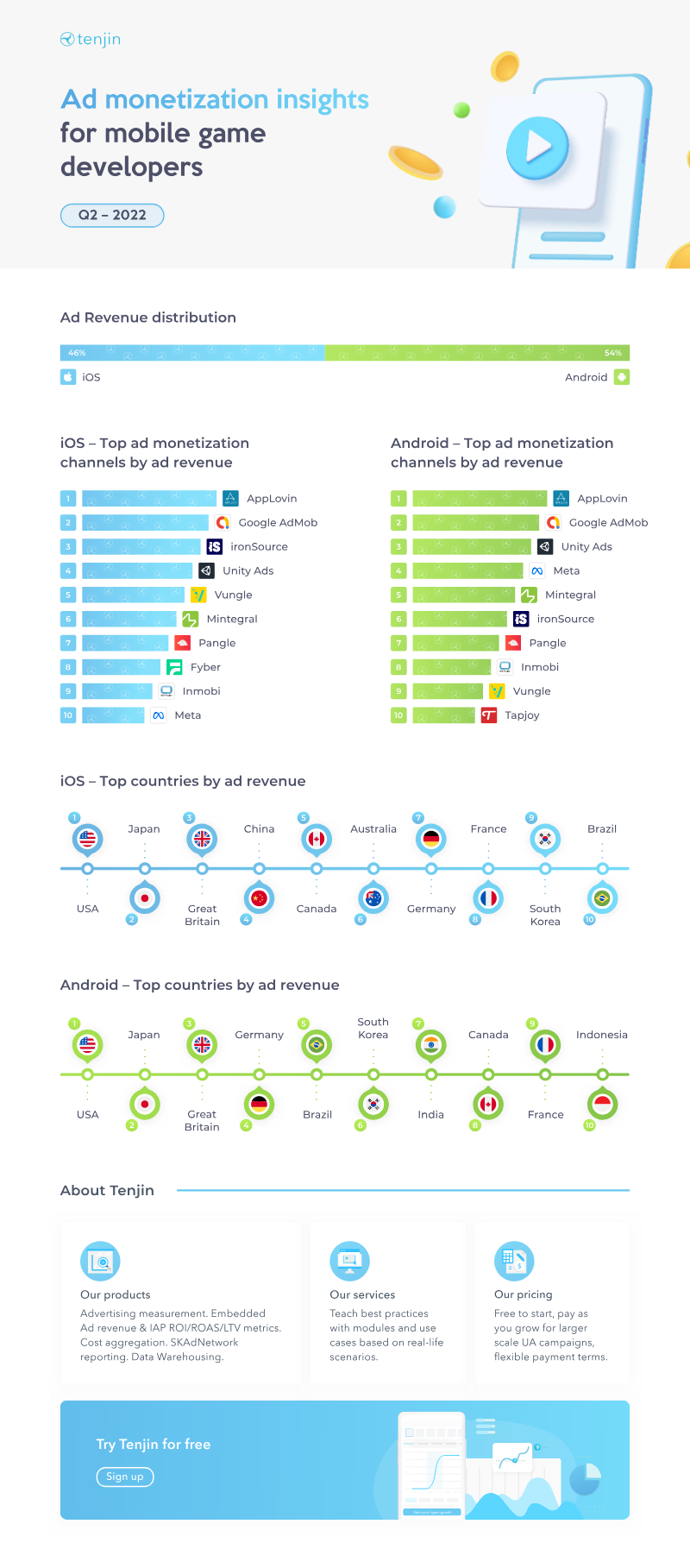
The 2022 ad monetization briefing delivers a data‑driven overview of revenue‑generation strategies for mobile game developers, emphasizing measurement, optimization, and regional performance trends. Core insights reveal that ad‑based income accounts for a majority share of total monetization, with a highlighted 54 % figure indicating the proportion of revenue derived from advertising across the surveyed markets. The analysis spotlights key territories—Germany, Japan, South Korea, Canada, and Indonesia—illustrating how each region contributes to overall earnings and how localized user acquisition (UA) campaigns influence cost structures and return on ad spend. A central theme is the importance of precise analytics to drive return on investment (ROI), return on ad spend (ROAS), and lifetime value (LTV) calculations. The briefing outlines a suite of measurement tools that aggregate ad revenue, in‑app purchase (IAP) data, and cost metrics, integrating SKAdNetwork reporting for iOS environments and offering flexible data‑warehousing solutions. These capabilities enable developers to assess campaign performance at scale, compare cost aggregation across organic and paid acquisition channels, and refine budgeting decisions based on real‑time insights. Tenjin’s platform is positioned as a turnkey solution for developers seeking to embed advanced measurement modules without upfront cost, operating on a free‑to‑start, pay‑as‑you‑grow pricing model. The service package includes advertising measurement, cost aggregation, and data‑warehousing, designed to support both emerging studios and larger publishers in optimizing ad revenue streams. While specific methodological details such as sample size or data sources are not disclosed, the briefing draws on 2022 market data to inform best‑practice recommendations for maximizing monetization efficiency across the highlighted global regions.
54% 3 Germany 5 South 9 # Japan * Korea Canada Indonesia 3 Germany 5 South 9 # Japan * Korea Canada Indonesia About Tenjin # Our products Our services Our pricing Advertising measurement. Embedded Teach best practices Free to start, pay as Ad revenue & IAP ROI/ROAS/LTV metrics. with modules and use you grow for larger Cost aggregation. SKAdNetwork cases based on real-life scale UA campaigns, cost aggregation. SNAaiNetwork scale OA campaigns, reporting. Data Warehousing scenarios. flexible payment terms. www.tenjin.com/signup
This analysis examines the evolving landscape of game monetization across Asia, focusing on how developers adapt revenue models to meet the demands of a maturing market. The central thesis posits that while free-to-play (F2P) remains the dominant force, the rise of hybrid models and advanced mechanics like battle passes and gacha are essential for capturing the increasing purchasing power of Asian gamers. The scope covers major markets including China, Japan, South Korea, India, and Southeast Asia, utilizing 2019 and 2020 data to highlight shifts accelerated by the COVID-19 pandemic. Key findings underscore the overwhelming success of the F2P model, which accounted for 98.5% of all mobile games revenue in 2019. In China, 100% of the top-grossing mobile titles utilized F2P. However, regional nuances are significant; Japan represents the most valuable mobile market with a revenue per download of $12.84, compared to a regional average of $1.53. While premium models remain a staple in console-heavy Japan, emerging markets like India are "leapfrogging" traditional stages by quickly adopting sophisticated F2P mechanics, such as battle passes, which were featured in half of India’s top-grossing games by early 2020. The methodology relies on a combination of proprietary consumer panels exceeding four million users, developer interviews, and market modeling. The conclusions suggest that developers must move toward hybrid monetization—blending in-app purchases with rewarded ads—to mitigate economic risks and appeal to diverse player segments. By aligning monetization with core gameplay rather than interrupting it, publishers can sustain long-term engagement in a region where player motivations range from high-spend competition to time-intensive casual play.
Southeast Asia solidified its position as the world’s second-largest mobile gaming market by downloads in early 2025, reaching 1.93 billion installs. While the region currently ranks seventh globally in revenue at $625 million, it demonstrates significant monetization potential fueled by expanding digital payment infrastructure and rising smartphone penetration. Indonesia serves as the primary volume driver with 870 million installs, while Thailand leads the region in consumer spending, generating $162 million. This growth is increasingly supported by publishers based in Singapore and Vietnam, who have emerged as a dominant global force, contributing over 5.8 billion installs to the international market through a mix of hypercasual hits and competitive titles. Market dynamics reveal a shift toward high-engagement genres and localized content strategies. Although casual arcade and simulation games drive the highest download volumes, monetization is concentrated in Strategy, MOBA, and RPG segments. Mobile Legends: Bang Bang remains the regional revenue leader, sustained by hyper-local live operations and community engagement. Simultaneously, the 4X Strategy genre is experiencing rapid expansion, highlighted by a 77.7% revenue surge for titles like Last War: Survival. Conversely, traditional MMORPGs have seen a decline of nearly 20%, making way for Open World Adventure RPGs and sophisticated strategy games that leverage deep social and competitive mechanics. The regional landscape is characterized by distinct national preferences and the global expansion of local firms. Vietnam has become a powerhouse for survival-themed hypercasual games, while Thailand shows a unique affinity for realistic sports simulations. Established titles like Garena Free Fire continue to dominate global charts by blending cultural relevance with nostalgic collaborations. Ultimately, the region’s trajectory is defined by a transition from high-volume downloads to sophisticated monetization, driven by a combination of community-led activations and the strategic global influence of Southeast Asian publishers.
The global mobile application market underwent a period of stabilization in 2023, characterized by a slight year-over-year decline of 3.6% in downloads and 1% in total revenue. Despite these minor contractions, the industry remains a massive economic force, with a distinct divide between platform utility and monetization. Android continues to dominate the global market share by volume, facilitating 84% of all installs, while iOS remains the primary engine for monetization, accounting for 67% of total consumer spending. Geographically, while emerging markets like India and Brazil are driving significant download growth, global revenue remains highly concentrated, with the United States, China, and Japan collectively generating 58% of all spending. Gaming persists as the most influential vertical, particularly within the Casual and RPG subgenres, though performance metrics across most categories have trended downward. A significant disparity exists between the apps that consumers download most frequently and those that generate the highest revenue. While Meta-owned platforms and utility services lead in global installs, high-engagement entertainment and social platforms like TikTok and Tinder drive the highest financial returns. Notably, Duolingo has established a unique position as a leader in both volume and monetization within the education sector, signaling the potential for specialized platforms to achieve cross-metric dominance. The mobile advertising landscape is currently adapting to increased privacy restrictions and tracking challenges by pivoting toward AI-driven video and hybrid formats. Although the total number of advertisers and publishers decreased in 2023, the volume of creative content surged, reflecting a highly competitive environment where over half of all ads are cycled out within three days. Gaming advertisers remain the most active participants, representing 53% of all advertisers and nearly 79% of App Store traffic. Current strategic trends favor user-generated content and gamified video over traditional or misleading creatives, emphasizing high-quality, targeted engagement to maintain visibility in an increasingly saturated digital ecosystem.
Analysis of mobile advertising intelligence from 2022 reveals a rapidly expanding market, with the number of advertisers doubling since 2019 to exceed 120,000. Data collected from 35 countries across the Apptica platform indicates a significant platform disparity, as Android accounts for 71% of advertisers and over 80% of the 14.6 million total creatives tracked during the period. While Android publishers outnumber those on iOS by a factor of two, the gaming sector remains the dominant force on both platforms, capturing 69.02% of advertising traffic on the App Store and 55.58% on Google Play. The gaming landscape is primarily led by the Casual and Puzzle genres. Casual games represent the largest traffic share on iOS at 23.8%, while Puzzles lead on Android at 25.4%. Beyond gaming, the Shopping and Social categories emerge as the other primary drivers of high-volume traffic. Top individual advertisers by traffic share include Meta Platforms, Playrix, and TikTok, while NewsBreak and ITI Inc. lead in the sheer volume of unique creatives. Methodological findings highlight distinct creative strategies between operating systems. On iOS, video is the preferred format, accounting for 59.9% of creatives. Conversely, Android relies more heavily on static images, which make up 58.8% of its ad inventory. Interactive or playable ads remain a niche but consistent segment, representing less than 3% of the total share on both platforms. The data suggests that publishers are significantly more aggressive with creative testing on Android, often running between 2 and 124 times more creative variations than they do on iOS. Playrix, Easybrain, and Tripledot Studios are identified as the most consistent market leaders, appearing in the top ten for buying share across both ecosystems.