The primary purpose of this analysis is to challenge the video game industry and its audience to move beyond passive consumption and embrace games as a sophisticated, evolving art form. The central thesis posits that video games are currently an "unfinished project" that suffers from a lack of clear purpose, often masked by an uncritical acceptance of flawed design, repetitive tropes, and superficial storytelling. By examining the perspectives of Frank Lantz, director of the NYU Game Center, the discussion argues that players and creators must demand greater ambition and intellectual rigor to realize the medium's full potential as a "cathedral of the modern world."
Key findings highlight that the industry frequently relies on formulaic mechanics and "childish" narratives that audiences tolerate out of habit rather than genuine preference. The analysis suggests that games possess the unique capacity to influence human cognition and cultural evolution, similar to literature or painting, but this potential remains largely untapped. To bridge this gap, the text advocates for a more literate audience capable of critical comparison, a culture of professional criticism that moves beyond mere consensus, and a willingness among developers to pursue original, expressive design goals rather than relying on established, generic templates.
The scope of this inquiry is broad, focusing on the philosophical and aesthetic state of the global video game industry in the mid-2020s. The methodology relies on qualitative synthesis, drawing from expert interviews, critical analysis of game design literature, and personal reflection on the player experience. By contrasting the "sublime" potential of games with the reality of common design pitfalls, the analysis serves as a call to action for stakeholders to treat games as a serious, evolving aesthetic medium that requires active participation to reach maturity.
The provided text serves as an analytical review and endorsement of Jason Schreier’s book, Play Nice, which chronicles the history of Blizzard Entertainment. The central thesis challenges the industry’s tendency to view corporate history through a binary lens of heroes and villains. By examining the internal dynamics of Blizzard, the book argues that the company’s trajectory was defined by a chaotic, unrepeatable development process rather than a simple narrative of creative purity corrupted by corporate oversight.
Key findings from the book, based on interviews with over 350 individuals, highlight the inherent tension between creative freedom and necessary structural constraints. A notable case study involves the development of Overwatch, which emerged from the wreckage of the cancelled Titan project. Contrary to the perception of Bobby Kotick as a purely antagonistic figure, the text reveals that his executive intervention—specifically his appreciation for the game’s unique character art—was instrumental in greenlighting the project. Furthermore, the imposition of a strict two-year development timeline, which deviated from Blizzard’s traditional "it’ll be ready when it’s ready" philosophy, resulted in one of the studio’s most cohesive and successful production cycles.
The analysis emphasizes that Blizzard’s history is characterized by extreme volatility, ranging from periods of intense creative brilliance to toxic office cultures marked by crunch and unprofessional conduct. By moving away from simplistic moral narratives, the book provides a nuanced look at how management, financial pressure, and creative vision intersect. Ultimately, the text positions Play Nice as an essential read for game developers, suggesting that understanding these complex, often messy realities is vital for navigating the modern games industry.
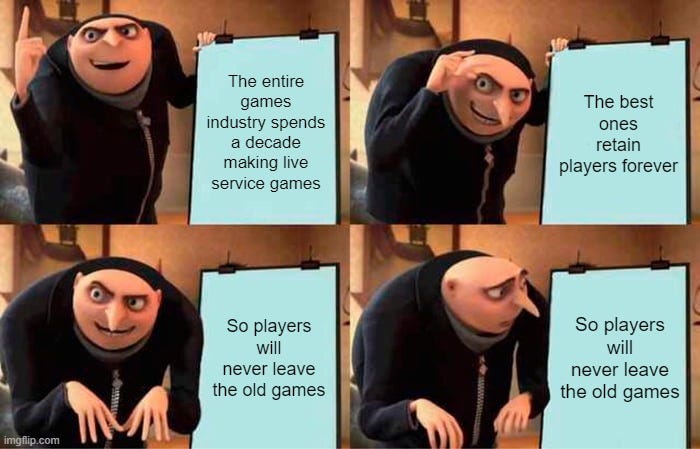
The modern gaming industry is increasingly defined by a phenomenon where a significant portion of the player base remains "locked in" to a small selection of long-standing titles. Analysis of industry data, including reports from Newzoo, indicates that the vast majority of total gaming hours are now consumed by games that are often a decade or older. This trend suggests that a large segment of the audience has established a "forever" game, rendering them largely inaccessible to developers of new titles.
The primary thesis posits that while these "grizzled veterans" may occasionally sample new releases, they consistently return to their primary, established titles. This behavior creates a distinct market dynamic: premium-priced games can still thrive by capturing these players during their brief "vacations" from their main games. Conversely, new free-to-play live service titles often suffer from a "sugar-rush" launch—characterized by a massive initial spike in concurrent users followed by a rapid, terminal decline as players revert to their established habits.
The stickiness of these legacy titles is attributed to several factors, including the significant time and social equity players have invested, the presence of robust competitive scenes, and the development of community-driven institutions. While some players eventually disengage due to life changes, technical shifts, or developer mismanagement, the core audience for these mature live service games remains remarkably resilient. Consequently, the industry is shifting away from a traditional hits-driven model toward one where sustained, long-term engagement with a few dominant titles creates a challenging environment for new market entrants.
The video game industry is currently facing a significant structural challenge where consumer attention is increasingly dominated by legacy titles, leaving little room for new releases to gain traction. Data from Newzoo’s 2024 PC and Console Gaming Report highlights a stark trend: 61% of total playtime is dedicated to games released more than six years ago. Furthermore, in 2023, just five older titles accounted for more aggregate playtime than every game released during the 2022 and 2023 calendar years combined.
The market for new games is heavily concentrated, with annual franchise releases—such as major sports titles and Call of Duty—capturing the majority of the remaining engagement. When these annualized series and the top five new megahits are excluded, all other new releases, including the more than 14,000 games launched on Steam in 2023, must compete for a mere 4.5% of total gaming hours. This environment creates a "hard mode" for developers, where even critically acclaimed indie projects, such as the tactics RPG Arco, struggle to achieve commercial viability despite high user ratings.
The industry is experiencing a period of transition where traditional marketing and distribution strategies are becoming less effective. While the barrier to entry for game development has lowered, the sheer volume of content has led to a fragmentation of audience attention. Developers note that even with strong publisher support, the lack of centralized media outlets to champion new titles makes it increasingly difficult to break through the noise. This shift suggests that the market is currently favoring established intellectual property and long-running live-service games, creating a challenging landscape for new, original, or independent creative works.
Odyssey Interactive has adopted a high-stakes, transparent approach to game development, prioritizing early market validation over traditional long-term production cycles. The studio’s current strategy centers on the prototype Byte Breakers, a 40-player platform fighter with battle royale elements. Rather than committing to a multi-year development roadmap, the studio is utilizing public playtests on Steam to determine the project's viability. If the title fails to meet specific performance and engagement targets, the studio intends to cancel the project immediately, a departure from its previous experience with Omega Strikers, which required three years of development before the team realized it lacked long-term sustainability.
This methodology represents a philosophical shift toward rapid, data-driven decision-making. By engaging players early—well before a standard marketing or release window—the studio seeks to measure genuine player behavior and market potential rather than relying on internal greenlight committees, surveys, or static feedback. The current testing phase is limited to players in the United States, Canada, and Mexico, allowing the team to gather real-world data on engagement and retention.
The studio maintains the flexibility to pivot because Byte Breakers is developed by a small core team of approximately ten people, and the company manages a portfolio of concurrent projects. This approach minimizes the risk of "sunk cost" fallacies, ensuring that resources are only committed to titles that demonstrate immediate, organic appeal. By prioritizing early market signals, the studio aims to avoid the prolonged development cycles that often characterize modern live-service games, ultimately seeking to identify which concepts possess the necessary momentum to succeed in a competitive landscape.
The recent failure of the hero shooter Concord serves as a primary case study for the necessity of early market validation in the video game industry. The central thesis posits that catastrophic commercial failures are largely avoidable if developers prioritize gathering "market signal"—actual player interaction data—well before a game's official launch. By relying on internal development cycles rather than external, iterative testing, studios risk investing years of resources into products that fail to resonate with their target audience.
Key data points highlight the severity of the Concord launch, which saw estimated first-week sales of only 25,000 units and a peak concurrent player count of fewer than 700 on Steam. These figures were preceded by an open beta that struggled to maintain even 2,400 concurrent users, signaling a lack of interest that was evident months before the final release. In contrast, the development of Deadlock illustrates a more effective strategy; by utilizing a closed, invite-based testing model that allows for organic growth and real-world player feedback, the developers are able to gauge long-term retention and market viability long before a formal commercial debut.
The analysis suggests that the industry often suffers from a disconnect between internal design culture and player expectations. When developers fail to solicit or act upon honest, external feedback, they risk creating products that are perceived as uninspired or derivative. The core recommendation is for studios to move away from secretive, high-stakes development models and toward a more transparent, iterative approach that treats public or semi-public testing as a vital component of the development lifecycle. This shift allows for the early identification of fundamental flaws, providing teams the opportunity to pivot or refine their core gameplay loops before the point of no return.
The rapid commercial success of Black Myth: Wukong serves as a pivotal indicator of shifting dynamics within the global video game industry. Developed by the Chinese studio Game Science, the title has achieved significant international reach, with projections estimating between 10 and 15 million copies sold within its first week. This performance underscores the immense, often underestimated, purchasing power of the Chinese gaming audience, which has consistently supported major titles on platforms like Steam. The game’s success suggests a permanent expansion of the global PC gaming market, as a massive influx of players engages with high-fidelity, single-player experiences.
Beyond its commercial impact, the game has garnered widespread critical acclaim for its art direction, creative design, and genre-blending combat mechanics, which synthesize elements of soulslike difficulty with fluid action-oriented gameplay. Despite this reception, the launch has highlighted persistent challenges regarding PC optimization. Reports of performance inconsistencies, crashes, and hardware-specific issues across various high-end systems remain prevalent, pointing to a broader industry struggle to standardize performance across diverse PC configurations.
Looking ahead, the game is positioned as a major contender for industry accolades, including potential nominations for Game of the Year at the 2024 Game Awards. However, the discourse surrounding its reception—particularly the divide between its massive popularity in China and the expectations of Western award juries—suggests that its legacy may be marked by ongoing debates regarding cultural representation and industry bias. Ultimately, the game represents a transformative moment for the industry, signaling that Chinese developers are increasingly capable of producing global, high-budget hits that fundamentally alter market expectations.
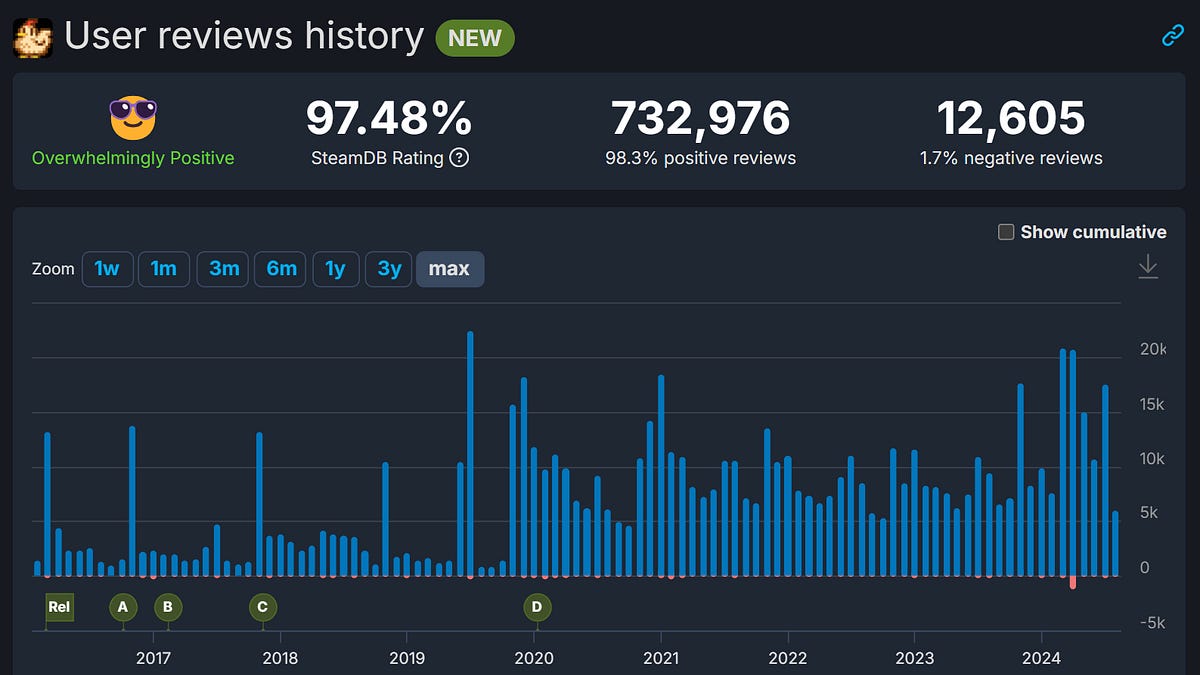
The gaming industry frequently relies on peak concurrent user (CCU) counts to measure success, yet this metric often fails to capture the long-term commercial viability of premium titles. A more effective analytical approach involves tracking weekly review volume on Steam, which serves as a reliable proxy for consistent sales performance. By examining these trends, it becomes clear that many games achieve "perennial seller" status, maintaining steady, non-declining sales curves for years after their initial release.
Data from SteamDB illustrates this phenomenon across various scales, from major titles like the Resident Evil 4 remake and Stardew Valley to smaller, sleeper hits such as Timberborn and Pseudoregalia. For instance, Stardew Valley has maintained a consistent sales velocity for nearly a decade, while Timberborn continues to generate significant revenue in Early Access. These findings suggest that perennial sellers are not limited to large-budget productions; even small teams can achieve substantial, recurring revenue through sustained interest.
The methodology for identifying these titles relies on analyzing weekly review history, using a conservative estimate of 30 sales per review to gauge gross revenue. While factors like platform-wide updates to review prompts and seasonal sales spikes can influence raw data, the underlying consistency of these review bars reveals a distinct market behavior.
Perennial sellers typically share several core characteristics: exceptionally strong, long-term word-of-mouth driven by dedicated fan bases; overwhelmingly positive user review scores, usually between 95% and 98%; a reputation as the definitive best in their specific genre; and a unique gameplay experience that cannot be replicated elsewhere. Notably, these games often succeed without significant ongoing marketing, as their quality and community engagement drive continuous discovery and sales.
Game development is frequently undermined by pervasive psychological biases that distort strategic planning and operational execution. Across the industry, from independent solo creators to large-scale studios, a reliance on unrealistic expectations often replaces disciplined methodology. Solo developers frequently fall victim to the belief that their debut project will achieve immediate mastery, while mid-sized studios often gamble their financial stability on the hope of viral influencer promotion. These mindsets frequently result in the neglect of essential practices, such as rigorous playtesting and the selection of viable, data-backed business models, ultimately leading to avoidable project failures.
Large studios are similarly susceptible to ego-driven decision-making, specifically the delusion that brand identity serves as the primary catalyst for player engagement. This focus on reputation over core product quality often triggers scope creep, inefficient production cycles, and team burnout. While these internal narratives may occasionally function as a necessary psychological mechanism to sustain morale during the grueling development process, they frequently obscure the reality that players prioritize functional quality and gameplay experience above corporate prestige.
The broader landscape of the modern games industry is defined by a tension between these internal delusions and external market realities. Current trends, such as the unexpected success of titles like Lethal Company and the increasing competitive pressure exerted by legacy games, demonstrate that market dominance is rarely the result of singular silver bullets. Instead, long-term viability requires a shift away from speculative optimism toward iterative learning, disciplined scoping, and a robust go-to-market strategy. Success in this sector is fundamentally predicated on the ability to decouple creative ambition from the deprofessionalizing effects of industry-wide myths.
This profile examines the career and business philosophy of Jason Killingsworth, the founder of the luxury publishing imprint Tune & Fairweather. The central thesis posits that extreme, obsessive attention to detail—specifically regarding material quality and physical craftsmanship—can create a viable, high-end niche business model within the video game industry, even for products that might initially appear to have limited market appeal.
The narrative highlights the success of Tune & Fairweather, which produces high-end, unofficial books analyzing FromSoftware titles such as the Dark Souls series and Elden Ring. These publications, which often feature premium materials like specialized paper stocks and custom leather bindings, have achieved significant financial success, including a Kickstarter campaign for the book Soul Arts that raised over €1.8 million. The business model relies on the premise that fans are willing to pay premium prices—often exceeding $200—for tangible, high-quality artifacts that serve as physical manifestations of their favorite digital experiences.
The scope of this analysis covers the evolution of Killingsworth’s career, from his early work in magazine publishing to his transition into independent luxury book production following a layoff from Riot Games in 2020. The methodology relies on a biographical interview and personal account, tracing how his lifelong tendency toward intense, singular focus—previously demonstrated in competitive gaming and journalism—was channeled into the creation of a boutique publishing house. By prioritizing the "tactile" nature of print media, the company successfully positions its books as heirlooms, effectively bridging the gap between ephemeral digital gaming content and the enduring, physical nature of luxury collectibles.
This analysis explores tactical marketing strategies for video games, emphasizing the value of adapting successful, unconventional methods from other titles. The core thesis posits that effective game marketing often relies on specific, creative tactics tailored to a game’s unique design and community needs rather than generic industry standards.
Three distinct case studies illustrate these tactical approaches. First, the promotion of Animal Well utilized a private, pre-release Discord server for media and critics. By curating a space for influencers to collaboratively uncover the game’s secrets, the publisher fostered genuine excitement and deeper understanding of the title’s mechanics before launch. Second, the Boyfriend Dungeon campaign replaced standard marketing emails with personalized "love letters" written from the perspective of in-game characters. This approach significantly increased engagement and demonstrated the potential for storytelling to occur outside the game environment. Finally, the development of Omega Strikers utilized Google Ads to A/B test potential genre descriptors. By comparing click-through rates for terms like "MOBA" against the player-inspired "footbrawler," the team identified highly effective, data-backed terminology that resonated across multiple geographic regions.
These findings suggest that successful marketing requires moving beyond traditional, boring info-dumps. Instead, developers should prioritize tactics that align with their game's core identity, such as hosting exclusive community events, humanizing marketing channels through character-driven narratives, and using performance-based advertising to validate messaging. By treating marketing as an iterative, data-informed process, developers can identify small but impactful wins that improve overall visibility and player reception.
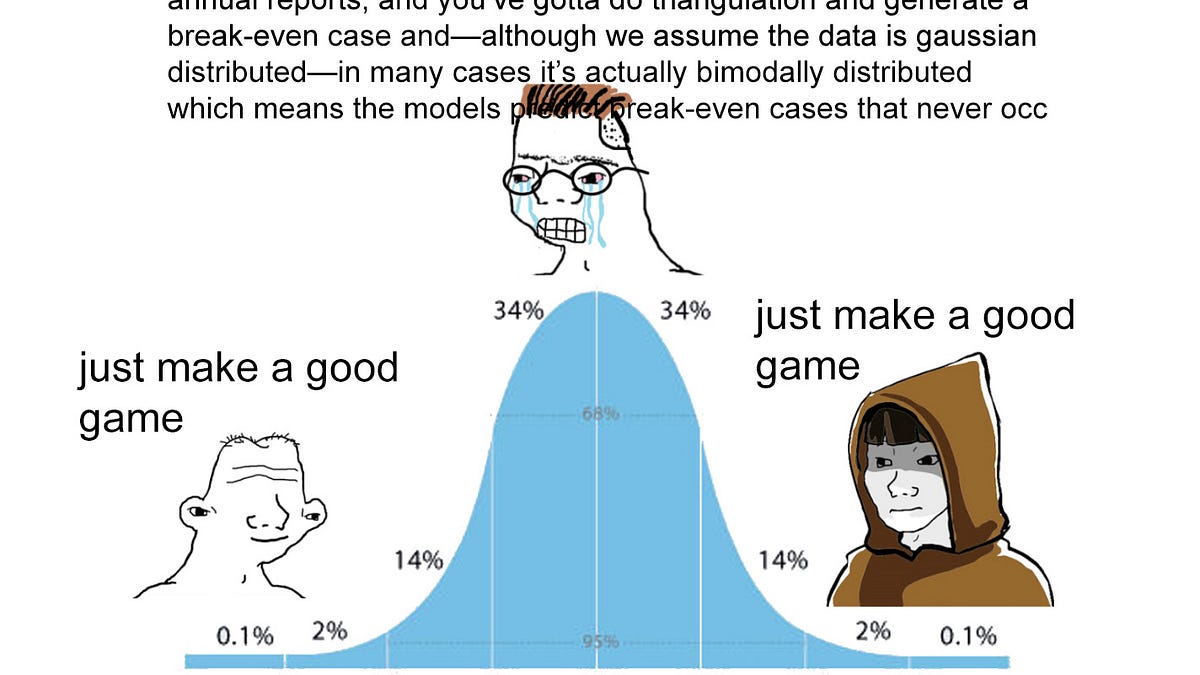
The video game industry operates under a fundamental condition of unpredictability, where traditional spreadsheet-based forecasting often fails to account for the volatile nature of market success. While financial models are necessary to align internal teams and external stakeholders on expectations, they remain speculative exercises rather than precise predictive tools. The most reliable strategy for achieving a commercial hit is not found in complex modeling, but rather in the application of the equal-odds rule, which posits that increasing the total volume of creative output is the most effective way to improve the probability of success.
Determination, characterized by a combination of discipline, ambition, and persistent output, serves as a more accurate indicator of long-term viability than raw talent or intelligence. Because individual project outcomes are notoriously difficult to forecast, developers should prioritize the generation of market signals through early playtests and authentic player feedback. This iterative process allows teams to gauge engagement levels and refine quality before a full-scale launch. By focusing on these tangible interactions, creators can better sense the potential of a project, even when traditional sales projections for complex titles—such as those reliant on microtransactions or long-term DLC—remain inherently uncertain.
Ultimately, the industry must balance the necessity of data-driven forecasting with the reality that hit-making remains an elusive art. While engagement data from beta participation provides a critical foundation for managing expectations throughout a game’s lifecycle, success is rarely guaranteed by metrics alone. By fostering a culture of high output and rigorous, early-stage testing, studios can mitigate the risks of market unpredictability and better position their titles to capture player interest in a crowded global landscape.