Koei Tecmo
Game Co.173 documents
Japanese developer/publisher. Dynasty Warriors, Nioh, Dead or Alive, Atelier, Romance of the Three Kingdoms.
Documents
Financial1 pages
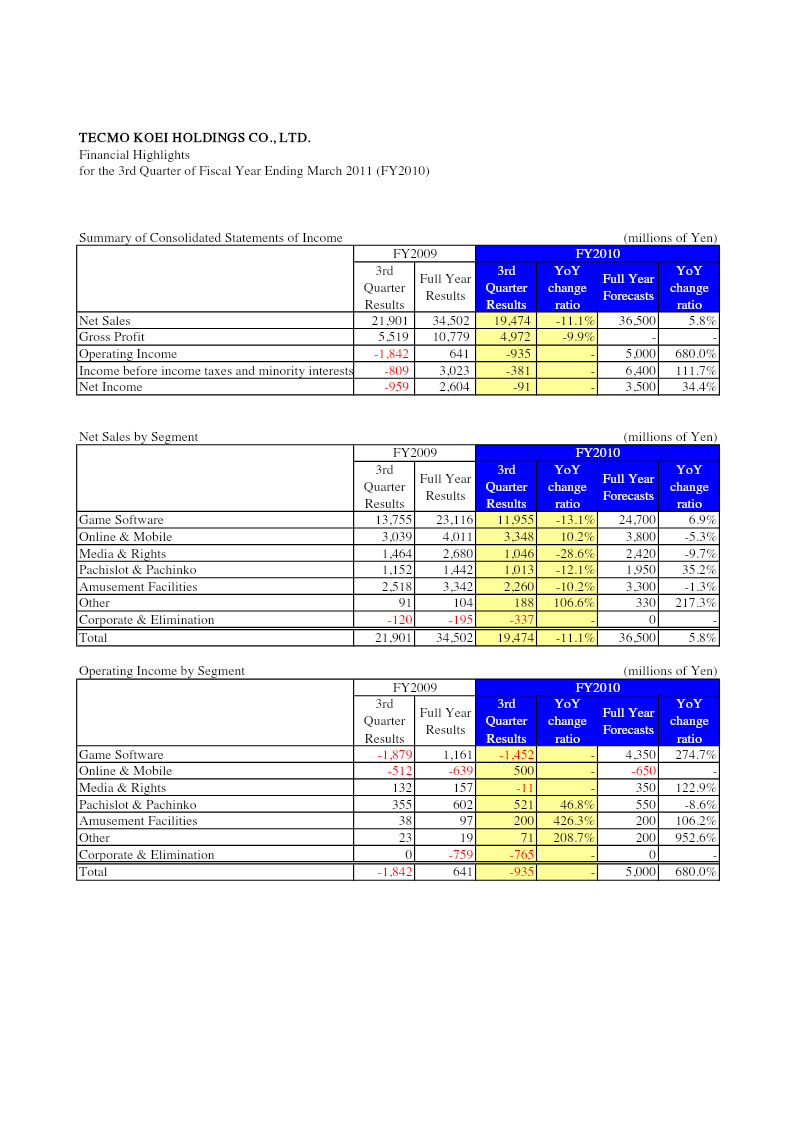
Financial Highlights for the 3rd Quarter of Fiscal Year Ending March 2011 (FY2010)
Tecmo Koei Holdings reported a challenging third quarter for the fiscal year ending March 2011, characterized by a year-on-year decline in net sales and continued operating losses. Total net sales for the third quarter reached 19.47 billion yen, representing an 11.1% decrease compared to the same period in the previous fiscal year. Despite this downturn, the company significantly narrowed its net loss from 959 million yen in the prior year to 91 million yen, suggesting improved cost management or more favorable non-operating conditions.
The core Game Software segment remained the primary revenue driver but saw a 13.1% decline in sales to 11.96 billion yen, resulting in an operating loss of 1.45 billion yen for the quarter. In contrast, the Online and Mobile segment showed growth, with sales increasing 10.2% to 3.35 billion yen and the division swinging from a loss to a 500 million yen operating profit. Other segments, including Media and Rights and Amusement Facilities, generally experienced sales contractions, though the Pachislot and Pachinko division maintained profitability with a 46.8% increase in operating income.
Management maintains an optimistic outlook for the full fiscal year, forecasting a recovery that would bring total net sales to 36.5 billion yen, a 5.8% increase over the previous full year. This projection relies on a massive surge in the final quarter to achieve a forecasted operating income of 5 billion yen, which would represent a 680% increase over the prior year’s results. The anticipated growth is heavily weighted toward the Game Software segment, where full-year sales are expected to reach 24.7 billion yen with a substantial return to profitability.
- Tecmo Koei reported a 11.1% year-on-year decline in Q3 net sales to 19.47 billion yen, though net losses narrowed significantly from 959 million yen to 91 million yen.
- The core Game Software segment, the company's primary revenue driver, saw sales drop 13.1% to 11.96 billion yen, resulting in an operating loss of 1.45 billion yen.
- Management projects a full-year recovery with net sales reaching 36.5 billion yen, representing a 5.8% increase over the previous fiscal year.
- The Online and Mobile segment grew 10.2% to 3.35 billion yen, successfully swinging from a loss to a 500 million yen operating profit.
- The Pachislot and Pachinko division demonstrated strong performance with a 46.8% increase in operating income.
Koei TecmoJan 2011
Financial1 pages
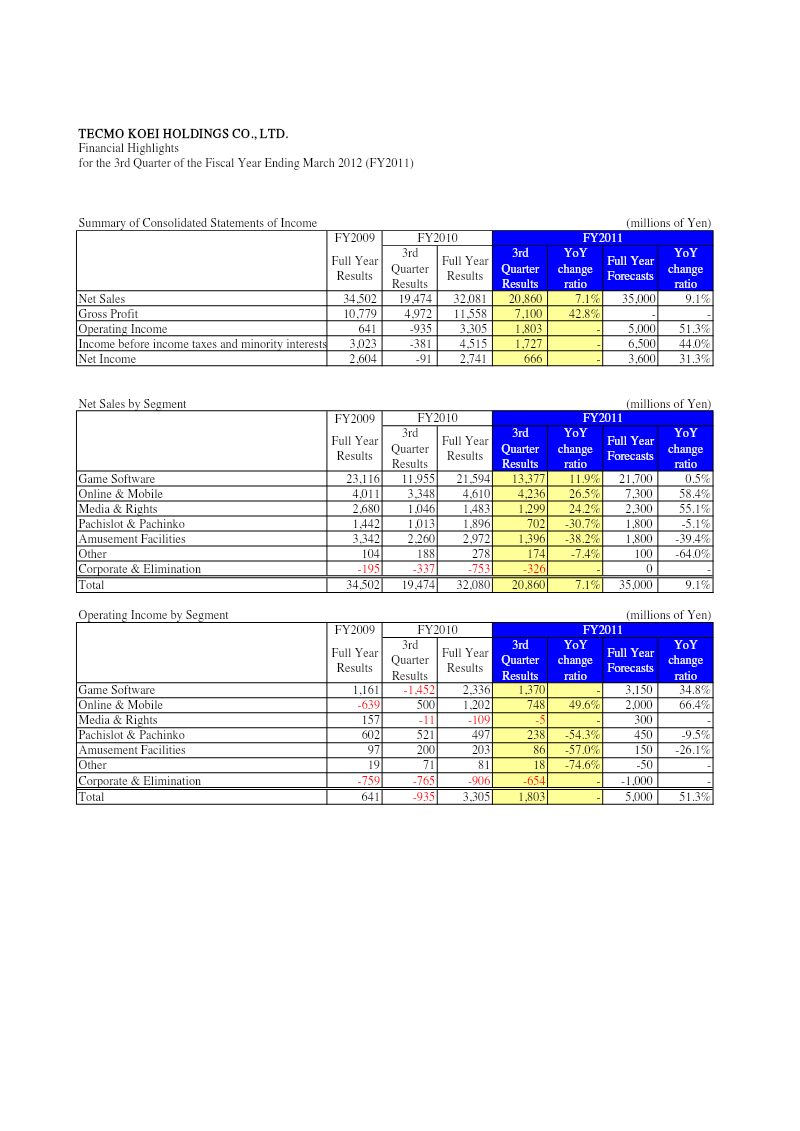
Financial Highlights for the 3rd Quarter of the Fiscal Year Ending March 2012 (FY2011)
Tecmo Koei Holdings demonstrated a significant financial recovery during the third quarter of the fiscal year ending March 2012, transitioning from an operating loss in the previous year to a profitable position. Net sales for the nine-month period reached 20.86 billion yen, representing a 7.1% increase year-over-year. More notably, operating income swung from a 935 million yen loss in the third quarter of the prior year to a positive 1.8 billion yen. This upward trajectory supported an optimistic full-year forecast, with the company projecting total sales of 35 billion yen and a 51.3% increase in annual operating income to 5 billion yen.
The growth was primarily driven by the core Game Software and Online & Mobile segments. Game Software sales rose 11.9% to 13.38 billion yen, returning the division to profitability with 1.37 billion yen in operating income. The Online & Mobile segment showed even more robust momentum, with sales increasing 26.5% to 4.24 billion yen and operating income rising nearly 50% to 748 million yen. These two divisions represent the vast majority of the company's revenue and profit, offsetting declines in other areas.
In contrast, the Amusement Facilities and Pachislot & Pachinko segments experienced sharp contractions. Amusement Facilities revenue fell 38.2% to 1.4 billion yen, while Pachislot & Pachinko sales dropped 30.7% to 702 million yen. Despite these downturns, the overall corporate performance remained strong due to the high margins in digital and software sectors. The data indicates a strategic shift toward software and online services, which are forecasted to provide the bulk of the anticipated 3.6 billion yen in total net income for the full fiscal year.
- Tecmo Koei Holdings achieved a financial turnaround in the first nine months of FY2011, shifting from an operating loss of 935 million yen in the prior year to an operating profit of 1.8 billion yen.
- Net sales for the nine-month period grew 7.1% year-over-year to 20.86 billion yen, supported by strong performance in the Game Software and Online & Mobile segments.
- The Game Software division returned to profitability with 1.37 billion yen in operating income on 13.38 billion yen in sales, an 11.9% increase over the previous year.
- The Online & Mobile segment demonstrated significant momentum with a 26.5% increase in sales to 4.24 billion yen and a nearly 50% rise in operating income to 748 million yen.
- Amusement Facilities and Pachislot & Pachinko segments saw sharp declines, with revenues falling 38.2% and 30.7% respectively.
Koei TecmoJan 2011

Financial24 pages
Fiscal Year Ending 1st Half Financial Overseas Titles
The financial results for the first half of the fiscal year ending March 2011 reveal a period of transition and strategic realignment following the merger of Koei and Tecmo. During the six months ending September 2010, net sales reached 11,069 million yen, a decline from the 15,264 million yen reported in the previous year. The period saw an operating loss of 1,656 million yen, influenced in part by 510 million yen in goodwill amortization expenses related to the merger and the acquisition of Koei Net Co., Ltd. Despite these short-term losses, the full-year forecast remains optimistic, targeting 34,500 million yen in sales and a return to profitability with a projected 4,000 million yen in operating profit.
Geographically, the Japanese market remains the primary revenue driver, accounting for 85.5% of sales in the first half. However, there is a clear strategic shift toward international expansion, with plans to increase overseas sales from 15.8% to 18.1% of total revenue by the end of the fiscal year. North America and Europe are identified as key growth regions. To support this, a Global Marketing Department has been established to integrate overseas market feedback into the early planning stages of game development, ensuring titles are better tailored for international audiences.
A significant pillar of the future growth strategy involves aggressive entry into the social and mobile gaming sectors. Successes with titles like Nobunaga’s Ambition for Everyone, which surpassed one million registered users on the Mobage platform, serve as a blueprint for leveraging established intellectual property in rapidly growing digital markets. Moving forward, the focus will shift toward continuous content releases, smartphone implementation, and breaking into global social platforms like Facebook. This digital expansion is paired with a commitment to cost reduction and the maximization of internal IP to stabilize long-term financial performance.
- For the first half of the fiscal year ending September 2010, net sales fell to 11,069 million yen from 15,264 million yen, resulting in an operating loss of 1,656 million yen.
- The company maintains a full-year forecast of 34,500 million yen in sales and a projected operating profit of 4,000 million yen.
- Operating losses were impacted by 510 million yen in goodwill amortization expenses following the merger of Koei and Tecmo and the acquisition of Koei Net Co., Ltd.
- Management aims to increase overseas revenue from 15.8% to 18.1% of total sales by the end of the fiscal year, with a focus on growth in North America and Europe.
- A new Global Marketing Department has been established to integrate international market feedback into the early stages of game development.
+2
Koei TecmoJan 2010

Financial34 pages
Financial Results: Fiscal Year Ended 2010
Tecmo Koei Holdings demonstrated a significant recovery in profitability during the 2010 fiscal year, characterized by a dramatic rise in operating profit from 641 million to 3.3 billion yen despite a slight decline in net sales to 32.1 billion yen. While the Game Software and Online & Mobile segments continue to serve as the primary engines of revenue, the organization remains heavily concentrated in the Japanese market, which currently generates 85.8% of total sales. This financial performance marks a critical stabilization period following the merger of Koei and Tecmo, setting the stage for a long-term objective of reaching 50 billion yen in annual sales.
The strategic roadmap for the 2011 fiscal year prioritizes aggressive expansion into the social gaming sector and a broader global footprint. By doubling social development staff to 200 employees and leveraging established intellectual properties such as Dynasty Warriors and Monster Rancher on international platforms like Facebook and Tencent, the company aims to double its social gaming growth. These initiatives are expected to drive net sales to 35 billion yen and increase operating profit by 51% to 5 billion yen. This growth strategy is supported by a commitment to cross-group synergies and rigorous cost management to improve overall margins.
Future operations will focus on revitalizing the packaged game segment through support for new hardware platforms while pursuing a target ordinary profit ratio exceeding 30%. By diversifying content across multiple platforms and reducing reliance on the domestic Japanese market, the company seeks to establish a more balanced global presence. The transition toward high-growth digital segments and the optimization of internal resources post-merger remain the central pillars for achieving sustained financial expansion and operational scale in the coming years.
- Tecmo Koei achieved a significant profitability turnaround in fiscal year 2010, with operating profit rising from 641 million to 3.3 billion yen despite a slight decline in net sales to 32.1 billion yen.
- The company is heavily reliant on the Japanese market, which currently accounts for 85.8% of total sales.
- For fiscal year 2011, the company targets 35 billion yen in net sales and a 51% increase in operating profit to 5 billion yen.
- The strategic roadmap prioritizes aggressive expansion into social gaming by doubling the dedicated development staff to 200 employees.
- Growth initiatives involve leveraging established intellectual properties like Dynasty Warriors and Monster Rancher on international platforms such as Facebook and Tencent.
+1
Koei TecmoJan 2010
Financial1 pages
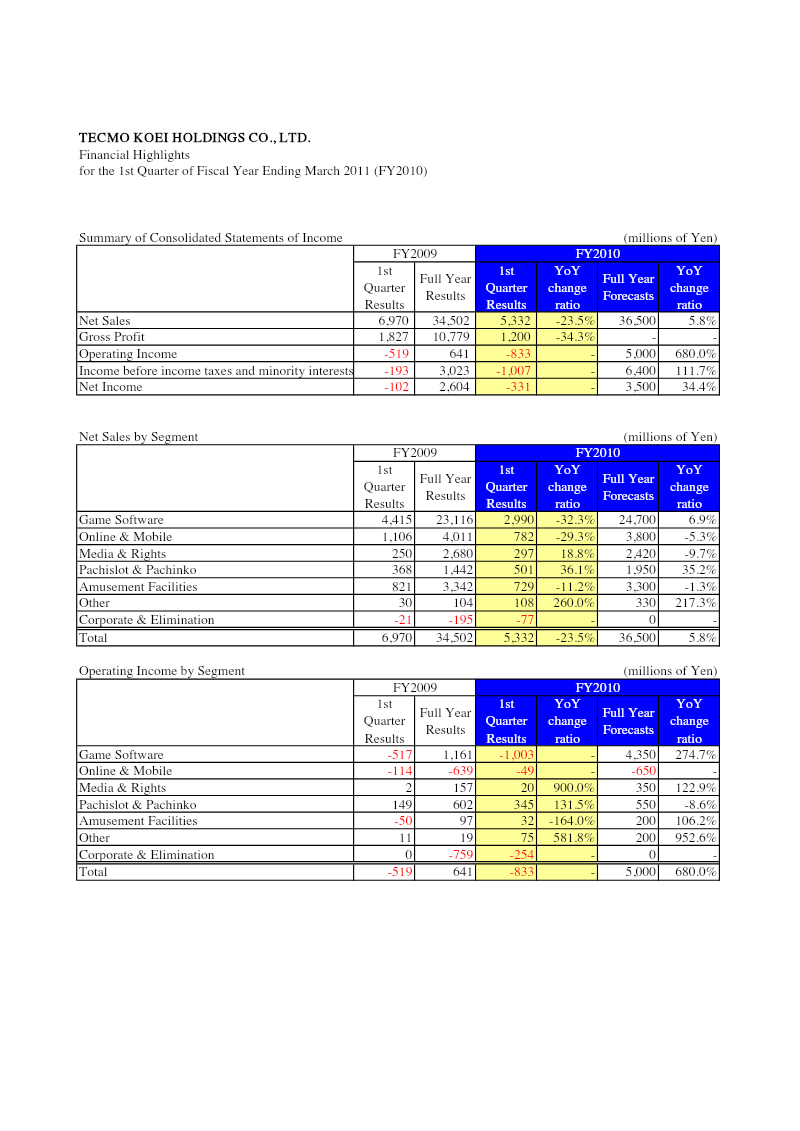
Financial Highlights for the 1st Quarter of FY2010
Tecmo Koei Holdings experienced a challenging start to the fiscal year ending March 2011, reporting significant year-over-year declines across its primary business segments during the first quarter. Net sales for the period fell by 23.5% to 5,332 million yen, down from 6,970 million yen in the previous year’s first quarter. This downturn contributed to an operating loss of 833 million yen and a net loss of 331 million yen, reflecting a period of contraction compared to the prior year’s performance.
The Game Software segment, the company’s largest division, was the primary driver of this decline, with sales dropping 32.3% to 2,990 million yen and operating losses widening to over 1 billion yen. Similarly, the Online and Mobile segment saw a 29.3% decrease in revenue. In contrast, smaller divisions such as Media and Rights and Pachislot and Pachinko showed resilience, posting year-over-year sales growth of 18.8% and 36.1% respectively. The Pachislot and Pachinko segment was particularly notable for more than doubling its operating income to 345 million yen during the quarter.
Despite the weak first-quarter results, the financial outlook for the full fiscal year remains optimistic. Projections suggest a recovery with total net sales expected to reach 36,500 million yen, representing a 5.8% increase over the previous full year. Most significantly, the company forecasts a substantial turnaround in profitability, targeting an operating income of 5,000 million yen—a 680% increase over the prior year’s total. This recovery is predicated on a strong rebound in the Game Software segment and continued growth in the Pachislot and Pachinko business, suggesting a back-heavy release schedule or anticipated operational efficiencies for the remainder of the year.
- Tecmo Koei Holdings reported a Q1 FY2010 net loss of 331 million yen and an operating loss of 833 million yen, driven by a 23.5% decline in total net sales to 5,332 million yen.
- The core Game Software segment suffered a 32.3% revenue drop to 2,990 million yen and incurred an operating loss exceeding 1 billion yen.
- Despite the poor start, the company projects a full-year recovery with net sales reaching 36,500 million yen, a 5.8% increase over the previous year.
- Management forecasts a significant turnaround in profitability for the full fiscal year, targeting an operating income of 5,000 million yen, representing a 680% increase over the prior year's total.
- The Online and Mobile segment experienced a 29.3% revenue decline during the quarter.
+1
Koei TecmoJan 2010