Koei Tecmo
Game Co.173 documents
Japanese developer/publisher. Dynasty Warriors, Nioh, Dead or Alive, Atelier, Romance of the Three Kingdoms.
Documents

Financial27 pages
Management Policy & Strategy: Fiscal Year Ended March 2013 Financial Results
Tecmo Koei Holdings presents a comprehensive analysis of its financial performance for the fiscal year ended March 2013 and outlines its strategic management policy for the 2013 fiscal year. The primary thesis centers on the company’s achievement of record-breaking profits and its transition toward a growth model driven by intellectual property (IP) creation and multi-platform expansion.
Financial data reveals that while sales slightly decreased by 2.5% to 34.6 billion yen in FY2012, operating profit rose by 7.8% to 6.2 billion yen, and ordinary profit surged by 18.2% to 8.8 billion yen. This represents the third consecutive year of profit increases. The game software segment remained the primary driver, though the company noted a strategic need to rebuild its online, mobile, and media rights businesses. Geographically, Japan remains the dominant market, accounting for over 83% of sales, though overseas unit sales saw a significant 47.3% year-over-year increase, particularly in North America.
The strategic outlook for FY2013 targets 37 billion yen in sales and 7 billion yen in operating profit. Key initiatives include the 30th anniversary of the Nobunaga’s Ambition franchise, support for new hardware such as the Wii U and PlayStation 4, and an expansion of the download business. In the mobile sector, the company plans to shift focus from feature phones to smartphones and native applications while prioritizing the Asian market for social game expansion. The overarching methodology emphasizes cost-of-goods improvements and the integration of IP across various media, including animation, events, and toys, to ensure long-term profitability and market share growth.
- Tecmo Koei achieved record-breaking profitability in FY2012, marking the third consecutive year of profit growth with operating profit rising 7.8% to 6.2 billion yen and ordinary profit surging 18.2% to 8.8 billion yen.
- Despite a 2.5% decline in total sales to 34.6 billion yen, the company set an FY2013 growth target of 37 billion yen in sales and 7 billion yen in operating profit.
- While Japan remains the primary market at 83% of total sales, the company saw a significant 47.3% year-over-year increase in overseas unit sales, driven largely by performance in North America.
- The company is pivoting its mobile strategy from feature phones to smartphones and native applications, with a specific focus on expanding social game presence in the Asian market.
- Strategic initiatives for FY2013 include multi-platform support for new hardware such as the Wii U and PlayStation 4 and the expansion of the digital download business.
Koei TecmoJan 2013
Financial1 pages
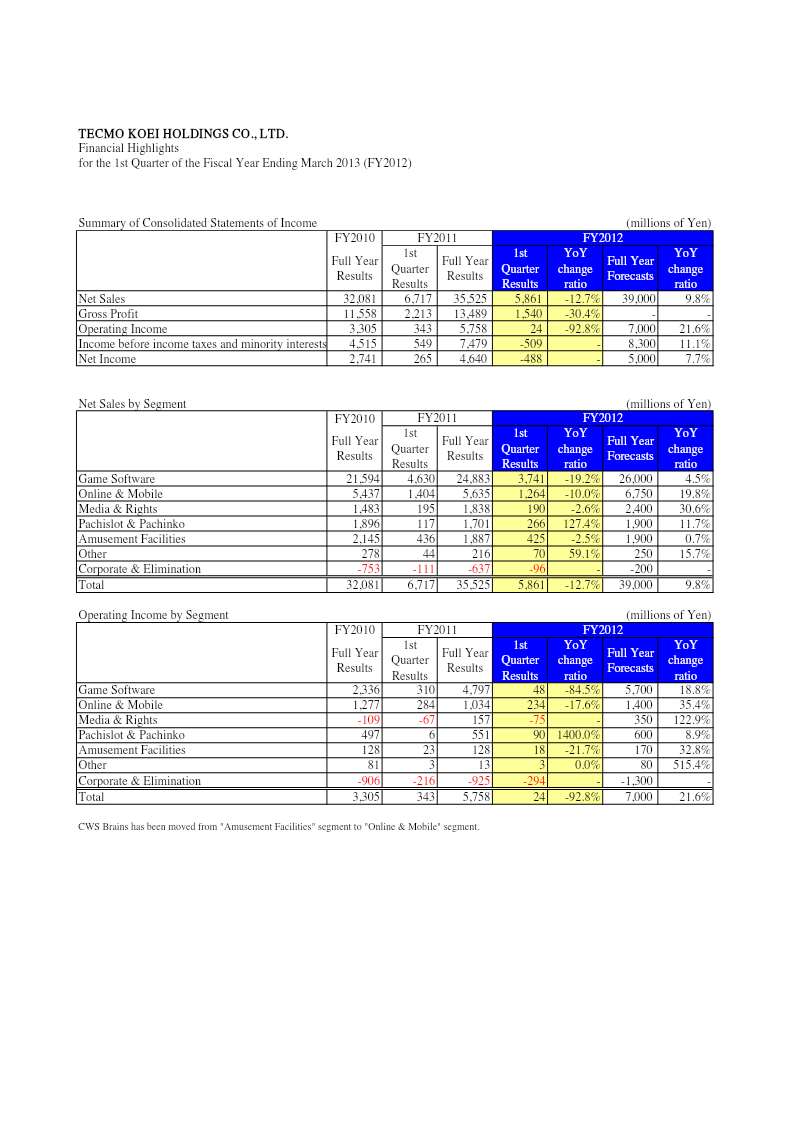
Financial Highlights for the 1st Quarter of the Fiscal Year Ending March 2013 (FY2012)
Tecmo Koei Holdings experienced a significant downturn in financial performance during the first quarter of the fiscal year ending March 2013. Net sales fell by 12.7% year-over-year to 5.86 billion yen, while operating income plummeted by 92.8% to just 24 million yen. The period was marked by a transition into a net loss of 488 million yen, a sharp contrast to the 265 million yen profit recorded in the same quarter of the previous year. This decline was primarily driven by the core game software segment, which saw sales drop nearly 20% and operating income fall by 84.5% as the company navigated a challenging market environment.
Performance across most business segments remained sluggish during the quarter. The online and mobile division saw a 10% decrease in sales, while the media and rights segment continued to operate at a loss. Conversely, the pachislot and pachinko segment provided a rare bright spot, with sales increasing by 127.4% and operating income rising from 6 million to 90 million yen. Despite these quarterly setbacks, the organization maintains an optimistic outlook for the full fiscal year, forecasting total net sales of 39 billion yen and a net income of 5 billion yen, representing projected annual growth of 9.8% and 7.7% respectively.
The data reflects a heavy reliance on the traditional game software segment, which accounts for the majority of revenue but also the highest volatility in earnings. While the first quarter results suggest a difficult start to the year, the full-year projections indicate an expected recovery driven by upcoming releases and growth in the online and mobile sectors. Methodologically, the figures represent consolidated financial statements for the Japanese holding company, including internal segment reclassifications such as the movement of CWS Brains from amusement facilities to the online and mobile division.
- Tecmo Koei Holdings reported a net loss of 488 million yen for Q1 FY2012, a significant reversal from the 265 million yen profit recorded in the same period the previous year.
- Operating income collapsed by 92.8% year-over-year to 24 million yen, while net sales declined by 12.7% to 5.86 billion yen.
- The core game software segment, the company's primary revenue driver, experienced a 20% drop in sales and an 84.5% decline in operating income.
- The pachislot and pachinko segment was the only major growth area, with sales increasing by 127.4% and operating income rising to 90 million yen.
- The online and mobile division underperformed during the quarter, recording a 10% decrease in sales.
+1
TECMO KOEI HOLDINGS CO., LTD.Jan 2013
Financial2 pages
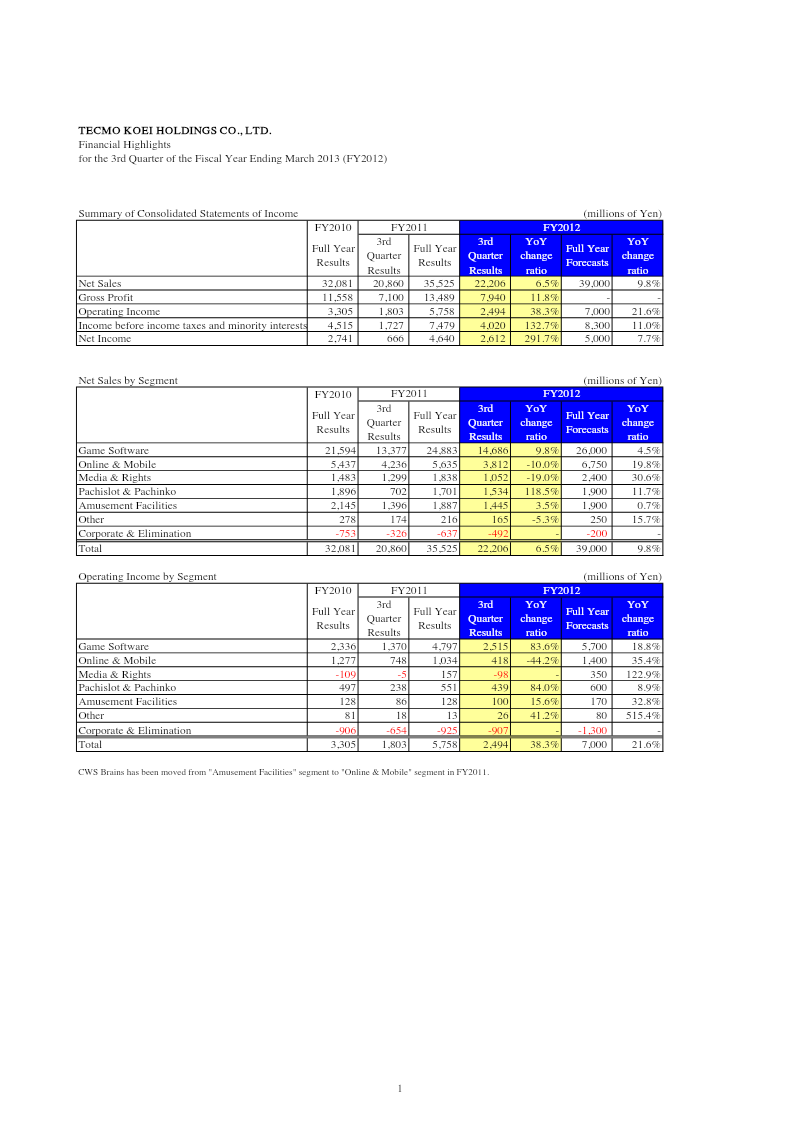
Financial Highlights for the 3rd Quarter of the Fiscal Year Ending March 2013 (FY2012)
Tecmo Koei Holdings reports significant financial growth for the third quarter of the fiscal year ending March 2013. Net sales for the nine-month period reached 22.2 billion yen, representing a 6.5% increase over the same period in the previous year. Profitability metrics showed even more substantial gains, with operating income rising 38.3% to 2.49 billion yen and net income surging 291.7% to 2.61 billion yen. This performance positions the company to meet its full-year forecast of 39 billion yen in net sales and 5 billion yen in net income.
The Game Software segment remains the primary driver of revenue and profit, contributing 14.69 billion yen in sales and 2.52 billion yen in operating income, reflecting year-over-year growth of 9.8% and 83.6% respectively. In contrast, the Online & Mobile and Media & Rights segments experienced declines in both revenue and operating income during the third quarter. The Pachislot & Pachinko segment emerged as a high-growth area, with sales increasing 118.5% to 1.53 billion yen. Amusement Facilities maintained steady performance with a slight 3.5% increase in sales.
The consolidated balance sheet as of December 31, 2012, indicates a strong financial position with total assets of 81.96 billion yen. A notable shift in the asset mix includes a significant increase in investment securities, which rose from 33.75 billion yen to 40.31 billion yen. Total liabilities decreased from 10.33 billion yen to 6.78 billion yen, primarily due to a reduction in current liabilities such as notes and accounts payable. Shareholders' equity remains robust at 79.07 billion yen, contributing to total net assets of 75.17 billion yen. These figures reflect the company's consolidated performance across its diverse entertainment portfolios in the Japanese and global markets.
- Tecmo Koei Holdings reported a 291.7% surge in net income to 2.61 billion yen for the nine-month period ending December 31, 2012.
- Operating income rose 38.3% to 2.49 billion yen, while net sales grew 6.5% to 22.2 billion yen compared to the same period in the previous fiscal year.
- The Game Software segment remains the primary profit driver, achieving 14.69 billion yen in sales and an 83.6% increase in operating income.
- The Pachislot & Pachinko segment experienced significant growth, with sales increasing 118.5% to 1.53 billion yen.
- The company maintains a strong balance sheet with 79.07 billion yen in shareholders' equity and a reduction in total liabilities from 10.33 billion yen to 6.78 billion yen.
Koei TecmoJan 2013
Financial1 pages
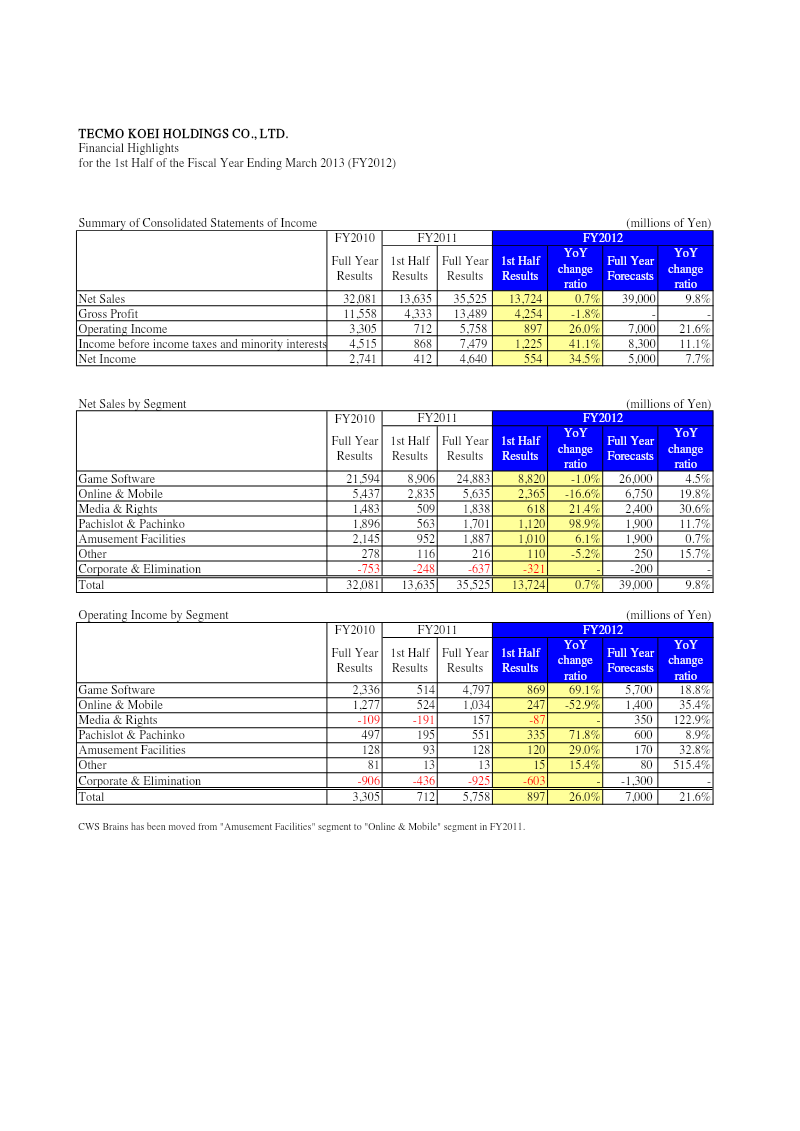
Financial Highlights for the 1st Half of the Fiscal Year Ending March 2013
Tecmo Koei Holdings demonstrated steady financial growth during the first half of the fiscal year ending March 2013, characterized by significant improvements in profitability despite relatively flat top-line revenue. Net sales for the six-month period reached 13,724 million yen, representing a modest 0.7% increase compared to the same period in the previous year. However, operating income rose sharply by 26% to 897 million yen, while net income saw a substantial 34.5% year-over-year increase to 554 million yen. This performance suggests improved operational efficiency and a more profitable product mix during the first half of the year.
The game software segment remained the primary driver of the business, contributing 8,820 million yen in sales. While segment sales saw a marginal decline of 1%, its operating income surged by 69.1%, indicating high margins on core software titles. In contrast, the online and mobile segment experienced a downturn, with sales falling 16.6% and operating income dropping 52.9%. This decline was offset by exceptional growth in the pachislot and pachinko segment, which saw sales nearly double with a 98.9% increase, and the media and rights segment, which grew by 21.4%.
Looking toward the full fiscal year, projections remain optimistic with an anticipated 9.8% increase in total net sales to 39,000 million yen. The company expects a significant recovery in the online and mobile sector and continued strength in game software to drive a forecasted 21.6% increase in annual operating income. These consolidated financial results reflect a diversified entertainment portfolio across game development, digital content, and physical amusement facilities, primarily focused on the Japanese market during the 2011 to 2013 fiscal periods.
- Tecmo Koei Holdings reported a 34.5% increase in net income to 554 million yen and a 26% rise in operating income to 897 million yen for the first half of the fiscal year ending March 2013.
- Net sales remained nearly flat at 13,724 million yen, a marginal 0.7% increase, indicating that the company's profit growth was driven by improved operational efficiency rather than revenue expansion.
- The game software segment, while seeing a 1% decline in sales, achieved a 69.1% surge in operating income, highlighting the high profitability of core titles.
- The pachislot and pachinko segment experienced significant growth, with sales nearly doubling by 98.9%, which helped offset a 16.6% sales decline in the online and mobile segment.
- The company projects a 9.8% increase in total net sales to 39,000 million yen for the full fiscal year, supported by an expected recovery in the online and mobile sector.
+1
Koei TecmoJan 2013

Financial33 pages
Fiscal Year Ending March 2014: 1st Half Financial Results
Tecmo Koei Holdings reported record-breaking financial results for the first half of the fiscal year ending March 2014, marking the third consecutive year of growth in both sales and profit. Net sales reached 15.46 billion yen, a 12.6% increase year-over-year, while operating profit rose 83.8% to 1.65 billion yen. Net income saw a substantial surge of 329.6%, totaling 2.38 billion yen. These results were driven by strong performances in the Game Software and Online & Mobile segments, alongside effective cost management that improved the operating profit ratio from 6.5% to 10.7%.
The geographic scope of these results remains heavily centered in Japan, which accounted for 82.7% of sales. While overseas sales saw a slight decline of 6.9%, the Asian market emerged as a growth area with a 56% increase in revenue. In terms of industry segments, Game Software remains the primary driver, supported by successful titles such as Toukiden: The Age of Demons, which sold 470,000 units in Japan and Asia. The Online & Mobile segment also showed growth, supported by over 25 million users across various social and mobile platforms, including successful titles on App Store and Google Play.
The strategic thesis focuses on "IP Creation and Expansion," emphasizing multi-platform development and the integration of intellectual property across games, animation, and events. Looking forward, the company plans to aggressively support new platforms like the PlayStation 4 and expand its digital distribution and smartphone application business. Financial projections for the full fiscal year 2013 estimate sales of 37 billion yen and net income of 5.7 billion yen. The company maintains a robust dividend policy, aiming for a 50% payout ratio or a minimum dividend of 50 yen, reflecting a commitment to shareholder returns as it pursues long-term profitability.
- Tecmo Koei achieved record-breaking growth for the first half of FY2014, with net sales rising 12.6% to 15.46 billion yen and net income surging 329.6% to 2.38 billion yen.
- Operating profit increased by 83.8% to 1.65 billion yen, driven by effective cost management that improved the operating profit ratio from 6.5% to 10.7%.
- The Game Software segment remains the primary revenue driver, highlighted by the success of 'Toukiden: The Age of Demons,' which sold 470,000 units across Japan and Asia.
- The Online & Mobile segment grew significantly, supported by a user base exceeding 25 million across social and mobile platforms, including titles on the App Store and Google Play.
- While 82.7% of total sales remain concentrated in Japan, the Asian market emerged as a key growth region with a 56% increase in revenue.
Koei TecmoJan 2013
Financial2 pages
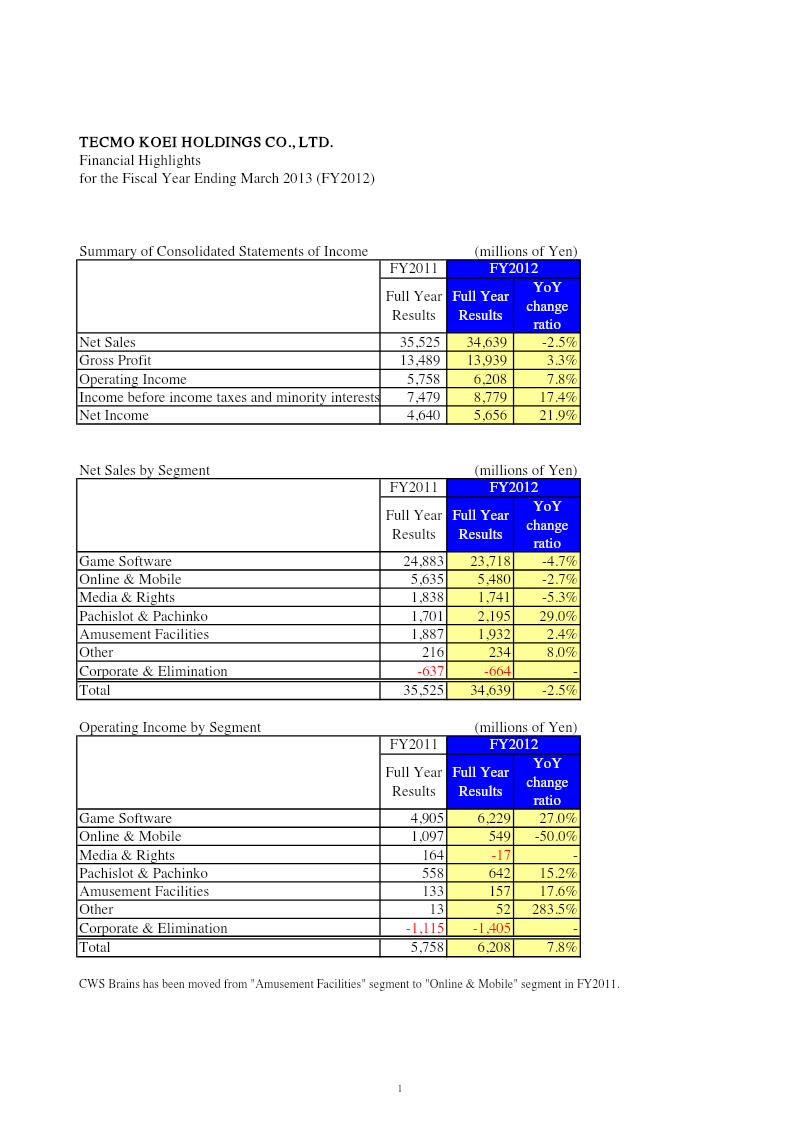
Financial Highlights for the Fiscal Year Ending March 2013 (FY2012)
Tecmo Koei Holdings achieved significant profitability growth during the fiscal year ending March 31, 2013, despite a slight contraction in overall revenue. Net sales decreased by 2.5% to 34.6 billion yen, yet the company realized a 7.8% increase in operating income and a substantial 21.9% rise in net income, which reached 5.6 billion yen. This divergence between top-line revenue and bottom-line profit suggests improved operational efficiencies and a more profitable product mix within the core business segments.
The game software division remains the primary revenue driver, contributing 23.7 billion yen. While sales in this segment fell by 4.7%, its operating income surged by 27%, indicating higher margins on software titles. Conversely, the online and mobile segment experienced a sharp 50% decline in operating income, falling to 549 million yen. The pachislot and pachinko segment emerged as a high-growth area, with sales increasing by 29% and operating income rising by 15.2%. Other smaller segments, such as amusement facilities, showed modest growth, while the media and rights division posted a small operating loss.
The corporate balance sheet strengthened considerably over the twelve-month period, with total assets expanding from 80.7 billion yen to 95 billion yen. This growth was largely fueled by a significant increase in investment securities, which rose from 33.7 billion yen to 45.3 billion yen, and a doubling of cash and time deposits. Shareholders' equity improved to 82.4 billion yen, supported by a recovery in accumulated other comprehensive income, specifically a swing from unrealized losses to gains on securities. These financial results reflect a period of consolidation and asset growth for the Japanese publisher, characterized by robust software profitability and a diversifying revenue base.
- Tecmo Koei Holdings achieved a 21.9% increase in net income to 5.6 billion yen for the fiscal year ending March 31, 2013, despite a 2.5% decline in net sales to 34.6 billion yen.
- The core game software division saw a 4.7% revenue decrease but achieved a 27% surge in operating income, signaling a shift toward higher-margin titles.
- The pachislot and pachinko segment emerged as a key growth driver, recording a 29% increase in sales and a 15.2% rise in operating income.
- The online and mobile segment performed poorly, with operating income dropping 50% to 549 million yen during the fiscal year.
- Total assets grew from 80.7 billion yen to 95 billion yen, driven primarily by an increase in investment securities from 33.7 billion yen to 45.3 billion yen.
Koei TecmoJan 2013
Financial2 pages
Financial Highlights for the Fiscal Year Ending March 2014 (FY2013)
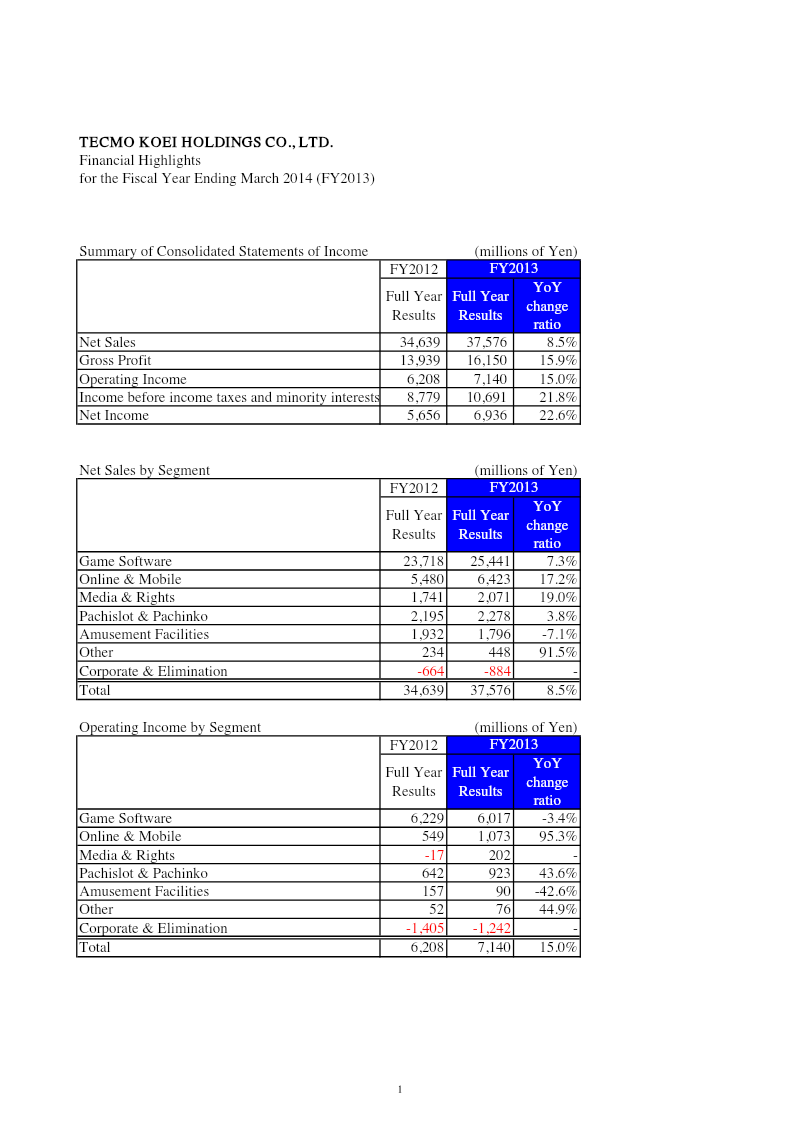
Tecmo Koei Holdings achieved significant financial growth during the fiscal year ending March 31, 2014, characterized by an 8.5% increase in net sales to 37.58 billion yen. Profitability metrics showed even stronger momentum, with operating income rising 15% to 7.14 billion yen and net income surging 22.6% to 6.94 billion yen. These results reflect a successful transition toward digital and diversified entertainment segments within the Japanese and global gaming markets.
The Online and Mobile segment emerged as a primary driver of profitability, recording a 17.2% increase in revenue and a 95.3% jump in operating income. While Game Software remained the largest revenue contributor at 25.44 billion yen, its operating income saw a slight contraction of 3.4%, suggesting higher development costs or shifting margins within traditional retail software. Other growth areas included Media and Rights, which returned to profitability, and the Pachislot and Pachinko business, which grew operating income by 43.6%. Conversely, the Amusement Facilities segment struggled, with revenue and operating income declining by 7.1% and 42.6% respectively.
The consolidated balance sheet indicates a robust financial position with total assets expanding to 100.62 billion yen. A notable strategic shift is visible in the investment portfolio, where investment securities rose from 45.34 billion yen to 56.91 billion yen. Total net assets increased to 88.79 billion yen, supported by a rise in retained earnings and favorable foreign currency translation adjustments. This financial stability, paired with a reduction in total liabilities to 11.83 billion yen, positioned the company with a strong equity ratio to pursue further expansion in the digital entertainment landscape.
- Tecmo Koei Holdings reported strong fiscal 2013 growth, with net sales rising 8.5% to 37.58 billion yen and net income surging 22.6% to 6.94 billion yen.
- The Online and Mobile segment became a primary profit driver, achieving a 17.2% revenue increase and a 95.3% jump in operating income.
- While Game Software remained the largest revenue contributor at 25.44 billion yen, its operating income contracted by 3.4% due to higher costs or margin shifts.
- The Pachislot and Pachinko business demonstrated significant momentum with a 43.6% increase in operating income, while the Amusement Facilities segment struggled with a 42.6% decline in operating income.
- The company strengthened its balance sheet by increasing total assets to 100.62 billion yen and reducing total liabilities to 11.83 billion yen.
Koei TecmoJan 2013

Financial29 pages
FY2012 2nd Quarter Presentation Materials
The financial results for the first half of fiscal year 2012 reflect a period of steady growth and strategic transition for the merged entity of Koei and Tecmo. Net sales for the period ending September 2012 reached 13.7 billion yen, a slight increase over the previous year, while operating profit saw a significant rise to 1.2 billion yen. This performance was driven largely by the worldwide success of Dead or Alive 5, which sold 580,000 units, and the domestic Japanese performance of Atelier Ayesha at 120,000 units. The geographic profile of the company shifted during this period, with overseas sales increasing from 13.3% to 20.9% of total revenue, supported by a near doubling of unit sales in North America and Europe.
The strategic focus emphasizes a multi-platform approach, expanding beyond traditional home video game software into online and mobile segments. While game software remains the primary revenue driver, accounting for 8.9 billion yen in the first half, there is a concerted effort to strengthen the download business and social game integration. Key initiatives include the global expansion of social titles like Samurai Cats and the utilization of the Gust brand following its acquisition. Efficiency remains a priority, as evidenced by a 2.0-point improvement in the selling, general, and administrative expenses ratio compared to the previous year.
Looking ahead, the full-year plan for fiscal 2012 targets 39 billion yen in net sales and 7 billion yen in operating profit. This outlook is supported by a robust pipeline of collaborative titles, such as Fist of the North Star: Ken’s Rage 2, and continued expansion into the smartphone market with titles like Shin Sangoku Musou Slash. The company aims to capitalize on a recovering Japanese home video game market, which grew 10.7% in the first half of the year, while continuing to reduce costs and maximize synergies between its various intellectual properties and business segments.
- Koei Tecmo reported H1 FY2012 net sales of 13.7 billion yen and an operating profit of 1.2 billion yen, driven by the release of Dead or Alive 5 (580,000 units) and Atelier Ayesha (120,000 units).
- The company is successfully expanding its international footprint, with overseas revenue rising from 13.3% to 20.9% of total sales following a near doubling of unit sales in North America and Europe.
- Management has set full-year FY2012 targets of 39 billion yen in net sales and 7 billion yen in operating profit, supported by upcoming titles like Fist of the North Star: Ken’s Rage 2.
- The business is shifting toward a multi-platform strategy that emphasizes online and mobile growth, including the global expansion of social titles like Samurai Cats and the development of Shin Sangoku Musou Slash for smartphones.
- Operational efficiency improved during the first half, with the selling, general, and administrative (SG&A) expenses ratio decreasing by 2.0 percentage points compared to the previous year.
+1
Koei TecmoJan 2012
Financial1 pages
Financial Highlights for the Fiscal Year Ending March 2012 (FY2011)
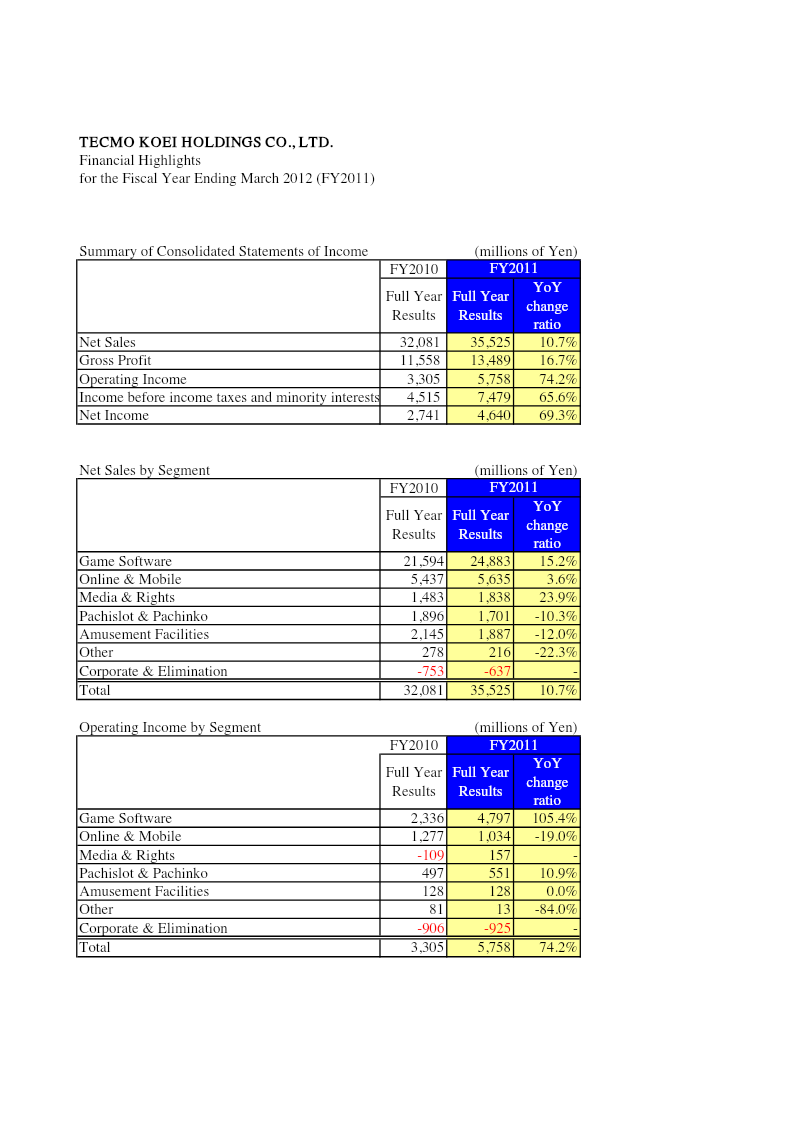
Tecmo Koei Holdings achieved significant financial growth during the fiscal year ending March 2012, characterized by a substantial increase in profitability across its core business operations. Net sales rose by 10.7% to reach 35,525 million yen, while net income experienced a dramatic surge of 69.3%, totaling 4,640 million yen. This performance was driven primarily by a 74.2% year-over-year increase in operating income, which climbed to 5,758 million yen. The results indicate a period of high operational efficiency and successful product delivery within the Japanese gaming and entertainment sectors.
The game software segment served as the primary engine for growth, contributing 24,883 million yen in sales, a 15.2% increase from the previous year. More notably, the operating income for this segment more than doubled, rising 105.4% to 4,797 million yen. While the online and mobile division saw a modest 3.6% increase in sales, its operating income declined by 19.0%, suggesting higher costs or shifting margins within the digital space. The media and rights segment demonstrated a successful turnaround, moving from an operating loss in the prior year to a profit of 157 million yen on the back of 23.9% sales growth.
In contrast to the success of software and media, the company faced challenges in its physical and traditional entertainment divisions. Sales in the amusement facilities and pachislot and pachinko segments declined by 12.0% and 10.3% respectively. Despite the drop in revenue, the pachislot and pachinko business managed to increase its operating income by 10.9%, while amusement facility profits remained flat. These figures reflect a strategic shift where high-margin software and intellectual property rights increasingly dominate the corporate portfolio, offsetting the contraction in legacy arcade and physical gaming segments.
- Tecmo Koei Holdings saw a 69.3% surge in net income to 4,640 million yen for the fiscal year ending March 2012, supported by a 10.7% increase in net sales to 35,525 million yen.
- The game software segment was the primary growth driver, with sales rising 15.2% to 24,883 million yen and operating income more than doubling with a 105.4% increase to 4,797 million yen.
- Operating income across the entire company grew by 74.2% year-over-year to 5,758 million yen, signaling significant improvements in operational efficiency.
- The media and rights segment achieved a successful turnaround, moving from an operating loss in the previous year to a profit of 157 million yen alongside 23.9% sales growth.
- The online and mobile division experienced a 19.0% decline in operating income despite a 3.6% increase in sales, indicating rising costs or margin compression in the digital space.
Koei TecmoJan 2012

Financial34 pages
Financial Results for the First Half of the Fiscal Year Ending March 2011
This financial report details the performance of Tecmo Koei Holdings for the first half of the fiscal year ending March 2011. The primary thesis centers on the company’s successful transition to profitability following the merger of Koei and Tecmo, achieving its first-ever first-half operating profit. Net sales for the period reached 13.6 billion Yen, a significant increase from 11.1 billion Yen in the previous year, while operating profit swung from a 1.6 billion Yen loss to a 712 million Yen gain.
The scope of the data covers global operations, though Japan remains the dominant market, accounting for 86.7% of sales. While the Game Software segment remains the largest revenue driver, the Online & Mobile segment showed robust growth, with sales increasing from 1.8 billion Yen to 2.8 billion Yen. Management attributes this recovery to disciplined resource allocation toward profitable titles, stable contributions from the social gaming sector, and aggressive cost-reduction measures that lowered selling, general, and administrative expenses.
Strategic priorities for the remainder of the fiscal year include doubling growth in social gaming through global expansion on platforms like Mobage, GREE, and Tencent, and supporting new hardware launches such as the Nintendo 3DS and PlayStation Vita. The company is also emphasizing "group synergy" by crossing over legacy IPs, such as the integration of Tecmo’s horse racing mechanics into combined titles. Looking forward, the company plans to reach 35 billion Yen in annual sales, driven by a shift toward multiplayer-centric play styles and high-profile collaborations like the One Piece Kaizoku Musou project.
- Tecmo Koei achieved its first-ever first-half operating profit of 712 million Yen for the period ending March 2011, reversing a 1.6 billion Yen loss from the previous year.
- Net sales grew to 13.6 billion Yen, up from 11.1 billion Yen in the prior year, driven by disciplined resource allocation and cost-reduction measures.
- The Online & Mobile segment experienced significant growth, with sales increasing from 1.8 billion Yen to 2.8 billion Yen.
- Japan remains the company's primary market, accounting for 86.7% of total sales.
- Strategic growth plans include expanding social gaming on platforms like Mobage, GREE, and Tencent, alongside development support for the Nintendo 3DS and PlayStation Vita.
+1
Koei TecmoMar 2011

Financial34 pages
Fiscal Year Ended March 2012 Financial Results
Tecmo Koei achieved record financial performance for the fiscal year ending March 2012, characterized by a 10.7% increase in sales to ¥35.5 billion and a substantial 69.3% surge in net income to ¥4.6 billion. This growth was primarily fueled by the success of high-profile software titles, most notably One Piece: Kaizoku Musou, which sold 630,000 units, and a rapid expansion into the social gaming sector that reached a user base exceeding 500 million. The company’s strategic focus centered on leveraging established intellectual properties and high-impact collaborations, such as Pokémon + Nobunaga’s Ambition, to drive engagement across both traditional and digital platforms.
Operational efficiency remained a core pillar of the corporate strategy, evidenced by an 8.9-point improvement in the selling, general, and administrative expenses-to-sales ratio since 2009. The acquisition of Gust Co., Ltd. further bolstered profitability by integrating the high-margin Atelier franchise into the portfolio. Moving forward, the objective is to maintain an ordinary profit ratio above 30% while targeting ¥39 billion in sales for the upcoming fiscal year. This trajectory relies on the continued globalization of core IPs and an aggressive pivot toward digital download revenue and mobile gaming markets.
While these projections reflect a robust outlook for the 2012 fiscal year, they remain subject to the inherent risks and uncertainties of the global entertainment market. Future performance depends on the successful execution of digital expansion and the ability to maintain cost efficiencies amidst shifting consumer preferences. These financial objectives represent strategic targets rather than guaranteed outcomes, as the company navigates a transition toward a more digitally-oriented business model.
- Tecmo Koei achieved record fiscal year 2012 results with a 10.7% increase in sales to ¥35.5 billion and a 69.3% surge in net income to ¥4.6 billion.
- The company’s social gaming division reached a user base exceeding 500 million, serving as a primary growth driver alongside high-profile titles like One Piece: Kaizoku Musou, which sold 630,000 units.
- Operational efficiency improved significantly, with the selling, general, and administrative expenses-to-sales ratio decreasing by 8.9 points since 2009.
- The acquisition of Gust Co., Ltd. was a key strategic move to increase profitability by integrating the high-margin Atelier franchise into the company's portfolio.
- Management has set a target of ¥39 billion in sales for the upcoming fiscal year while aiming to maintain an ordinary profit ratio above 30%.
+1
Koei TecmoJan 2011
Financial1 pages
Financial Highlights for the 1st Half of Fiscal Year Ending March 2011 (FY2010)
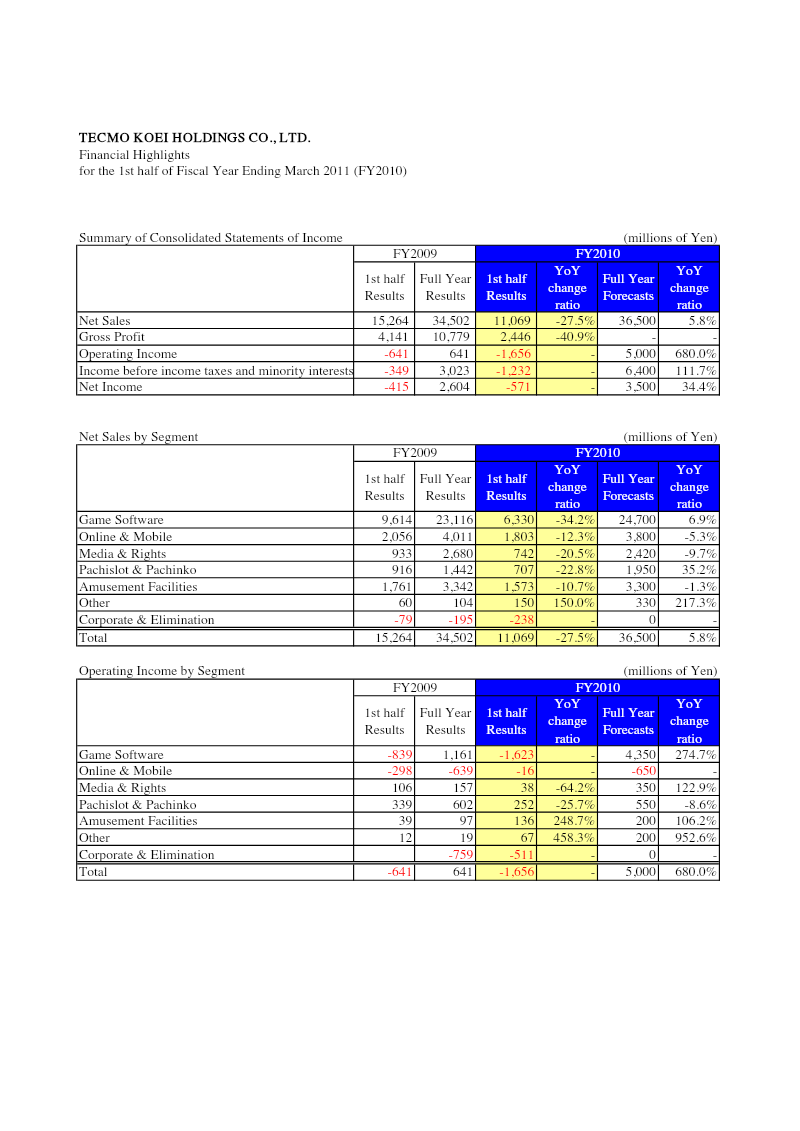
Tecmo Koei Holdings experienced a challenging first half for the fiscal year ending March 2011, characterized by significant year-over-year declines across nearly all business segments. Net sales for the six-month period fell to 11,069 million yen, representing a 27.5% decrease compared to the same period in the previous year. This downturn led to an operating loss of 1,656 million yen and a net loss of 571 million yen, deepening the deficits recorded during the first half of fiscal year 2009.
The game software segment, the company’s largest division, was the primary driver of this decline, with sales dropping 34.2% to 6,330 million yen and operating losses nearly doubling to 1,623 million yen. Other core areas, including online and mobile, media and rights, and pachislot and pachinko, also saw revenue contractions ranging from 12.3% to 22.8%. Amusement facilities remained a small bright spot in terms of profitability, seeing operating income rise to 136 million yen despite a 10.7% dip in sales.
Despite these immediate losses, the financial outlook for the full fiscal year remains optimistic, projecting a significant recovery in the second half. Management forecasts total annual net sales of 36,500 million yen, a 5.8% increase over the prior full year. This recovery is expected to be driven by a massive surge in game software profitability, with a full-year operating income target of 5,000 million yen. Achieving these goals would represent a 680% year-over-year increase in operating income, suggesting a heavy reliance on major product launches or seasonal performance scheduled for the latter half of the fiscal year.
- Tecmo Koei Holdings reported a net loss of 571 million yen and an operating loss of 1,656 million yen for the first half of fiscal year 2010.
- Net sales for the six-month period fell 27.5% year-over-year to 11,069 million yen, driven primarily by a 34.2% decline in the game software segment.
- The company’s game software division recorded an operating loss of 1,623 million yen, nearly doubling its deficit compared to the same period in the previous year.
- Revenue across online and mobile, media and rights, and pachislot and pachinko segments contracted between 12.3% and 22.8%.
- Amusement facilities were the only profitable segment, generating 136 million yen in operating income despite a 10.7% decline in sales.
Koei TecmoJan 2011