Koei Tecmo
Game Co.173 documents
Japanese developer/publisher. Dynasty Warriors, Nioh, Dead or Alive, Atelier, Romance of the Three Kingdoms.
Documents

Financial31 pages
Fiscal Year Ending March 2017 Financial Results
Koei Tecmo Holdings presents its financial results for the fiscal year ending March 31, 2017, alongside its strategic outlook for the 2018 fiscal year. The primary thesis emphasizes that an increasing proportion of digital business sales is a fundamental driver of corporate profitability. While total sales for FY2016 saw a slight year-over-year decline of 3.4% to 37,034 million yen, net income rose by 7.1% to 11,624 million yen. This growth in net profit despite lower revenue is attributed to the higher margins associated with digital distribution and the success of key intellectual properties.
The data covers global operations, with Japan remaining the largest market at 73.1% of sales. However, overseas unit sales grew to 51.7% of the total volume, led by strong performance in North America and Asia. Key product milestones include the success of Nioh, which surpassed one million copies worldwide, and the strong performance of mobile titles like Dissidia Final Fantasy Opera Omnia and Dynasty Warriors Unleashed, the latter of which exceeded three million downloads. The entertainment segment remains the dominant revenue contributor, supported by smaller contributions from pachislot, amusement facilities, and real estate.
Looking forward to FY2017, the strategy focuses on IP creation and multi-platform expansion, including support for the Nintendo Switch and PlayStation VR. The company aims for record-high profits with a sales target of 42,000 million yen. To mitigate risks associated with recent game delays, management is implementing stricter quality and delivery controls. The plan also includes the launch of "midas," a new brand focused on mobile development by younger creators, and increased collaborative efforts across different media and industries to maximize the value of existing franchises.
- Koei Tecmo achieved a 7.1% increase in net income to 11,624 million yen for the fiscal year ending March 2017, despite a 3.4% decline in total sales to 37,034 million yen.
- Profitability growth is primarily driven by high-margin digital distribution and the performance of key intellectual properties.
- Overseas unit sales grew to 51.7% of total volume, even as Japan remained the largest revenue market at 73.1% of total sales.
- Key product successes included the action title Nioh, which surpassed one million units sold, and the mobile game Dynasty Warriors Unleashed, which exceeded three million downloads.
- The company set a sales target of 42,000 million yen for the 2018 fiscal year, aiming for record-high profits through multi-platform expansion and Nintendo Switch and PlayStation VR support.
Koei TecmoJan 2016
Financial2 pages
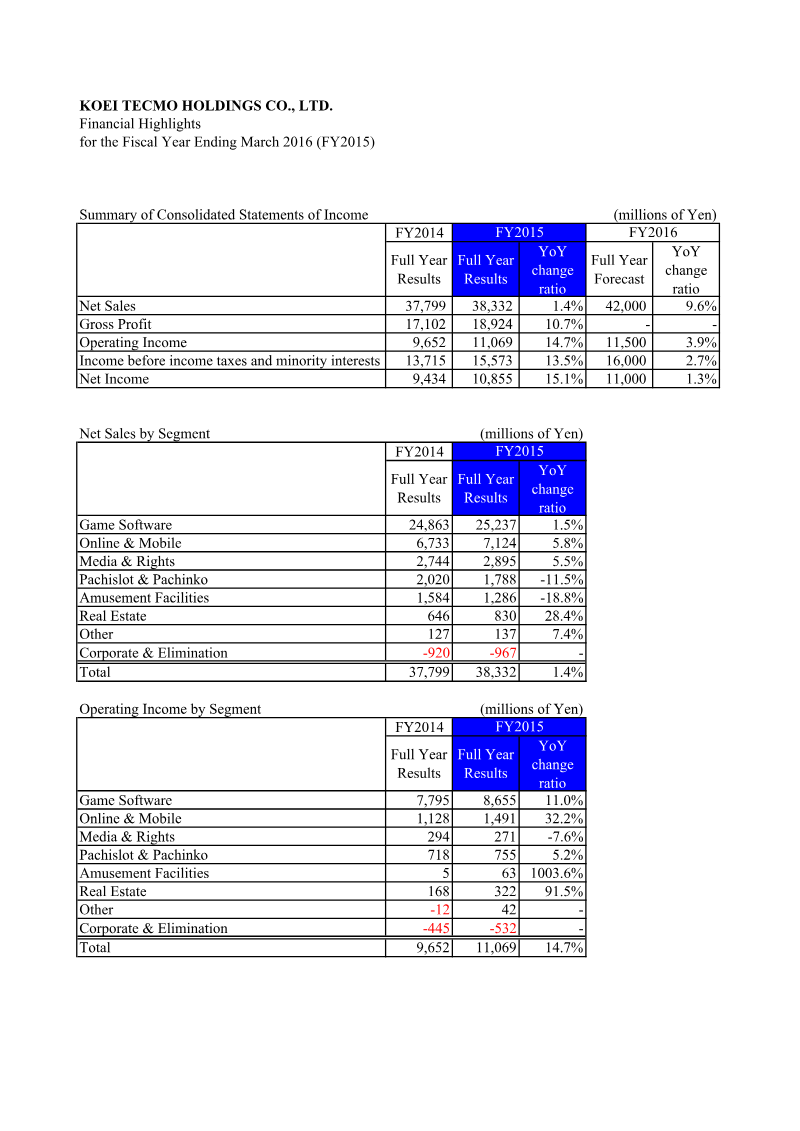
Financial Highlights for the Fiscal Year Ending March 2016 (FY2015)
Koei Tecmo Holdings achieved record financial performance for the fiscal year ending March 31, 2016, characterized by steady growth in net sales and significant double-digit increases in profitability. Net sales rose to 38.3 billion yen, a 1.4% increase over the previous year, while operating income grew by 14.7% to reach 11.1 billion yen. Net income saw the most substantial gain, rising 15.1% to 10.9 billion yen. These results reflect a successful transition toward higher-margin digital and software segments, with forecasts for the 2016 fiscal year predicting continued expansion across all major financial metrics.
The game software segment remains the primary driver of the company’s portfolio, contributing 25.2 billion yen in sales and 8.7 billion yen in operating income. While the online and mobile segment represents a smaller portion of total revenue at 7.1 billion yen, it demonstrated the highest growth potential with a 32.2% year-over-year increase in operating income. Conversely, the amusement facilities and pachislot/pachinko segments experienced revenue declines of 18.8% and 11.5% respectively, though the amusement facilities division saw a dramatic recovery in profitability from a low baseline.
The consolidated balance sheet as of March 2016 shows a total asset value of 110.9 billion yen, a slight decrease from the prior year primarily due to fluctuations in the market value of investment securities. Despite this, the company maintains a robust equity position with retained earnings growing to 60 billion yen. The financial structure remains stable, with total liabilities decreasing to 12.2 billion yen. This data covers the Japanese gaming and multimedia conglomerate’s global operations for the twelve-month period concluding in early 2016, utilizing audited consolidated financial statements to track performance across its diverse entertainment and real estate holdings.
- Koei Tecmo achieved record financial performance for FY2015, with net income rising 15.1% to 10.9 billion yen and operating income increasing 14.7% to 11.1 billion yen.
- The game software segment remains the company's primary revenue driver, contributing 25.2 billion yen in sales and 8.7 billion yen in operating income.
- The online and mobile segment demonstrated the highest growth potential, recording a 32.2% year-over-year increase in operating income despite contributing 7.1 billion yen in total revenue.
- Amusement facilities and pachislot/pachinko segments faced revenue declines of 18.8% and 11.5% respectively during the fiscal year.
- The company maintains a strong financial position with 60 billion yen in retained earnings and a reduced total liability of 12.2 billion yen as of March 2016.
+1
Koei TecmoJan 2016
Financial2 pages
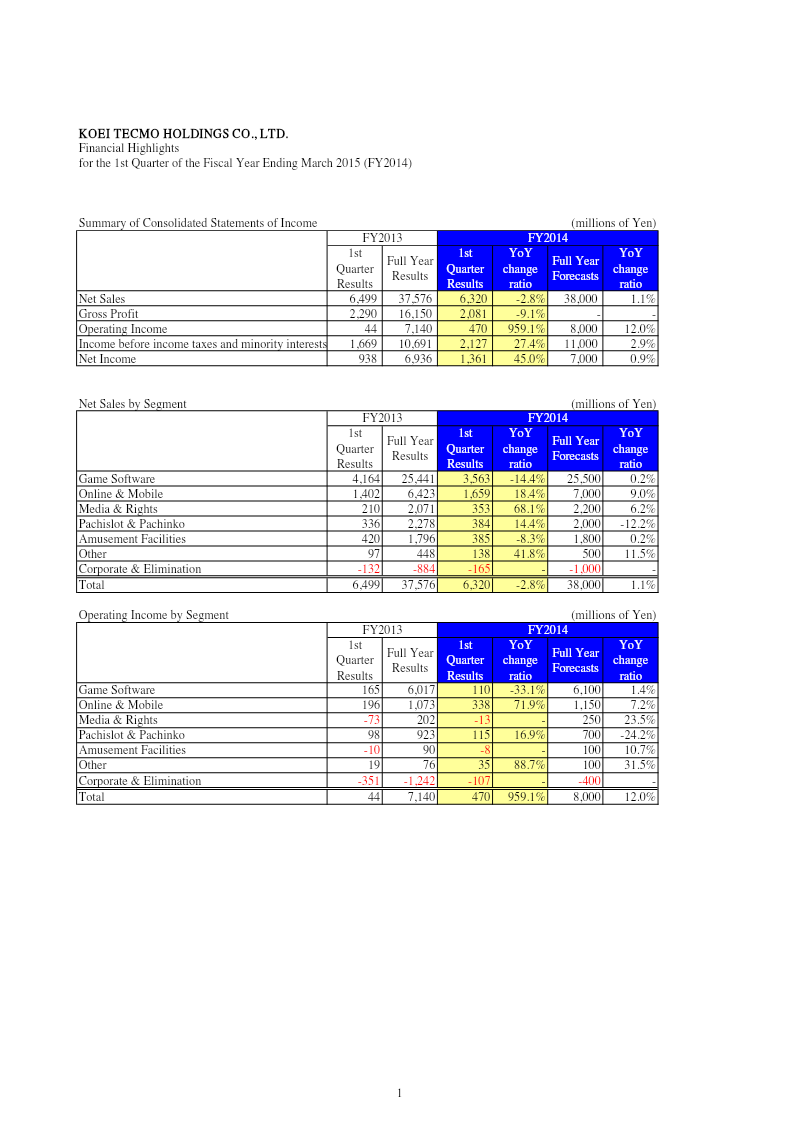
Financial Highlights for the 1st Quarter of the Fiscal Year Ending March 2015 (FY2014)
Koei Tecmo Holdings reported a significant increase in profitability for the first quarter of the fiscal year ending March 2015, despite a slight decline in overall revenue. While net sales decreased by 2.8% year-over-year to 6.32 billion yen, operating income surged by 959.1% to 470 million yen. Net income also saw substantial growth, rising 45% to 1.36 billion yen. These results indicate a shift toward higher-margin business activities and improved operational efficiency during the three-month period ending June 30, 2014.
Performance across business segments was mixed. The core Game Software division experienced a 14.4% drop in sales and a 33.1% decline in operating income, reflecting the cyclical nature of major title releases. Conversely, the Online & Mobile segment emerged as a primary growth driver, with sales increasing 18.4% and operating income rising 71.9%. Other areas, including Media & Rights and Pachislot & Pachinko, also posted revenue gains, while the Amusement Facilities segment continued to face challenges, reporting a small operating loss.
The consolidated balance sheet shows a total asset value of 93.8 billion yen, a decrease from the 100.6 billion yen reported at the end of the previous fiscal year. This change was largely driven by a reduction in cash and accounts receivable. However, the company maintains a strong equity position with net assets totaling 87.3 billion yen. Looking ahead, the full-year forecast remains optimistic, projecting net sales of 38 billion yen and an operating income of 8 billion yen, suggesting that the company expects continued momentum in its digital and mobile sectors to offset fluctuations in traditional software retail.
- Koei Tecmo Holdings achieved a 959.1% surge in operating income to 470 million yen and a 45% increase in net income to 1.36 billion yen for the quarter ending June 30, 2014, despite a 2.8% decline in net sales to 6.32 billion yen.
- The Online & Mobile segment acted as the primary growth engine, delivering an 18.4% increase in sales and a 71.9% rise in operating income.
- The core Game Software division underperformed during the quarter, with sales falling 14.4% and operating income dropping 33.1% due to the cyclical nature of title releases.
- The company maintains a strong financial position with 87.3 billion yen in net assets, despite a decrease in total assets from 100.6 billion yen to 93.8 billion yen since the previous fiscal year-end.
- Management projects a positive full-year outlook for FY2014, targeting 38 billion yen in net sales and 8 billion yen in operating income.
+2
Koei TecmoMar 2015

Financial34 pages
Fiscal Year Ending March 2016: 1st Half Financial Results
Koei Tecmo Holdings presents a financial analysis for the first half of the fiscal year ending March 2016, highlighting a period of strategic transition toward digital and global expansion. While net sales for the six-month period ended September 2015 decreased by 5.9% year-over-year to 15,159 million yen, the company significantly outperformed its initial profit forecasts. Operating profit reached 2,477 million yen, exceeding projections by 45.7%, while net income rose 3.4% to 4,061 million yen, surpassing the forecast by 84.6%. This profitability was driven by increased royalty revenue from collaboration titles and the growth of high-margin digital download sales.
The data covers global operations across Japan, North America, Europe, and Asia, with a specific focus on the Game Software and Online & Mobile segments. Although Japan remains the primary market, accounting for 74.9% of sales, the Asian market showed the most aggressive growth, with sales increasing by 75.9% and unit volumes rising by 132.6%. The Game Software segment remains the largest contributor, generating 8,873 million yen in sales, while the Online & Mobile segment contributed 3,459 million yen.
Strategic initiatives emphasize the expansion of intellectual property through multi-platform development and large-scale collaborations with major overseas and domestic partners. The company is aggressively pursuing the smartphone and browser game markets in Asia and adapting core titles for PlayStation 4 and Xbox One in China. To enhance shareholder value, a 1:1.2 stock split was implemented in October 2015, supported by a dividend policy targeting a 50% payout ratio. Management aims to achieve record-high yearly financial results for the full fiscal year, targeting 40,000 million yen in sales and an operating profit ratio of 25%, with a long-term goal of reaching 30%.
- Koei Tecmo exceeded profit forecasts for the first half of fiscal year 2016, with operating profit reaching 2,477 million yen (45.7% above projections) and net income rising 3.4% to 4,061 million yen.
- Despite a 5.9% year-over-year decline in net sales to 15,159 million yen, profitability was bolstered by high-margin digital download sales and increased royalty revenue from collaboration titles.
- The Asian market emerged as a key growth driver, recording a 75.9% increase in sales and a 132.6% rise in unit volume, even as Japan remained the primary market at 74.9% of total sales.
- Management is targeting record-high full-year results, aiming for 40,000 million yen in sales and an operating profit ratio of 25%, with a long-term goal of 30%.
- Strategic expansion is focused on multi-platform development, including adapting core titles for PlayStation 4 and Xbox One in China and targeting the smartphone and browser game markets in Asia.
+1
Koei TecmoJan 2015
Financial2 pages
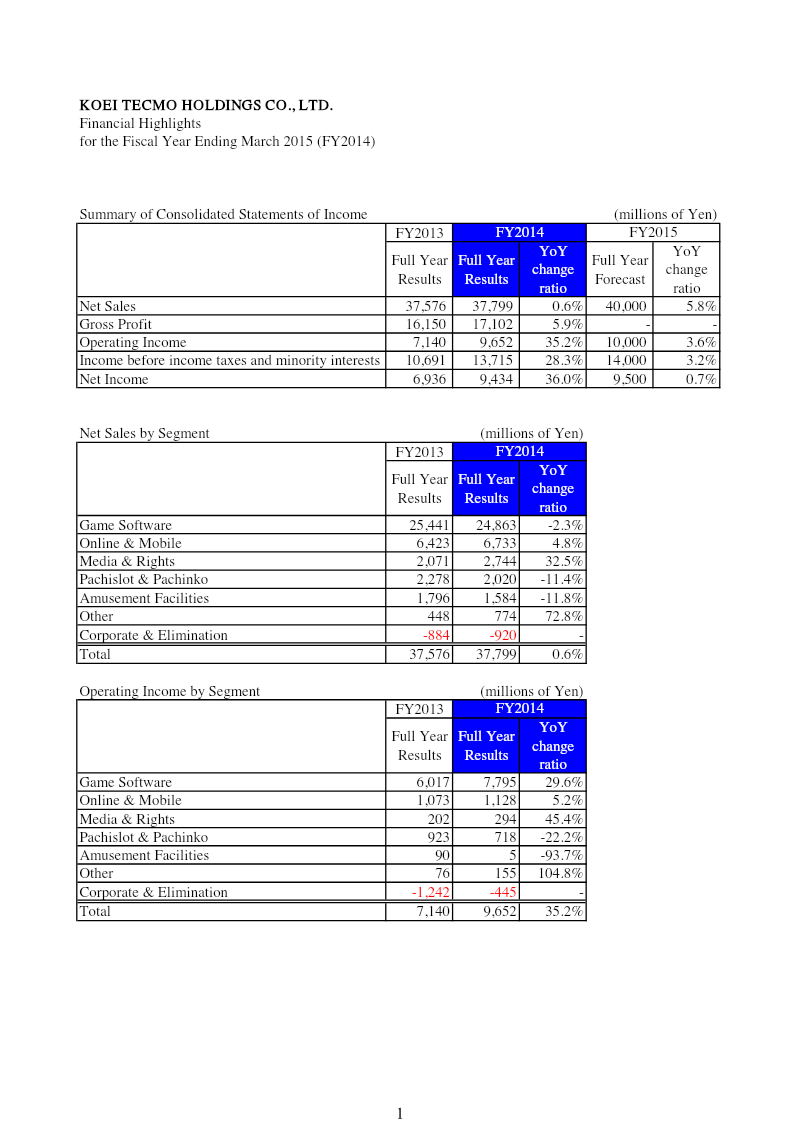
Financial Highlights for the Fiscal Year Ending March 2015 (FY2014)
Koei Tecmo Holdings achieved significant profitability growth during the fiscal year ending March 31, 2015, despite relatively flat top-line revenue. While net sales saw a marginal increase of 0.6% to 37.8 billion yen, operating income surged by 35.2% to 9.65 billion yen. This trend extended to net income, which rose 36% to reach 9.4 billion yen. These results reflect a successful shift toward higher-margin business activities and improved operational efficiency across the company’s core segments.
The game software division remains the primary driver of financial performance, contributing 24.9 billion yen in sales. Although segment revenue declined slightly by 2.3%, its operating income grew by nearly 30%, indicating a more profitable product mix or reduced development costs. The online and mobile segment and the media and rights division both posted gains in revenue and profit, with media and rights seeing a notable 32.5% increase in sales. Conversely, the amusement facilities and pachislot segments experienced double-digit declines in both revenue and operating income, reflecting a challenging environment for physical location-based entertainment.
The consolidated balance sheet reveals a strong liquidity position and a substantial increase in total assets, which grew from 100.6 billion yen to 115.2 billion yen. This growth was largely driven by a rise in investment securities and property and equipment. Shareholders' equity also strengthened, supported by a significant increase in retained earnings and unrealized gains on securities. Looking ahead to the 2015 fiscal year, forecasts suggest continued growth with a sales target of 40 billion yen and a modest increase in net income, signaling confidence in the sustained performance of the company’s digital and intellectual property portfolios.
- Koei Tecmo Holdings achieved a 35.2% surge in operating income to 9.65 billion yen and a 36% increase in net income to 9.4 billion yen for the fiscal year ending March 2015, despite net sales remaining nearly flat at 37.8 billion yen.
- The game software division, while seeing a 2.3% decline in revenue to 24.9 billion yen, improved its operating income by nearly 30% due to a more profitable product mix or reduced development costs.
- The media and rights division demonstrated strong growth with a 32.5% increase in sales, contributing to the company's overall shift toward higher-margin business activities.
- Total assets grew from 100.6 billion yen to 115.2 billion yen, bolstered by increases in investment securities and property and equipment.
- Amusement facilities and pachislot segments underperformed, recording double-digit declines in both revenue and operating income.
Koei TecmoJan 2015
Financial2 pages
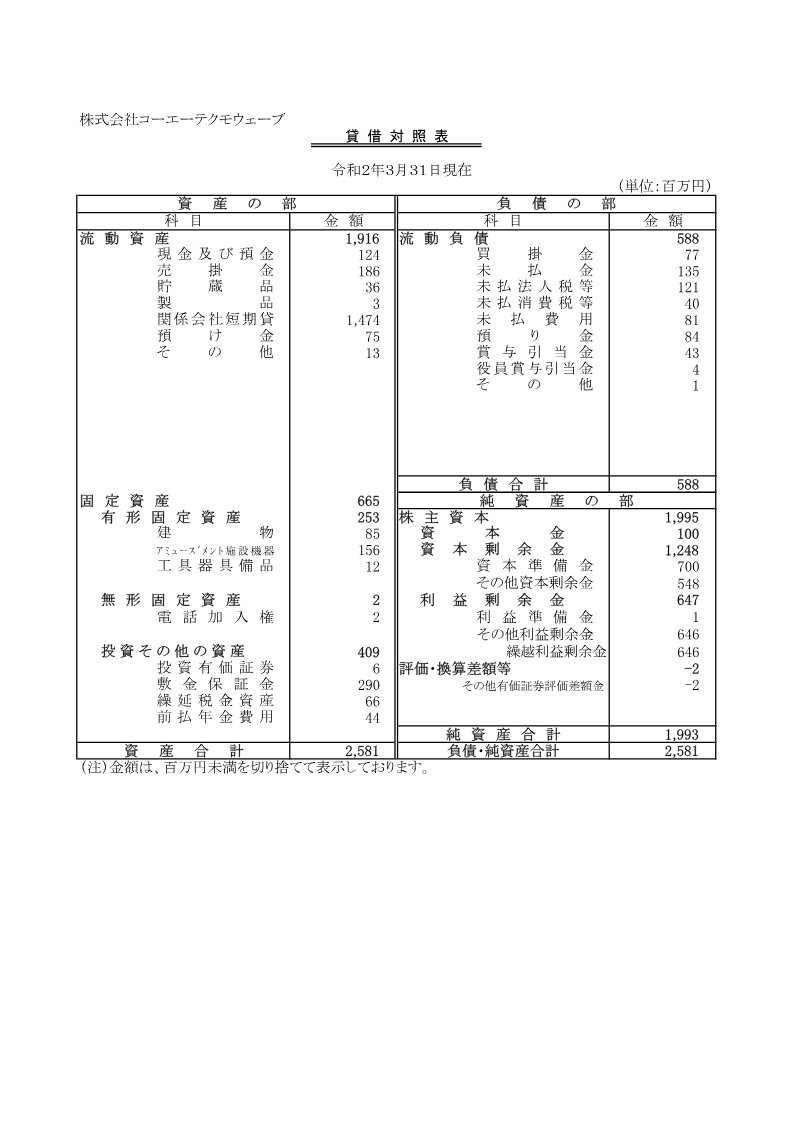
Koei Tecmo Wave Balance Sheet: FY2019
Koei Tecmo Wave, a subsidiary of the Koei Tecmo Group specializing in amusement facility management and arcade equipment, maintained a stable financial position for the fiscal year ending March 31, 2020. The balance sheet reflects a total asset value of 2.58 billion yen, with a significant concentration in liquid assets. Current assets account for 1.92 billion yen, largely driven by 1.47 billion yen in short-term loans to affiliated companies, suggesting a centralized cash management strategy within the broader corporate group. Cash and deposits stand at 124 million yen, while accounts receivable total 186 million yen.
The fixed asset portfolio, valued at 665 million yen, is primarily composed of tangible assets related to amusement facility equipment and buildings, totaling 253 million yen. Investment and other assets contribute 409 million yen, which includes substantial leasehold deposits of 290 million yen, typical for a business operating physical entertainment venues. On the liability side, the company maintains a conservative debt profile with 588 million yen in total liabilities, all of which are classified as current. Key obligations include accounts payable of 77 million yen and accrued income taxes of 121 million yen.
The company’s equity position remains robust, with total net assets of 1.99 billion yen. This is supported by 100 million yen in capital stock and 1.25 billion yen in capital surplus. Retained earnings reached 647 million yen, bolstered by a reported net income of 303 million yen for the fiscal period. Accounting methodologies follow standard Japanese practices, utilizing declining-balance and straight-line depreciation for fixed assets and cost-basis valuation for inventories. Overall, the data indicates a highly liquid, profitable operation with minimal long-term debt and strong internal financing capabilities.
- Koei Tecmo Wave reported a net income of 303 million yen for the fiscal year ending March 31, 2020, contributing to a robust total net asset position of 1.99 billion yen.
- The company maintains a highly liquid balance sheet with 1.92 billion yen in current assets, of which 1.47 billion yen consists of short-term loans to affiliated companies.
- Total liabilities are limited to 588 million yen, all of which are current, indicating a conservative debt profile with no long-term debt obligations.
- Total assets reached 2.58 billion yen, with 665 million yen in fixed assets primarily comprised of amusement equipment, buildings, and 290 million yen in leasehold deposits.
- The company’s equity is supported by 100 million yen in capital stock, 1.25 billion yen in capital surplus, and 647 million yen in retained earnings.
+2
Koei TecmoJan 2015
Financial2 pages
Financial Highlights for the 3rd Quarter of the Fiscal Year Ending March 2016 (FY2015)
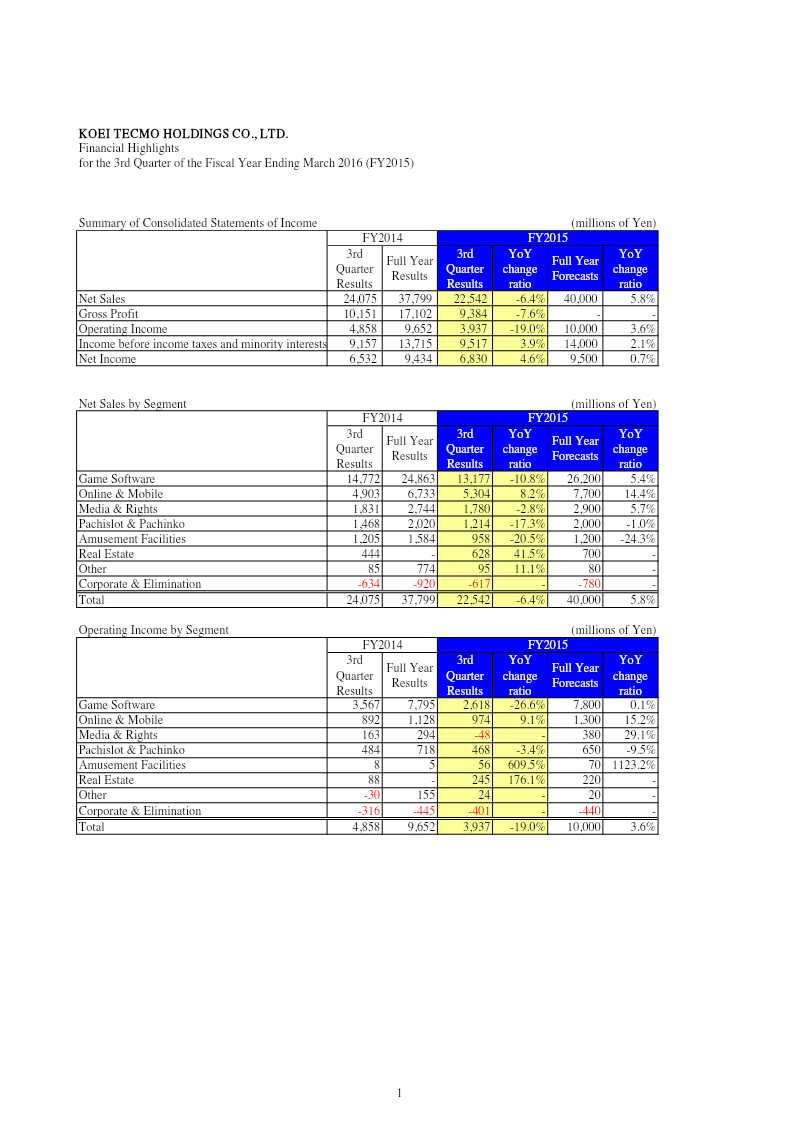
Koei Tecmo Holdings reported its financial results for the third quarter of the fiscal year ending March 2016, revealing a period of mixed performance characterized by declining top-line revenue but improved net profitability. For the nine-month period ending December 31, 2015, net sales reached 22.54 billion yen, representing a 6.4% decrease compared to the same period in the previous year. Operating income also saw a significant year-over-year contraction of 19.0%, falling to 3.94 billion yen. Despite these declines in operational performance, net income rose by 4.6% to 6.83 billion yen, supported by strong non-operating figures that bolstered income before taxes.
The performance across business segments was varied. The core Game Software division experienced a 10.8% drop in sales and a 26.6% decline in operating income, reflecting a challenging period for traditional packaged software. Conversely, the Online & Mobile segment demonstrated growth, with sales increasing by 8.2% to 5.30 billion yen and operating income rising by 9.1%. Other smaller segments, such as Amusement Facilities and Real Estate, showed improved profitability despite their smaller scale, while the Media & Rights division swung to a small operating loss.
Geographically focused on the Japanese market with global reach through its software titles, the company remains optimistic about its full-year outlook. Management maintained forecasts that project a recovery in the fourth quarter, targeting annual net sales of 40 billion yen and a net income of 9.5 billion yen. The balance sheet remains liquid, though total assets decreased from 115.2 billion yen at the start of the fiscal year to 104.5 billion yen, primarily driven by a reduction in notes and accounts receivable and a decrease in the valuation of investment securities. Net assets stood at 97.8 billion yen at the end of the third quarter.
- Koei Tecmo reported a 4.6% increase in net income to 6.83 billion yen for the nine-month period ending December 31, 2015, despite a 6.4% decline in net sales to 22.54 billion yen.
- Operating income fell 19.0% year-over-year to 3.94 billion yen, as the company relied on strong non-operating figures to bolster its bottom line.
- The core Game Software division struggled with a 10.8% drop in sales and a 26.6% decline in operating income.
- The Online & Mobile segment served as a growth driver, achieving an 8.2% increase in sales to 5.30 billion yen and a 9.1% rise in operating income.
- Management maintained its full-year forecast, targeting 40 billion yen in net sales and 9.5 billion yen in net income for the fiscal year ending March 2016.
Koei TecmoJan 2015
Financial2 pages
Financial Highlights for the First Half of the Fiscal Year Ending March 2014 (FY2013)
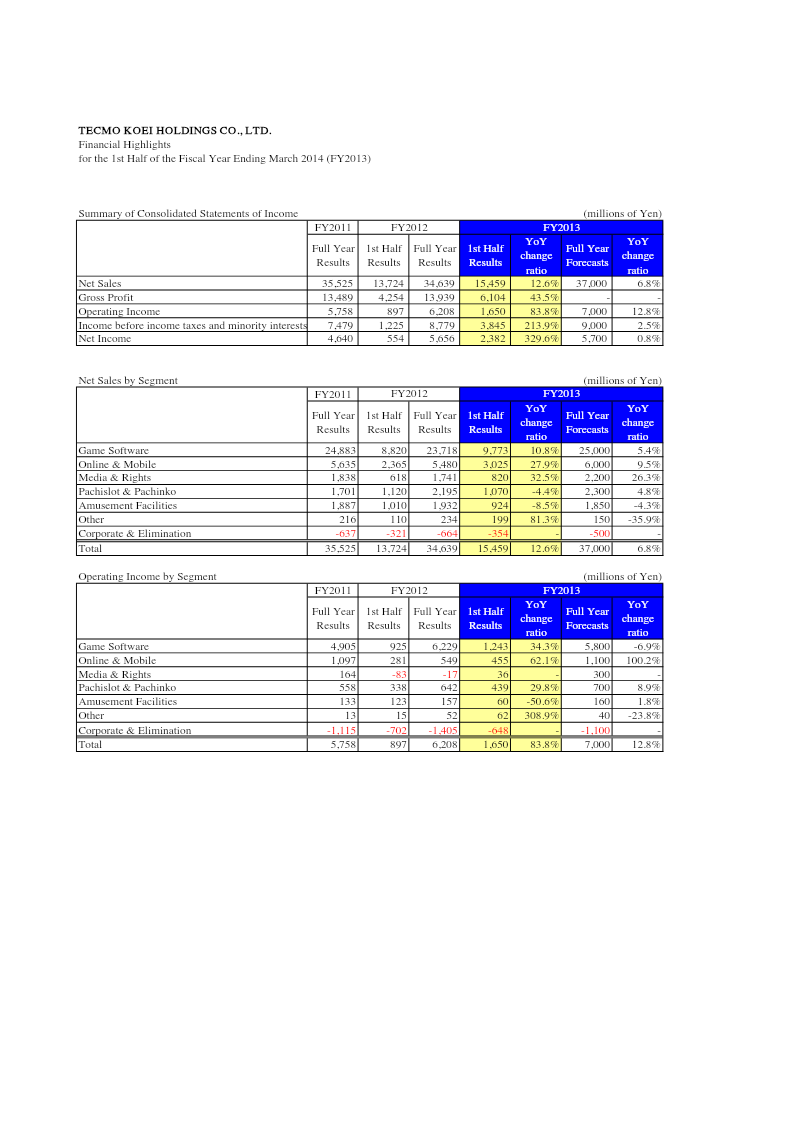
Tecmo Koei Holdings reported significant growth across all major profitability metrics for the first half of the fiscal year ending March 2014. Net sales reached 15.46 billion yen, representing a 12.6% increase over the same period in the previous year. This growth was accompanied by a substantial rise in operating income, which surged 83.8% to 1.65 billion yen. Most notably, net income experienced a dramatic year-over-year increase of 329.6%, totaling 2.38 billion yen for the six-month period ending September 30, 2013.
The Game Software segment remained the primary revenue driver, contributing 9.77 billion yen in sales, a 10.8% increase. However, the Online & Mobile and Media & Rights segments showed the strongest relative growth at 27.9% and 32.5% respectively. While most divisions saw improved performance, the Amusement Facilities and Pachislot & Pachinko segments experienced slight declines in sales. From a profitability standpoint, the Online & Mobile segment demonstrated a significant recovery, with operating income rising 62.1% to 455 million yen.
The consolidated balance sheet as of September 30, 2013, shows total assets of 88.2 billion yen, a decrease from the 95.01 billion yen reported at the end of the prior fiscal year. This change was largely driven by a reduction in current assets, specifically cash and accounts receivable. Conversely, investment securities rose to 50.02 billion yen. Total liabilities decreased significantly from 13.39 billion yen to 6.07 billion yen, primarily due to a reduction in accounts payable and income taxes payable.
Looking ahead to the full fiscal year results, forecasts suggest continued growth with net sales expected to reach 37 billion yen and operating income projected at 7 billion yen. These targets indicate a positive outlook for the remainder of the year, particularly for the Online & Mobile segment, which is forecasted to double its annual operating income compared to the previous full year.
- Tecmo Koei Holdings reported a 329.6% year-over-year increase in net income to 2.38 billion yen for the first half of FY2013, ending September 30, 2013.
- Operating income surged 83.8% to 1.65 billion yen, while net sales grew 12.6% to 15.46 billion yen compared to the same period in the previous year.
- The Online & Mobile segment showed strong momentum with a 27.9% increase in sales and a 62.1% rise in operating income to 455 million yen.
- The Game Software segment remains the company's primary revenue driver, contributing 9.77 billion yen in sales, a 10.8% increase over the prior year.
- Full-year forecasts project net sales of 37 billion yen and operating income of 7 billion yen, with expectations that the Online & Mobile segment will double its annual operating income.
+1
Koei TecmoMar 2014

Financial29 pages
Fiscal Year Ending March 2014 Financial Results
Tecmo Koei Holdings reported record-breaking financial results for the fiscal year ending March 31, 2014, marking the fourth consecutive year of profit growth. Net sales reached 37.58 billion yen, an 8.5% year-on-year increase, while net income rose 22.6% to 6.94 billion yen. This performance was driven by the successful execution of the "IP Creation and Expansion" strategy, highlighted by the 30th anniversary of the Nobunaga’s Ambition series and the launch of the new Toukiden IP, which sold 550,000 units.
The Game Software segment remained the primary revenue driver, contributing 25.4 billion yen in sales, followed by the Online & Mobile segment at 6.4 billion yen. Geographically, Japan accounted for over 83% of total sales, though the Asian market showed the strongest growth at 33.2%. While total unit sales remained relatively flat at 6.5 million units, profitability improved significantly; the operating profit ratio rose to 19.0%, and the ordinary profit ratio reached 28.6%. These gains were supported by a reduction in the cost of goods sold and improved management of SG&A expenses.
Looking ahead to fiscal year 2014, the company plans to achieve further growth with a sales target of 38 billion yen and an ordinary profit ratio exceeding 30%. Strategic priorities include expanding smartphone and browser games in Asian markets, pursuing major collaborations such as Hyrule Warriors for the Wii U, and supporting new hardware platforms like the PlayStation 4 and Xbox One. To reward shareholders, the company maintains a 50% payout ratio policy, increasing the annual dividend to 41 yen with a long-term goal of reaching 50 yen.
- Tecmo Koei achieved record financial results for the fiscal year ending March 31, 2014, marking four consecutive years of profit growth with net income rising 22.6% to 6.94 billion yen.
- Net sales increased 8.5% year-on-year to 37.58 billion yen, driven by the 'IP Creation and Expansion' strategy and the successful launch of the Toukiden franchise, which sold 550,000 units.
- Profitability improved significantly as the operating profit ratio reached 19.0% and the ordinary profit ratio hit 28.6%, supported by reduced costs of goods sold and tighter management of SG&A expenses.
- The Game Software segment remains the primary revenue driver at 25.4 billion yen, while the Asian market emerged as the fastest-growing region with a 33.2% increase in sales.
- For the upcoming fiscal year, the company targets 38 billion yen in sales and an ordinary profit ratio exceeding 30%, with a strategic focus on smartphone games, Asian market expansion, and collaborations like Hyrule Warriors.
Koei TecmoJan 2014

Financial32 pages
Fiscal Year Ending March 2015: 1st Half Financial Results
Koei Tecmo Holdings reported record-breaking financial results for the first half of fiscal year 2014, ending September 30, 2014. Net sales reached 16.1 billion yen, a 4.2% increase year-over-year, while operating profit nearly doubled to 3.29 billion yen. This performance represents the fourth consecutive year of sales and profit growth, driven by strong software sales on new hardware platforms, the expansion of the download business, and high-performing social games.
The game software segment remains the primary revenue driver, contributing 9.87 billion yen in sales. Key titles such as Hyrule Warriors, Toukiden: Kiwami, and Atelier Shallie performed well globally. Geographically, while Japan remains the largest market accounting for 78.2% of sales, overseas revenue grew by 31%, with significant gains in North America and Europe. The company also noted a strategic shift toward multi-platform development, supporting PlayStation 4 and Xbox One, and expanding its presence in the smartphone and mobile market through native apps and regional expansion in China, Korea, and Taiwan.
Management’s long-term strategy focuses on intellectual property creation and expansion through a "media mix" approach, including animations, comics, and movies. A notable organizational change included the merger of Koei Tecmo Games and Gust to strengthen development synergies. For the full fiscal year 2014, the company projects net sales of 38 billion yen and an operating profit of 8 billion yen. Based on this growth, the company has targeted an annual dividend increase to 50 yen, maintaining a policy of a 50% payout ratio or a minimum 50-yen dividend to enhance shareholder returns.
- Koei Tecmo achieved record-breaking first-half results for fiscal year 2014, with net sales reaching 16.1 billion yen and operating profit nearly doubling to 3.29 billion yen.
- The company marked its fourth consecutive year of growth, driven by strong software sales, an expanding digital download business, and high-performing social games.
- The game software segment generated 9.87 billion yen in revenue, bolstered by the global performance of titles including Hyrule Warriors, Toukiden: Kiwami, and Atelier Shallie.
- While Japan accounts for 78.2% of total sales, overseas revenue grew by 31% with notable expansion in North America and Europe.
- Management is executing a strategic shift toward multi-platform development for PlayStation 4 and Xbox One, alongside an increased focus on the mobile market in China, Korea, and Taiwan.
+1
Koei TecmoJan 2014

Financial38 pages
Fiscal Year Ending March 2015 Financial Results
Koei Tecmo achieved record-breaking financial performance for the fiscal year ending March 2015, marking five consecutive years of profit growth and two years of rising sales. Net income surged 36% year-over-year to ¥9.4 billion, a success attributed to the robust performance of the Online and Mobile segment and high-profile intellectual property collaborations such as Dragon Quest Heroes. This period of growth was characterized by a significant improvement in operational efficiency, with the operating profit ratio rising to 25.5% and the cost-of-sales ratio decreasing by 7.0 points since 2011. Consequently, the company increased its dividend to 55 yen per share, reflecting a strong commitment to shareholder returns.
The strategic focus has shifted toward a multi-platform digital approach, prioritizing the expansion of smartphone games and digital download content. A central pillar of this strategy involves leveraging established IP through global licensing and large-scale collaborations, supported by the creation of a dedicated Business Promoting Division. Geographically, there is a concerted effort to penetrate Asian markets, specifically China and Korea, across both console and mobile platforms. This international outlook extends to the company’s investment strategy, which saw foreign asset holdings increase from 20% in 2011 to 60% in 2014, with future targets set even higher.
Looking ahead to the next fiscal year, sales are forecasted to grow by 5.8% to reach ¥40 billion. The long-term objective remains the continuous creation and expansion of intellectual property to maintain this upward trajectory. By balancing traditional console development with aggressive mobile growth and international licensing, the organization aims to solidify its position as a highly profitable global entertainment provider while maintaining the financial stability established over the previous four-year period.
- Koei Tecmo achieved record-breaking performance for the fiscal year ending March 2015, marking five consecutive years of profit growth with net income surging 36% year-over-year to ¥9.4 billion.
- Operational efficiency improved significantly, resulting in an operating profit ratio of 25.5% and a 7.0-point reduction in the cost-of-sales ratio since 2011.
- The company’s investment strategy shifted heavily toward international markets, with foreign asset holdings increasing from 20% in 2011 to 60% in 2014.
- Growth was driven by the Online and Mobile segment and high-profile intellectual property collaborations, most notably 'Dragon Quest Heroes'.
- The company increased its dividend to 55 yen per share, signaling a strong commitment to shareholder returns following two years of rising sales.
Koei TecmoJan 2014
Financial2 pages
Financial Highlights for the 3rd Quarter of the Fiscal Year Ending March 2014 (FY2013)
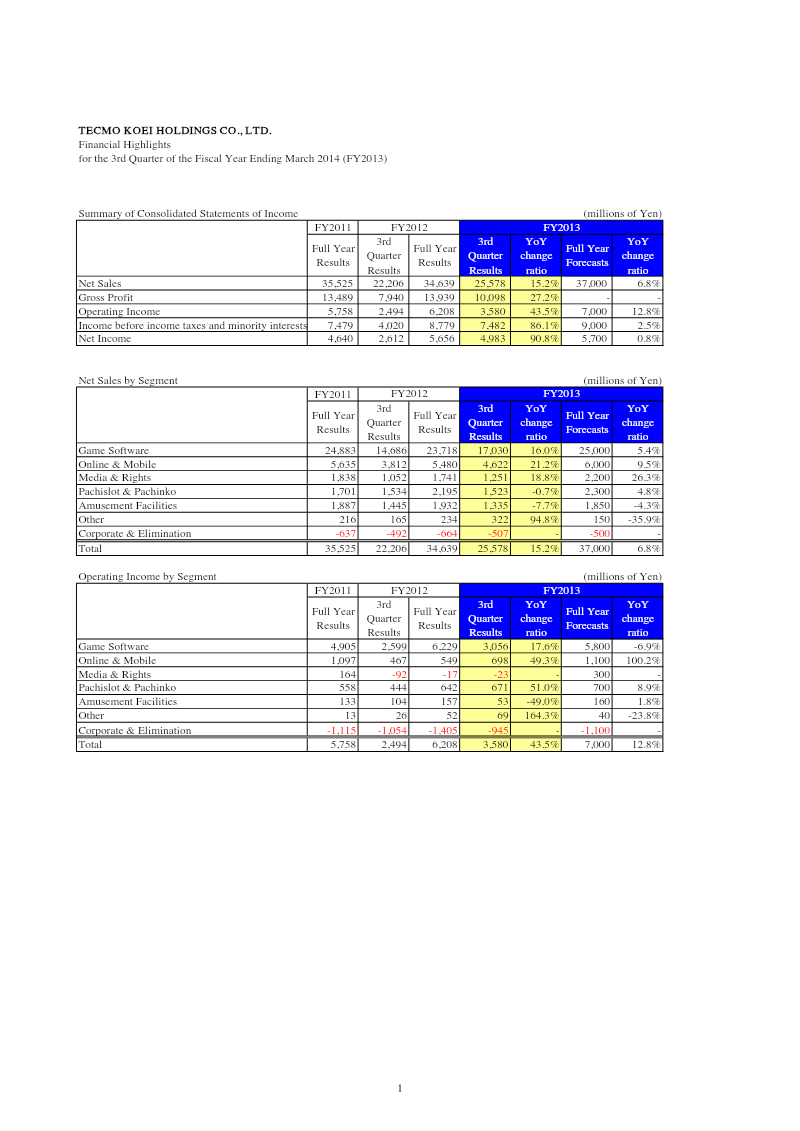
Tecmo Koei Holdings reported significant financial growth for the third quarter of the fiscal year ending March 2014, demonstrating a strong upward trend in profitability and revenue compared to the same period in the previous year. Net sales for the nine-month period reached 25.58 billion yen, a 15.2% increase year-over-year. This growth was accompanied by a substantial rise in earnings, with operating income climbing 43.5% to 3.58 billion yen and net income nearly doubling with a 90.8% increase to 4.98 billion yen. These results indicate high operational efficiency and a successful product mix during the reporting period.
The Game Software segment remained the primary driver of revenue, contributing 17.03 billion yen in sales, a 16% increase. However, the Online & Mobile segment showed the most significant momentum in profitability, with operating income rising 49.3% to 698 million yen. Other segments, such as Media & Rights and Pachislot & Pachinko, also saw revenue gains, while the Amusement Facilities division experienced a decline in both sales and operating income. The company’s balance sheet reflects a strategic shift in asset allocation, characterized by a decrease in cash and time deposits and a notable increase in investment securities, which rose from 45.34 billion yen to 56.26 billion yen.
Geographically focused on the Japanese market with broader international implications, the data suggests a positive outlook for the full fiscal year. Management forecasted total annual sales of 37 billion yen and a net income of 5.7 billion yen. The financial position remains robust, with total net assets increasing to 86.88 billion yen by the end of December 2013. This stability is supported by a significant rise in accumulated other comprehensive income, driven largely by unrealized gains on securities and favorable foreign currency translation adjustments.
- Tecmo Koei Holdings achieved strong growth in the first nine months of FY2013, with net sales rising 15.2% to 25.58 billion yen and net income nearly doubling by 90.8% to 4.98 billion yen.
- Operating income for the period grew by 43.5% to 3.58 billion yen, reflecting improved operational efficiency and a successful product mix.
- The Game Software segment remains the primary revenue driver with 17.03 billion yen in sales, while the Online & Mobile segment demonstrated the highest profit momentum with a 49.3% increase in operating income to 698 million yen.
- The company shifted its asset strategy by increasing investment securities from 45.34 billion yen to 56.26 billion yen while reducing cash and time deposits.
- Management projects a positive full-year outlook with forecasted annual sales of 37 billion yen and net income of 5.7 billion yen.
Koei TecmoJan 2014