Koei Tecmo
Game Co.173 documents
Japanese developer/publisher. Dynasty Warriors, Nioh, Dead or Alive, Atelier, Romance of the Three Kingdoms.
Documents

Financial28 pages
Financial Results for the First Half of the Fiscal Year Ending March 2020
Koei Tecmo reported a 4.8% year-on-year decrease in sales to ¥16.56 billion and a 26.6% drop in operating profit for the first half of the fiscal year ending March 2020. These declines were primarily driven by lower console sales and rising development costs associated with future projects. However, ordinary and net profits exceeded initial projections due to robust non-operating income and significant growth in the online and mobile segments. This success was largely fueled by IP licensing and the performance of smartphone titles, which helped offset the impact of increased fixed costs related to the completion of the Minato-Mirai office and expanded development teams.
The current fiscal year serves as a strategic preparation period for the company’s 2020 mid-term goals. Despite the early dip in operating profit, the full-year forecast remains unchanged at ¥43 billion in sales, representing a 10.3% year-on-year increase. This growth is expected to be driven by a 29.6% surge in overseas sales and a 61.4% rise in international console unit volume. Recent successes, such as the strong performance of Atelier Ryza and the critical acclaim for co-developed titles like Fire Emblem: Three Houses, provide a foundation for this expansion.
Long-term strategy focuses on the creation of global intellectual properties and multi-platform expansion. The company is targeting an operating profit of ¥17 billion by the end of the next fiscal year, supported by the development of a major AAA console title aimed at selling five million units and a top-tier mobile title capable of generating ¥1 billion in monthly revenue. With a pipeline featuring high-profile releases such as Nioh 2 and Persona 5 Scramble, the company aims to leverage its royalty income and international reach to achieve sustainable growth across the global gaming market.
- Koei Tecmo reported a 4.8% decrease in sales to ¥16.56 billion and a 26.6% drop in operating profit for the first half of the fiscal year ending March 2020, driven by higher development costs and lower console sales.
- Despite the initial operating profit decline, the company maintains its full-year sales forecast of ¥43 billion, a 10.3% year-on-year increase, supported by strong performance in mobile and online segments.
- The company is targeting an operating profit of ¥17 billion by the end of the next fiscal year, anchored by a goal of selling five million units for a major AAA console title and generating ¥1 billion in monthly revenue from a top-tier mobile title.
- Growth projections for the current fiscal year rely on a 29.6% surge in overseas sales and a 61.4% increase in international console unit volume.
- Recent titles such as 'Atelier Ryza' and the co-developed 'Fire Emblem: Three Houses' are serving as the foundation for the company's international expansion strategy.
Koei TecmoOct 2019

Financial36 pages
Fiscal Year Ending March 2019 Financial Results
Koei Tecmo achieved record-high profitability during the fiscal year ending March 2019, marking its ninth consecutive year of profit growth. Despite a 20.2% decline in total unit sales, net income rose 5.2% to 13.69 billion yen. This financial resilience is attributed to a strategic shift toward high-margin digital sales and IP licensing. Looking toward fiscal year 2020, the company aims to reach 51 billion yen in total sales, supported by a projected 61.4% recovery in overseas unit sales and a 10.3% increase in group-wide revenue.
The strategic roadmap centers on three primary milestones: the launch of a new AAA title capable of selling 5 million units, the development of a smartphone game generating 1 billion yen in monthly revenue, and a comprehensive expansion into the Chinese market. To facilitate this global growth, the company is reevaluating the roles of its international offices and intensifying digital marketing efforts across Asia. Major franchises such as Nioh 2 and Dynasty Warriors remain central to this multi-platform approach, which balances original titles based on an Oriental worldview with high-profile collaborative projects.
Shareholder returns remain a priority, evidenced by a 62.03% payout ratio and the issuance of a special dividend for the 2018 fiscal year. By leveraging its intellectual property across console and mobile sectors while expanding its footprint in China, the company seeks to solidify its position as a global entertainment leader. This transition from domestic stability to aggressive international expansion defines the current mid-term plan, focusing on high-volume individual titles and sustainable mobile revenue streams to drive long-term value.
- Koei Tecmo achieved record-high profitability for the ninth consecutive year, with net income rising 5.2% to 13.69 billion yen despite a 20.2% decline in total unit sales.
- The company’s financial resilience is driven by a strategic pivot toward high-margin digital sales and IP licensing rather than relying solely on physical unit volume.
- Management has set a fiscal year 2020 target of 51 billion yen in total sales, supported by a projected 61.4% recovery in overseas unit sales and a 10.3% increase in group-wide revenue.
- The mid-term growth strategy focuses on three specific milestones: launching a 5-million-unit AAA title, developing a smartphone game with 1 billion yen in monthly revenue, and expanding into the Chinese market.
- Key franchises such as Nioh 2 and Dynasty Warriors will anchor a multi-platform strategy that balances original titles with high-profile collaborative projects.
+2
Koei TecmoApr 2019
Financial2 pages
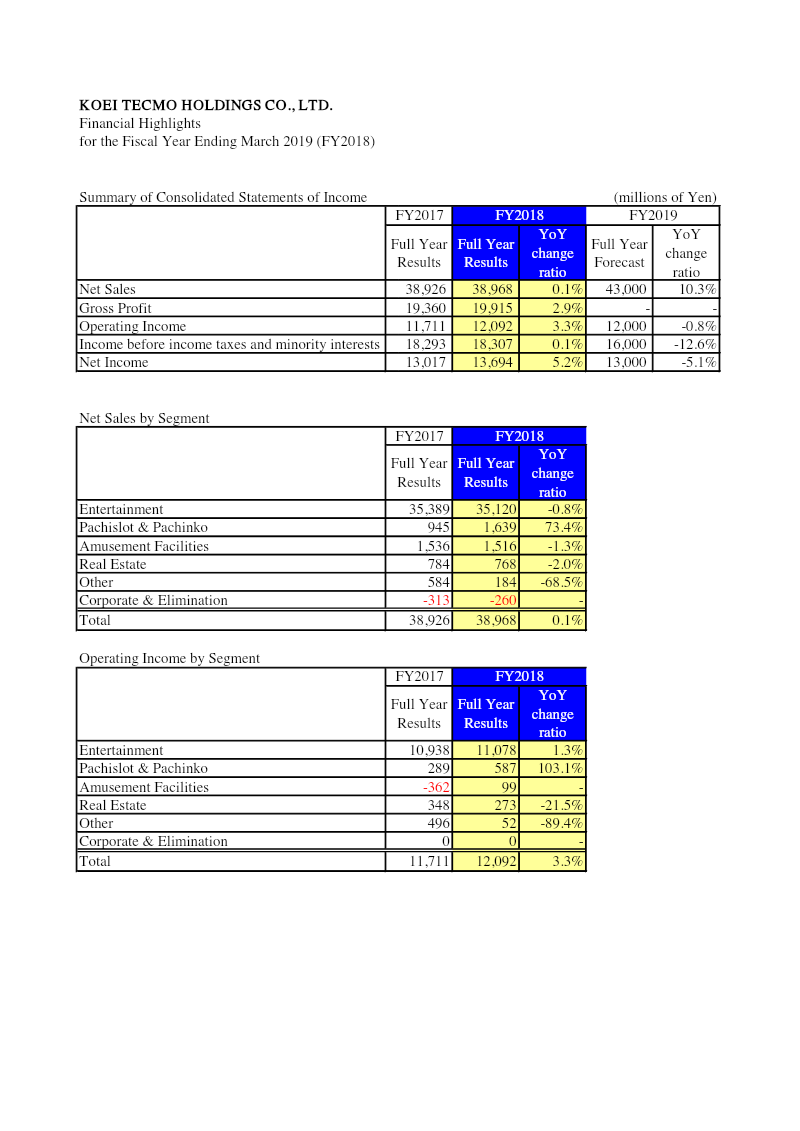
Financial Highlights for the Fiscal Year Ending March 2019 (FY2018)
Koei Tecmo Holdings achieved steady financial growth during the fiscal year ending March 31, 2019, characterized by record-level profits and a stable expansion of its core business segments. Net sales reached 38,968 million yen, representing a slight year-on-year increase, while operating income rose by 3.3% to 12,092 million yen. The most significant growth was observed in net income, which climbed 5.2% to 13,694 million yen. These results demonstrate the company's ability to maintain high profitability margins, with gross profit improving by 2.9% despite relatively flat top-line revenue growth.
The Entertainment segment remains the primary driver of corporate value, contributing 35,120 million yen in sales and the vast majority of operating income at 11,078 million yen. While Entertainment sales saw a marginal dip of 0.8%, the Pachislot and Pachinko segment experienced a dramatic surge, with sales increasing by 73.4% and operating income doubling to 587 million yen. The Amusement Facilities segment also showed a successful turnaround, moving from an operating loss in the previous year to a profit of 99 million yen. Conversely, the Real Estate and Other segments saw declines in both revenue and operating income, though their overall impact on the consolidated balance sheet remains secondary to the core gaming and entertainment divisions.
The corporate financial position is robust, with total assets valued at 129,192 million yen. A significant portion of the company’s strength is tied to its investment activities, evidenced by 76,355 million yen held in investment securities. Total net assets grew to 119,284 million yen, supported by a substantial increase in retained earnings, which rose from 73,269 million yen to 80,404 million yen. Looking forward to the fiscal year ending March 2020, the company forecasts a 10.3% increase in net sales to 43,000 million yen, though it anticipates a slight contraction in net income to 13,000 million yen.
- Koei Tecmo achieved record-level profits in FY2018, with net income rising 5.2% to 13,694 million yen and operating income increasing 3.3% to 12,092 million yen.
- The Entertainment segment remains the primary business driver, generating 35,120 million yen in sales and 11,078 million yen in operating income.
- The Pachislot and Pachinko segment experienced significant growth, with sales increasing 73.4% and operating income doubling to 587 million yen.
- The company maintains a strong financial position with 129,192 million yen in total assets, including 76,355 million yen held in investment securities.
- The Amusement Facilities segment successfully returned to profitability, moving from an operating loss in the previous year to a profit of 99 million yen.
+1
Koei TecmoJan 2019
Financial2 pages
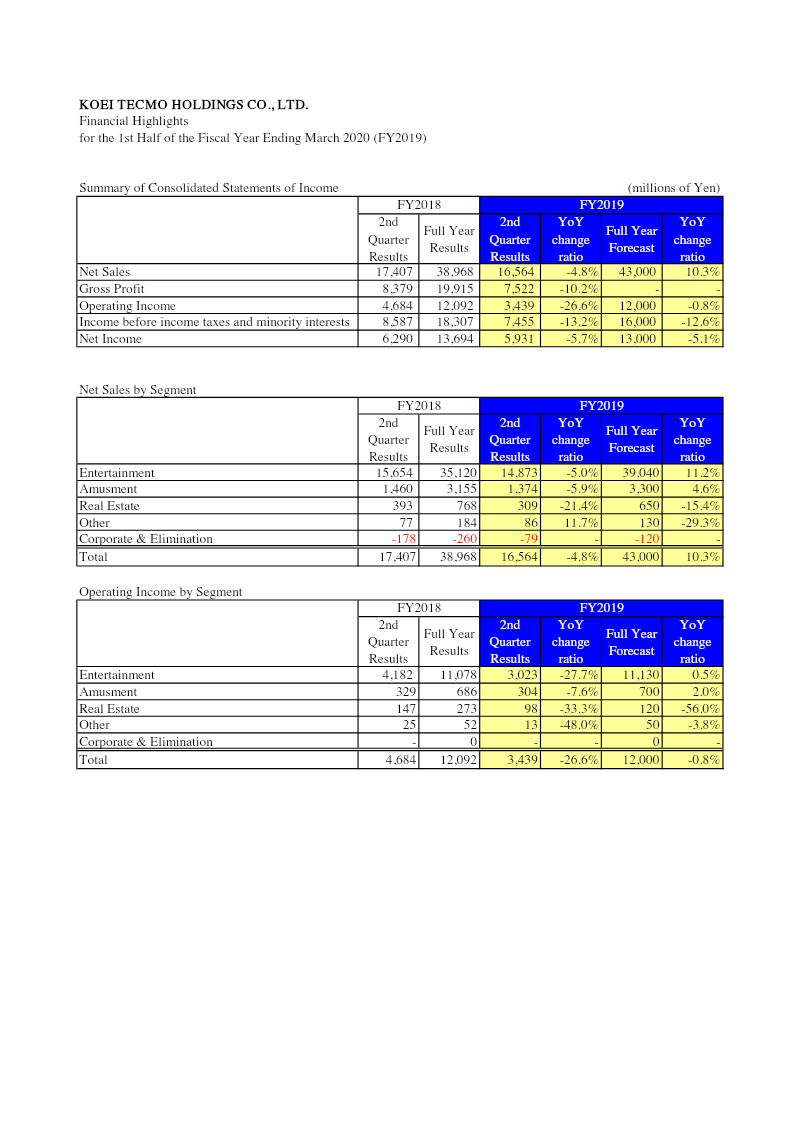
Financial Highlights for the 1st Half of the Fiscal Year Ending March 2020 (FY2019)
Koei Tecmo Holdings reported a moderate decline in financial performance for the first half of the fiscal year ending March 2020. During the six-month period concluding September 30, 2019, net sales reached 16.56 billion yen, representing a 4.8% decrease compared to the same period in the previous year. Operating income saw a more significant contraction, falling 26.6% to 3.44 billion yen, while net income declined by 5.7% to 5.93 billion yen.
The entertainment segment remains the primary driver of the company’s business, accounting for 14.87 billion yen in sales, though it experienced a 5.0% year-over-year decrease. Other business units, including amusement and real estate, also reported lower sales and operating income. Despite the downward trend in the first half, the full-year forecast remains optimistic regarding top-line growth, projecting total net sales of 43.0 billion yen, which would constitute a 10.3% increase over the prior full fiscal year. However, full-year net income is expected to decrease by 5.1% to 13.0 billion yen.
The consolidated balance sheet indicates a strong asset position, with total assets valued at 125.75 billion yen. A substantial portion of the company’s value is held in fixed assets, specifically 74.4 billion yen in investment securities. Shareholders' equity remains robust at 118.67 billion yen, contributing to a total net asset value of 118.12 billion yen. The data reflects a period of transition where short-term earnings have softened, yet the company maintains a stable capital base and anticipates a recovery in sales volume by the end of the fiscal year.
- Koei Tecmo reported a 4.8% decline in net sales to 16.56 billion yen and a 26.6% drop in operating income to 3.44 billion yen for the first half of FY2019 ending September 30, 2019.
- The entertainment segment, the company's primary revenue driver, saw sales fall 5.0% year-over-year to 14.87 billion yen.
- Despite the first-half downturn, the company projects a 10.3% increase in full-year net sales to 43.0 billion yen.
- The company maintains a strong financial position with 125.75 billion yen in total assets and 118.67 billion yen in shareholders' equity.
- Investment securities represent a significant portion of the company's asset base, valued at 74.4 billion yen.
+1
Koei TecmoJan 2019
Financial2 pages
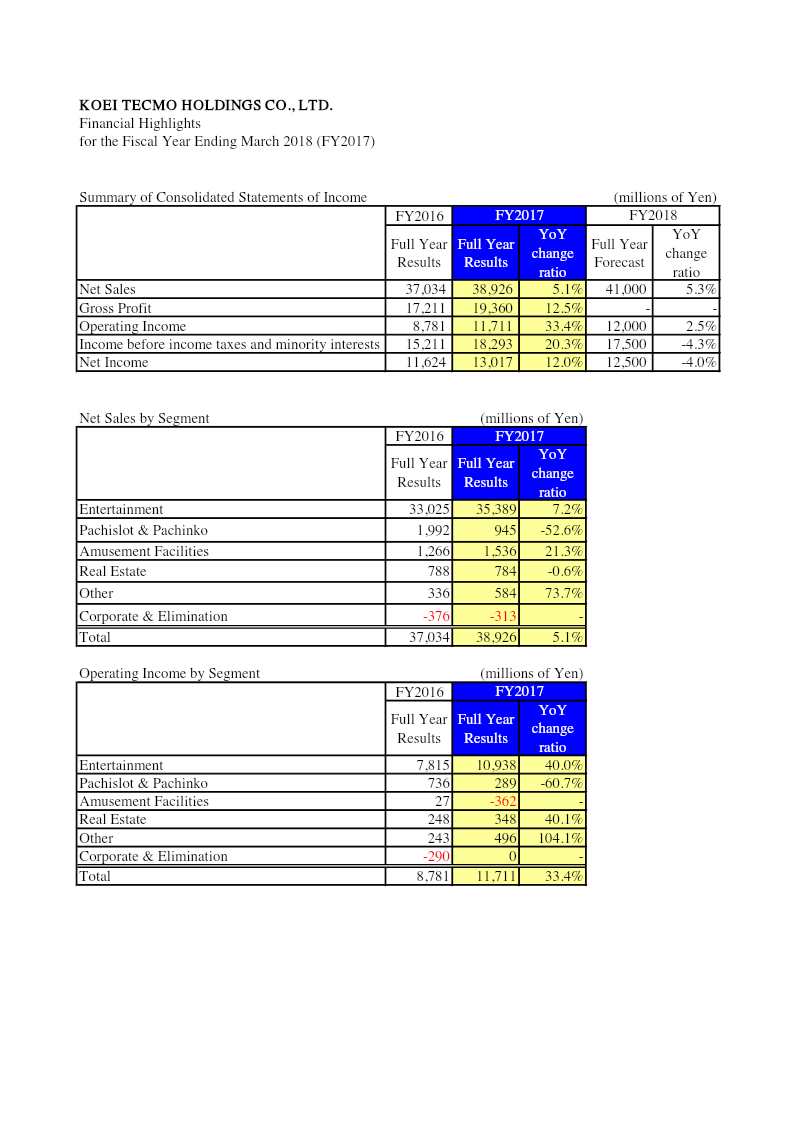
Financial Highlights: Fiscal Year Ending March 2018 (FY2017)
Koei Tecmo Holdings achieved significant financial growth during the fiscal year ending March 31, 2018, characterized by a substantial increase in profitability despite modest top-line expansion. Net sales rose by 5.1% to reach 38,926 million yen, while operating income surged by 33.4% to 11,711 million yen. This performance was driven primarily by the core Entertainment segment, which saw a 7.2% increase in sales and a 40% jump in operating income. Net income for the period reached 13,017 million yen, representing a 12% year-over-year improvement.
The Entertainment division remains the dominant revenue driver, contributing 35,389 million yen to the total sales mix. In contrast, the Pachislot and Pachinko segment experienced a sharp decline, with sales falling by 52.6% and operating income dropping by over 60%. While the Amusement Facilities segment saw a 21.3% increase in sales, it recorded an operating loss of 362 million yen. Other smaller segments, including Real Estate and miscellaneous categories, showed varied performance but remained minor contributors to the overall corporate portfolio.
The consolidated balance sheet reflects a strong capital position, with total assets increasing from 119,461 million yen to 129,367 million yen. A notable shift occurred in the asset structure, as cash and time deposits decreased while investment securities grew significantly to 78,938 million yen. Total net assets rose to 116,242 million yen, supported by a healthy increase in retained earnings. Looking forward to the 2018 fiscal year, forecasts suggest continued sales growth to 41,000 million yen, though net income is projected to stabilize with a slight 4% decrease compared to the 2017 results.
- Koei Tecmo Holdings achieved strong profitability in FY2017, with operating income surging 33.4% to 11,711 million yen and net income rising 12% to 13,017 million yen.
- The Entertainment segment is the primary growth driver, delivering a 7.2% increase in sales to 35,389 million yen and a 40% jump in operating income.
- The Pachislot and Pachinko segment experienced a significant downturn, with sales falling 52.6% and operating income declining by more than 60%.
- Total net sales for the company grew by 5.1% to 38,926 million yen, while total assets increased to 129,367 million yen.
- The Amusement Facilities segment reported a 21.3% increase in sales but failed to achieve profitability, recording an operating loss of 362 million yen.
Koei TecmoMar 2018

Financial28 pages
Fiscal Year Ending March 2018: Financial Results
Koei Tecmo Holdings reported record-high profits for the fiscal year ending March 2018, driven by a successful multi-platform strategy and significant growth in overseas markets. Net sales reached 38.9 billion yen, a 5.1% year-over-year increase, while operating profit surged by 33.4% to 11.7 billion yen. This financial performance was supported by the global success of key titles such as Nioh, which sold over 1.9 million copies, and Fire Emblem Warriors, which surpassed 1 million units.
The geographic data highlights a strategic shift toward international expansion. While domestic sales in Japan saw a slight decline of 4%, overseas revenue grew by 30%, now accounting for one-third of total sales. Unit sales outside of Japan were particularly strong, representing nearly 69% of total volume, with Europe and North America showing the most aggressive growth rates at 89.8% and 60.6% respectively. The entertainment segment remains the primary driver of the business, contributing 35.4 billion yen in sales.
Looking forward, the mid-term management plan through fiscal year 2020 aims for a 10% average annual increase in sales and profit. Key strategic pillars include the creation of global intellectual properties capable of selling 5 million units and the development of smartphone titles generating 1 billion yen in monthly profit. A major focus is placed on a three-year expansion plan into the Chinese market and the reevaluation of global offices to strengthen digital marketing and community engagement.
For the fiscal year ending March 2019, the company projects continued growth with a sales target of 41 billion yen. To support these objectives, management is accelerating leadership transitions and maintaining a shareholder-friendly payout policy of 50%. Capital expenditure plans also include the development of a new office in Minato Mirai to modernize infrastructure and support the cultivation of global-oriented producers and directors.
- Koei Tecmo achieved record-high profits for the fiscal year ending March 2018, with net sales rising 5.1% to 38.9 billion yen and operating profit surging 33.4% to 11.7 billion yen.
- International expansion drove performance, as overseas revenue grew by 30% to account for one-third of total sales, with unit sales in Europe and North America increasing by 89.8% and 60.6% respectively.
- Key titles were central to financial success, specifically Nioh with over 1.9 million copies sold and Fire Emblem Warriors surpassing 1 million units.
- The company’s mid-term plan through fiscal year 2020 targets a 10% average annual increase in sales and profit, supported by a goal to create global IPs capable of selling 5 million units.
- Strategic priorities include a three-year expansion into the Chinese market and the development of smartphone titles targeted to generate 1 billion yen in monthly profit.
+2
Koei TecmoJan 2018

Financial26 pages
Fiscal Year Ending March 2019: 1st Half Financial Results
Koei Tecmo Holdings reported record-breaking financial results for the first half of the fiscal year ending March 2019, characterized by significant growth in profitability and the expansion of its global intellectual property (IP) portfolio. Net sales reached 17.4 billion yen, a 16.7% increase year-over-year, while operating profit surged by 64.3% to 4.68 billion yen. This performance was driven by high-margin royalty income from licensed titles and the continued success of the smartphone game sector, resulting in an improved operating profit ratio of 26.9%.
The strategic focus centers on three primary pillars: creating global AAA titles with sales targets of 5 million copies, developing smartphone titles capable of generating 1 billion yen in monthly revenue, and collaborating with leading overseas IPs. Key product milestones during this period included the continued success of Nioh, which surpassed 2 million copies, and the strong performance of licensed mobile titles like Shin-Sangoku-shi and Dynasty Warriors: Unleashed, both of which achieved high rankings on the App Store and Google Play in Japan.
Geographically, Japan remains the largest market, accounting for approximately 66% of sales, though the Asia region saw the most dramatic growth with a 46.1% increase in revenue. While unit sales for packaged software saw a slight decline of 6.6% to 2.39 million units, the company offset this through digital growth and licensing. Looking forward, the mid-term management plan aims for 51 billion yen in sales and 21 billion yen in ordinary profit by fiscal year 2020, supported by upcoming major releases such as Dead or Alive 6 and Nioh 2, alongside a full-scale entry into the Chinese market and the completion of a new office in Minato Mirai.
- Koei Tecmo achieved record-breaking H1 FY2019 results with net sales of 17.4 billion yen (up 16.7% YoY) and operating profit of 4.68 billion yen (up 64.3% YoY).
- The company’s operating profit ratio improved to 26.9%, driven primarily by high-margin royalty income from licensed titles and strong performance in the smartphone sector.
- Strategic growth targets include developing AAA titles with 5 million unit sales and smartphone games capable of generating 1 billion yen in monthly revenue.
- While packaged software unit sales declined 6.6% to 2.39 million units, the company successfully offset this decrease through growth in digital sales and licensing.
- Japan remains the primary market at 66% of total sales, but the Asia region experienced the most significant expansion with a 46.1% increase in revenue.
Koei TecmoJan 2018
Financial2 pages
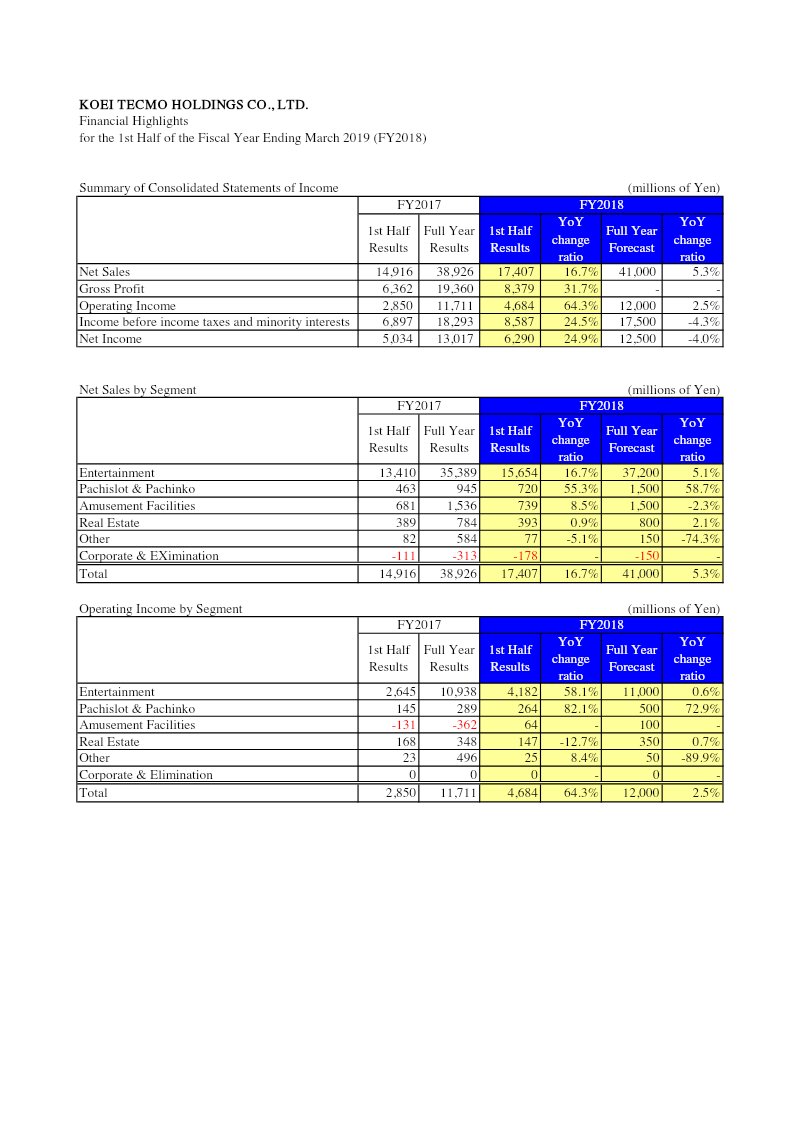
Financial Highlights for the 1st Half of the Fiscal Year Ending March 2019 (FY2018)
Koei Tecmo Holdings reported strong financial growth for the first half of the fiscal year ending March 2019, characterized by double-digit increases across all major profitability metrics. Net sales reached 17.4 billion yen, representing a 16.7% increase over the same period in the previous year. Operating income saw a more dramatic rise of 64.3%, totaling 4.68 billion yen, while net income grew by 24.9% to reach 6.29 billion yen. These results indicate a high level of operational efficiency, as gross profit margins expanded significantly during the period.
The Entertainment segment remains the primary driver of the company’s business, contributing 15.65 billion yen in sales and 4.18 billion yen in operating income. Other business units also showed notable momentum; the Pachislot & Pachinko segment grew its revenue by 55.3%, and the Amusement Facilities segment successfully transitioned from an operating loss in the prior year to a profit. While the company maintains a positive outlook for the full fiscal year with a sales forecast of 41 billion yen, the projections suggest a more conservative second half, with anticipated slight year-over-year declines in full-year pre-tax and net income.
The consolidated balance sheet as of September 30, 2018, reflects a robust financial position with total assets of 126.6 billion yen. A significant portion of the company’s value is held in investment securities, totaling nearly 75 billion yen. Shareholders' equity remains strong at 112.9 billion yen, and the company maintains a low debt profile, with total liabilities decreasing to 9.5 billion yen from 12.3 billion yen at the start of the fiscal year. This financial stability provides a solid foundation for the company’s continued expansion in the global entertainment market.
- Koei Tecmo reported strong H1 FY2018 growth with net sales rising 16.7% to 17.4 billion yen and operating income surging 64.3% to 4.68 billion yen.
- The Entertainment segment remains the core business driver, generating 15.65 billion yen in sales and 4.18 billion yen in operating income during the first half.
- The company maintains a robust balance sheet with 126.6 billion yen in total assets, including 75 billion yen in investment securities and a strengthened equity position of 112.9 billion yen.
- Diversified business units showed significant momentum, with the Pachislot & Pachinko segment growing revenue by 55.3% and the Amusement Facilities segment returning to profitability.
- Total liabilities decreased from 12.3 billion yen to 9.5 billion yen by September 30, 2018, reflecting a low-debt financial profile.
Koei TecmoJan 2018
Financial2 pages
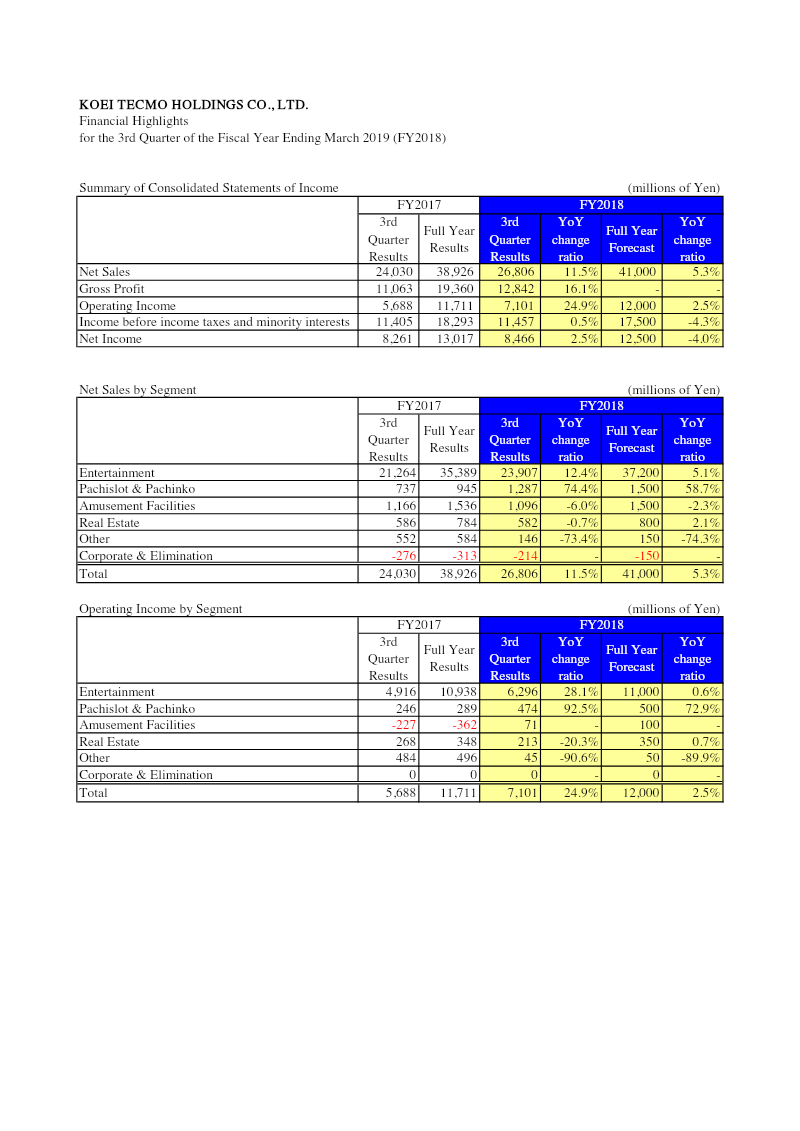
Financial Highlights for the 3rd Quarter of the Fiscal Year Ending March 2019 (FY2018)
Koei Tecmo Holdings Co., Ltd. reported strong financial performance for the third quarter of the fiscal year ending March 2019, characterized by double-digit growth in both revenue and operating profitability. Net sales reached 26.8 billion yen, an 11.5% increase over the same period in the previous year, while operating income rose significantly by 24.9% to 7.1 billion yen. This growth was primarily driven by the core Entertainment segment, which remains the company’s largest business unit, contributing 23.9 billion yen in sales and 6.3 billion yen in operating income.
The Pachislot & Pachinko segment also demonstrated substantial momentum, with sales increasing by 74.4% and operating income nearly doubling year-over-year. In contrast, the Amusement Facilities and Real Estate segments saw slight declines in revenue, though the Amusement Facilities division successfully returned to profitability during the period. Despite the strong operational performance, net income growth was more modest at 2.5%, totaling 8.47 billion yen, as non-operating factors and market fluctuations influenced the bottom line.
The consolidated balance sheet as of December 31, 2018, shows total assets of 116.2 billion yen, a decrease from the 128.6 billion yen reported at the end of the previous fiscal year. This reduction was largely driven by a decrease in investment securities and accounts receivable. Shareholders' equity remained robust at 114.1 billion yen, though total net assets were impacted by unrealized losses on securities. Looking ahead, the company maintains a positive full-year forecast, projecting net sales of 41 billion yen and operating income of 12 billion yen, signaling continued confidence in its core entertainment software and licensing businesses.
- Koei Tecmo reported strong Q3 FY2018 growth with net sales rising 11.5% to 26.8 billion yen and operating income increasing 24.9% to 7.1 billion yen.
- The core Entertainment segment remains the primary revenue driver, contributing 23.9 billion yen in sales and 6.3 billion yen in operating income.
- The Pachislot & Pachinko segment experienced significant expansion, with sales growing 74.4% and operating income nearly doubling year-over-year.
- Net income growth was modest at 2.5%, totaling 8.47 billion yen, due to the impact of non-operating factors and market fluctuations.
- The company maintains a positive full-year outlook, projecting 41 billion yen in net sales and 12 billion yen in operating income.
Koei TecmoJan 2018

Financial33 pages
Fiscal Year Ending March 2018: 1st Half Financial Results
Koei Tecmo Holdings reported record-breaking financial performance for the first half of the fiscal year ending March 2018, achieving all-time highs in ordinary profit and net income. Despite a 10% year-over-year decrease in sales to 14.9 billion yen, ordinary profit rose 40.6% to 6.9 billion yen, and net income increased 33% to 5.0 billion yen. These results significantly exceeded initial management forecasts, driven by high-margin IP licensing and a strong performance in the entertainment segment, which remains the primary revenue driver.
The geographic scope of the results reveals a strategic shift toward international markets. While domestic sales in Japan declined by 19.1%, overseas revenue grew by 15.6%, with the Asian market showing the most significant growth at 45.9%. Unit sales data further illustrates this trend, as overseas software sales rose to 69.3% of the total volume, nearly doubling in North America and Europe compared to the previous year. Key titles contributing to this success included Nioh, which surpassed 2 million units, and Fire Emblem Warriors.
Looking ahead, the company maintains an optimistic full-year outlook, projecting sales of 42 billion yen and an operating profit of 11.5 billion yen. The strategy for the second half of the fiscal year focuses on multi-platform releases for the Nintendo Switch, PlayStation 4, and Steam, alongside the expansion of smartphone gaming through the new "midas" brand. Additionally, the company is diversifying its portfolio through location-based entertainment, such as the "VR Sense" cabinet, and strategic alliances with AI technology firms like HEROZ, Inc. to enhance future development capabilities.
- Koei Tecmo achieved record-breaking profitability for the first half of FY2018, with ordinary profit rising 40.6% to 6.9 billion yen and net income increasing 33% to 5.0 billion yen, despite a 10% decline in total sales to 14.9 billion yen.
- The company is successfully pivoting to international markets, as overseas revenue grew 15.6%—led by a 45.9% surge in Asia—while domestic sales in Japan fell by 19.1%.
- Overseas software sales now account for 69.3% of total volume, with unit sales in North America and Europe nearly doubling compared to the previous year.
- Key software titles drove performance, most notably 'Nioh,' which surpassed 2 million units sold, alongside the release of 'Fire Emblem Warriors.'
- Management projects a strong full-year outlook of 42 billion yen in sales and 11.5 billion yen in operating profit, supported by a strategy of multi-platform releases on Nintendo Switch, PS4, and Steam.
Koei TecmoJan 2017
Financial2 pages
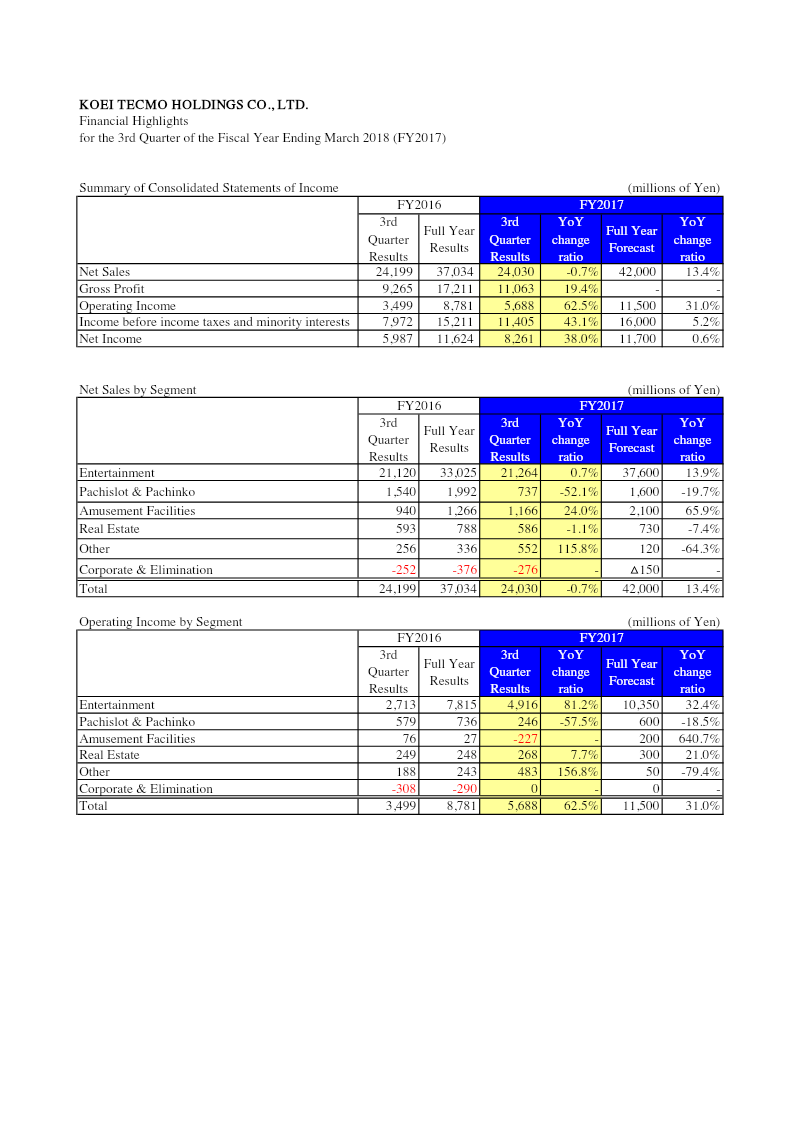
Financial Highlights for the 3rd Quarter of the Fiscal Year Ending March 2018 (FY2017)
Koei Tecmo Holdings reported strong profitability growth for the third quarter of the fiscal year ending March 2018, despite a slight softening in top-line revenue. While net sales saw a marginal year-over-year decline of 0.7% to 24.03 billion yen, the company achieved significant improvements in its bottom-line performance. Operating income rose by 62.5% to 5.69 billion yen, and net income increased by 38.0% to 8.26 billion yen. This growth was driven by enhanced operational efficiency, as evidenced by a 19.4% increase in gross profit.
The Entertainment segment remains the primary driver of the business, contributing 21.26 billion yen in sales and 4.92 billion yen in operating income, the latter representing an 81.2% year-over-year increase. In contrast, the Pachislot & Pachinko segment experienced a sharp decline, with sales falling 52.1% and operating income dropping 57.5%. The Amusement Facilities segment saw a 24.0% rise in sales but recorded an operating loss of 227 million yen for the period.
On the balance sheet, total assets grew to 126.29 billion yen as of December 31, 2017. This growth was largely fueled by a substantial increase in investment securities, which rose from 65.48 billion yen to 81.45 billion yen. The company maintains a robust equity position with total net assets of 114.63 billion yen. Looking ahead to the full fiscal year, the company forecasts a recovery in sales to 42.0 billion yen, representing a 13.4% annual increase, while maintaining a positive outlook for continued growth in operating and net income.
- Koei Tecmo Holdings achieved significant profitability growth in Q3 FY2017, with operating income rising 62.5% to 5.69 billion yen and net income increasing 38.0% to 8.26 billion yen, despite a marginal 0.7% decline in net sales.
- The Entertainment segment is the company's primary profit engine, generating 21.26 billion yen in sales and a substantial 81.2% year-over-year increase in operating income to 4.92 billion yen.
- The Pachislot & Pachinko segment underperformed significantly, suffering a 52.1% decline in sales and a 57.5% drop in operating income.
- The Amusement Facilities segment recorded a 24.0% increase in sales but failed to reach profitability, reporting an operating loss of 227 million yen.
- The company's balance sheet remains strong with total assets reaching 126.29 billion yen as of December 31, 2017, largely driven by an increase in investment securities from 65.48 billion yen to 81.45 billion yen.
+1
Koei TecmoJan 2017

Financial29 pages
Fiscal Year Ending March 2017: 1st Half Financial Results
Koei Tecmo Holdings reports record-high sales for the first half of the fiscal year ending March 2017, driven by strong performances in the entertainment segment and successful intellectual property (IP) expansions. Net sales reached 16.58 billion yen, a 9.3% increase year-over-year, while operating profit rose 11% to 2.75 billion yen. Despite these gains, ordinary profit and net income saw declines of 13.3% and 6.8% respectively, primarily due to the timing of game releases and fluctuations in non-operating expenses.
The entertainment division remains the primary revenue driver, contributing 14.6 billion yen to total sales. Geographically, Japan continues to be the dominant market, accounting for nearly 75% of sales, though Asian markets showed significant growth. Key titles such as Toukiden 2, Attack on Titan, and Dragon Quest Heroes II supported the software lineup, while major social games maintained solid performance. The company is increasingly shifting toward a digital-first business model, with digital sales proportions rising steadily to improve profit margins.
Looking ahead, the management strategy focuses on a brand-based organizational structure to maximize IP value through multi-platform expansion, global tie-ups, and collaborations. Notable upcoming projects include Nioh, new entries in the Atelier and Samurai Warriors series, and a push into PlayStation VR content. For the full fiscal year 2016, the company maintains a positive outlook, projecting total sales of 42 billion yen and aiming for its seventh consecutive year of profit growth. The financial plan also includes a dividend increase to 63.6 yen, reflecting confidence in the long-term strategy of IP creation and expansion across smartphones, consoles, and emerging media.
- Koei Tecmo achieved record-high first-half sales of 16.58 billion yen, representing a 9.3% year-over-year increase, with operating profit rising 11% to 2.75 billion yen.
- Despite revenue growth, ordinary profit and net income declined by 13.3% and 6.8% respectively, attributed to game release timing and non-operating expense fluctuations.
- The entertainment division generated 14.6 billion yen in revenue, supported by key titles including Toukiden 2, Attack on Titan, and Dragon Quest Heroes II.
- Japan remains the primary market at 75% of total sales, though the company is actively pursuing growth in Asian markets and shifting toward a digital-first business model to improve margins.
- Management projects full-year sales of 42 billion yen and aims for a seventh consecutive year of profit growth, supported by a dividend increase to 63.6 yen.
Koei TecmoJan 2016