Games and Culture
SAGE journal for the cultural, social and humanities study of games. Only its open-access articles are included.
Documents
Coziness in Games: Homes, Audiences, and Esthetics
Coziness functions as a multifaceted structural and affective tool within the gaming landscape rather than a restrictive genre classification.
“You Feel Like You’ve Found a Place Where You Belong”: Symbolic Interactionism and Online Social Video Games in the Age of COVID-19
Online social video games functioned as essential conduits for human connection and social development during the COVID-19 pandemic.
Scale and Technologies of Hope in Taiwan's OPUS Game Trilogy
The OPUS trilogy, developed by the Taiwanese studio SIGONO, functions as a sophisticated environmental text that utilizes science fiction to navigate the complexities of the Anthropocene.
From the Ontology of Video Games to the Epistemology of Digital Movements: Towards a Semiotics of Virtual Practices
Video games and virtual reality environments function as complex image-movements, where meaning emerges from the synthesis of visual representation and kinetic performance.
- Video games should be analyzed as processual, embodied practices where meaning is generated through the synthesis of physical user inputs and kinetic in-game actions.
- The traditional dichotomy between gameplay and narrative is artificial; both are interdependent components of a unified, performative experience.
- Developers create 'kinetic diagrams' that map abstract command syntaxes to simplified, genre-specific micro-languages, effectively using stylized representations to facilitate interaction.
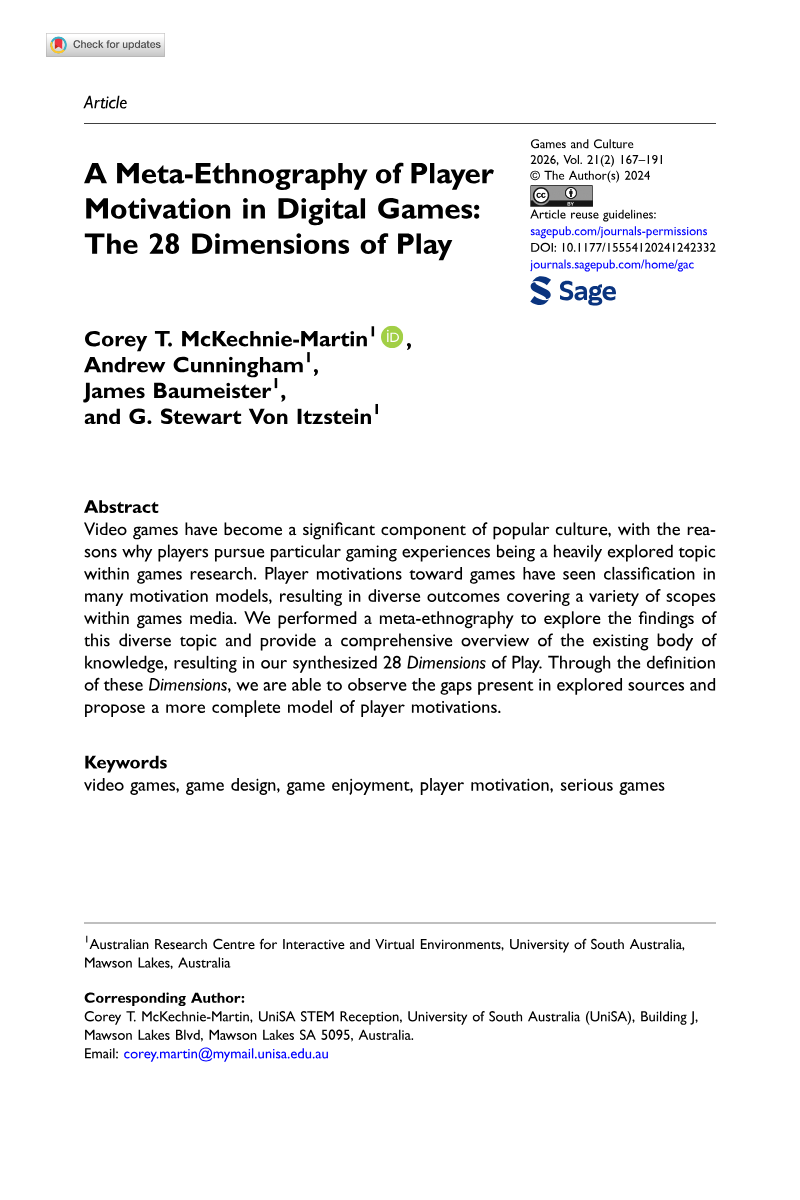
Motivation in Digital Games: The 28 Dimensions of Play
The study of digital game engagement has long suffered from fragmented research and overly simplistic player typologies that fail to capture the complexity of modern gaming experiences.
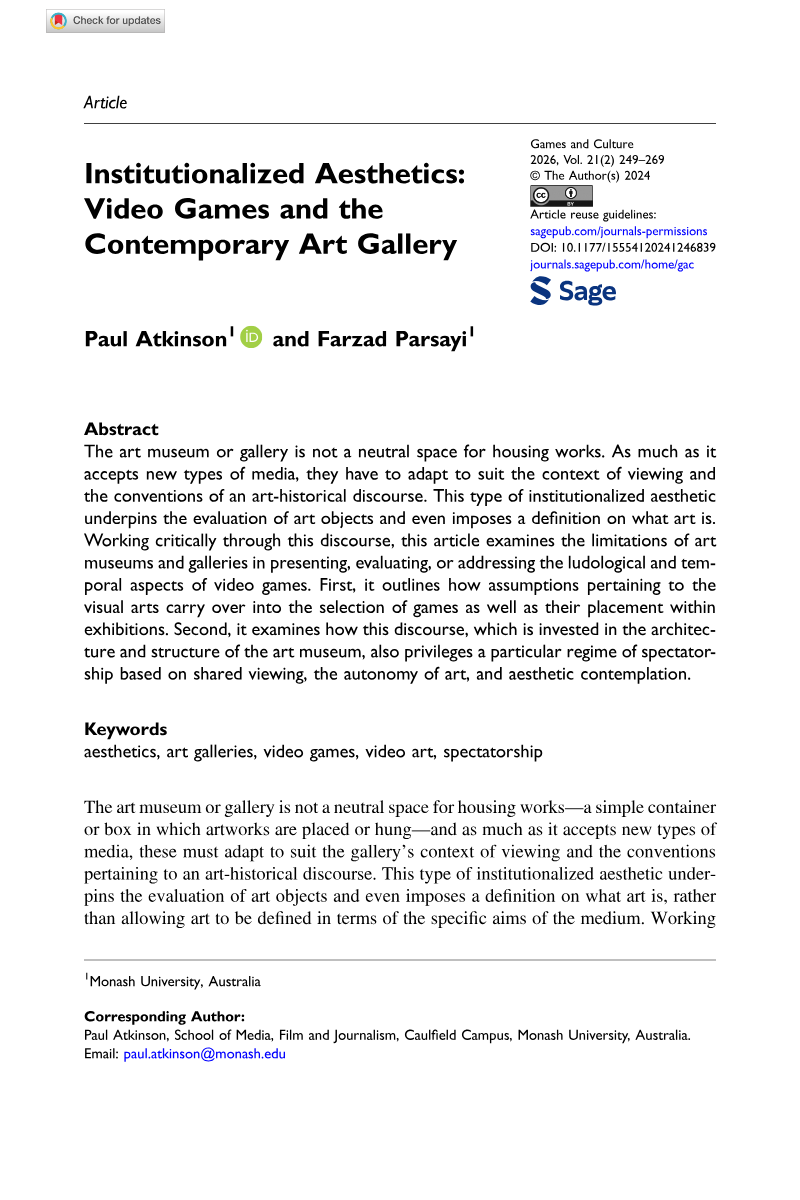
Video Games and the Contemporary Art Gallery
Contemporary art galleries face significant structural and conceptual challenges when attempting to integrate video games into the traditional white cube environment.
- The fundamental tension between video games and art galleries stems from a mismatch between the gallery's requirement for fragmented, self-directed viewing and the game's need for sustained, linear immersion.
- Curators often employ an 'aesthetics of reduction' by stripping away narrative and gameplay mechanics to force video games into traditional art-historical frameworks.
- Current exhibition strategies, such as large-scale projections and modified game states, frequently relegate games to the status of design artifacts rather than treating them as distinct, evolving forms of expression.
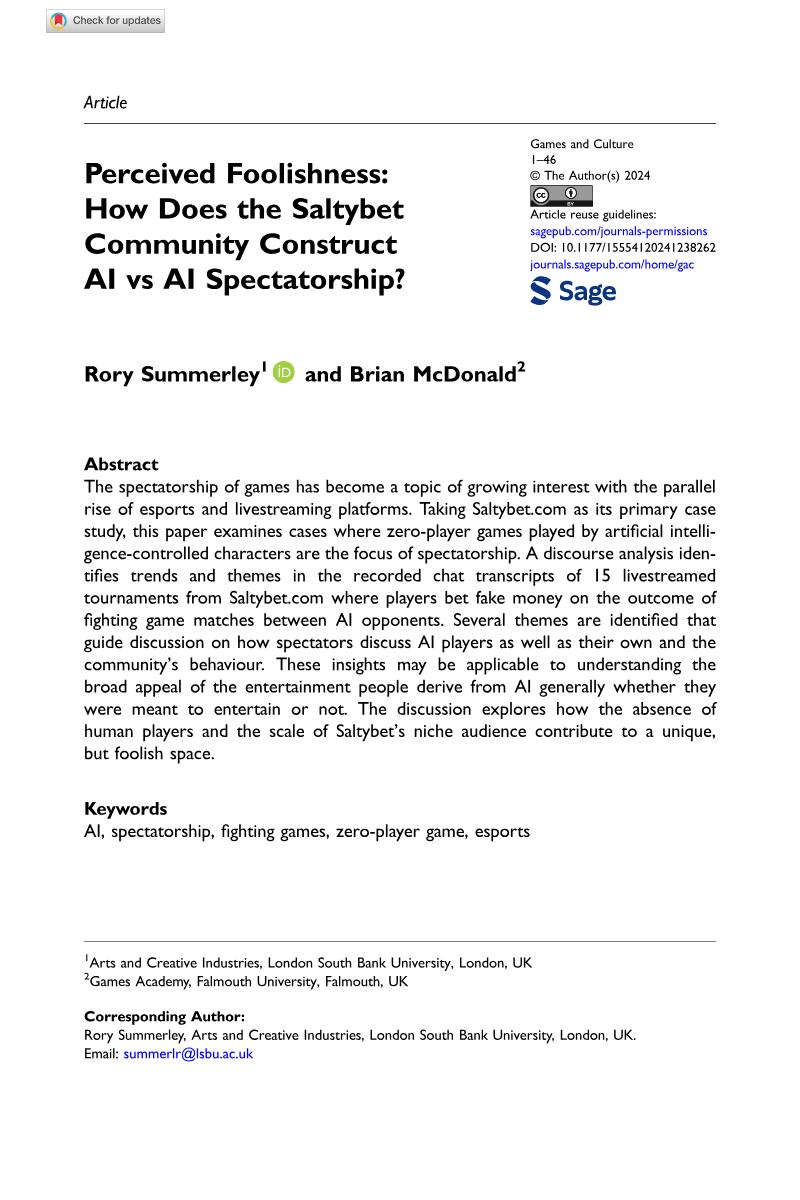
How Does the Saltybet Community Construct AI vs AI Spectatorship?
Saltybet serves as a unique case study for understanding how audiences construct meaning and narrative within automated, AI-versus-AI environments.
- Saltybet spectators transform deterministic AI-versus-AI matches into character-driven narratives by anthropomorphizing software, assigning personality, intent, and moral traits to fighters.
- The community functions as a digital 'third place' that prioritizes shared rituals, nostalgia, and ironic parody over the serious competition found in traditional esports.
- Spectators actively bridge the agency gap by using a complex lexicon of slang and memes to provide the intentionality and context missing from the automated gameplay.
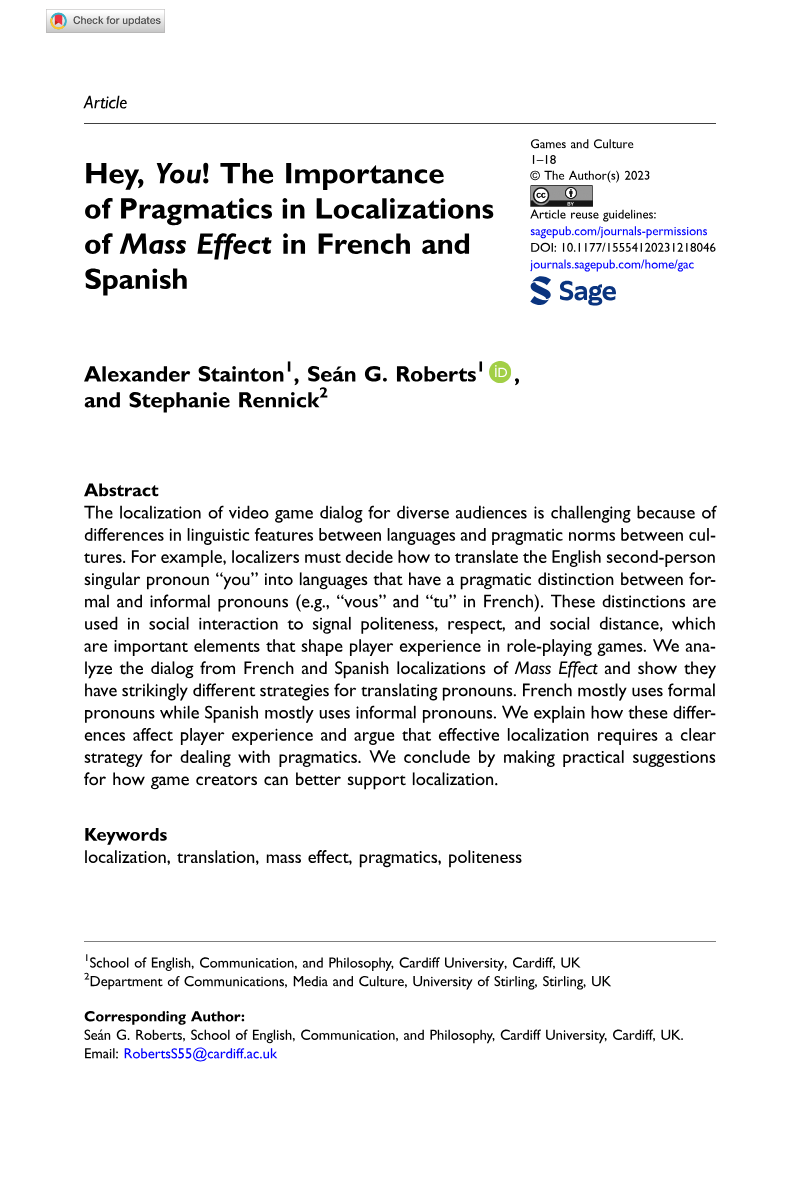
You! The Importance of Pragmatics in Localizations of Mass Effect in French and Spanish
The localization of the Mass Effect series reveals that pragmatic choices regarding second-person pronouns fundamentally alter player experience and character perception.
- In Mass Effect, the choice between formal and informal second-person pronouns fundamentally alters player perception of character intimacy, power dynamics, and narrative immersion.
- French localizations of the series consistently prioritize formal pronouns, while Spanish versions lean toward informal registers, creating distinct social realities for players in different regions.
- Localization in interactive media requires different strategies than film subtitling because direct address forces translators to navigate complex social hierarchies and human-AI dynamics.
Display: An Extension of the Matrix Model
The matrix model for museum videogame display requires a fundamental expansion to better account for the multifaceted nature of visitor engagement.
- Museums should adopt a tripartite matrix model for videogame exhibits, categorizing visitor engagement into playable, collective, and situational dimensions to balance entertainment with historical rigor.
- Institutions must abandon the artificial segregation of fun and learning by prioritizing the accessibility of complex games through enhanced instruction and social support systems rather than relying solely on simple, accessible titles.
- Shifting the focus toward active visitor participation helps mitigate ideological biases inherent in traditional, top-down museum narratives.
The Mukokuseki Strategy and the Application of Pivot Translation in the Localization of Japanese Games
The global distribution of Japanese video games increasingly relies on the mukokuseki strategy, a design philosophy that strips content of specific national markers to create a culturally odorless, universally appealing aesthetic.
- Japanese game developers are increasingly adopting the 'mukokuseki' strategy, which removes specific national markers to create a culturally odorless aesthetic designed for universal global appeal.
- The industry is shifting toward pivot translation, using English as an intermediate language rather than direct Japanese-to-target-language translation to streamline international distribution.
- Titles like Dark Souls 3 demonstrate the integration of European cultural motifs as a deliberate design choice to enhance marketability in Western regions.
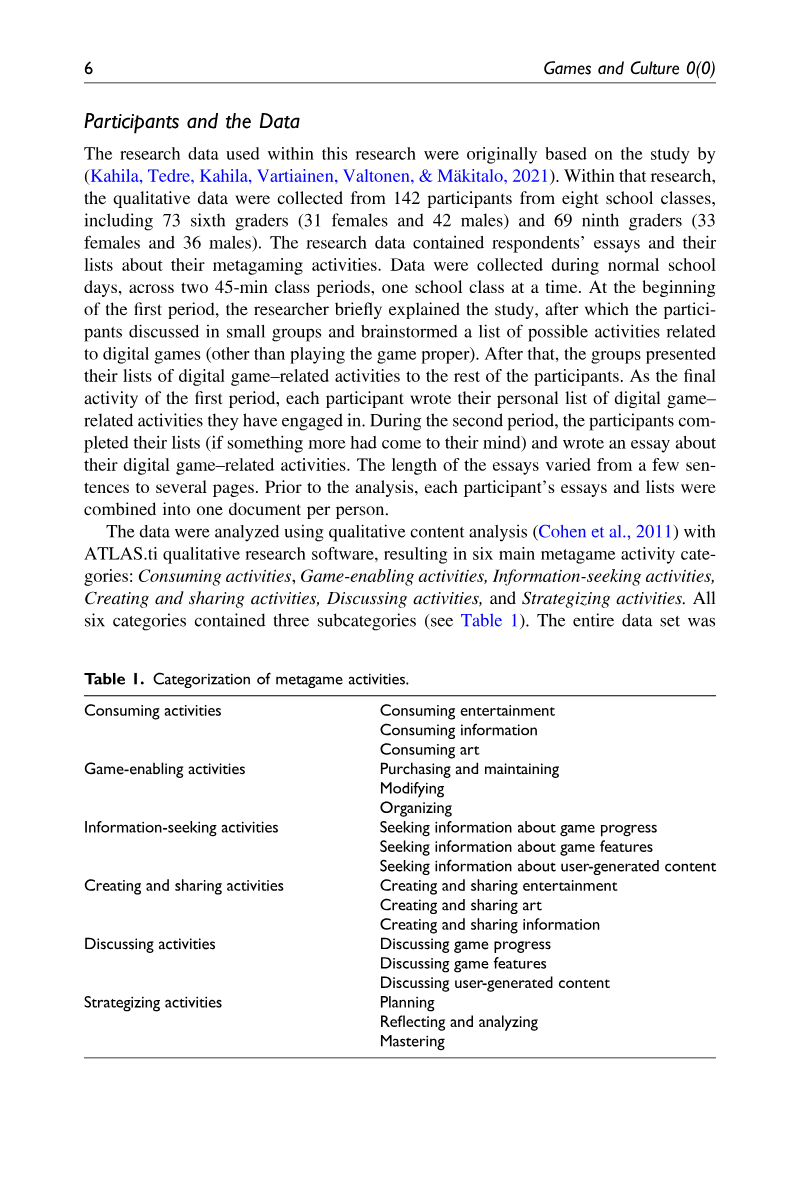
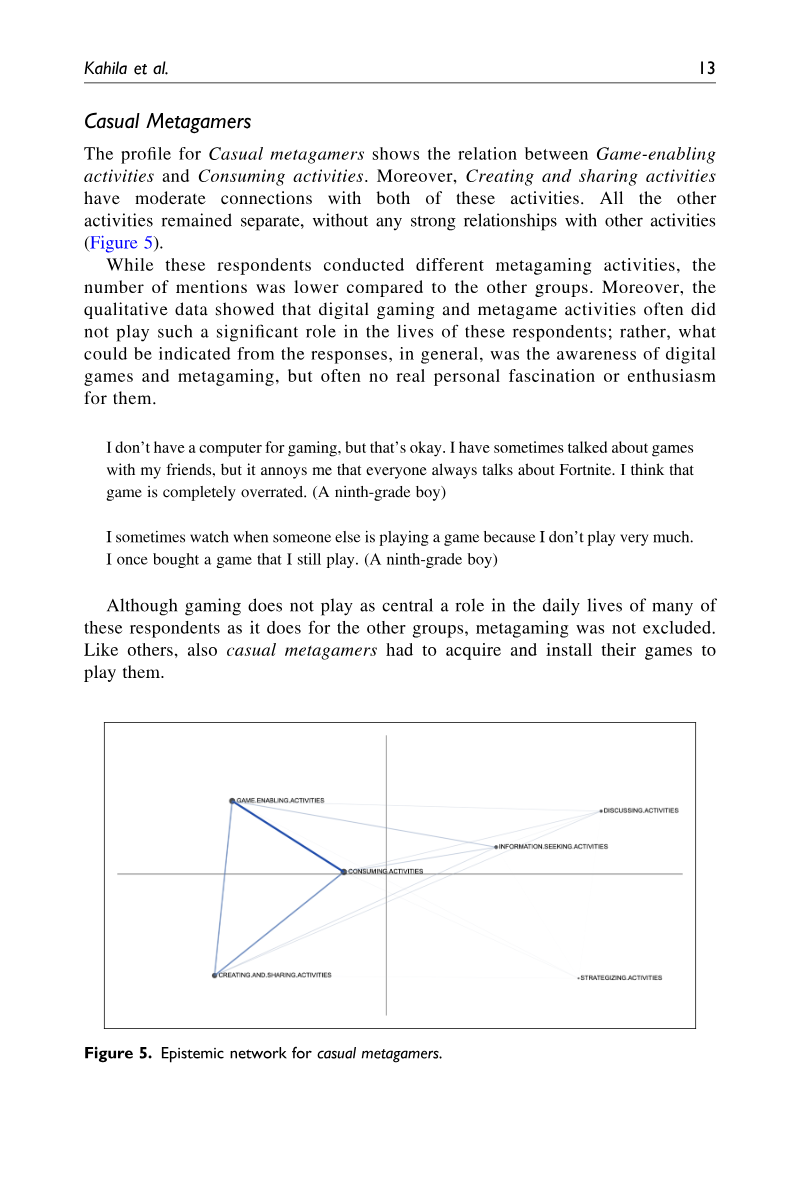
Identifying Player Types Based on Beyond the Game Activities
Traditional player typologies often overlook the significant portion of engagement that occurs outside of active gameplay.
- Casual metagamers constitute the largest player segment at 45.8%, followed by versatile metagamers at 35.2% and strategizers at 19%.
- Information-seeking is the foundational behavior across all player types, serving as the primary catalyst for engagement beyond active gameplay.
- Player engagement should be modeled by integrating metagame activities—such as content consumption, strategizing, and information gathering—rather than focusing solely on in-game performance.
Aesthetics of Agency and the Rhythm of Gameplay
The aesthetics of agency in digital games are best understood through the lens of rhythm, which functions as a continuous, temporal process rather than a series of static, isolated choices.
Do you work at Games and Culture? Get a free report of how these documents are read and cited here.