
Game Developers Conference
Game Developers Conference (GDC, now the GDC Festival of Gaming) is the professional event for the games industry. It publishes recorded talks and interviews, annual industry survey reports such as the State of the Game Industry, and news articles.
Documents
Design in Detail
The pursuit of excellence in modern game development hinges on the meticulous execution of granular design elements rather than broad conceptual strokes.
- Game quality is determined by the meticulous execution of granular mechanics like movement speeds and control constraints rather than broad conceptual design.
- Designers must maintain player engagement by keeping interaction latency under 100 milliseconds to ensure actions feel intentional and responsive.
- Systemic cohesion, or harmonics, is achieved by synchronizing layered mechanics like health regeneration and enemy encounters to create a rhythmic, varied flow.

Prototype Through Production: Pro Guitar in Rock Band 3
The development of Pro Guitar for Rock Band 3 represents a strategic effort to bridge the gap between casual rhythm gaming and genuine musical proficiency.
- The Pro Guitar project for Rock Band 3 successfully bridged casual gaming and musical proficiency by using a Montessori-inspired pedagogical approach to teach guitar fundamentals.
- The development team executed the project over a 13-month period, utilizing an agile, iterative process to move from experimental prototypes to a polished, feature-complete system.
- Engineers developed a proprietary, perspective-based notation system that utilized chord shapes to provide real-time visual feedback, allowing players to maintain focus on the screen.

Level Design Case Studies: Trainyard and Cut the Rope
Successful puzzle game design hinges on the delicate balance between accessibility for casual players and sufficient depth to satisfy experienced users.
- Design levels for casual players by assuming they lack a 'vocabulary of games' rather than lacking intelligence, which requires intuitive mechanics that do not rely on text.
- Use the 'Wingdings test' to ensure game mechanics are clear without text, allowing players from any culture to understand the gameplay through visual cues alone.
- Implement 'dips' in the difficulty curve to allow players to relax and practice existing mechanics, preventing the burnout that occurs when a game constantly ramps up in intensity.

Controls You Can Feel: Putting Tactility Back Into Touch Controls
Successful game design on touch-based platforms requires prioritizing tactility and physical interaction, moving beyond the traditional reliance on visual feedback.
- Prioritize proprioception and muscle memory over visual feedback to make the interface feel invisible and allow players to focus on the game world.
- Avoid virtual joysticks and other legacy controller paradigms that lack physical affordances, as these force players to rely on slower visual processing.
- Design for primary feedback where players intuitively know the outcome of an input before it is confirmed visually.
Classic Game Postmortem: Alone in the Dark
Alone in the Dark serves as a foundational milestone in the survival horror genre, emerging from an effort to blend 1970s horror cinema aesthetics with pioneering 3D character modeling.
- Alone in the Dark established the survival horror genre by blending 1970s horror aesthetics with 3D character modeling, prioritizing atmosphere over traditional interface-heavy design.
- The development team overcame early 1990s hardware constraints by layering 3D polygonal characters over static, pre-rendered backgrounds to ensure consistent performance.
- A core team of fewer than ten people completed the entire project in under eight months, utilizing a critical three-day planning session to define the narrative framework.

Bringing Mars Down to Earth: Designing Educational Games for Low Income Students
Educational initiatives targeting STEM engagement among middle school students in low-income communities require a departure from traditional, rigid pedagogical models in favor of immersive, narrative-driven experiences.
- A pilot program reaching 2,500 middle school students in low-income communities resulted in 78% of participants reporting an increased commitment to completing high school.
- Over 50% of student participants expressed heightened confidence in pursuing STEM-related career paths following their engagement with the game-based platform.
- The design framework prioritizes the engineering design cycle and metacognitive learning over rote memorization to foster deeper scientific discovery.
Exploring Helplessness in Games with Bury Me, My Love
Bury Me, My Love functions as a deliberate subversion of traditional game design by prioritizing emotional resonance over player agency.
- Bury Me, My Love subverts traditional game design by prioritizing emotional resonance over player agency, deliberately stripping away the illusion of mastery to mirror the migrant experience.
- The game simulates the helplessness of long-distance communication during humanitarian crises by forcing players into the role of a passive observer who must navigate unpredictable character availability.
- Mechanics such as real-time waiting periods and the omission of save points are used to maintain a state of constant uncertainty and anxiety for the player.
The Journey to Creating SHANK
The development of the action game Shank by Klei Entertainment serves as a case study in independent game production, navigating publisher relationships, and the transition to multi-platform releases.
- Klei Entertainment maintained creative control over Shank by self-funding the initial development, allowing them to present a nearly finished prototype to EA that was visually and mechanically identical to the final product.
- The studio rejected a previous publishing deal to maintain independence and protect the industry's ethical standards, opting instead for a more equitable partnership with EA.
- Development efficiency was high, with the core game concept prototyped in two months and the team working only three weekends throughout the nine-month production cycle due to robust internal tool development.
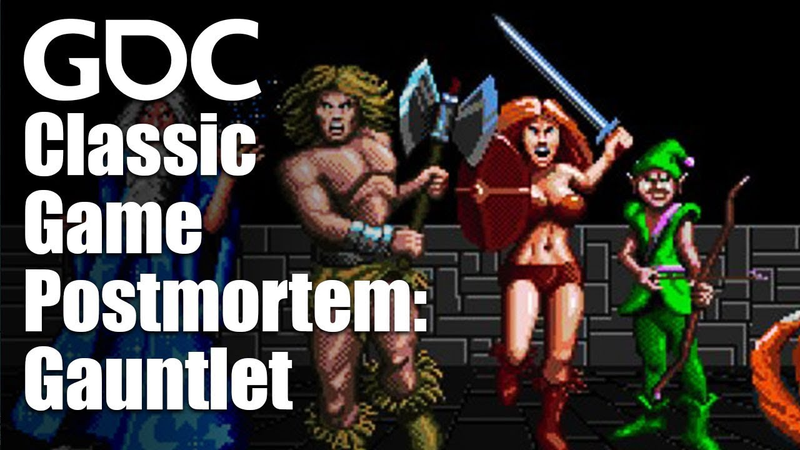
Classic Game Postmortem: Gauntlet
The arcade industry of the mid-1980s faced significant pressure to increase revenue per session as hardware costs rose and the market became increasingly volatile.
- Gauntlet was a large-scale project for its time, featuring a development team of two programmers, four to five artists, one engineer, and three part-time audio staff members, beginning in February 1985.
- The game's hardware limitations included a display constraint of only 56 motion objects per scanline, which necessitated complex grid-based movement and re-assignment algorithms for sprites.
- To manage memory constraints, the team utilized a three-layer graphics system consisting of alpha-numerics on top, a playfield on the bottom, and sprites in between, all rendered using color palettes rather than a high-bit color space.
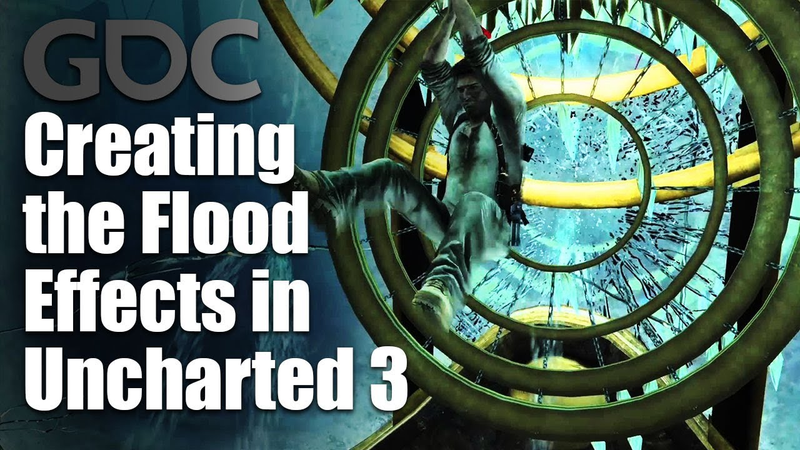
Creating the Flood Effects in Uncharted 3
The development of flood effects for Uncharted 3 relied on a hybrid approach that combined fluid simulations with optimized, artist-driven mesh and particle systems.
- To optimize performance on PlayStation 3 hardware, the team used skeletal meshes with one joint per vertex, reducing the required joint count by two-thirds by utilizing elongated rectangular polygons.
- The team achieved high-fidelity water surfaces by using a ray-casting technique aligned with the camera’s perspective to extract mesh data from Houdini simulations, effectively eliminating visual artifacts like incorrect overhangs.
- Particle system performance was managed by rendering to a quarter-resolution buffer and replacing standard quad shapes with octagonal ones to overcome fill-rate limitations.
Level Design Workshop: Blockmesh and Lighting Tips
Effective level design relies on the early integration of block-mesh geometry and intentional lighting to establish pacing, scale, and intuitive navigation.
- Prioritize block-mesh geometry in the early development phase to test core movement mechanics and player flow before committing to high-fidelity assets.
- Use intentional guidance principles like consistent shape language, color coding, and landmark placement to reduce reliance on intrusive HUD markers.
- Integrate lighting as a functional navigation tool by treating level geometry as a framing device to highlight critical paths and gameplay interactions.
Alternative Paths in Indie Dev
Independent game development increasingly prioritizes artistic expression, social commentary, and experimental hardware over the pursuit of traditional commercial success.
- Independent developers are shifting focus from traditional commercial success toward projects centered on artistic expression, social commentary, and experimental hardware.
- Financial sustainability in this sector is achieved by diversifying income through freelance contracting, teaching, performance art, and personal savings rather than relying on standard industry business models.
- Developers are expanding their professional reach beyond the gaming industry by securing commissioned installations at museum exhibitions, film festivals, and maker faires.