
Game Developers Conference
Game Developers Conference (GDC, now the GDC Festival of Gaming) is the professional event for the games industry. It publishes recorded talks and interviews, annual industry survey reports such as the State of the Game Industry, and news articles.
Documents
Star Wars: The Old Republic - Creating A True Competitor in the AAA MMO Space
The development of Star Wars: The Old Republic was driven by the ambition to challenge the established AAA MMORPG market through a strategy of product differentiation and massive scale.
- To manage the massive scale of Star Wars: The Old Republic, BioWare employed a workforce of 30 producers, 75 designers, and 120 engineers, with 40 of those engineers dedicated solely to platform management and infrastructure.
- The project set a Guinness World Record for the largest voiceover project ever completed, featuring six times the dialogue of Dragon Age and nine times that of Mass Effect.
- BioWare transitioned from a discipline-based organization to a matrix structure to prevent knowledge silos, using 'strike teams' to manage up to 40 concurrent development groups.
The Identity Bubble - A Design Approach to Character and Story Development
The Identity Bubble framework addresses the fundamental tension in game design between developer-authored narratives and player agency.
- The 'Identity Bubble' framework resolves ludonarrative dissonance by treating the player and the avatar as distinct but connected entities, ensuring systemic actions reinforce the character's established identity.
- Designers must achieve 'ludonarrative parity' by aligning player objectives with the protagonist's narrative goals, preventing the collapse of immersion caused by divergent motivations.
- Core character traits should be integrated directly into gameplay mechanics rather than relying on cutscenes to foster 'identity absorption' and bridge the gap between blank-slate agency and pre-defined narratives.

Classic Game Postmortem - Raid On Bungeling Bay
The development of Raid on Bungeling Bay, released in 1984, serves as a pivotal case study in the technical ingenuity required during the early 8-bit computing era.
- The financial success of Raid on Bungeling Bay, which sold 800,000 units on the Nintendo platform in Japan, provided the essential capital required to launch Maxis.
- The project achieved unprecedented smooth-scrolling graphics on the Commodore 64 by utilizing manual, byte-level memory management and custom development interfaces.
- The game introduced a dynamic, clockwork resource-management system where enemy defenses escalated based on player progress, establishing early foundations for the simulation genre.

Building an Inclusive Tech Lab: How and Why You Should Too
The Inclusive Tech Lab serves as a strategic initiative to embed accessibility into the core of game development by fostering empathy and providing hands-on education for designers.
- The Inclusive Tech Lab transitioned from temporary pop-up stations to a permanent, purpose-built facility to move accessibility from theoretical knowledge to hands-on developer engagement.
- The facility hosted over 3,400 visitors in a five-month period, demonstrating that dedicated physical spaces effectively bridge the gap between technical development and user needs.
- Operational success is driven by prioritizing feedback from individuals with lived experience over internal simulations to ensure authentic validation of accessibility features.
Failing to Fail: The Spiderweb Software Way
The game industry is characterized by extreme volatility and unpredictability, rendering traditional notions of success—such as chasing viral hits or scaling into large organizations—largely unsustainable for independent developers.
- Long-term viability for independent developers is best achieved by cultivating a niche, story-heavy fantasy RPG identity that prioritizes creative autonomy over chasing viral market trends.
- Operational stability relies on a disciplined 18-month development cycle that balances innovation with manageable production costs.
- Developers should adopt lean production methods, including the strategic reuse of assets and the maintenance of a robust back catalog, to ensure consistent output without burnout.
Vault, Slide, Mantle: Building Brink's SMART System
The development of the SMART (Smooth Movement Across Random Terrain) system for the multiplayer first-person shooter Brink aimed to solve the common issue of player characters snagging on environmental geometry.
- Splash Damage developed the 'SMART' movement system for Brink to provide consistent, accessible traversal across diverse maps without requiring manual level-design work for every ledge or obstacle.
- The system utilizes the game's navigation mesh (navmesh) to pre-calculate reachability between areas, storing specific flags for vaulting, mantling, and low-ceiling traversal to assist both AI pathfinding and player movement.
- To optimize performance, the system moved away from the prototype's runtime collision traces—which could reach 8 traces per player per frame—to a BSP tree-based query system that searches for pre-defined reachability segments within a bounding box of 6x2.5 times the player's dimensions.
AI-driven Dynamic Dialog through Fuzzy Pattern Matching
Dynamic dialogue systems in modern gaming rely on fuzzy pattern matching to create reactive, context-aware character interactions without the burden of extensive custom programming.
- Dynamic dialogue systems utilize fuzzy pattern matching to enable reactive, context-aware character interactions without requiring extensive custom programming.
- The architecture represents the game world as a flat database of key-value pairs, allowing writers to create complex narratives that respond to procedural gameplay through a rule-based framework.
- System relevance is maintained by selecting the most specific match—defined by the highest number of matching criteria—when multiple potential responses exist.
Breaking the Rules of Game Design
Game design traditionally centers on the psychological pillars of autonomy, competence, and relatedness to foster intrinsic motivation and player retention.
- Intentionally disrupting the psychological pillars of autonomy, competence, and relatedness can transform mechanical frustration into a powerful narrative tool to evoke complex emotions like helplessness or sadness.
- Mechanical failure must be precisely aligned with narrative context, such as tying a loss of competence to a character death or moral compromise, to ensure the emotional weight feels earned rather than arbitrary.
- Designers should treat the sacrifice of one psychological pillar as a trade-off to amplify another, such as reducing a player's sense of mastery to deepen the impact of a narrative revelation.

Girl Games of the 1990s: A Retrospective
The 1990s marked a pivotal shift in interactive media as developers challenged the industry’s dismissal of female players by proving the commercial viability of games designed specifically for girls.
- The 'girl games' genre of the 1990s relied heavily on evidence-based design, with companies like Purple Moon conducting extensive research with thousands of girls to inform game mechanics rather than relying on developer assumptions.
- Barbie Fashion Designer (1996) was a pivotal success that proved the necessity of television advertising for the genre, despite initial skepticism from publishers who were unfamiliar with the market potential.
- The genre experienced a significant boom in the mid-1990s but largely collapsed by 2006, as many projects were viewed as short-term marketing phenomena rather than sustainable long-term business models.
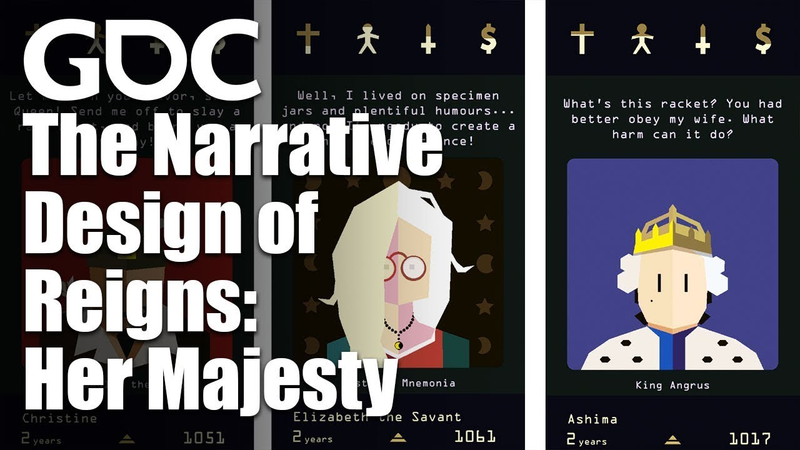
Queens of the Phone Age: The Narrative Design of Reigns: Her Majesty
Reigns: Her Majesty functions as a critical exploration of power dynamics, utilizing a modular, swipe-based interface to simulate the constraints of navigating a patriarchal society.
- Reigns: Her Majesty uses a swipe-based mechanic to simulate the constraints of a patriarchal society, forcing players to navigate power through indirect influence and strategic compromise rather than overt authority.
- The game’s narrative design balances four kingdom pillars—church, people, army, and finances—to explore the complexities of self-care and the commercialization of feminism within restrictive environments.
- The project functions as a meta-commentary on the video game industry, critiquing the ethics of corporate-branded progressivism and the limitations of empathy-driven design.

Waltzing with Blades: The Music of Assassin's Creed Syndicate
The musical direction for Assassin’s Creed Syndicate represents a deliberate departure from the franchise’s traditional, brooding orchestral scores in favor of a nimble, character-driven aesthetic.
- The score utilized a modular, character-driven design featuring solo violin for Jacob and cello for Evie to provide real-time, reactive feedback based on player choices.
- Production shifted from a traditional orchestral style to a Neo-Mendelssohn, chamber music framework to better reflect the sarcastic and intimate tone of Victorian London.
- Technical implementation prioritized grid-based transitions to eliminate cross-fades, ensuring seamless audio continuity across gameplay, loading screens, and cinematics.
Sid Meier's Interesting Decisions
Game design centers on the creation of interesting decisions, defined as choices that require meaningful trade-offs, reflect individual playstyles, and carry clear consequences.
- Game design must prioritize 'interesting decisions,' which are defined as choices requiring meaningful trade-offs, risk-versus-reward evaluation, and clear consequences.
- Mechanics that do not contribute to the core enjoyment of the experience should be removed regardless of their development stage to preserve the integrity of the gameplay loop.
- Designers should balance short, medium, and long-term goals while limiting the number of simultaneous choices to prevent player fatigue and confusion.