
Game Developers Conference
Game Developers Conference (GDC, now the GDC Festival of Gaming) is the professional event for the games industry. It publishes recorded talks and interviews, annual industry survey reports such as the State of the Game Industry, and news articles.
Documents

Building a Strong Studio Culture Microtalks
Building a resilient and productive studio culture requires leadership to move beyond superficial policies and prioritize human-centric management.
- Studio culture is defined by the consistent behaviors modeled by leadership during high-stress periods rather than static, written values.
- The gaming industry currently underperforms compared to other sectors in metrics regarding workforce diversity and employee engagement, which directly threatens talent retention and long-term economic viability.
- Leadership must transition from top-down mandates to horizontal ownership models that dismantle silos and eliminate 'othering' language.
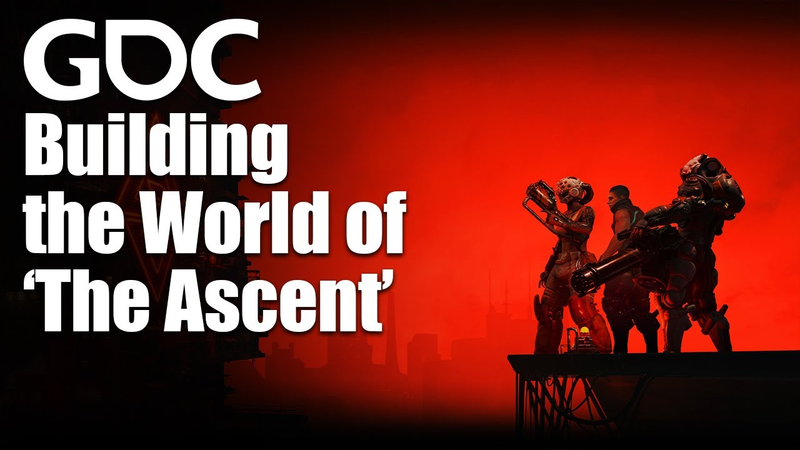
Building the World of 'The Ascent'
The development of the cyberpunk action game The Ascent demonstrates how a small team can achieve high-fidelity world-building through a strictly constrained, tech-driven production pipeline.
- The development team managed over 8,000 individual assets by utilizing a modular construction pipeline that prioritized shared texture sheets and trim sheets over traditional high-to-low poly workflows.
- Strict adherence to a three-color palette and the use of vertex colors combined with light-baked ambient occlusion kept total texture memory usage under 100MB.
- Procedural tools built in Houdini were essential for generating architectural elements like rooms and pipes, allowing a small team to populate a sprawling environment efficiently.

Freelancing Tech Art Part-Time: A Few Dos and Don'ts
Technical art represents a high-demand niche within the gaming industry, offering significant opportunities for full-time professionals to supplement their income through strategic freelance consulting.
- Treat freelance technical art as a formal business entity with separate financial accounts and professional accounting services to manage tax obligations.
- Implement a 15% time buffer on all project estimates to account for unforeseen technical complexities and ensure accurate delivery schedules.
- Protect proprietary client data and maintain professional standards by utilizing robust version control systems like Perforce for all project assets.

Keep Redlining OUT of the Metaverse
The Black Developers Initiative (BDI) at Niantic serves as a framework for addressing systemic exclusion within the gaming industry, specifically targeting the lack of representation for Black-led development teams.
- The Black Developers Initiative (BDI) at Niantic aims to dismantle the industry's 'pipeline of privilege' by providing Black-led development teams with essential funding, mentorship, and resource access.
- Industry demographics have remained stagnant, with the percentage of Black developers holding at approximately two percent since 2014, according to IGDA data.
- Systemic barriers to entry include limited access to capital, confirmation bias in hiring and publishing, and a reliance on 'battlefield promotions' that favor existing professional networks.
Micro Postmortems: 'Sky', 'Blaseball', and 'Space Warlord Organ Trading Simulator'
Modern game development increasingly relies on community-driven narratives and collaborative, sustainable production models to achieve both critical success and long-term player engagement.
- Game development is shifting from auteur-driven models to a 'constellation approach,' which prioritizes team health, fair compensation, and flexible collaboration to produce projects reflecting collective rather than singular visions.
- Titles like 'Blaseball' demonstrate that treating simulation outputs as definitive narrative truths allows developers to foster a living, evolving world driven by player influence.
- In collaborative production environments, selecting partners based on empathy and shared creative perspectives is more critical to long-term success than prioritizing raw technical skill.
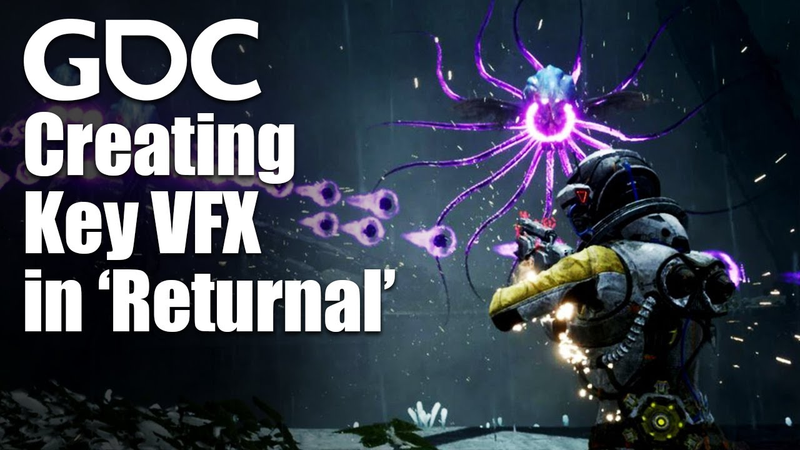
Can We Do It with Particles?: VFX Learnings from 'Returnal'
Housemarque’s development of the 2021 title Returnal leveraged a proprietary, GPU-based visual effects engine to achieve complex environmental and character effects.
- Housemarque utilized a proprietary, GPU-based VFX engine, originally developed in 2014 and integrated into Unreal Engine, which relies on custom HLSL-based code rather than pre-built nodes to achieve high-performance particle systems.
- The engine employs particle hierarchies, or 'node particles,' allowing child particles to reference parent data to procedurally generate complex structures like tentacles and destructible objects.
- By treating particles as control points for curves, the team implemented efficient tube rendering that manages complex movement and player collisions with minimal performance overhead.

Emotional Neural Style Transfer: Expressing Character AI Emotion through Paintings
This research explores the integration of neural style transfer (NST) as a novel medium for character AI to express emotion within video games.
- The research implements a system where character AI emotions, modeled via OCC and PAD frameworks, are expressed by dynamically applying neural style transfer (NST) to the game environment.
- The technical architecture utilizes conditional instance normalization to support four distinct NST variations: basic, blending, mask-based, and color-controlled style transfer.
- To preserve GPU resources for primary game rendering, the system performs CPU-based inference using TensorFlow Lite, ensuring compatibility with Unreal Engine 4 and various console architectures.
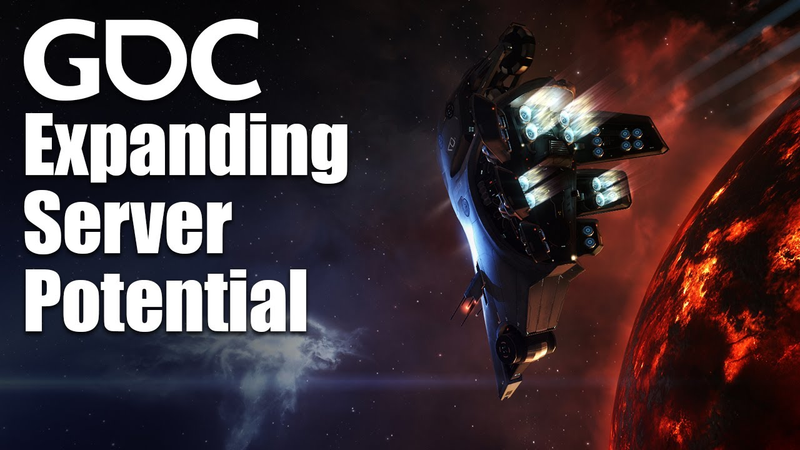
Quasar, Brightest in the Galaxy: Expanding 'EVE Online's' Server Potential with gRPC
EVE Online is undergoing a fundamental architectural transformation to ensure the long-term viability of its twenty-year-old single-shard MMO environment.
- CCP Games transitioned EVE Online's architecture to a domain-service model using gRPC, Kubernetes, and Go to move away from a 20-year-old monolithic codebase that had become difficult to scale and maintain.
- The adoption of gRPC and Protocol Buffers allowed CCP to offload serialization tasks from Python to C++, resulting in an average performance increase of 60 milliseconds in messaging latency.
- By shifting to domain-specific services rather than a single monolithic database, CCP decoupled data ownership, allowing teams to manage specific domains like user, skill, or market data independently.

Recalibrating Our Limits: Lighting on 'Ratchet and Clank: Rift Apart'
The development of Ratchet & Clank: Rift Apart represents a strategic shift toward achieving feature-animation-level visual fidelity on PlayStation 5 hardware.
- Insomniac Games prioritized performance on the PlayStation 5 by mandating that all light sources cast shadows, abandoning previous-generation optimization tactics that sacrificed visual fidelity for performance.
- The lighting team established a consistent baseline by locking exposure and key light intensity as foundational variables, ensuring that all subsequent adjustments to fog, bounce light, and light intensity remained balanced throughout the project.
- To optimize performance and simplify workflows, the team utilized fewer, larger light sources rather than numerous smaller ones, which reduced performance overhead and created more realistic bounce lighting.

Don't Talk to Me or My Baby Ever Again: Negotiating Challenging Collaboration
Effective game development hinges on shifting the industry paradigm from viewing external contractors as mere service providers to treating them as integrated, expert partners.
- Shift the industry paradigm by treating external contractors as integrated, expert partners rather than mere service providers to improve creative output.
- Involve contractors early in the development lifecycle to ensure their expertise aligns with the project’s broader vision and technical requirements.
- Maintain transparency regarding scope changes and provide consistent, timely feedback to external partners, acknowledging that development pressures like crunch affect them as severely as internal staff.
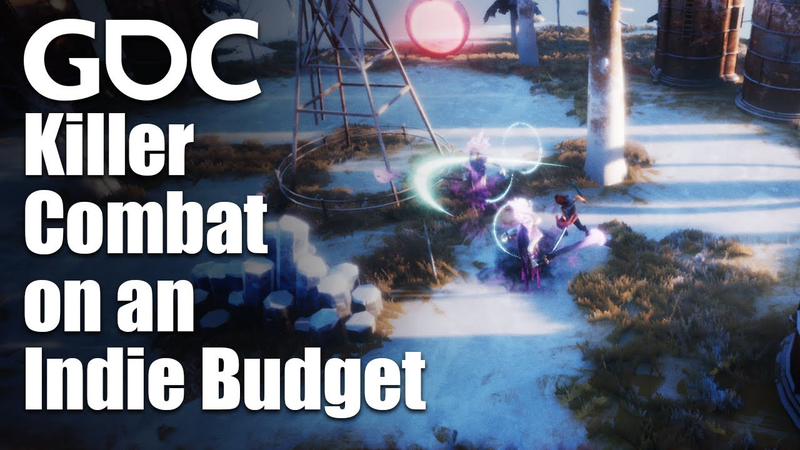
Dreamscaper: Killer Combat on an Indie Budget
Developing a high-quality combat system within the constraints of an indie budget requires a disciplined focus on core design pillars and iterative refinement.
- Define core design pillars early—such as 'purposeful action' and 'tough but fair'—to guide development and ensure combat systems remain focused on player strategy rather than RNG.
- Invest in hit reactions and state machines to add depth without increasing player complexity, as these provide critical feedback that makes combat feel responsive and interactive.
- Implement a 'hit stop' system that freezes the attacker and target for approximately 115 milliseconds (7 frames) upon impact to create a visceral, satisfying sense of weight in combat.

Anti-Crunch: Patterns and Practices
Sustainable game development requires a fundamental shift from reactive, deadline-driven management to a proactive culture that prioritizes human well-being and long-term stability.
- Crunch is primarily a management failure caused by poor estimation and rigid scheduling rather than an inherent necessity of ambitious game development.
- Project management should rely on probabilistic estimation based on historical velocity and Fibonacci scaling instead of making fixed-date commitments.
- Studios can deliver complex features, such as the League of Legends Team Builder, without crunch by treating development as a continuous, disciplined process.