
DiGRA
The Digital Games Research Association: the international association of academics and professionals who study digital games. Its Digital Library holds the proceedings of the DiGRA conferences since 2002.
Documents
Independent Gamework and Identity: Problems and Subjective Nuances
The document, "Independent Gamework and Identity: Problems and Subjective Nuances," examines the motivations, challenges, and identity formations within the independent game development sector.
- Independent game developers are drawn to indie work largely out of dissatisfaction with retail-model constraints such as compartmentalised large teams, publisher rejection of creative proposals, and high production costs, with digital distribution offering ownership and creative control.
- Independence in game development is not purely autonomous: it is conditioned by the precarity and flexibility typical of cultural industries, and the study's 24 participants (largely from Cambridge and Yorkshire networks, interviewed in 2010 and 2011) form a UK-centred sample.
- A persistent tension exists between artistic autonomy and economic necessity, with many self-described indies embracing business logic while others prioritise experimental, critical, or community-oriented goals.
Inviting Grief into Games: The Game Design Process as Personal Dialogue
The document presents a novel approach to game design, advocating for a shift from traditional "emotioneering" to a "facilitation" model that deeply engages underrepresented groups to inform emotional game content.
- The paper argues game design should shift from an "emotioneering" model of engineering emotional reactions through stimulus and response toward facilitating players' own emotional dialogue.
- The game Jocoi, about grieving a baby's death, was co-developed with an Austrian self-help group for bereaved parents, with informants treated as experts on their own experience.
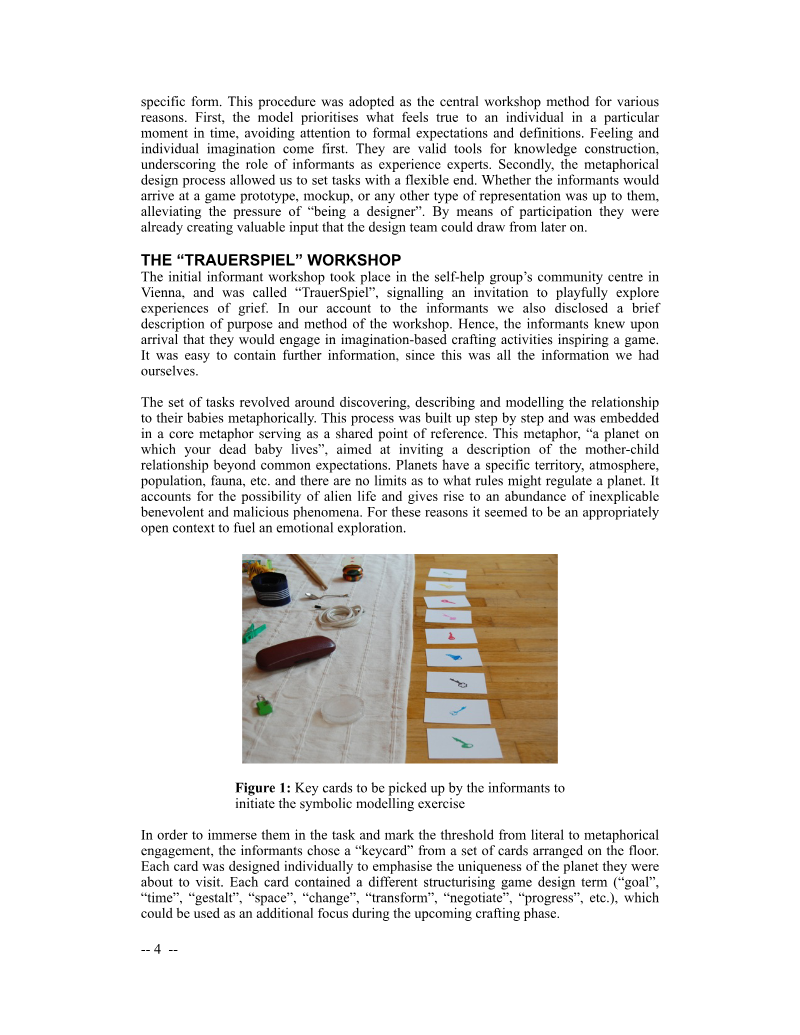
- A "TrauerSpiel" workshop had mothers who lost a pregnancy or infant build miniature models of a "planet on which your dead baby lives"; the models consistently depicted idyllic, timeless spaces centered on nurturing the lost child, with rivers, cave walls, and flames representing harder existential questions.
Exploring Playful Experiences in Social Network Games
This study investigates playful experiences within social network games, utilizing the PLEX framework to analyze player engagement.
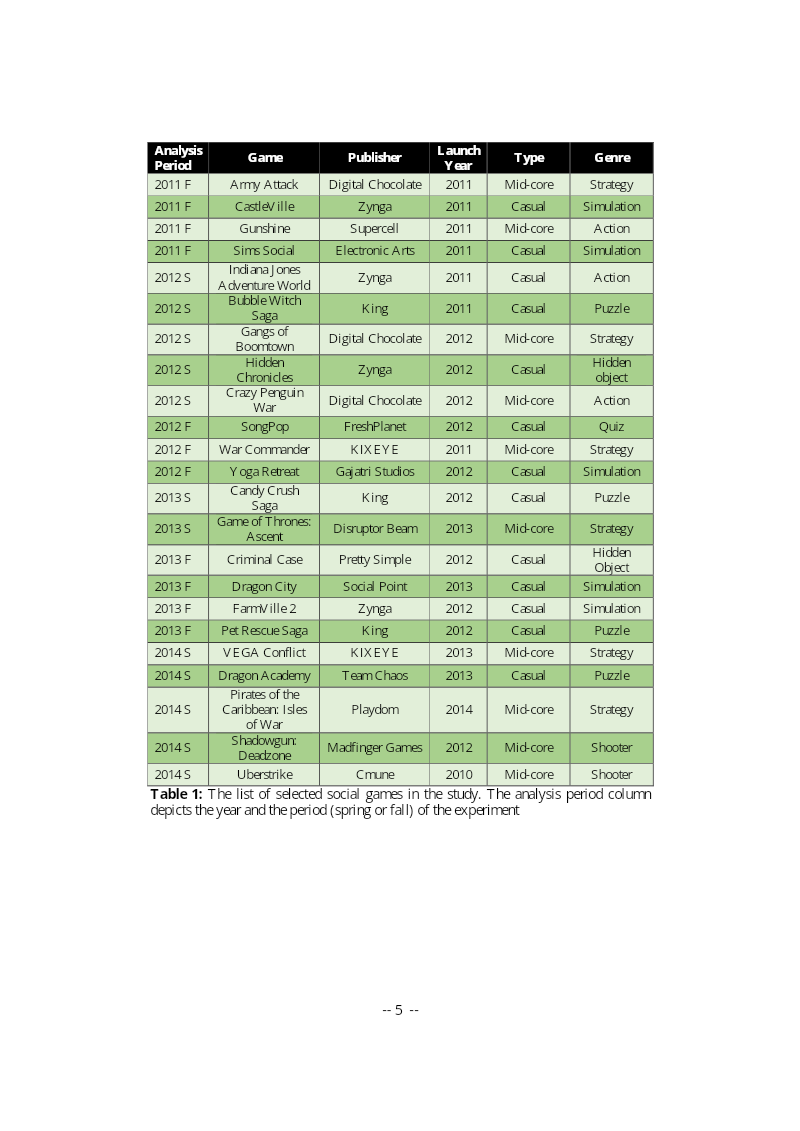
- The study analyzes 330 coded playful experiences from 110 university-student informants playing 23 Facebook social games, using the PLEX (Playful Experiences) framework.
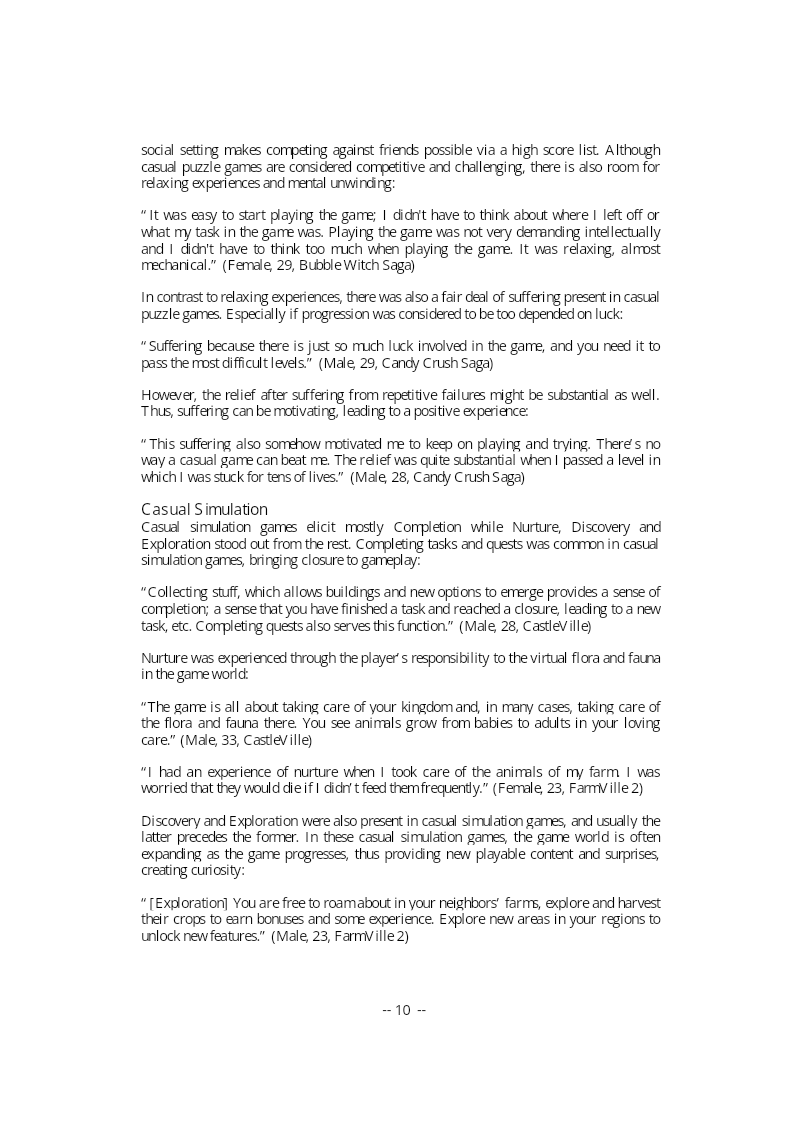
- Competition, Completion, and Challenge were the three most frequently reported experiences, together accounting for 39 percent of all instances, while eight categories covered 68 percent of instances.
- Competitive experiences were more common than collaborative ones such as Fellowship and Nurture, a pattern the authors consider significant for how social games are designed and understood.
Co-Creative Game Design in MMORPGs
The document proposes a four-point model for understanding co-creative game design, specifically within the context of Massively Multiplayer Online Role-Playing Games (MMORPGs), using World of Warcraft as a primary case study.
- Co-creation, per Patrick Prax, requires a creative activity that modifies the game for a considerable group of players and can subvert the designer's original intent, so routine play alone does not qualify.
- Prax frames game design as "second-order design," where developers shape the environment while players produce the experiences that unfold within it.
- Player-built tools in World of Warcraft, such as damage-meter add-ons, the World of Logs platform, and theorycrafting, substantially alter play and have at times prompted designers to respond, as with the built-in hit-rating calculation.

The Case for Computer-Augmented Games: Using Computers to Support and Not Dictate Gameplay
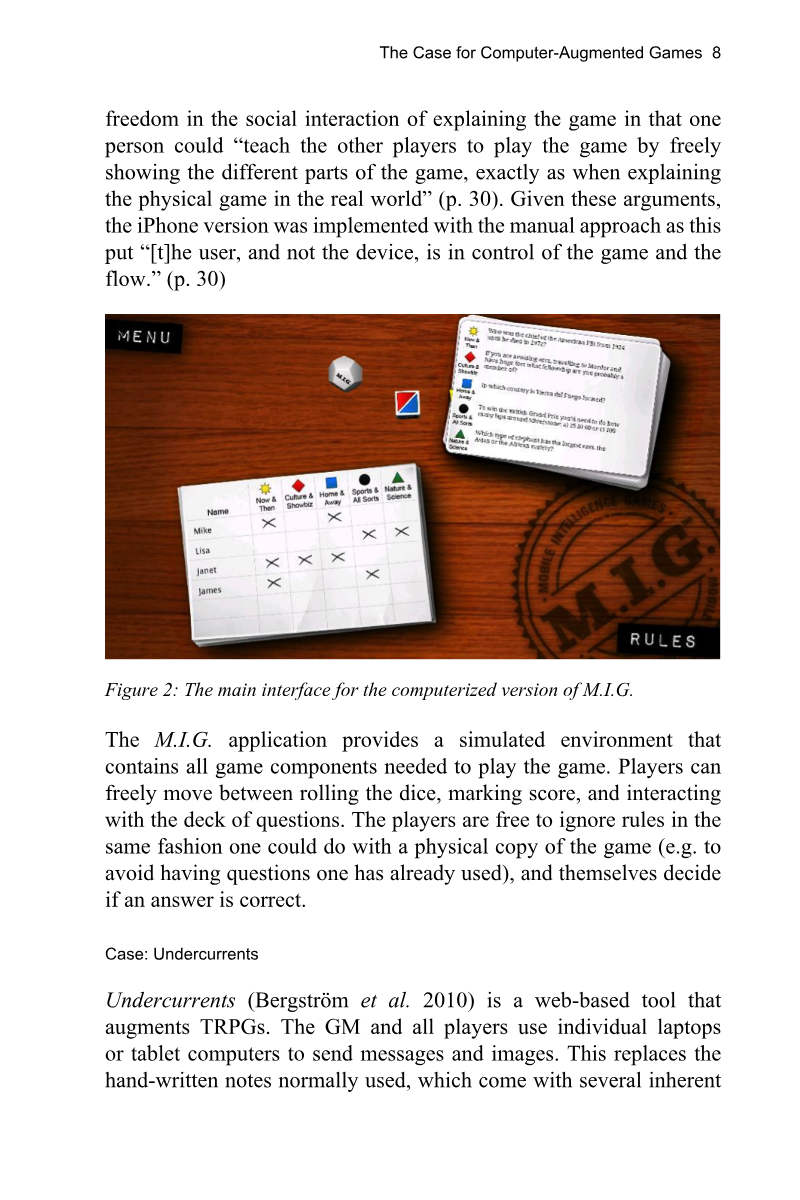
Computer-augmented games represent a distinct design paradigm that prioritizes human agency by utilizing technology as a supportive tool rather than a restrictive, mediating platform.
- Computer-augmented games prioritize human agency by using technology as a supportive tool to reduce administrative overhead rather than as a platform that dictates gameplay.
- Successful design in this space balances automated convenience with the preservation of social spontaneity and player-led mastery found in traditional tabletop and live-action gaming.
- The effectiveness of digital integration is evaluated through a multi-dimensional framework focusing on game logic, physical tangibility, and content fluidity.

“That’s Not a Secure Area”: Physical-Digital Sound Links in Commercial Locative Games
Commercial locative mobile games utilize sound design as a primary mechanism to bridge the gap between digital content and the physical environment.
- Developers prioritize narrative plausibility and emotional resonance over technical geolocation accuracy to maintain cohesive experiences despite mobile hardware limitations.
- Sound design in locative games functions as a tool for mobility and situated experience rather than a primary navigational requirement.
- Designers utilize verbal references, spatialization, and functional indexing to anchor digital interactions within the physical environment.

SimCity and the Creative Class: Happiness, Place, and the Pursuit of Urban Planning
The SimCity franchise functions as a significant cultural artifact that bridges the gap between complex urban planning theory and interactive digital simulation.
- SimCity functions as a model-based simulation that embeds specific urban planning and sociological assumptions—such as Richard Florida’s 'creative class' theories—into its gameplay mechanics.
- The game series has evolved from a basic city-planning tool in 1989 to complex simulations like SimCity 3000 (1999) and SimCity Societies (2007), which incorporate sophisticated variables like waste management, pollution, and citizen happiness.
- In 2013, Electronic Arts partnered with GlassLab to release SimCityEDU, a STEM-focused educational adaptation designed to meet Common Core standards by removing variables to isolate specific learning objectives.

From the Board to the Streets: A Case Study of Local Property Trader
Local Property Trader functions as a location-based mobile application designed to revitalize high-street commerce and foster community social capital by transposing the mechanics of traditional property-trading board games onto real-world urban environments.
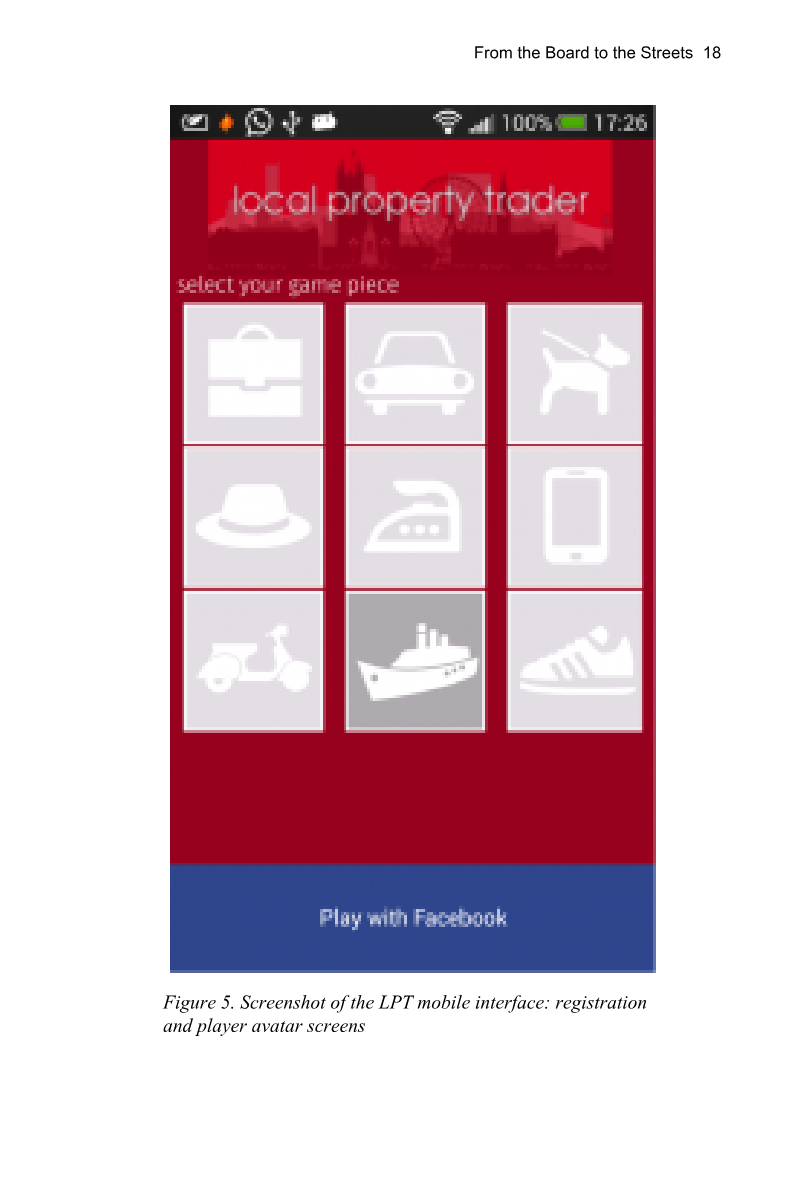
- Local Property Trader (LPT) is a location-based mobile game that adapts Monopoly mechanics to real-world city streets, using property ownership and wealth accumulation to educate players and businesses on 'social capital.'
- The game calculates a property's 'Social Capital' score daily by pulling Twitter data—such as follower counts, retweets, and post frequency—to dynamically adjust rent prices and property values.
- To ensure physical engagement with local environments, LPT requires players to physically visit locations and interact with NFC tags or QR codes to perform actions like checking in or purchasing property, preventing the location-spoofing common in GPS-only apps.

Game Design in an Internet of Things
The convergence of the Internet of Things and game design is fundamentally transforming the industry by blurring the boundaries between physical toys and virtual environments.
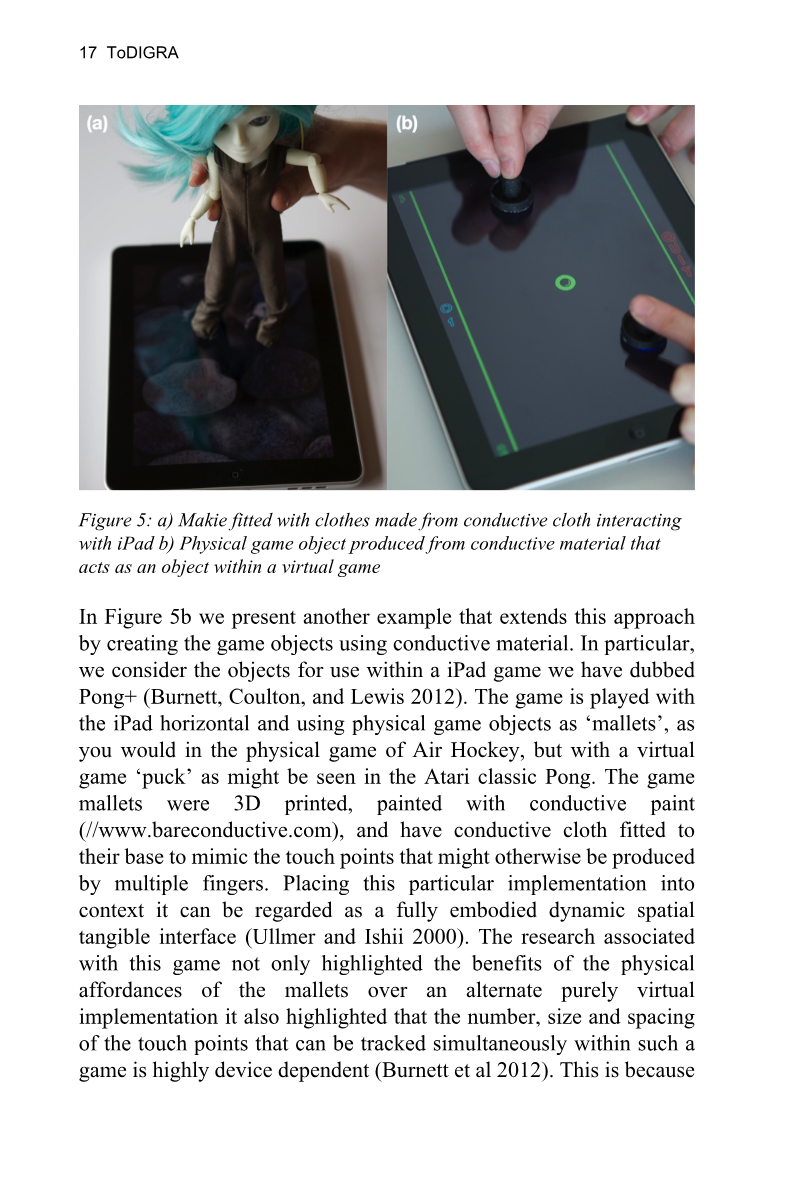
- Game design is shifting toward 'phygital' experiences that treat physical objects as active participants in the gameplay loop rather than relying solely on screen-centric conventions.
- The democratization of low-cost 3D printing and open-source platforms is enabling independent developers to create hybrid products that exist simultaneously in tangible and digital spaces.
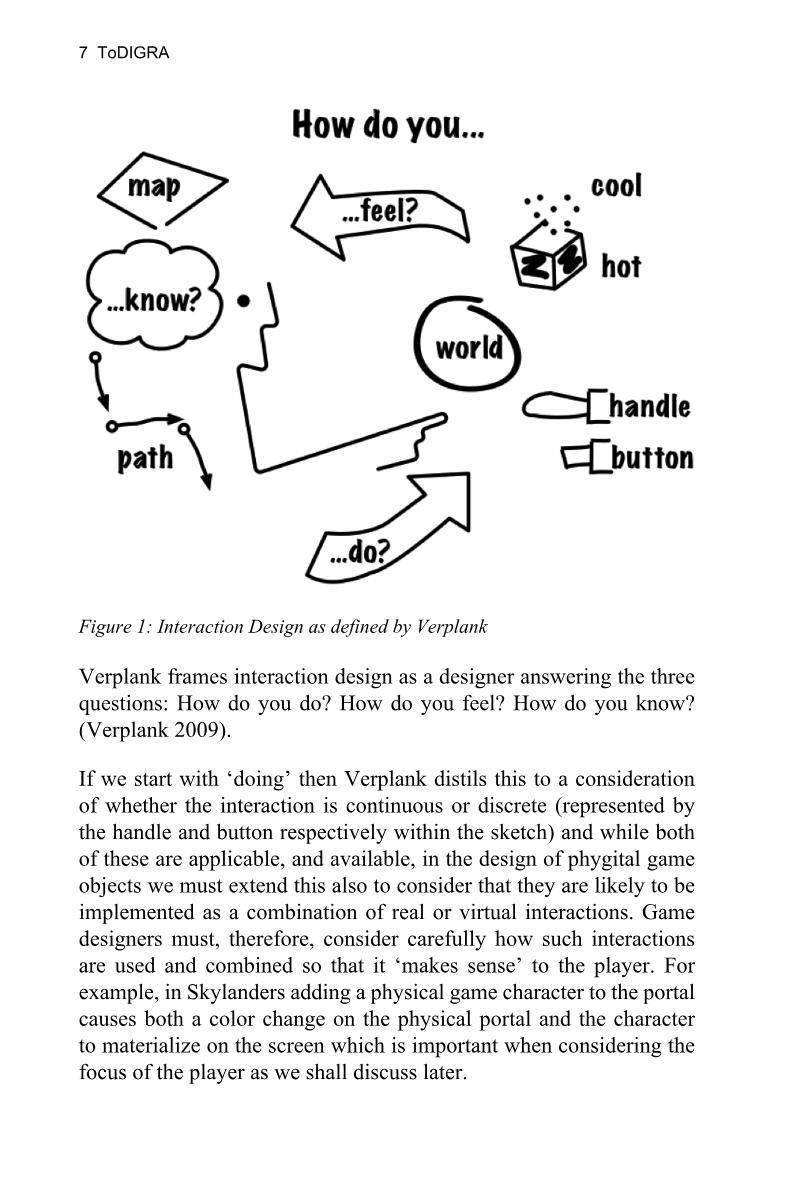
- Effective phygital design requires synthesizing product design with computer interface principles, specifically utilizing frameworks like Gaver’s affordance model to ensure intuitive interactions.

Exploring Playfulness of 3D Printers
The ludification of contemporary culture is increasingly evident through the adoption of consumer 3D printers, which function less as static manufacturing tools and more as platforms for participatory media practice.
- Consumer 3D printers like the Ultimaker Original function as platforms for participatory media rather than static manufacturing tools.
- The core value of 3D printing technology is derived from its modularity and open-source architecture, which facilitate hardware and software hacking.
- User engagement is defined by a tinkering culture that prioritizes the iterative process of customization over the creation of a final product.

Physical and Digital in Games and Play
This collection of research papers explores the evolving relationship between physical materiality and digital technology within the landscape of games and play.
- The traditional divide between analog and digital gaming is becoming obsolete as sensors, mobile connectivity, and IoT technologies create hybrid play experiences.
- Physical elements in games provide essential social and sensory cues that digital automation often fails to replicate or inadvertently diminishes.
- Designers should avoid the 'digital augmentation fallacy,' which incorrectly assumes that all physical game tasks are inefficient and require digital replacement.
In Defence of a Magic Circle: The Social, Mental and Cultural Boundaries of Play
The magic circle serves as a vital, albeit frequently misunderstood, framework for understanding the intersection of play and reality.
- The 'magic circle' is a useful metaphor for the boundary between play and non-play, but it must be analytically separated into three distinct components: the participant's psychological mindset, the socially negotiated contract of play, and the formal, pre-existing rules of the game arena.
- The 'strong-boundary hypothesis'—the idea that play is a closed, enchanted system—is often inaccurate for digital gaming, where players frequently engage in mundane, non-magical play that is deeply integrated with everyday activities like watching television.
- Play is not inherently separate from the real world; it is a social construct maintained by a 'man-made agreement' where participants collectively decide that objects and actions within the play space hold specific, transformed meanings.
Do you work at DiGRA? Get a free report of how these documents are read and cited here.