
DiGRA
The Digital Games Research Association: the international association of academics and professionals who study digital games. Its Digital Library holds the proceedings of the DiGRA conferences since 2002.
Documents
A Machine-Learned Framework for Automatic Content Generation, Evaluation, and Critique
The document outlines a proposed machine-learned framework for automatic content generation, evaluation, and critique in video games, aiming to move beyond human-authored rules and heuristics in procedural level design.
- Adam Summerville's doctoral proposal (University of California, Santa Cruz) argues that procedural level design should shift from hand-authored rules toward machine learning systems that learn from existing creative artifacts, because designers struggle to introspect and formalize their own creative reasoning.
- The proposed workflow has designers curate positive and negative examples rather than write formal constraints, and models then infer style, playability, and structure from those examples.
- The proposed end-to-end framework has three components: learning entity properties and annotating 2D levels (ideally extracted from video), training generative models that match input style while learning likely player paths, and using trained models to suggest edits, critique levels, and visualize probable player routes.
Exploration of Open Data through Procedural Content Generation
The document explores the integration of open data into procedural content generation (PCG) for games, a concept referred to as "data games."
- The core argument is that using open data in procedural content generation can make dry or difficult information more accessible, since players engage more readily with material they already know, such as their hometown or familiar public figures.
- The approach rests on a reusable two-part framework: a crawler that gathers and pre-processes data from sources like Wikipedia, DBpedia, OpenStreetMap, and Wikimedia Commons, and a parser that converts that data into game content, so the same crawled data can yield items, dialogues, or levels by swapping parsers.
- The author identifies three core challenges for data games: data acquisition, transforming data into game content, and balancing gameplay enjoyment against faithful, understandable representation of the source information.
TaleBox: A Mobile Game for Mixed-Initiative Story Creation
TaleBox is a mobile card game that lets groups of players collaboratively create stories, doubling as a mixed-initiative content generation system in which human creativity leads and computational assistance supports coherence.
- TaleBox is a mobile card game in which group players take turns appending contributions to a shared story using dealt cards, positioned as both entertainment and a mixed-initiative computational authoring system.
- Its card hand generation system tracks story progress and enforces narrative consistency by rejecting actions that contradict element states, such as deploying a dead character.
- The system draws on GluNet, an open-source knowledge base integrating VerbNet and FrameNet, to derive semantic relations and expand the story space with verbs and abstract vocabulary.
A Typology of Verbs Culled From 23,000 Videogame Walkthroughs
Verbs are central to both natural language and game analysis, where "game verbs" denote core gameplay interactions.
- The study builds a preliminary hierarchical typology of videogame verbs from 23,131 GameFAQs walkthroughs, a corpus of roughly 1.4 billion words, on the premise that walkthrough verbs proxy for core gameplay interactions.
- The method applied tf-idf weighting and part-of-speech tagging to the 1,000 most frequent verbs, grouped them into fifty k-means clusters, discarded nineteen incoherent clusters, and labeled the remainder through grounded theory; each analyzed verb occurred at least 8,467 times.
- The resulting typology has three hierarchical levels, 47 categories, and four top-level domains: Development (construction and attributes), Competition (strategy, warfare, physical combat), Movement (locomotion, acrobatics, vehicle control), and Psychosocial interactions (exploration, investigation, emotion, social relations).
Solving Belief-Driven Pathfinding Using Monte-Carlo Tree Search
The document introduces Stochastic Belief-Driven Pathfinding (SBDP), an extension of the discrete Belief-Driven Pathfinding (BDP) approach, designed to create more realistic and believable navigation for non-player characters (NPCs) in games.
- Stochastic BDP (SBDP) extends Belief-Driven Pathfinding by replacing binary open/closed states for entrances such as doors with a probability of being open, initialized at 0.5, so NPCs plan under uncertainty about the map.
- The authors frame SBDP as a special case of the Canadian Traveler Problem (a stochastic shortest-path problem with recourse) that can be reduced to a Markov Decision Process, requiring a policy covering possible outcomes rather than a single fixed path.
- Beliefs are updated through sensing, which sets an observed entrance's probability to 1 (open) or 0 (closed), and through knowledge decay, which drifts probabilities back toward 0.5 at a rate set by a decay parameter.
Adamastor: A Case Study on Generative Game Design
The document presents "Adamastor," a case study on generative game design, focusing on using Procedural Content Generation (PCG) not merely as a content creation tool but as a core element for shaping the player experience and mediating emotions like challenge and uncertainty.
- "Adamastor" is a case study of an exploration roguelike in which procedural content generation is a core experiential mechanic, not merely a tool for producing assets: the player's seed traverses a living planet whose terrain, ocean currents, and geology are reshaped by generators.
- The game uses two procedural layers: an offline generator built on pseudo-random number generators that produces layered world data such as height maps and ocean currents, and an online generator that analyses player playstyle to alter unexplored terrain, add natural or moving barriers, and manipulate how the environment is perceived.
- The design is framed around the Discovery and Challenge aesthetics of the MDA framework and draws on Smith's dynamics of searching in a vast world, building generator strategies, and practicing across different environments.
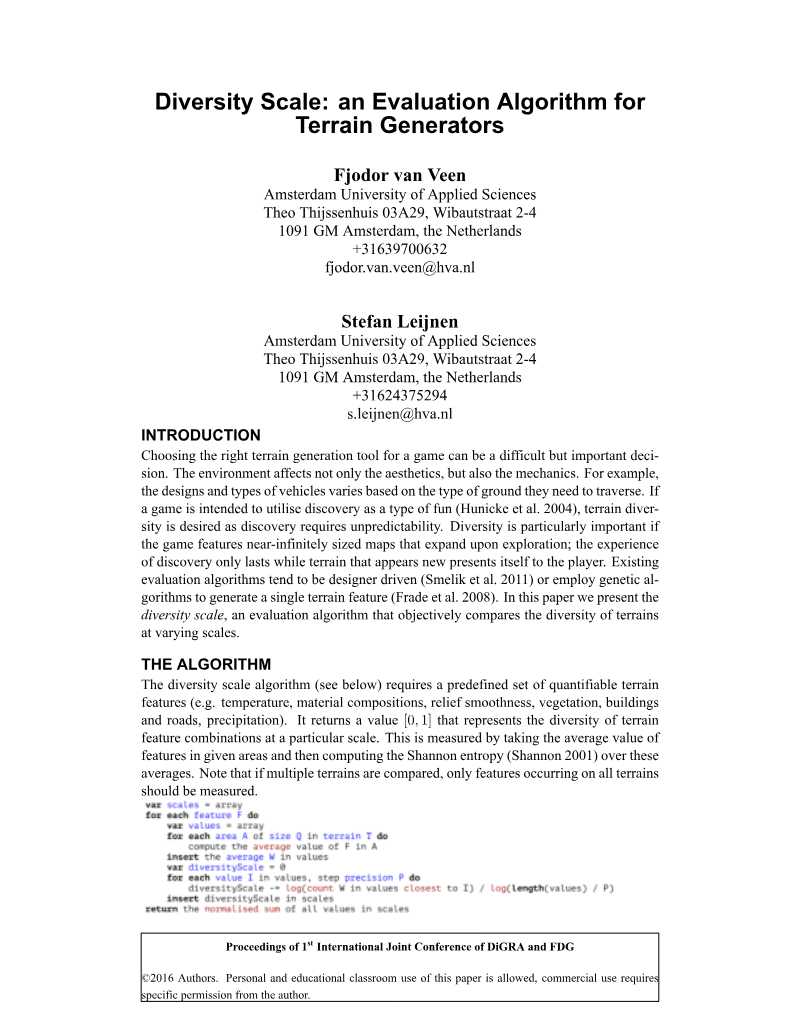
Diversity Scale: An Evaluation Algorithm for Terrain Generators
The document introduces the "diversity scale," an evaluation algorithm designed to objectively compare the diversity of terrains generated for video games.
- The Diversity Scale is an objective algorithm that returns a value between 0 and 1 measuring how diverse the feature combinations of a procedurally generated terrain are at a given area size, addressing a gap where prior approaches were designer-driven or evaluated only a single feature with genetic algorithms.
- Terrain diversity is framed as critical for games built on discovery and near-infinite maps, where the sense of exploration depends on continually encountering terrain that feels new.
- The method works by computing average values of predefined features (such as temperature, material composition, relief smoothness, vegetation, buildings and roads, and precipitation) across areas of a chosen size, applying Shannon entropy to their distributions, and aggregating per-feature results with weights reflecting each feature's importance to the game.
Why Do Players Experience Social Anxiety in a Virtual World?
This study investigates why players who self-identify as socially anxious continue to experience significant social anxiety within the virtual world of World of Warcraft (WoW), despite the common understanding that online environments can alleviate such anxiety through features like anonymity and control over self-presentation.
- Preliminary University of Oulu research examines why some socially anxious players struggle to take part in World of Warcraft, even though online anonymity and controlled self-presentation are expected to reduce social anxiety.
- Early findings identify two contributing factors: a perception of merit-based social acceptance within the player community, and stigma attached to difficulty in social interaction.
- The study is motivated by WoW's inherently cooperative gameplay and by the growing relevance of inclusive design for socially anxious users as online interaction expands into work, education, and leisure.
Digital Play, iPad Apps and Young Children's Development
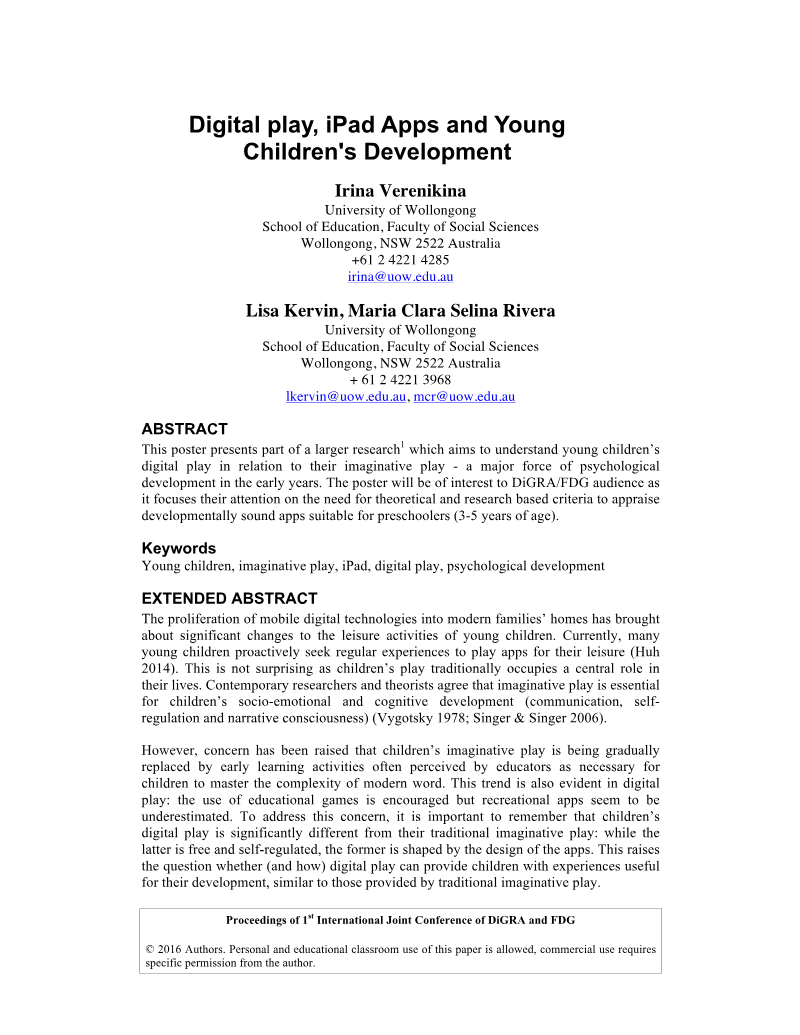
This research investigates the relationship between young children's digital play with iPad apps and their imaginative play, a critical component of early psychological development.
- The study proposes four criteria for evaluating preschooler apps: intrinsic motivation and enjoyment over goal completion, support for "as if" pretend play without right or wrong answers, discovery-oriented play involving choice and problem solving, and support for collaborative rather than solitary play.
- Digital play differs fundamentally from traditional imaginative play because it is shaped by app design, whereas traditional play is free and self-regulated.
- Recreational apps are often undervalued relative to educational apps, yet the authors argue they warrant the same research-based scrutiny for developmental soundness.
Shhh! We're Making Games in the Library and You Can Too
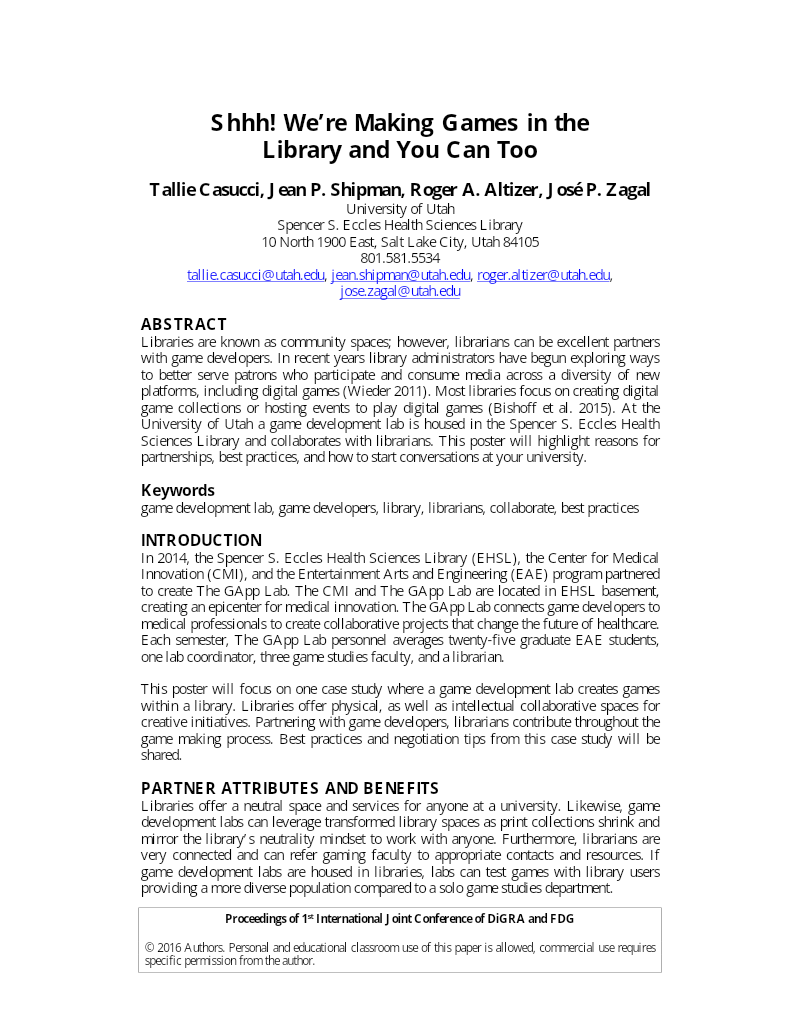
Libraries and game developers can be strong collaborators, yet most library engagement with games centers on building digital game collections or hosting play events.
- The Spencer S. Eccles Health Sciences Library at the University of Utah partnered with the Center for Medical Innovation and the Entertainment Arts and Engineering program in 2014 to create The GApp Lab, a game development lab housed in the library's basement that connects game developers with medical professionals on healthcare projects.
- Each semester the GApp Lab averages about twenty-five graduate EAE students, one lab coordinator, three game studies faculty, and a librarian.
- Libraries offer neutral, university-wide space and services, and game development labs gain access to expert searchers who can quickly locate background literature, market research, data sources, prior art, and discipline-specific knowledge for game projects.
Dark Game Design Patterns in Online Games: Exploitation, Loyalty and Engagement
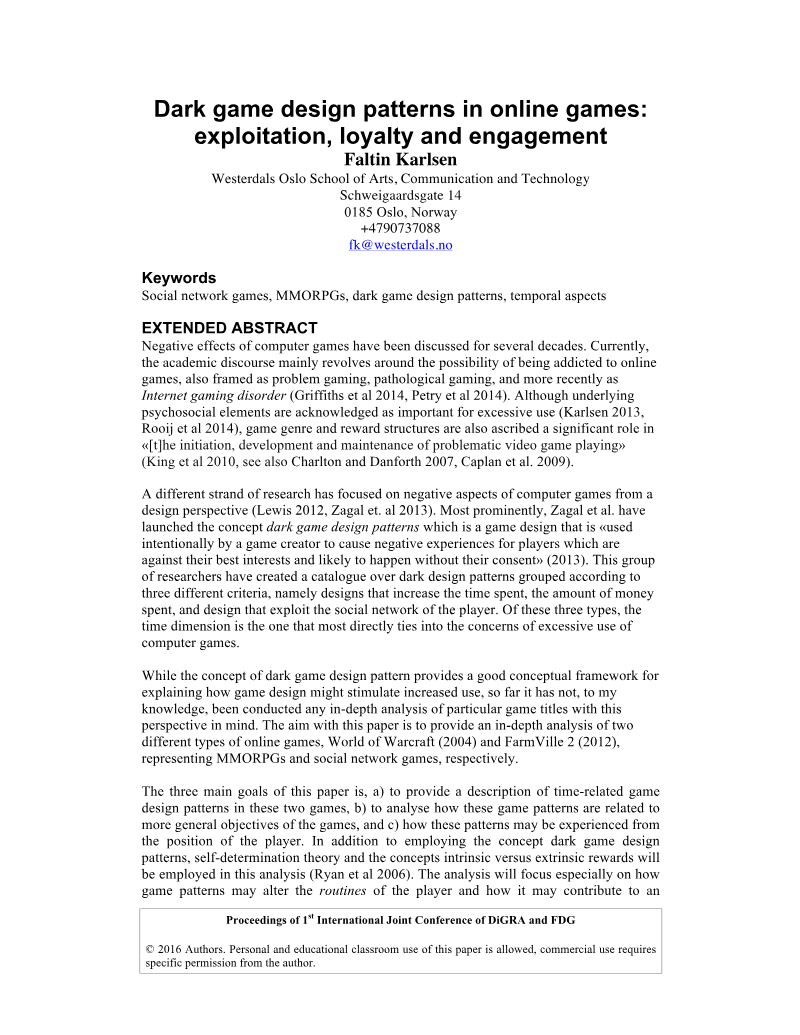
This paper investigates "dark game design patterns" in online games, focusing on how these patterns stimulate player engagement, loyalty, and time investment, rather than directly addressing problematic gaming or addiction.
- Dark game design patterns are intentional design choices that create negative experiences for players against their own interests; this paper focuses on their temporal dimension, the category most directly linked to excessive play.
- The study is a qualitative, conceptual close reading of two titles, World of Warcraft (2004, subscription MMORPG) and FarmVille 2 (2012, social game with micro-transactions), rather than based on player surveys or a large sample.
- The author does not claim these patterns cause severe detrimental effects on players; the aim is to describe how they encourage greater and more routine play across the player base.
Conceptualizing Social and Political Conflict in Games: Hegemony, Agonism and the Post-Political in Crusader Kings II, Democracy 3 and SimCity
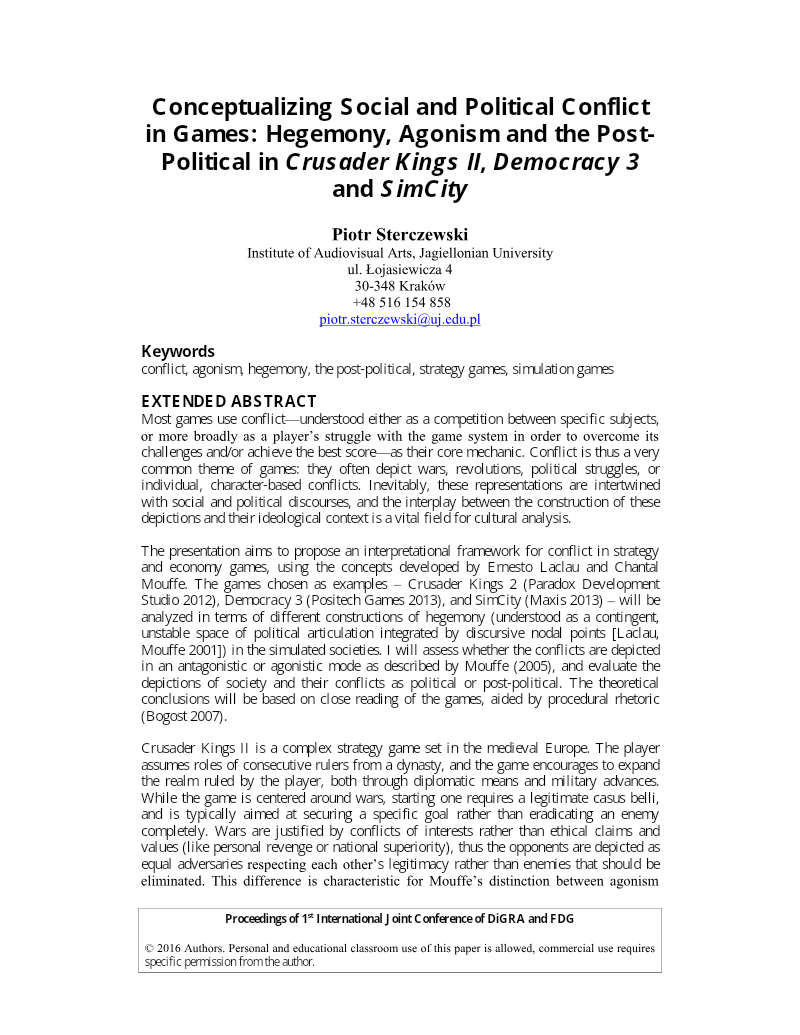
The document proposes an interpretational framework for analyzing social and political conflict in strategy and economy games, drawing on concepts from Ernesto Laclau and Chantal Mouffe, specifically hegemony, agonism, and the post-political.
- The paper proposes using Laclau and Mouffe's vocabulary to analyze how games depict social and political conflict, arguing that each game's conflict modes reveal its underlying ideological assumptions.
- The key analytical distinction is between agonistic conflict, where opponents recognize each other's legitimacy and compete within a shared framework, and antagonistic conflict, which divides society into friend and enemy.
- Crusader Kings II is read as largely agonistic because wars require a legitimate casus belli and a shared feudal order, while religious wars and non-Christian rulers in expansion content push it toward antagonism.
Do you work at DiGRA? Get a free report of how these documents are read and cited here.