1 free read left. Create a free account for unlimited reading + AI research.
Create free accountArticle DiGRA
1 free read left. Create a free account for unlimited reading + AI research.
Create free accountArticleDiGRA
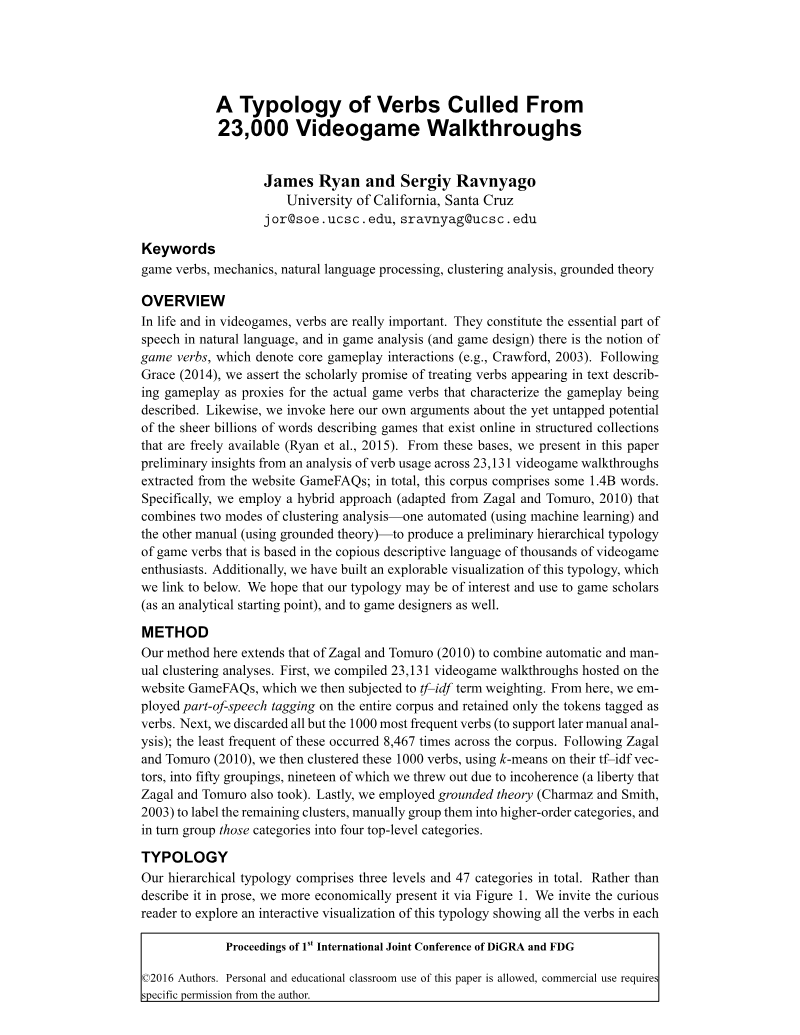
The study analyzes the language of gameplay descriptions rather than the games themselves. It draws on 23,131 GameFAQs walkthroughs.
This paper builds a preliminary hierarchical typology of videogame verbs by analyzing the language of gameplay descriptions rather than the games themselves. The authors draw on 23,131 walkthroughs from the GameFAQs website, a corpus of roughly 1.4 billion words, and argue that verbs in walkthrough text serve as reasonable proxies for the core gameplay interactions that define a game's experience. The typology is intended as an analytical starting point for game scholars and as a resource for game designers.
The method combines automated and manual clustering in a hybrid approach adapted from prior work on game aesthetics. Tf-idf weighting and part-of-speech tagging were applied to the corpus, after which the 1,000 most frequent verbs were grouped into fifty k-means clusters. Nineteen clusters were discarded for incoherence, and the remaining groupings were labeled and organized through grounded theory. The 1,000 verbs analyzed each occurred at least 8,467 times across the corpus, giving the typology a strong empirical basis in common usage.
The resulting typology has three hierarchical levels and 47 categories, grouped under four top-level domains. Among the domains are Development, which includes construction and attribute-related verbs; Competition, covering strategy, warfare, and physical combat; Movement, spanning locomotion, acrobatics, and vehicle control; and Psychosocial interactions, encompassing exploration, investigation, emotion, and social relations. Representative verbs for each category are presented in a figure, and an interactive visualization allows readers to explore the full verb assignments.
The authors position the work as preliminary and exploratory rather than definitive. Its scope is limited to English-language walkthroughs from one hosted repository, and the reliance on verb frequency and clustering means the typology reflects how players and writers describe games rather than a complete account of game mechanics. Even so, the study demonstrates the feasibility of large-scale, bottom-up analysis of game language as a complement to traditional, theory-driven game studies.

DiGRA · 2022

DiGRA · 2022



DiGRA · 2022



DiGRA · 2022

DiGRA · 2022

DiGRA · 2022



DiGRA · 2022

DiGRA · 2022

DiGRA · 2022



DiGRA · 2022



DiGRA · 2022

DiGRA · 2022












Comments