1 free read left. Create a free account for unlimited reading + AI research.
Create free accountWhitepaper DiGRA
1 free read left. Create a free account for unlimited reading + AI research.
Create free accountWhitepaperDiGRA
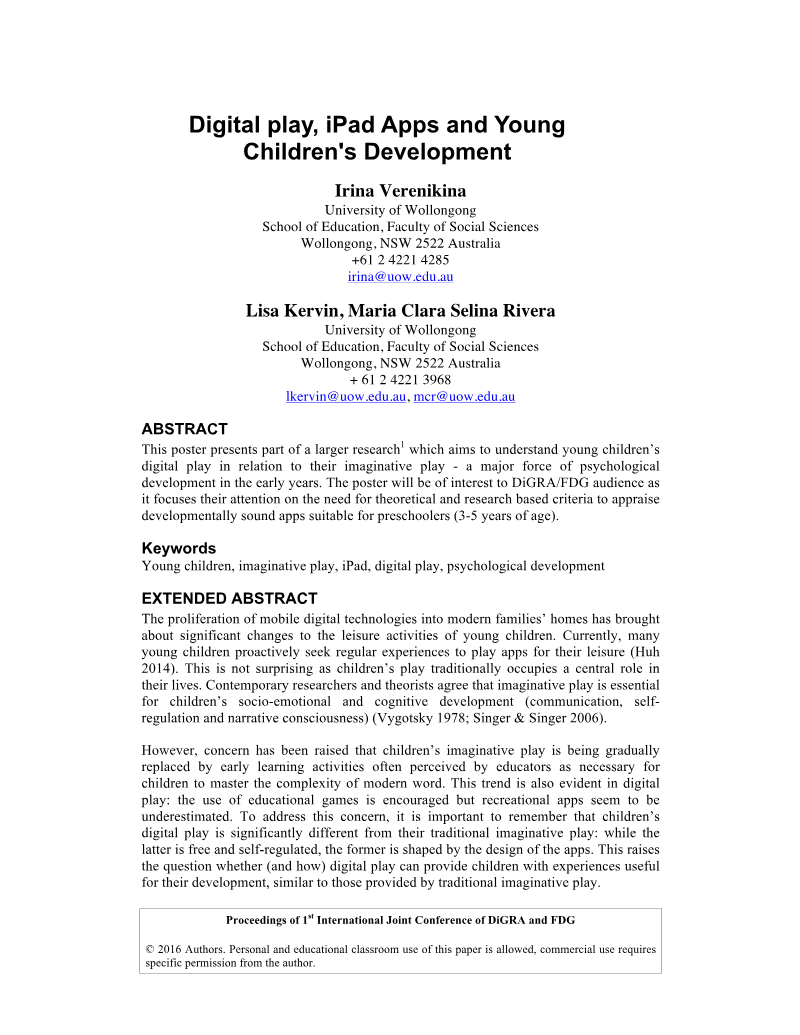
Traditional imaginative play is free and self-regulated, whereas digital play is shaped by how apps are designed.
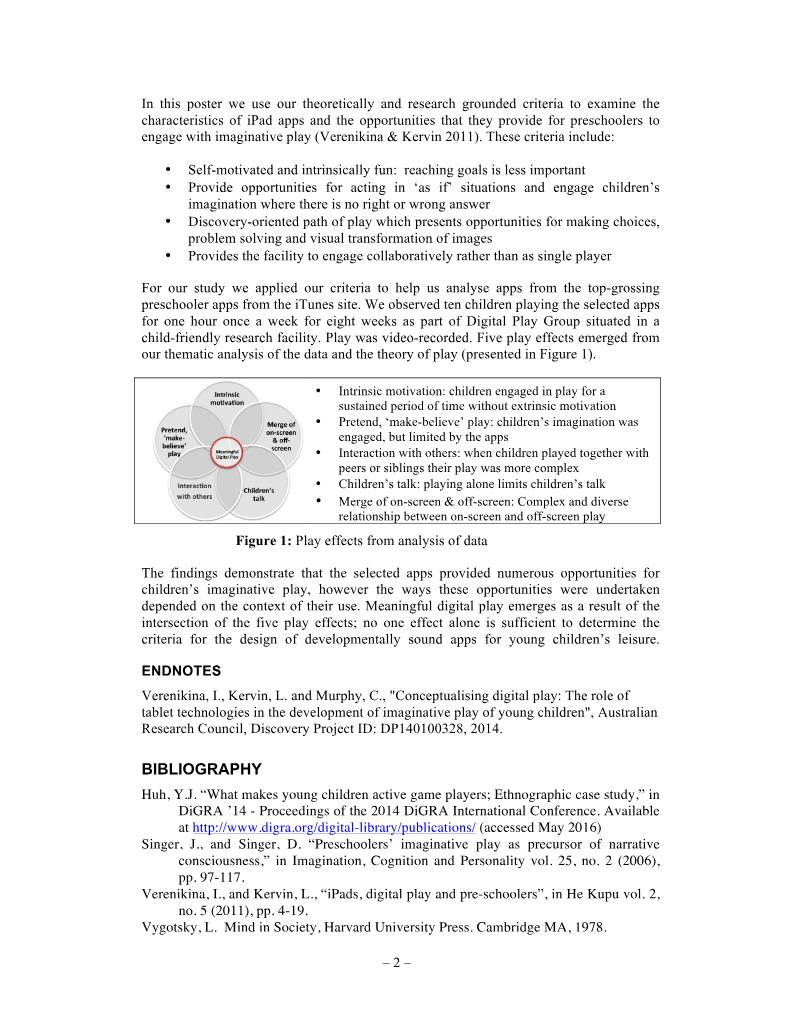
This poster from the University of Wollongong examines how iPad apps relate to imaginative play, a central driver of psychological development in preschoolers aged 3 to 5. Its core argument is that digital play differs fundamentally from traditional imaginative play: whereas the latter is free and self-regulated, digital play is shaped by app design. The authors therefore call for theoretically grounded, research-based criteria to evaluate which apps are developmentally sound, particularly recreational apps, which the authors note are often undervalued relative to educational ones.
The authors propose four criteria for assessing apps: intrinsic motivation and enjoyment over goal completion, opportunities for "as if" pretend play without right or wrong answers, discovery-oriented play involving choice, problem solving and visual transformation, and support for collaborative rather than solitary play. These criteria were applied to a sample of top-grossing preschooler apps from the iTunes store. The study observed ten children playing the apps for one hour weekly over eight weeks in a child-friendly research facility, with sessions video-recorded and analysed thematically.
Five play effects emerged from the analysis: intrinsic motivation, pretend or make-believe play, interaction with others, children's talk, and the merging of on-screen and off-screen play. The findings indicate that the apps offered numerous opportunities for imaginative play, though these were realised differently depending on context; for example, imagination was constrained by the apps themselves, and play with peers or siblings was more complex than solitary play. The authors conclude that meaningful digital play arises from the intersection of these effects, and that no single effect is sufficient on its own to define developmentally sound app design. The scale of the study is small, a limitation that the poster's exploratory framing implicitly acknowledges.

DiGRA · 2022

DiGRA · 2022



DiGRA · 2022



DiGRA · 2022

DiGRA · 2022

DiGRA · 2022



DiGRA · 2022

DiGRA · 2022

DiGRA · 2022



DiGRA · 2022



DiGRA · 2022

DiGRA · 2022
Game Developers Conference · 2026








Comments