Deconstructor of Fun
Media44 documents
Leading mobile gaming analysis publication by Michail Katkoff. Publishes weekly deep deconstructions of mobile games, market trends, and monetization analysis.
Documents

Article
Golden Mechanics: Airbuds
Airbuds, a Gen‑Z focused music social network with 1.5 million daily active users and 5 million monthly active users, has attracted $10 million in funding from a16z, SV Angel and Seven Seven Six. The app differentiates itself by harvesting listening data from Spotify and Apple Music to create time‑bound, interactive “Events” that drive daily engagement. Three core event mechanics—Live Moments, Social Games and Listening Recaps—form a layered flywheel that turns passive listening into social interaction and shareable identity.
Live Moments surface in real time through the widget, revealing “Tune Twins” when a user and a friend listen to the same track within minutes. This manufactured serendipity creates immediate emotional payoff and encourages micro‑engagement without app launches. Social Games quantify musical compatibility, producing shareable scores that act as relationship barometers and generate anticipation for weekly updates. Listening Recaps, delivered every Sunday in a “Wrapped‑style” format, transform background consumption into a ritualistic reflection that users look forward to and share on social media.
The strategy leverages existing user data, avoids disrupting listening habits, and uses widgets to deliver non‑push notifications. By layering continuous micro‑engagement (Live Moments), periodic anticipation (Social Games) and weekly rituals (Recaps), Airbuds sustains daily returns, fuels virality through shareable content, and demonstrates how event‑driven mechanics from top mobile games can be adapted to consumer music apps.
- Airbuds has secured $10 million in funding from investors including a16z, SV Angel, and Seven Seven Six to support its music social network.
- The platform currently maintains 1.5 million daily active users and 5 million monthly active users by integrating with Spotify and Apple Music.
- The app utilizes a widget-based strategy to drive engagement without requiring app launches, specifically through 'Live Moments' that notify users when friends listen to the same track.
- Weekly 'Listening Recaps' provide a ritualistic, shareable summary of user data, mirroring the viral success of Spotify Wrapped to sustain long-term retention.
- The product employs 'Social Games' to quantify musical compatibility, turning passive listening habits into competitive, shareable relationship metrics.
+2
Deconstructor of FunMay 2026
Article
What I Learned About Building Companies From the People Who Funded Mine
The article examines how Play Ventures’ founders, Henric Suuronen and Harri Manninen, shape investment decisions through lessons learned from their own startup experiences. It argues that traditional metrics—years of industry experience or a one‑year vesting cliff—are insufficient indicators of startup success. Instead, the authors emphasize team composition, co‑founder dynamics, and hunger for innovation as critical factors. The piece highlights Play’s two‑year vesting cliff as a founder filter that reveals commitment and resilience, noting that it emerged from the founders’ own venture experience rather than investor mandates. Body‑language due diligence is presented as a practical tool: investors observe co‑founders’ nonverbal cues during pitches to gauge relationship health, while low‑stakes exercises like naming a company test collaborative decision making. The article also discusses Play’s investment committee structure, which requires only two affirmative votes out of five partners, allowing contrarian bets to succeed and encouraging a culture that tolerates disagreement. Finally, it contextualizes Play’s growth from a $40 million mobile gaming fund to a $500 million multi‑fund vehicle, noting the firm’s strategic blend of gaming and consumer app expertise that creates a unique cross‑industry advantage. The narrative is grounded in anecdotal evidence from the founders’ own ventures, offering actionable insights for investors and founders alike.
- Play Ventures utilizes a two-year vesting cliff as a founder filter to test long-term commitment and resilience, a practice derived from the founders' own startup experiences rather than standard investor mandates.
- The firm employs a decision-making structure requiring only two affirmative votes out of five partners, which is designed to facilitate contrarian investments and foster a culture that tolerates internal disagreement.
- Investors at Play Ventures conduct 'body-language due diligence' by observing nonverbal cues during pitches and using low-stakes exercises, such as naming a company, to evaluate the health and collaborative dynamics of co-founder relationships.
- Traditional metrics like years of industry experience are considered insufficient indicators of success, with the firm prioritizing team composition, co-founder dynamics, and a demonstrated hunger for innovation instead.
- Play Ventures has scaled from an initial $40 million mobile gaming fund to a $500 million multi-fund vehicle by strategically blending expertise in gaming and consumer applications.
+1
Deconstructor of FunMay 2026

Article
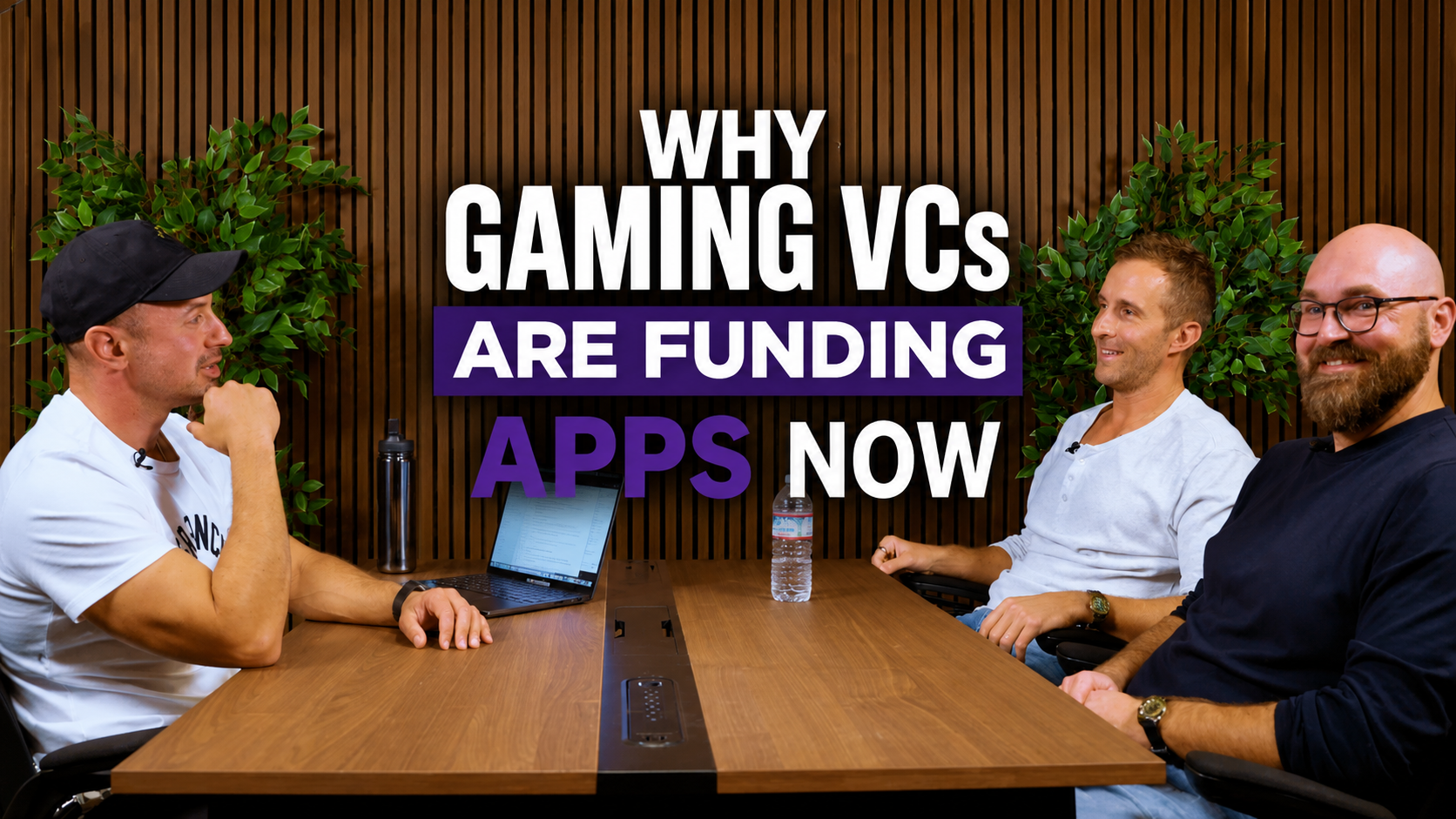
The Math That Broke Gaming VC
Gaming startup funding reached a low of $627 million in the first half of 2025, the weakest annual total in more than a decade and far below the $12.5 billion peak of 2021 or the $2.54 billion raised in all of 2024. No gaming venture round surpassed $100 million in 2025, while consumer‑app investors poured capital into high‑growth platforms: a16z launched a $15 billion Apps Fund in January 2026, and L Catterton raised $11 billion across strategies in 2025. The shift reflects two structural problems for mobile gaming after 2022: consolidation of acquirers (Zynga, Activision Blizzard, King) reduced exit opportunities, and Apple’s IDFA deprecation crippled targeted user acquisition, raising marketing costs and shortening revenue cycles. Venture‑fund math now requires a $1 billion company to generate $300–$700 million in revenue for a 10% stake, but the market lacks sufficient independent studios to reach such valuations. In contrast, consumer apps demonstrate predictable recurring revenue and higher multiples: Duolingo trades at 17× forward revenue, Noom at 6×, and Strava targets a $3 billion IPO. These apps benefit from subscription models that deliver long‑term LTV, broader market appeal, and investor perception of utility rather than content. While gaming VC still funds AI‑powered development tools ($1.8 billion over five years), the studio thesis has largely shifted to “picks and shovels.” The capital, exits, and valuation multiples now favor consumer‑app companies that leverage gaming‑derived engagement expertise.
- Gaming startup funding collapsed to $627 million in H1 2025, marking the lowest total in over a decade and a sharp decline from the $12.5 billion peak in 2021.
- The venture capital model for gaming is broken because the market lacks independent studios capable of reaching the $300–$700 million in annual revenue required to justify a $1 billion valuation for a 10% stake.
- Structural headwinds, specifically the consolidation of major acquirers like Activision Blizzard and Apple’s IDFA deprecation, have crippled targeted user acquisition and reduced viable exit opportunities.
- Capital has shifted toward consumer apps that offer predictable recurring revenue and higher valuation multiples, such as Duolingo (17x forward revenue) and Noom (6x).
- Investment firms are prioritizing high-growth platforms over traditional studios, evidenced by a16z launching a $15 billion Apps Fund in 2026 and L Catterton raising $11 billion in 2025.
+2
Deconstructor of FunMay 2026
Article
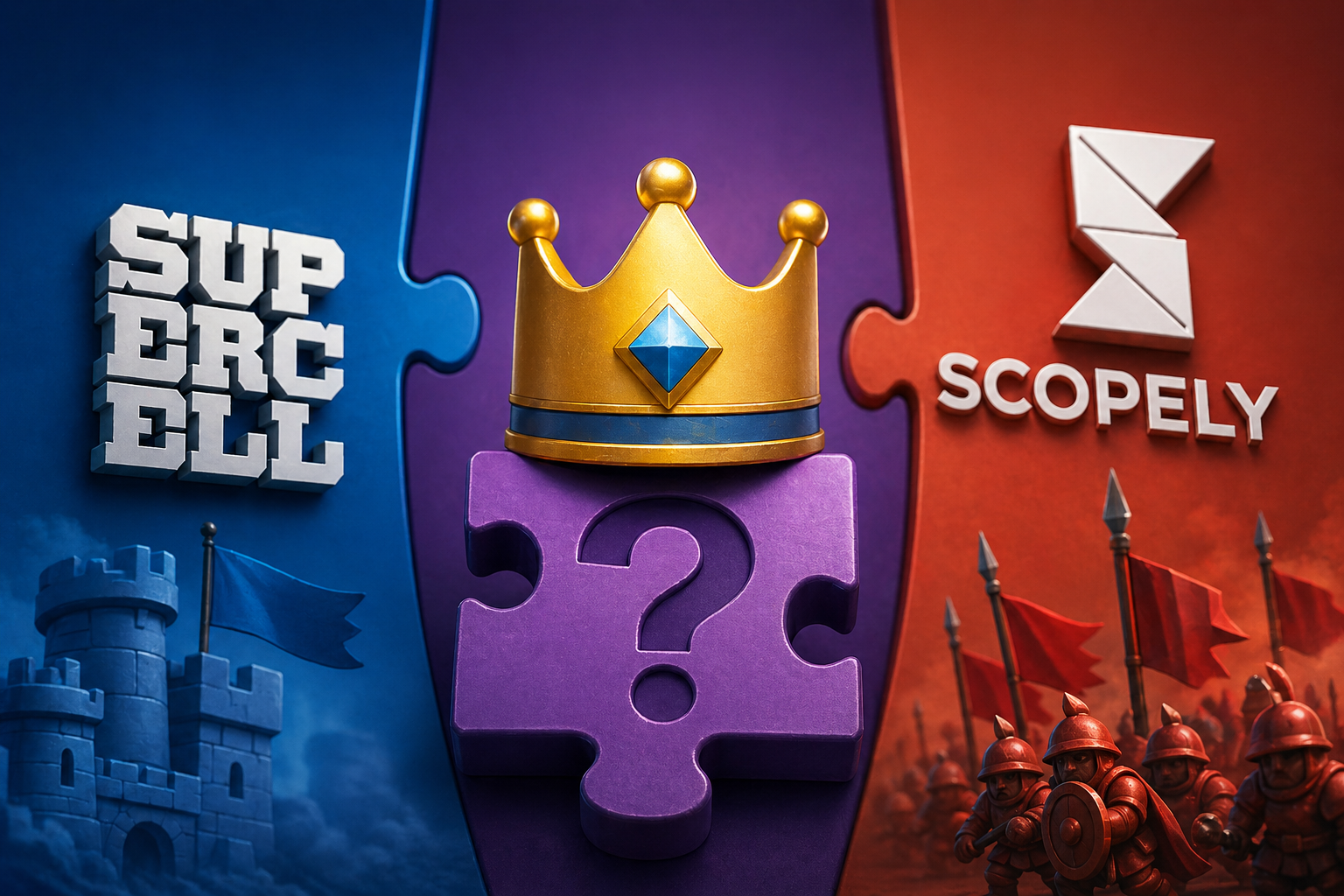
Supercell's Puzzling Gamble, Scopely’s War on Clones, and the Royal Kingdom Problem
The article examines current dynamics in the mobile puzzle market, focusing on three high‑profile cases. Turkish developers continue to secure significant funding—Vento Games raised a $4 million seed round in Istanbul and Cheer Games secured a $4.5 million pre‑seed round in Barcelona—both led by Makers Fund and backed by investors familiar with the Turkish casual puzzle talent pool that has historically produced globally downloaded titles. The piece highlights how this talent spill‑over is attracting venture capital across Europe and the United States, underscoring a geographic shift in puzzle development.
Supercell’s latest venture, Hay Day Match, represents an IP‑driven gamble in the Match‑3 segment. The studio is leveraging the Hay Day brand to lower user acquisition costs in a category where CPI exceeds $30 per user. The article notes that while IP can attract an existing fan base, the Match‑3 market remains highly competitive and monetization success is uncertain without a differentiated core mechanic.
Scopely’s strategic acquisition of Loom Games and the subsequent removal of the clone Color Blaze Shooter illustrate a market‑level enforcement tactic rather than regulatory change. The move signals that one‑to‑one clones can be eliminated through asset acquisition, but the broader clone ecosystem—particularly successful hybrids like Color Block Jam—continues to thrive.
Finally, Royal Kingdom’s 2025 revenue surpassed $300 million and its monthly earnings exceeded $30 million in early 2026, driven by a celebrity marketing push. However, the analysis points out a monetization gap: Royal Kingdom’s $12 per‑download revenue is markedly lower than its sister title, Royal Match’s $45 per download. This suggests potential cannibalization and a need for deeper retention strategies as the game matures beyond initial marketing spikes.
- Royal Kingdom reached over $300 million in revenue by 2025 and exceeded $30 million in monthly earnings by early 2026, yet its $12 revenue-per-download significantly trails the $45 per-download performance of its predecessor, Royal Match.
- Supercell is utilizing the Hay Day IP to mitigate high user acquisition costs in the Match-3 market, where customer acquisition costs currently exceed $30 per user.
- Venture capital investment is increasingly flowing into European puzzle developers, evidenced by recent seed and pre-seed rounds of $4 million for Vento Games and $4.5 million for Cheer Games.
- Scopely is actively suppressing market competition by acquiring studios like Loom Games to remove direct clones, though this strategy has not impacted the broader ecosystem of successful hybrid-genre titles.
- The mobile puzzle sector is experiencing a geographic shift in talent and development, with investors increasingly targeting established hubs in Turkey and Europe to replicate past global successes.
+3
Deconstructor of FunApr 2026

Article
Gaming Lost Another VC. Don't Be Surprised
The departure of experienced founders from the venture capital sector highlights a fundamental misalignment between the operational instincts of builders and the structural demands of fund management. Through the lens of Joakim Achren’s transition from a successful gaming entrepreneur to a venture capitalist and back to a builder, the analysis illustrates that while founder experience is valuable, it is insufficient for long-term success in venture capital. The core thesis posits that the role of a general partner is primarily defined by the management of limited partner (LP) relationships and fundraising, rather than the mentorship of portfolio companies.
Key findings indicate that the venture capital landscape for gaming has cooled significantly since the pandemic, as evidenced by data from Aream and InvestGame. With over 40 gaming-focused funds established during the COVID-19 era, the market has reached a saturation point where exit multiples often fail to justify the risk for new capital allocators. Consequently, the job of a general partner has become increasingly difficult, requiring a disproportionate amount of time—often exceeding 50%—dedicated to fundraising and managing LP expectations rather than engaging in the creative, hands-on work that defines the builder experience.
The analysis concludes that the decision to exit venture capital is often a rational response to these structural realities. For founders, the allure of emerging platform shifts, such as the current advancements in artificial intelligence, frequently outweighs the administrative and financial constraints of managing a micro-fund. Ultimately, the transition serves as a reminder that venture capital requires a distinct set of priorities focused on capital allocation and institutional trust, which may conflict with the intrinsic motivations of those driven to build products and solve problems directly.
- The role of a venture capital general partner is fundamentally misaligned with the builder mindset, as it requires dedicating over 50% of time to fundraising and managing limited partner expectations rather than mentoring portfolio companies.
- The gaming venture capital market is currently over-saturated, following the establishment of over 40 gaming-focused funds during the COVID-19 pandemic.
- Exit multiples in the current gaming market have failed to justify the risk for new capital allocators, leading to a significant cooling of the sector according to data from Aream and InvestGame.
- Experienced founders often exit venture capital because the administrative and financial constraints of managing a micro-fund conflict with their intrinsic motivation to build products.
- Emerging platform shifts, such as advancements in artificial intelligence, are drawing experienced talent away from venture capital and back into operational builder roles.
+1
Deconstructor of FunApr 2026

Article
Newzoo's Inflection Point Report: Three Things Worth Arguing About
The 2026 PC and Console market analysis identifies a critical inflection point characterized by a "winner-take-more" dynamic within a stagnant engagement environment. While total revenue has increased, aggregate playtime across major platforms remained flat or declined, suggesting that growth is increasingly concentrated among the top 20 franchises. The analysis covers global PC and console markets, excluding Nintendo and certain Asian regions, and relies on proprietary industry data to evaluate shifting consumer behaviors and monetization models.
A primary finding is the dominance of Roblox, which has emerged as the leading franchise on PC and console. Data indicates that Roblox and similar sandbox titles are not acting as a gateway to traditional AAA gaming; rather, they capture and retain younger audiences who exhibit little interest in migrating to premium narrative-driven experiences. Consequently, the long-held industry assumption that younger players will eventually graduate to mid-core or AAA titles is unsupported by current engagement trends.
The analysis also highlights a divergence in monetization strategies. While free-to-play (F2P) revenue per hour has grown on PC, it has declined on consoles, where premium live-service titles are increasingly capturing player spending. Furthermore, the rise of the $30–$50 price band represents a strategic shift for developers lacking established franchise leverage. Rather than a purely organic renaissance, this pricing tier is a tactical response to market saturation, where developers lower entry costs to drive conversion while relying on live-service mechanics to monetize the remaining player base. Ultimately, the data suggests that the market is becoming increasingly bifurcated, favoring established giants while creating a high-risk environment for new, unproven intellectual property.
- The PC and console market is experiencing a 'winner-take-more' dynamic where total revenue growth is increasingly concentrated within the top 20 franchises while aggregate playtime remains stagnant or in decline.
- Roblox has emerged as the leading franchise on PC and console, effectively capturing younger audiences who show no inclination to migrate toward traditional premium, narrative-driven AAA titles.
- The industry's long-held assumption that younger players will eventually transition from sandbox titles to mid-core or AAA gaming is unsupported by current engagement data.
- A strategic shift is occurring in the $30–$50 price band, where developers are lowering entry costs to combat market saturation while relying on live-service mechanics for long-term monetization.
- Monetization performance is diverging by platform, with revenue per hour for free-to-play titles increasing on PC but declining on consoles as premium live-service games capture more player spending.
+1
Deconstructor of FunApr 2026

Article
How to Build a Real Business on Roblox in 2026
Building a sustainable business on Roblox in 2026 requires a fundamental shift in strategy, moving away from traditional game development paradigms toward a model defined by extreme agility and platform-native optimization. The core thesis is that Roblox is not merely a distribution channel but a unique ecosystem where success is driven by algorithmic discovery rather than traditional user acquisition. Studios must prioritize rapid iteration, community engagement, and deep integration with the platform’s specific performance metrics to thrive.
Key findings emphasize that speed is the primary business model. Successful studios, often operating with lean teams of 10 to 15 people, leverage the platform’s infrastructure to bypass traditional production bottlenecks like multi-platform deployment and backend scaling. Development cycles have compressed significantly, with top-tier studios now launching core loops in five to eight weeks and maintaining momentum through weekly updates. This cadence is essential because the platform’s discovery algorithm rewards specific engagement signals, including qualified playthroughs, retention rates, and session value, rather than infinite playtime.
Methodologically, these insights are derived from expert consultations with Roblox leadership and high-performing studios, such as the team behind SpongeBob Tower Defense. The analysis highlights that Roblox is no longer a platform exclusively for children, as evidenced by titles with significant 18+ demographics. Consequently, developers must abandon "professional" instincts that prioritize polish over speed and control over community feedback. Instead, operators are encouraged to adopt a "white belt" mindset, respecting the platform’s unique social fabric and SEO-like discovery mechanics. Ultimately, the most successful studios are those that treat content as a compounding asset, allowing the algorithm to drive organic growth while utilizing paid advertising only as a secondary tool for bootstrapping.
- Success on Roblox in 2026 is driven by algorithmic discovery, requiring studios to prioritize engagement signals like qualified playthroughs and retention rates over traditional user acquisition.
- Speed is the primary business model, with top-tier studios launching core loops in five to eight weeks and maintaining momentum through weekly updates.
- Lean teams of 10 to 15 people are the industry standard, leveraging Roblox’s infrastructure to bypass traditional production bottlenecks like backend scaling and multi-platform deployment.
- Developers must abandon traditional polish-focused instincts in favor of a 'white belt' mindset that prioritizes rapid iteration and deep integration with the platform’s social fabric.
- Roblox is no longer exclusively for children, as evidenced by the emergence of titles with significant 18+ demographics.
+3
Deconstructor of FunApr 2026

Article
How Wellness App Finch Uses Gamified Widgets to Drive Retention
The mental wellness application Finch leverages gamified home screen widgets as a primary retention strategy to maintain high user engagement. By utilizing a Tamagotchi-inspired model, the app creates a persistent, evolving connection between the user and their virtual pet. This approach has proven highly effective, with the app achieving an estimated 10 million monthly active users and strong retention metrics, specifically 54% for Day 1 and 37% for Day 7, which outperform several leading consumer applications.
The core strategy relies on four distinct widget mechanics designed to foster emotional investment and habit formation. First, the widget provides a "living pet" experience, displaying personalized, real-time states of the user's pet to create a sense of continuous presence. Second, the app integrates "appointment mechanics" through timer-gated adventures, which encourage users to return at specific intervals to collect rewards. Third, a visual progress bar simplifies complex self-care goals into concrete, actionable steps. Finally, the app employs "micro-events" that align with natural daily rhythms, such as morning check-ins and evening reflections, to drive curiosity-based engagement rather than relying on intrusive push notifications.
These findings suggest that widgets serve as a critical, underutilized re-engagement channel that functions effectively alongside traditional lifecycle marketing tools. By designing for continuous value rather than static snapshots, developers can maintain a presence on the user's home screen, effectively lowering the impact of high customer acquisition costs. The analysis concludes that successful widget integration requires clear visual objectives, event-driven hooks, and a design philosophy that prioritizes passive, curiosity-driven interaction over constant, forced notifications.
- Finch achieves high user retention through a Tamagotchi-inspired model, reporting 54% Day 1 and 37% Day 7 retention rates with 10 million monthly active users.
- The app uses four specific widget mechanics—living pet states, timer-gated adventures, visual progress bars, and micro-events—to drive consistent user engagement.
- Timer-gated 'appointment mechanics' encourage repeat visits by requiring users to return at specific intervals to collect rewards.
- Micro-events aligned with natural daily rhythms, such as morning check-ins and evening reflections, serve as effective alternatives to intrusive push notifications.
- Home screen widgets function as a critical re-engagement channel that helps developers lower the impact of high customer acquisition costs.
+1
Deconstructor of FunMar 2026

Article
The Making of Match 3D
The Match 3D subgenre has evolved from a hypercasual novelty into a significant casual puzzle category, generating over $1 billion in in-app purchase (IAP) revenue. The market is currently characterized by a duopoly, with Triple Match 3D and Match Factory accounting for approximately 70% of total IAP earnings. This analysis examines the transition of the mechanic from its origins as a simple, timer-based hypercasual toy to a sophisticated casual puzzle experience defined by strategic depth and long-term retention.
The subgenre’s development is marked by three distinct phases. Initially, the original Match 3D title established the core tactile loop of clearing cluttered 3D piles. Subsequently, Triple Match 3D transformed the category by introducing tap-based controls and a multi-slot dock system, shifting the primary challenge from time-based pressure to spatial management. Finally, Match Factory achieved market dominance by applying high-level production values and refined, authored level design, which created a more cohesive progression funnel compared to the randomized nature of its predecessors.
The current landscape suggests that the category remains under-developed, as market leadership has been defined by a limited number of iterative improvements rather than fundamental innovation. Future success in this space likely requires a shift toward more classical puzzle design, incorporating deliberate level layouts, complex obstacle systems, and sophisticated difficulty curves. By moving beyond simple content wrappers and addressing the inherent chaos of 3D physics with structured, authored challenges, developers may find opportunities to disrupt the existing market hierarchy.
- The Match 3D subgenre has generated over $1 billion in total in-app purchase (IAP) revenue.
- The market is currently a duopoly, with Triple Match 3D and Match Factory capturing approximately 70% of total IAP earnings.
- The category evolved from timer-based hypercasual mechanics to a casual puzzle model defined by spatial management and multi-slot dock systems.
- Market dominance has been driven by high production values and authored level design, which replaced the randomized, chaotic physics of earlier titles.
- The current market is considered underdeveloped, as leadership is based on iterative improvements rather than fundamental innovation.
+3
Deconstructor of FunMar 2026

Article
The UA System the Platforms Can't Build for You
The mobile gaming industry faces a structural misalignment between ad networks, which optimize for short-term proxy metrics, and publishers, who rely on long-term user value. Because ad networks typically observe performance within a 7-to-28-day window, they are ill-equipped to value the multi-year relationships inherent in mobile games. This creates a critical gap in user acquisition (UA) strategy that studios must bridge internally to capture margin and achieve sustainable growth.
To address this, studios must implement a translation layer that maps business objectives—such as total dollar yield versus capital efficiency—to specific, network-level ROAS targets. This requires moving beyond simple reporting to a sophisticated measurement architecture that tracks cohort maturation and incrementality. A successful growth system relies on five core properties: signal clarity, low latency between data and action, high-frequency course correction, effective translation of data into actionable insights, and a closed-loop workflow that forces accountability between projections and actual outcomes.
Creative production serves as the highest-frequency input in this system. As networks increasingly automate baseline creative generation, competitive advantage shifts to production velocity and the ability to test numerous variants to isolate performance drivers. Studios that treat creative as a rigorous production system rather than a craft will outperform peers by identifying breakout formats before the market replicates them.
The organizational structure for modern growth teams must evolve to support these systems. As spend scales from $500,000 to over $25 million monthly, teams must transition from media-buying units to cross-functional systems teams. This structure integrates UA, creative, and data functions, ensuring that product, retention, and monetization insights continuously recalibrate acquisition targets. Ultimately, the growth function must extend beyond the install, engineering the entire user journey to maximize long-term value.
- Studios must build an internal translation layer to map long-term business objectives to network-level ROAS targets, as ad networks are structurally limited by 7-to-28-day optimization windows.
- Modern growth teams must transition from media-buying units to cross-functional systems teams as monthly spend scales from $500,000 to over $25 million.
- Competitive advantage in creative strategy now relies on production velocity and rigorous testing systems rather than individual craft, allowing studios to identify breakout formats before they are replicated.
- A sustainable growth architecture requires five core properties: signal clarity, low latency, high-frequency course correction, actionable data translation, and a closed-loop workflow that enforces accountability between projections and actual outcomes.
- The growth function must extend beyond the initial install to engineer the entire user journey, ensuring that product, retention, and monetization insights continuously recalibrate acquisition targets.
+2
Deconstructor of FunMar 2026

Article
Google Play's Rate Cuts: Who Actually Won
The settlement between Epic Games and Google, following years of antitrust litigation, has resulted in a restructured fee schedule for the Google Play Store that is less transformative than initial headlines suggested. While the standard in-app purchase commission for new installs has been reduced to 20%, existing installs remain subject to a 25% fee, effectively reaching 30% when combined with mandatory Google Play Billing. To access a lower 15% rate, developers must participate in the Level Up program, which requires the integration of specific Google services, including cloud saves, achievements, and an AI-powered sidekick.
The analysis characterizes the outcome as a Pyrrhic victory for Epic Games. Although the litigation successfully forced the removal of obstructive sideloading friction and established a more open Android ecosystem, the core duopoly remains intact. Major publishers are unlikely to abandon their established web-based monetization strategies, as the cost savings of direct-to-consumer channels continue to outweigh the benefits of the adjusted platform fees. Furthermore, the settlement imposes significant constraints on Epic’s leadership, effectively silencing public criticism of Google for a decade.
The broader industry impact remains nuanced. While small developers previously benefited from earlier rate cuts on the first $1 million in annual earnings, the current settlement primarily serves to provide Google with regulatory breathing room. Conversely, the reduction in friction for alternative payment methods may benefit third-party web shop providers. Ultimately, the shift in fee structures is expected to marginally improve lifetime value for publishers, potentially fueling increased user acquisition budgets and creating a rising-tide effect for ad-monetized games, even as the platforms retain significant control over the mobile ecosystem.
- The Google Play fee structure remains high, with a 20% commission for new installs and 25% for existing ones, effectively totaling 30% when combined with mandatory Google Play Billing.
- Developers can access a reduced 15% rate only by joining the 'Level Up' program, which mandates the integration of specific Google services like cloud saves, achievements, and an AI-powered sidekick.
- The settlement includes a non-disparagement clause that silences Epic Games from publicly criticizing Google for a decade.
- Major publishers are expected to maintain existing web-based monetization strategies, as direct-to-consumer channels remain more cost-effective than the adjusted platform fee structures.
- While the litigation successfully reduced sideloading friction, the core mobile duopoly remains intact, and the settlement primarily serves to provide Google with regulatory relief.
+1
Deconstructor of FunMar 2026

Article
GDC 2026 Post-Mortem
The GDC 2026 post-mortem provides an analytical overview of the state of the global gaming industry, characterizing the current market mood as one of cautious resignation. Despite a significant contraction in conference attendance—which fell to levels not seen since 2012—the event maintained high value for industry leaders. The primary thesis suggests that while the traditional convention floor has shrunk due to geopolitical tensions and industry downsizing, the concentration of high-level decision-makers remains unparalleled, making the event’s side-channel networking more critical than its formal programming.
Key findings highlight a stark divide between public optimism and private industry reality. Artificial intelligence emerged as the dominant topic, with a notable shift in focus from game development to back-office operational efficiency and process automation. AI-native development teams are increasingly viewed as a disruptive force, rendering traditional, high-budget studio models obsolete by producing comparable demos in significantly less time. Furthermore, the venture capital landscape for gaming has largely collapsed, with generalist funds exiting the sector. Capital is now primarily restricted to specific regions like Turkey, Israel, and Vietnam, and is increasingly directed toward AI-native founders or those pivoting to tools and apps rather than traditional game production.
The analysis also identifies a significant evolution in the perception of the Roblox ecosystem. It is no longer viewed as a peripheral marketing channel but as a sophisticated development platform where professional, adult-led studios are building canonical franchise experiences for major intellectual properties. Additionally, the industry is navigating rumors of potential large-scale mergers, such as a hypothetical acquisition of Xbox by Netflix, while Chinese publishers are expressing quiet concern regarding their own market dominance and the associated risks of regulatory scrutiny in Western territories.
- GDC 2026 attendance fell to its lowest level since 2012, shifting the event's primary value from formal programming to high-level networking among decision-makers.
- AI integration has shifted from game development to back-office operational efficiency, with AI-native teams now producing high-quality demos faster than traditional, high-budget studio models.
- Venture capital for gaming has largely collapsed, with remaining funding restricted to specific regions like Turkey, Israel, and Vietnam and prioritized for AI-native founders or tool-based applications.
- The Roblox ecosystem has transitioned into a professional development platform where adult-led studios are creating canonical franchise experiences for major intellectual properties.
- Market speculation includes potential large-scale industry consolidation, such as a hypothetical acquisition of Xbox by Netflix.
+1
Deconstructor of FunMar 2026