Europe reports and market data
Documents

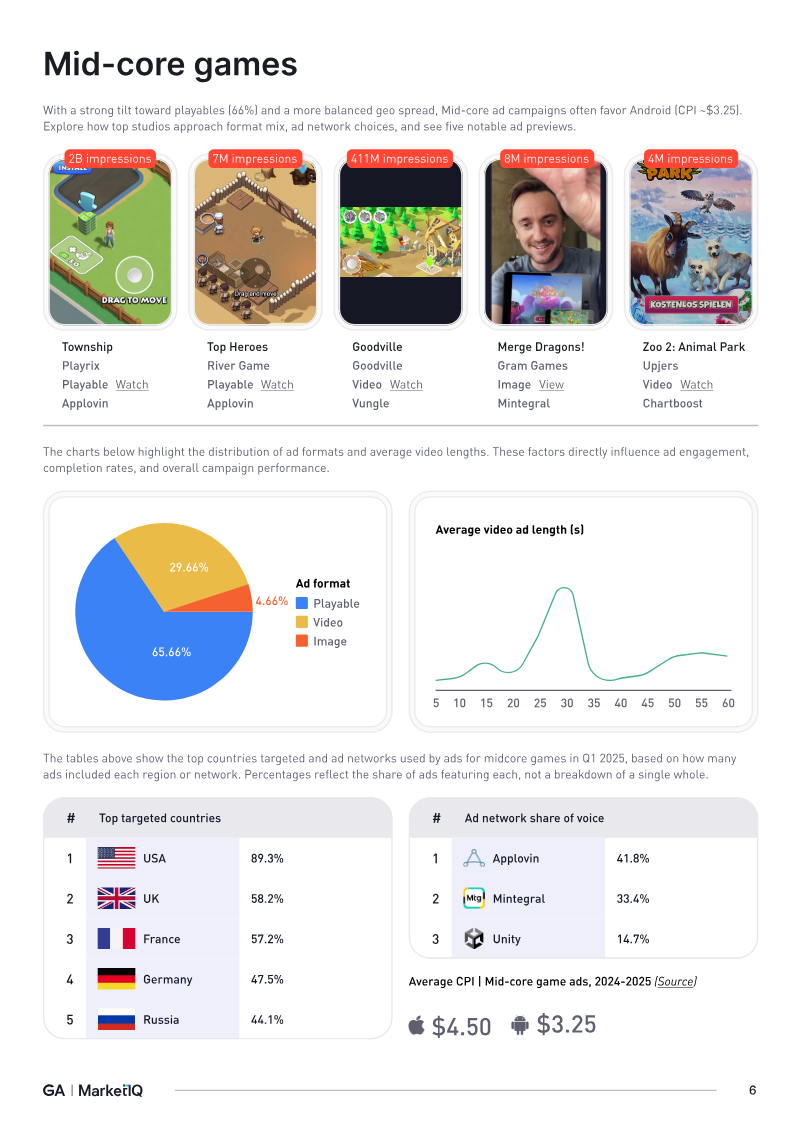
The Q1 2025 Gaming Ad Snapshot: North America and Europe
The Q1 2025 Gaming Ad Snapshot provides a data-driven analysis of mobile advertising strategies across North America and Europe, focusing on how top-performing studios tailor creative approaches by genre.
- User acquisition costs are rising, with iOS benchmarks hitting approximately $5 for Casual titles and exceeding $6 for Hardcore games in Q1 2025.
- Hyper-casual games rely heavily on playable ad formats, which constitute 83% of their total creative output.
- Hardcore games prioritize high-fidelity video content, which accounts for 56% of their advertising creative.


Wyniki Finansowe 3Q25
This financial analysis details the third-quarter 2025 performance of PCF Group S.A. (People Can Fly), a global game development studio.
- PCF Group S.A. reported a net loss of 117 million PLN for the first nine months of 2025, a significant increase from the 33.3 million PLN loss recorded in the same period of 2024.
- A 92 million PLN write-down for the project 'Lost Rift' (Victoria) following its September 25, 2025, Early Access launch was the primary driver of the group's financial deficit.
- Despite the net loss, total revenue grew to 152.1 million PLN in the first nine months of 2025, up from 131.9 million PLN in 2024, driven by work-for-hire projects including Delta, Zulu, and Echo.
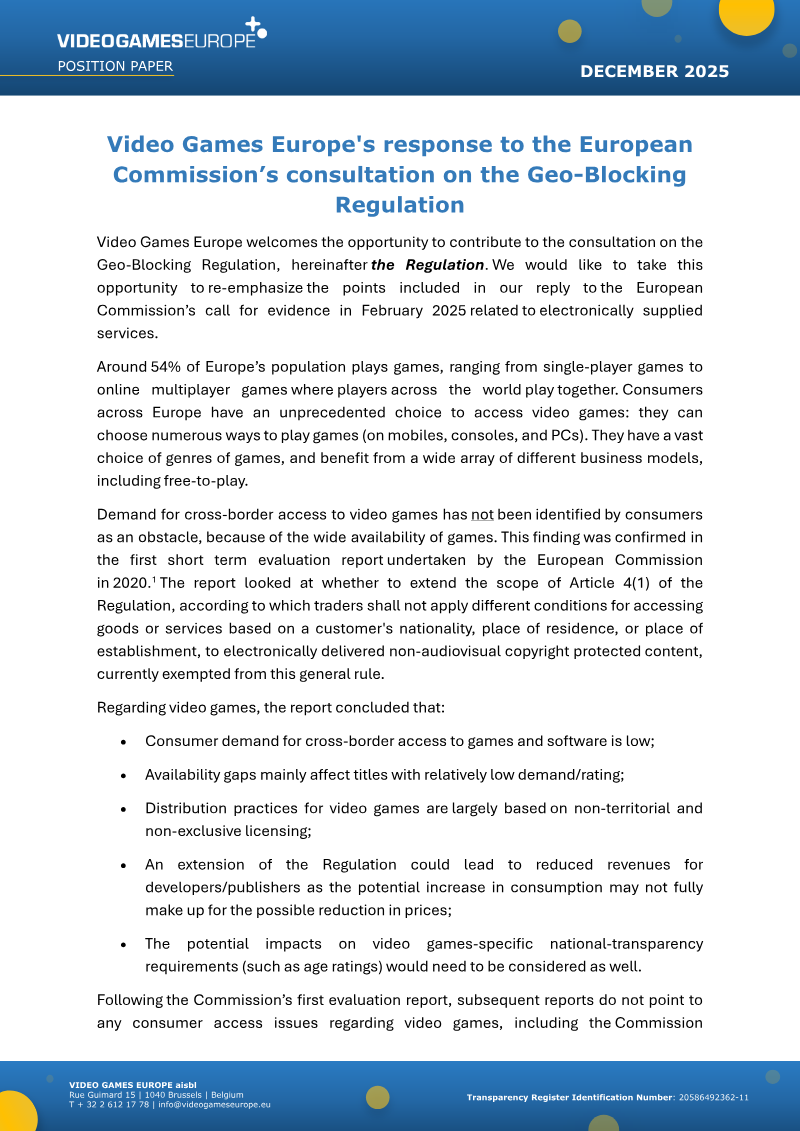
Video Games Europe’s Response to the European Commission’s Consultation on the Geo‑Blocking Regulation
Video Games Europe submits a policy position urging the European Commission to retain the existing exemption for electronically supplied non-audiovisual copyright-protected content within the Geo-Blocking Regulation.
- Video Games Europe is lobbying the European Commission to maintain the current Geo-Blocking Regulation exemption for non-audiovisual copyright-protected content to preserve commercial freedom for rights-holders.
- The European video game sector generates €26.8 billion in annual revenue and employs over 116,000 people across the EU.
- Industry analysis indicates that consumer demand for cross-border access to video games is modest, with low interest among the 54% of the European population that engages in gaming.

Insights on AI, China and EU regulation from RovioCon and Slush 2025 | Week in Mobile Games podcast
The mobile gaming industry is currently navigating a period of intense structural transition, characterized by a contraction in venture capital interest and mounting regulatory headwinds.
- Chinese mobile game developers are increasingly dominating global market categories like 4X strategy and shooters, utilizing massive marketing teams—sometimes exceeding 200 people per game—to outcompete Western studios.
- Epic Games and Unity have formed a strategic partnership allowing developers to use Unity's in-app purchase SDK within Unreal Engine and publish Unity-built games directly into the Fortnite ecosystem to access its 500 million registered accounts.
- Investors are increasingly favoring non-gaming apps over game studios due to higher valuation multiples, with some AI platforms like Lovable reaching $200 million in annual recurring revenue (ARR).

Cyprus LIVE #7 We Relocated our Studio from Ukraine to Cyprus and This Happened...
The relocation of game development studios to Cyprus serves as a strategic pivot for companies seeking to scale operations within a highly concentrated, collaborative ecosystem.
- Relocating game studios to Cyprus acts as a strategic pivot that trades high initial operational costs and first-year revenue volatility for long-term access to international contracts and an expanded product pipeline.
- The Cypriot gaming sector functions as a concentrated technology cluster where a collaborative culture of knowledge exchange among developers and executives replaces traditional corporate secrecy.
- The region’s professional ecosystem is characterized by a high density of international talent, where English serves as the primary language to facilitate fluid business intelligence and expertise sharing.

Cyprus LIVE #6 Behind White Nights Conferences with Julia Lebedeva
The gaming industry in Cyprus has evolved into a highly concentrated, senior-level hub following a significant influx of relocated studios and management-level professionals over the past three to four years.
- Limassol, Cyprus, has emerged as a high-density hub for senior-level gaming professionals and relocated studios over the past three to four years.
- The concentration of industry leadership in Cyprus serves as a critical environment for navigating global market volatility and sharing operational strategies.
- A persistent disconnect remains between male-dominated development teams and the female-heavy player bases prevalent in genres like casual puzzle games.

Cyprus LIVE #3 GDCy and the Story of the Largest Developer Festival in Cyprus
Cyprus has emerged as a significant hub for the global game development industry, driven by a combination of favorable tax legislation, intellectual property protections, and a high quality of life.
- Cyprus attracts global gaming companies through a highly favorable tax structure, featuring a 2.5% tax rate on intellectual property and 0% tax on dividends.
- The region utilizes British law to provide a stable legal framework for international firms to manage and protect their intellectual property.
- The GDCy festival has scaled from an informal gathering into the largest developer conference in Cyprus, serving as the primary networking hub for industry executives.

Cyprus LIVE #1 What If Cyprus Becomes The NEXT BIG Tech Powerhouse?
Cyprus is emerging as a significant international hub for mobile game development, specifically within the casual puzzle genre.
- Cyprus is establishing itself as a major mobile game development hub by consolidating a diverse talent pool of industry veterans from Turkey, Ukraine, and Russia.
- The regional development strategy prioritizes rigorous analytical processes and rapid iterative testing to overcome high user acquisition costs and stagnant gameplay innovation.
- Developers are successfully scaling titles by adapting hybrid-casual concepts and integrating high-quality meta-game layers, a model exemplified by the success of Royal Match.

The EU's Digital Fairness Act and what it means for the games industry explained
The European Commission’s proposed Digital Fairness Act represents a significant shift in the regulatory landscape for the gaming industry, aiming to modernize consumer protection standards across the European Union.
- The EU's proposed Digital Fairness Act aims to modernize consumer protection by targeting monetization strategies, addictive design elements, and the protection of vulnerable users.
- Industry stakeholders are concerned that the legislation may misclassify standard promotional mechanics, such as time-sensitive offers and limited-edition items, as prohibited dark patterns.
- New mandates requiring the display of fiat valuations for mixed-source virtual currencies are being challenged as technically flawed and potentially disruptive to free-to-play economic models.

Pokémon Poop & All the Gaming Stories Z-A Blocked Up | Games For Breakfast
The contemporary gaming landscape is defined by a tension between established franchises, platform-level mismanagement, and the aggressive monetization of player behavior.
- Major franchises like Pokémon are experiencing development stagnation, prioritizing iterative quality-of-life updates over innovation due to a lack of competitive pressure.
- The gaming industry is facing increased regulatory scrutiny, particularly from the European Union, regarding predatory monetization models like loot boxes and multi-currency systems.
- Twitch is struggling with systemic operational failures, including inadequate event security and a lack of substantive platform feature updates.

Supercell CEO vs. the EU — Is This the End of Free-to-Play in Europe?
The European Union’s proposed Digital Fairness Act and accompanying consumer protection guidelines have sparked significant industry concern regarding the future of the free-to-play gaming model.
- The EU’s proposed Digital Fairness Act threatens the $27 billion European gaming sector by potentially classifying in-game currencies as financial instruments similar to Bitcoin.
- If enacted, the regulation would require every virtual transaction to undergo rigorous legal processing, including mandatory parental approval and explicit euro-denominated price disclosures.
- These requirements risk dismantling the frictionless monetization mechanics that currently sustain the free-to-play gaming model.

Week in Mobile Games E68 - The Top 50 Mobile Game Makers, and crisis in the EU's games industry
The mobile gaming industry is currently defined by a stark dichotomy between the commercial success of established live-service titles and an increasingly hostile regulatory environment.
- Supercell CEO Ilkka Paananen has warned that the European Commission's proposed 'Digital Fairness Act' could severely damage the regional games industry by imposing restrictive regulations on free-to-play mechanics.
- The SEC is investigating AppLovin over allegations that the company breached platform partner agreements regarding data collection practices, specifically concerning the use of children's data.
- PocketGamer.biz released its 'Top 50 Mobile Game Makers 2025' list, which ranks Tencent at number one, followed by Take-Two Interactive and DeNA in the top three.