Baltic reports and market data
5 game industry reports, presentations and talks about baltic from writers such as BGZ Berliner Gesellschaft für internationale Zusammenarbeit mbH, Baltic Game Industry and BGI Project, newest from 2020. Every document has a summary and key insights with the page they come from, and 19 charts and tables are extracted as data.
Documents
Recommendations for Implementation of Virtual Reality Applications in Other Industries
Virtual reality and extended reality technologies offer transformative potential for the healthcare sector, provided that development strategies prioritize interdisciplinary collaboration between game designers and medical professionals.
- The goal of a VR application dictates design choices like game engine, target device, mechanics, and user interface, with therapeutic applications requiring careful consideration to avoid increasing muscular tension or using ergonomically poor hardware.
- Input devices for VR applications, especially in professional training or therapy, need careful selection; standard XR controllers are unsuitable for fine motor actions, making haptic gloves a viable but more expensive and technically complex alternative.
- When selecting an XR headset, key features to consider include Field of View (FOV) for immersion, tracking method (Outside-In for precision but higher room requirements, Inside-Out for flexibility and lower cost but less computing power), and eye-tracking for research and training.
The Game Incubation Landscape in Europe: Appraisal of the BSR in the European Context
The European game incubation landscape functions as a critical pillar of regional economic development, operating primarily through a mix of public subsidies, academic partnerships, and private-sector initiatives.
- The Baltic Sea Region (BSR) has 24 game-focused incubators and accelerators, with half located in Sweden (6) and Finland (6). Nearly 40% (9) of these programs were established in the last three years, indicating a recent trend.
- Most BSR incubation programs prioritize supporting regional ecosystem development and university students/alumni.
- Governments are crucial for fostering an environment where incubator capacity-building initiatives can thrive, by adopting laws and regulations that promote research, development, and entrepreneurship.
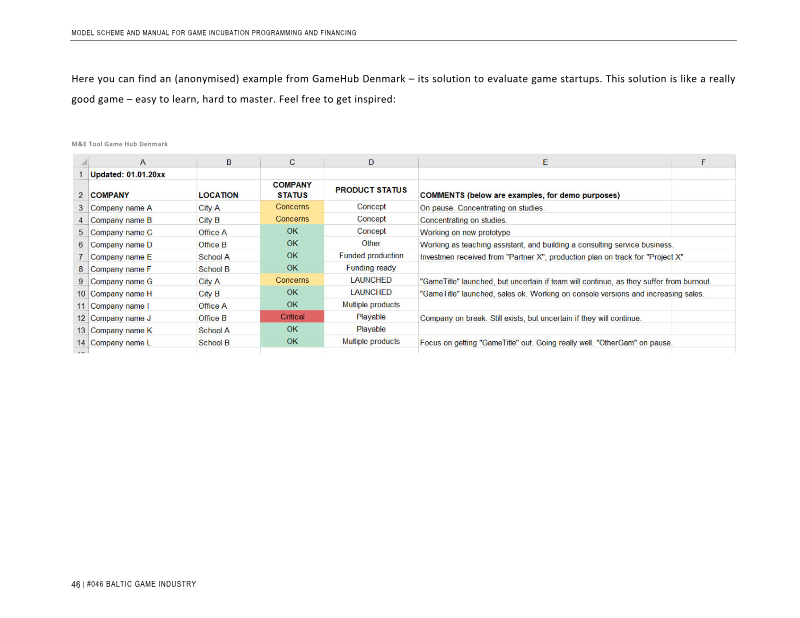
Model Scheme and Manual for Game Incubation Programming and Financing: Baltic Games Industry
The Baltic Sea region is currently undergoing a strategic transformation aimed at establishing itself as a globally competitive hub for game development.
- Most game incubators in Europe, especially those for game creators, are primarily funded by public sources, with private initiatives being a minority.
- Establishing a sustainable game incubator often takes over 5 years to break even, with only 40.8% of business incubators aiming to break even as part of their business plan.
- Game incubation programs can be structured in various ways, including long-term incubation (1 year+ for medium-maturity startups) and short-term acceleration (3-4 months for high-maturity startups, often involving equity exchange for funding).
Guideline for Set-Up and Maintenance of a Mentoring System for Game Business Incubation
Establishing and maintaining a successful game business incubator requires a specialized framework that addresses the unique, multidisciplinary challenges of the gaming sector, such as rapid market volatility and complex monetization strategies.
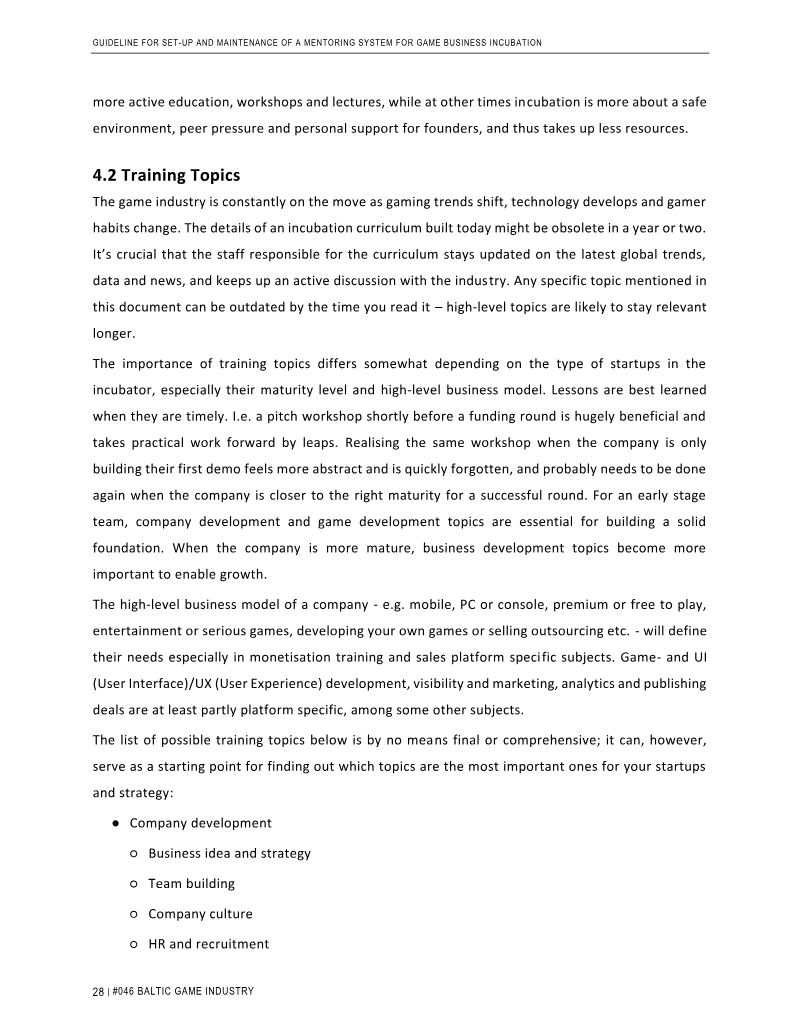
- The game industry is highly competitive and unique, with revenues exceeding three times that of the movie industry, requiring specialized incubation support distinct from generic tech incubators.
- Effective game incubation systems need to tailor their offerings based on the local startup ecosystem, considering factors like founders' experience (e.g., fresh graduates vs. industry veterans) and community focus (e.g., hobby developers needing business skills).
- Mentoring in game incubation involves a continuous, supportive relationship with experienced industry professionals, ideally based on a flexible long-term development plan, and requires mentors with strong communication, listening, and industry understanding.
Manual on International Cooperation for BSR-Wide Game Business Development
The Baltic Sea Region (BSR) game development sector requires a unified, transnational approach to overcome the resource constraints and fragmentation inherent in local incubation environments.
- The global game market is rapidly growing, with China leading in consumer spending, followed by the US and Japan. European countries, with smaller home markets, must focus on global markets, necessitating internationalization in game incubation.
- International cooperation is crucial for game incubators to stay updated on trends, tools, and opportunities, requiring resources like travel to events and partners, supported by sustainable business models or public funding.
- The Game Camps project (2017-2020), funded by Interreg Central Baltic, fostered cross-border startups by bringing together over 250 game enthusiasts from Finland, Sweden, Estonia, and Latvia, resulting in four new startups and support for over 15 existing ones.