Showing 30 of 406 results · 0.63s
FY2015 First Quarter Financial Results
GREE
decreased marginally. The company’s strategy focuses on accelerating native game development, having shifted resources from web games and added 12 new production lines. Three first‑party native
Financial32 pages
Apr 2022
Financial Results for the Fiscal Year Ending March 2022
Koei Tecmo
primarily catalyzed by the Entertainment segment, where smartphone and social game revenues rose by 48.2% and cumulative mobile downloads increased by nearly 30%. High-performing titles such
Financial35 pages
2008 Interim Report: Tencent Holdings Limited
Tencent
scaling of internet value-added services, particularly online gaming and community platforms, alongside sustained growth in mobile telecommunications and online advertising. Operational scaling necessitated increased investment in human
Financial78 pages
Dec 2025
Video Game Market Update: Q4 2025
Aream & Co
reflecting the increasing monetisation of interactive micro‑experiences within mobile ecosystems. Investment activity in the early‑stage gaming sector remains tightly concentrated among a small cohort of venture
Financial57 pages
Annual General Meeting FY 2022/23
Embracer Group
operations through studio closures and project cancellations. The global gaming landscape remains a complex environment, with the mobile sector commanding nearly half of the $188 billion market. Within
Financial80 pages
Jan 2026
FY2026 2Q Financial Results Briefing Material
Bushiroad
expansion of the PalVerse figure brand and consistent console game releases. Strategic focus remains on the worldwide mobile launch of HUNTER×HUNTER NEN×SURVIVOR in early
Financial31 pages
Jan 2022
Gaming Deals Activity Report H1'22
InvestGame
research, cover global markets and encompass all major video‑games subsectors, from console and PC titles to mobile and cloud‑based platforms. The analysis underscores that the record
Financial25 pages
HUYA Inc. Second Quarter 2026 Unaudited Financial Results: China
Huya
RMB1,101.5 million, the company’s focus on game publishing—exemplified by the performance of the mobile version of Goose Goose Duck—remains a core pillar
Financial11 pages
May 2020
Take-Two 10-K — FY2019 (May 2020)
Take-Two Interactive
owned titles across major platforms (PlayStation, Xbox, Switch, PC, mobile) and a multi‑label structure that includes Rockstar Games, 2K, Private Division, and Social Point. Emphasis on disciplined
Financial1 pages
Tencent Second Quarter 2026 Results Presentation: China
Tencent
Chinese market, where it maintains leadership in mobile community engagement, digital content, and productivity software. Domestic gaming revenue rose 17% to 47.3 billion RMB, driven by the success
Financial28 pages
Jul 2004
Square Enix Annual Report FY2004
Square Enix
value of established intellectual property across multiple platforms, including mobile and network-based digital entertainment. While offline games remained the primary revenue driver at ¥37,988 million
Financial70 pages
Jun 2004
NetEase.com, Inc. — Form 20‑F for the Fiscal Year Ended December 31, 2003
NetEase
concentrated: two MMORPG titles generate the bulk of game revenue, and wireless services depend on contracts with China Mobile and China Unicom. Regulatory risk is significant, encompassing licensing
Financial1 pages
Mar 2011
Financial Results for the First Half of the Fiscal Year Ending March 2011
Koei Tecmo
market, accounting for 86.7% of sales. While the Game Software segment remains the largest revenue driver, the Online & Mobile segment showed robust growth, with sales increasing from
Financial34 pages
Jun 2003
NetEase 20‑F: FY2002 Annual Report
NetEase
wireless value‑added services, particularly SMS and mobile products, contributed significantly to the revenue mix, with online gaming emerging as a notable new segment. Operating performance improved markedly
Financial1 pages
May 2019
Consolidated Financial Results for the First Quarter of the Fiscal Year Ending December 31, 2019
KLab
Japanese market with global reach through its mobile titles, KLab’s operations are divided between its core Game Business and Other Businesses, which now includes a venture capital
Financial8 pages
Tencent 2026 First Quarter Results Presentation
Tencent
year increase in domestic game revenue and a 13% rise in international game revenue, driven by titles such as Peacekeeper Elite and VALORANT Mobile. Marketing services saw significant
Financial25 pages
Jan 2022
Paradox Interactive Year-End Report: January – December 2022
Paradox Interactive
period included the release of Victoria 3, the mobile title Airport Simulator: First Class, and several expansions for existing games. The company also noted a shift
Financial21 pages
Jul 2020
SciPlay 10-Q — Q1 FY2020 (July 2020)
SciPlay
filing demonstrates robust growth for a small, emerging gaming company. Revenue rose 48 % to $165.6 million, driven largely by mobile platforms that accounted for roughly 87 % of total
Financial1 pages
2020 Annual Report
Tencent
performance bolstered by strong growth in online gaming—led by titles such as Honour of Kings and PUBG Mobile—and significant gains from the valuation and disposal
Financial314 pages
May 2022
SciPlay 10-Q — Q1 FY2022 (May 2022)
SciPlay
financial picture amid continued expansion into the casual gaming segment. Revenue rose modestly to $158 million, driven by higher mobile in‑app purchase volumes and a small advertising
Financial1 pages
Jan 2024
Global Gaming Report 2024
Drake Star Partners
Games to 51.4%, and DoubleU Games’ $27 million purchase of a majority stake in Paxie Games. LoopMe’s acquisition of Chartboost further consolidates ad‑tech within the mobile
Financial26 pages
Interim Results: Six Months Ended 30 June 2007
Tencent Holdings Limited
demand and an expanded pipeline of new game launches to sustain its growth trajectory. Despite regulatory headwinds in the mobile sector, the firm maintains a stable corporate governance
Financial62 pages
Interim Report 2009: Tencent Holdings Limited
Tencent
strong performance of Internet value-added services, mobile telecommunications, and online advertising. Specifically, the successful monetization of licensed online games such as DNF and Cross Fire served
Financial92 pages
May 2024
Bandai Namco Group Fiscal Year Ended March 2024 Information Meeting
Bandai Namco
stable, supported by the success of the Mobile Suit Gundam: The Witch from Mercury series and brisk sales in arcade games and collaboration facilities like the Bandai Namco
Financial17 pages
Apr 2025
Annual Report 2024: Fiscal Year Review
DoubleDown Interactive
engine comprising licensed IGT titles, exclusive DoubleU Games slots, and proprietary in‑house development—positions it to expand into new mobile genres and regulated iGaming jurisdictions. However, regulatory
Financial1 pages
Aug 2014
FY2014 Fourth Quarter Financial Results
GREE
games for fiscal year 2015, with plans to triple native game operations and expand the Japanese studio headcount to 1,000 employees. While the legacy web game business
Financial52 pages
Jan 2024
Q3 2024 GDEU Financial Results
GDEU
broader user base across mobile and PC platforms. Platform commissions rose from $91 million to $130 million, while game operation costs grew modestly. Selling and marketing expenses fell
Financial11 pages
Investor Presentation: August 2026
Take-Two Interactive
Redemption, and Borderlands with a robust mobile presence, the organization is strategically positioned to capture significant market share across all major gaming platforms. Financial performance reflects the success
Financial35 pages
May 2014
FY 2014 Third Quarter Financial Results
GREE
challenges in international markets, the broader native game segment reached a profitable milestone globally. To diversify revenue streams beyond traditional gaming, expansion is underway into commerce, advertising
Financial35 pages
Sep 2023
Games Investment Review: Q3 2023
DDM
continued appetite for large‑scale mobile publishers. Microsoft’s $68.7 billion acquisition of Activision Blizzard, cleared after the divestiture of cloud‑gaming rights to Ubisoft, dominated the corporate
Financial43 pages

FY2015 First Quarter Financial Results
32 pages4k words
Summary
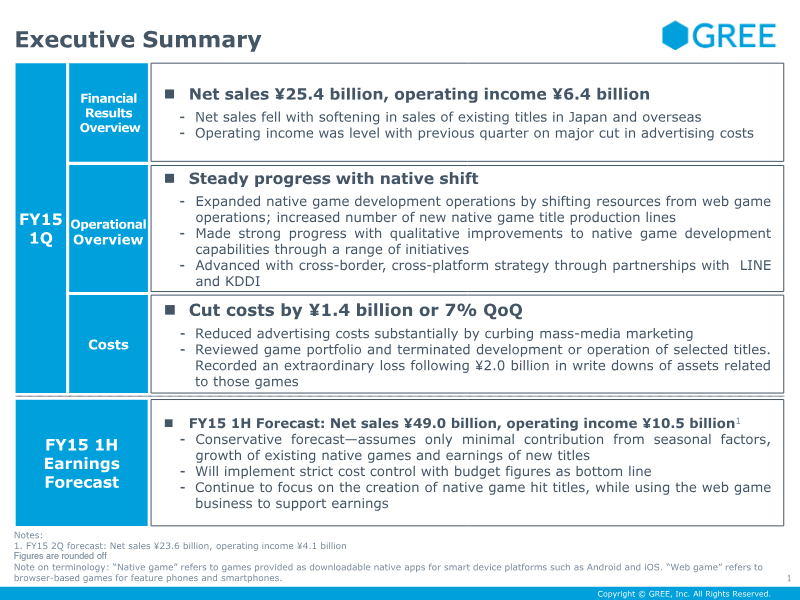
The first‑quarter fiscal 2015 results show net sales of ¥25.4 billion and operating income of ¥6.4 billion, a decline in sales but a flat operating margin compared with the previous quarter due to a ¥1.4 billion cut in advertising costs. Net sales fell 9.9% year‑over‑year, driven by softer performance of existing titles in Japan and overseas markets. EBITDA rose modestly to ¥8.01 billion, while ordinary income increased by ¥2.27 billion largely from a ¥17.2 billion exchange gain on USD‑denominated loans. An extraordinary loss of ¥2.03 billion was recorded from write‑downs of assets related to discontinued titles, reducing net income to ¥3.48 billion.
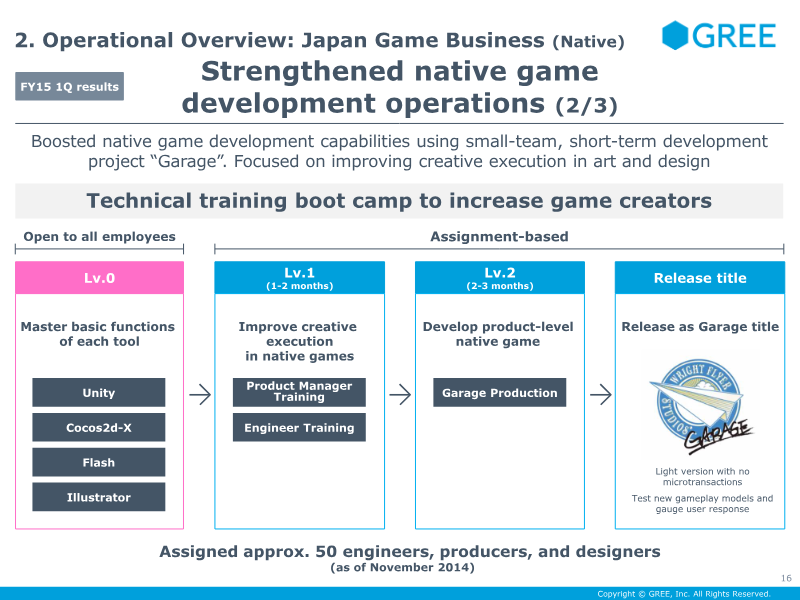
Cost structure analysis indicates a 7% reduction in total costs to ¥19.0 billion, largely from advertising (down 13% QoQ) and commission fees. Variable costs fell by ¥1.19 billion, while fixed costs decreased marginally. The company’s strategy focuses on accelerating native game development, having shifted resources from web games and added 12 new production lines. Three first‑party native titles are slated for launch in the winter, and partnerships with LINE and KDDI aim to expand cross‑border reach.
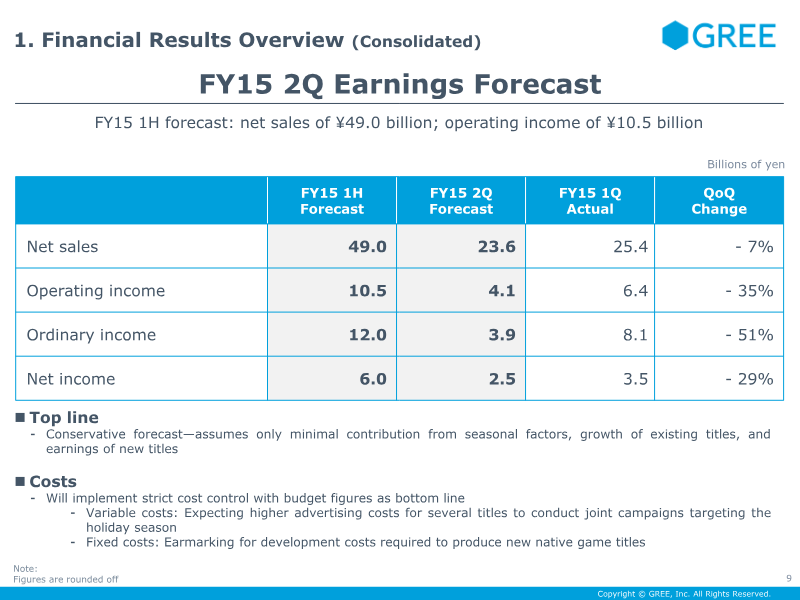
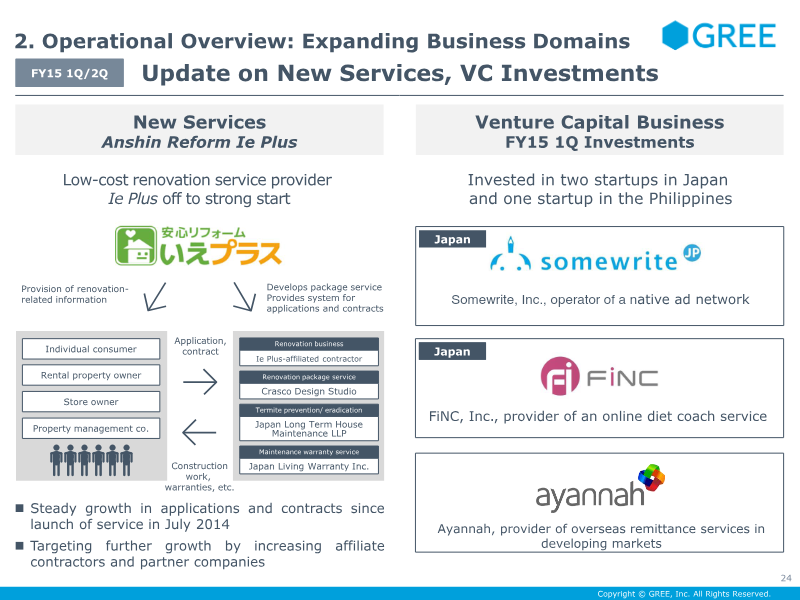
For FY15 first half, the company forecasts net sales of ¥49.0 billion and operating income of ¥10.5 billion, assuming minimal seasonal impact and continued cost control. The outlook emphasizes native hit titles as the primary growth driver, with web games supporting earnings and new ventures in mobile video advertising and venture capital investments.
Pages
Insights
- Net sales for Q1 FY2015 fell 9.9% year-over-year to ¥25.4 billion, driven by the underperformance of existing titles in both domestic and international markets.
- Operating income remained flat at ¥6.4 billion despite the sales decline, supported by a ¥1.4 billion reduction in advertising expenditures.
- Ordinary income saw a significant boost of ¥2.27 billion, primarily attributed to a ¥17.2 billion exchange gain on USD-denominated loans.
- Net income was reduced to ¥3.48 billion after accounting for a ¥2.03 billion extraordinary loss related to asset write-downs for discontinued titles.
- The company is shifting its strategic focus toward native game development, having added 12 new production lines and scheduled three first-party native titles for a winter launch.
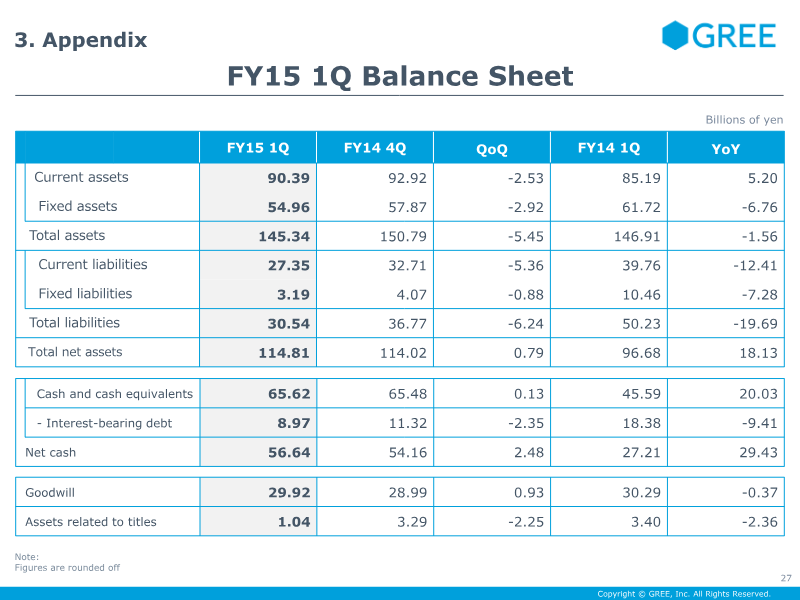
FY15 1Q Balance Sheet