Showing 30 of 463 results · 0.59s
Annual Report 2024: Tencent Holdings Limited
Tencent
market competition, regulatory compliance, and technological volatility. Geographically, the Mainland of China remains the primary market, accounting for roughly 90% of total revenue. To operate within this regulatory
Financial274 pages
Apr 2026
What Is Meta's China Exposure?
Mobile Dev Memo
article examines Meta’s current exposure to the Chinese market following a regulatory directive from China’s National Development and Reform Commission (NDRC). The NDRC has ordered Meta
Article1 pages
Jan 2022
Unity Gaming Report 2022
Unity
essential for maximizing player retention and market reach. Although mobile remains the dominant platform, especially in markets like China and Japan, developers are increasingly prioritizing cross-platform compatibility
Report40 pages
Jan 2024
Video Game Predictions for 2024
SuperJoost
United States, Europe, and China. It notes that Tencent’s domestic regulatory struggles in China—where the mobile market saw a 12% decline in late 2023—will likely
Article
Jun 2005
Gravity Co. 20‑F: Fiscal Year Ended December 31, 2004
Gravity Co.
majority of revenue overseas, where licensing agreements in Japan, Taiwan, Thailand, China, and other markets provided upfront fees and ongoing royalties. Operating income climbed to US$38.4 million
Financial1 pages
Consolidated Financial Results for the Six Months Ended June 30, 2026
NEXON Co.
Geographically, the company experienced a strategic shift in its market performance. While traditional strongholds in Korea and China saw declines, significant growth in North American and European markets
Financial26 pages
Jul 2026
Steam: Highest Revenue in History in H1 2026
Alinea Analytics, PWN Games
tracking platform to monitor market activity. Several factors are driving this expansion, including a notable influx of players from Asian markets, particularly China, and a strategic shift
Article1 pages
Dec 2023
Plus: Here Comes The Day Before, and We're Fascinated!
GameDiscoverCo
Geographically, the data indicates a strong influence from the Asian market, particularly China, where titles like Touhou Hero of Ice Fairy and Apocalypse Party have seen significant engagement
Article
Nov 2021
How Games Went From Premium to Freemium and What Could Come Next
Lu Weiming
entry. Historically, the Western market relied on a premium model where consumers purchased consoles and individual physical media. In contrast, developing markets like China faced rampant piracy
Article
May 2024
How The Planet Crafter Hit 1 Million Sold, Post-1.0!
GameDiscoverCo
perception. Geographically, the United States leads consumption at 29%, followed by Germany and China. Marketing success was driven by organic influencer interest and a €200,000 paid streamer
Article
Jun 2019
Raport Bieżący Nr 28/2019: China Market
PlayWay
navigate the complex regulatory and distribution landscape in China. The scope of this arrangement is geographically focused on mainland China and pertains specifically to the PC or console
Legal1 pages
Aug 2025
Corporate Data: As of August 31, 2025
Square Enix
branches in China and India. Square Enix (China) Co., Ltd. and Huang Long Co., Ltd. manage digital entertainment and online game sales within the Chinese market, while Square
Financial1 pages
Jan 2020
From Playing to Paying: The Art of Monetizing Games in Asia
Niko Partners
capturing the increasing purchasing power of Asian gamers. The scope covers major markets including China, Japan, South Korea, India, and Southeast Asia, utilizing 2019 and 2020 data
Report15 pages
Jun 2026
Asia and MENA Gaming Markets Forecast: 2030
Niko Partners
CAGR. China, Japan, and South Korea dominate the region, contributing $91.7 billion in 2030 revenue—88.6 % of the Asia‑MENA total. China’s market reached $51.8 billion
Article1 pages
Jan 2023
State of Mobile 2023
data.ai
engagement platforms that generate high‑frequency usage. Geographically, the top ten markets—China, India, the United States, Brazil, Indonesia and others—contributed the majority of downloads and spend
Report93 pages
FY2015 Third Quarter Financial Results
GREE
user engagement across its game portfolio. The document covers Japan, U.S., Europe, and China markets over FY2015, employing quarterly financial statements, cost‑structure analysis, headcount data
Financial30 pages
Sep 2019
Integrated Report 2019
Bandai Namco
large‑scale experiences (e.g., 18‑m moving Gundam slated for 2020). • Target markets: China, North America (localised content). Dragon Ball • YouTube masthead campaign → 17 M+ views
Financial114 pages
Jun 2024
Which Countries Dominate Steam Bandwidth Usage in 2025?
GameDiscoverCo
United States at 20.6%. This highlights the continued strength of the grey market in China, which saw a nearly 1% increase in usage since February 2024. Other significant
Article
Nov 2024
NVIDIA Form 10-Q: Q3 Fiscal Year 2025
NVIDIA
controls on high-performance AI semiconductors continue to restrict access to key markets, including China and the Middle East, necessitating complex licensing strategies and supply chain adjustments. These
Financial1 pages
Oct 2025
Does Steam Have Its Regional Pricing Recommendations Right?
GameDiscoverCo
publishers frequently deviate from these recommendations, often setting significantly higher prices in markets like China and Brazil. For instance, AAA titles in Brazil were found to be priced
Article1 pages
Jan 2025
Mobile Monetization Report 2025
AppMagic
Store and emerging regions such as LATAM and MENA. While established markets like China and Japan experienced revenue contractions of up to 15%, the Strategy genre surged
Report61 pages
Jan 2022
Shooter Games
Newzoo
players engaging with titles that feature microtransactions. Geographically, the research covers 37 markets, excluding China and India, and utilizes a sample of over 19,000 active gamers
Report26 pages
Jul 2014
Square Enix Annual Report FY2014
Square Enix
particularly in the JRPG genre, while aggressively expanding into high-growth mobile markets in China, India, and South America. Despite a ¥1.7 billion extraordinary loss from a review
Financial74 pages
Jan 2024
Death, and Rebirth, of Virtual Reality: Apple's Vision Pro Cannot Succeed
SuperJoost
that will directly impact major platforms like Roblox and Fortnite. Simultaneously, international markets like China are seeing increased government scrutiny over user controls. These economic and regulatory shifts
Article
Aug 2024
Form 10-Q: Q2 Fiscal Year 2025
NVIDIA
evolving U.S. export controls that restrict high-performance chip sales in key markets like China. These regulatory pressures, combined with the inherent difficulty of forecasting AI-driven demand
Financial1 pages
Aug 2026
The State of AI in Games
Video Games Industry Memo
financial pressures of maintaining expensive, proprietary frontier models, Asian companies in markets like China and Korea are making significant strides by leveraging smaller, open-weight models. This strategic
Article1 pages
Jan 2014
Fiscal Year Ending March 2015 Financial Results
Koei Tecmo
Business Promoting Division. Geographically, there is a concerted effort to penetrate Asian markets, specifically China and Korea, across both console and mobile platforms. This international outlook extends
Financial38 pages
FY2015 Annual Business Report: MIXI
mixi
over 30 million cumulative unique device downloads—and its expansion into new markets, including China, South Korea, North America, and Hong Kong/Macau. Strategic media‑mix initiatives such
Report2 pages
Jan 2025
Key Insights into Role-Playing Games (RPGs)
Newzoo
Gaming in June 2022. These insights are derived from data covering 37 markets, excluding China and India, and utilize proprietary gamer segmentation to analyze player motivations, viewing habits
Report26 pages
May 2025
Clair Obscur & Drive Beyond Horizons: Subgenre + Execution = Hit
GameDiscoverCo
aesthetic that resonated with Western audiences while maintaining strong performance in global markets, particularly China. Conversely, Drive Beyond Horizons demonstrates the potential for success in niche survival
Article1 pages
Annual Report 2024: Tencent Holdings Limited
274 pages111k words
Summary
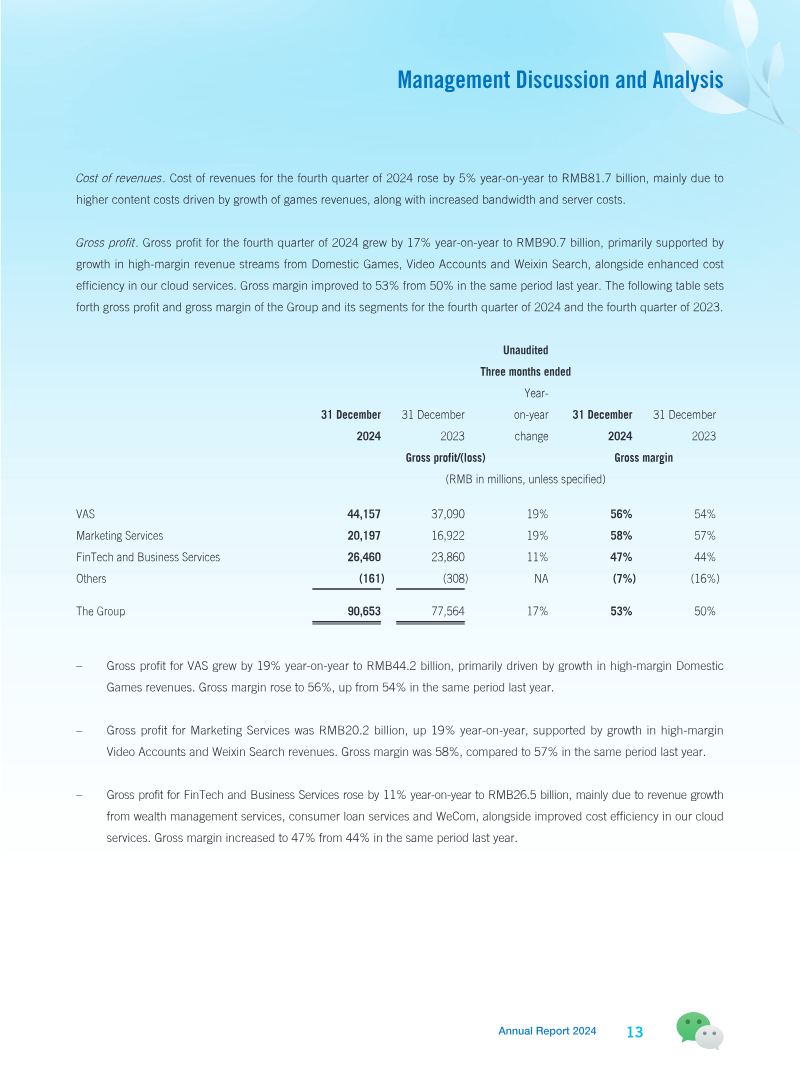
Tencent Holdings Limited’s 2024 annual report details a period of robust financial expansion and strategic operational refinement. The company achieved annual revenues of RMB 660.26 billion, representing an 8% increase over the previous year, while profit attributable to equity holders surged by 68% to RMB 194.07 billion. This performance was underpinned by double-digit growth in marketing services and the sustained success of an "evergreen" games portfolio, which expanded to 14 titles. The company’s financial health was further bolstered by improved operational efficiencies, particularly through AI-driven advertising enhancements and cost-optimization initiatives, which collectively expanded gross margins to 53%.
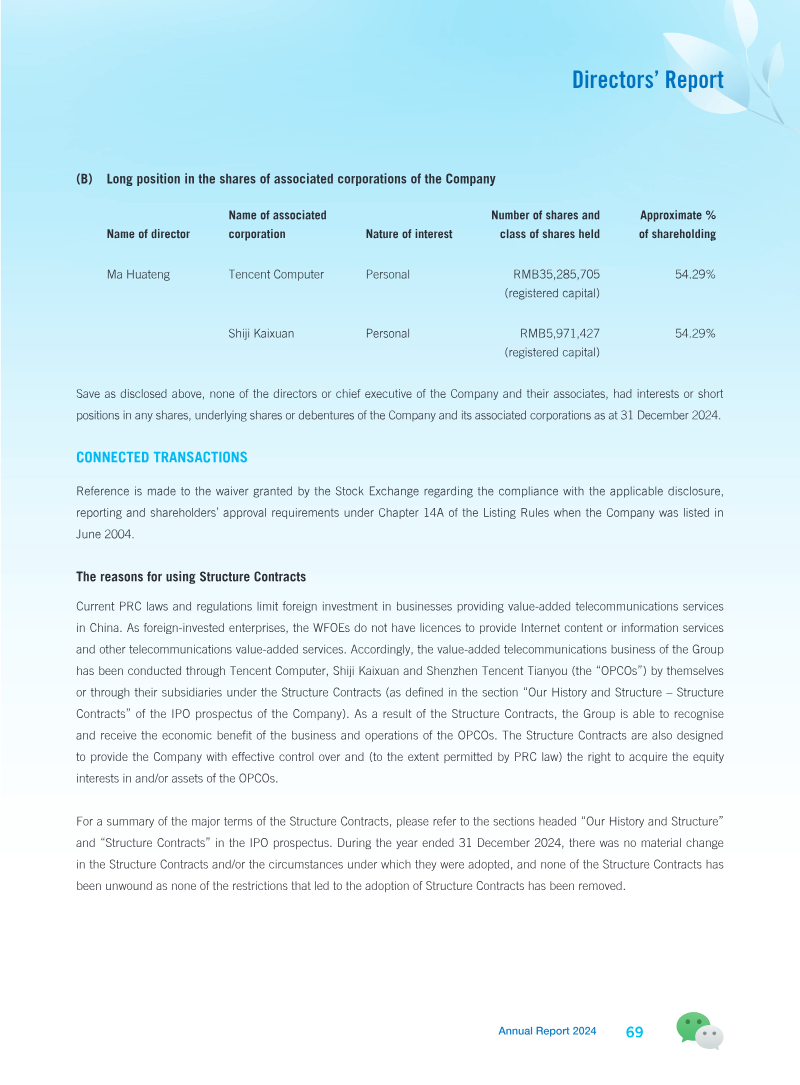
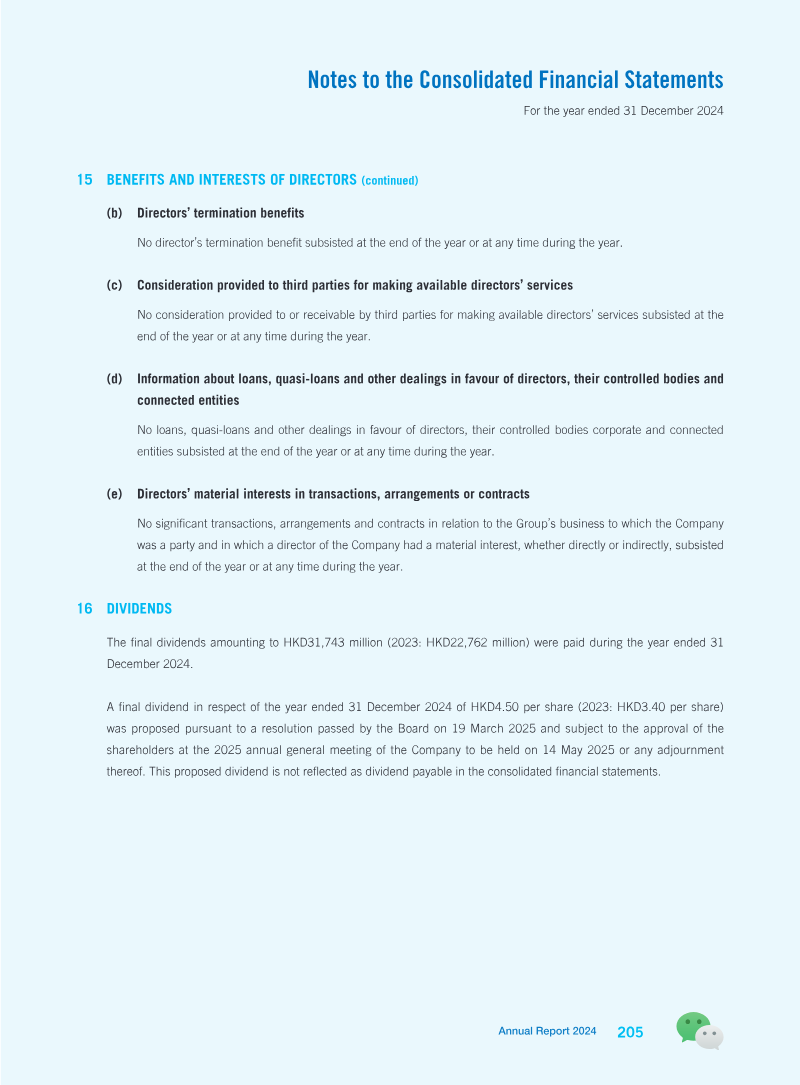
The report highlights a significant commitment to shareholder returns, evidenced by a 32% increase in the proposed annual dividend to HKD 4.50 per share and the repurchase of approximately HKD 112 billion in company shares. While the company maintains a strong net cash position of RMB 76.8 billion, it is aggressively scaling capital expenditures in AI infrastructure and research and development to drive future productivity and innovation. These investments are managed within a "Three Lines Model" of risk management, which prioritizes navigating market competition, regulatory compliance, and technological volatility.
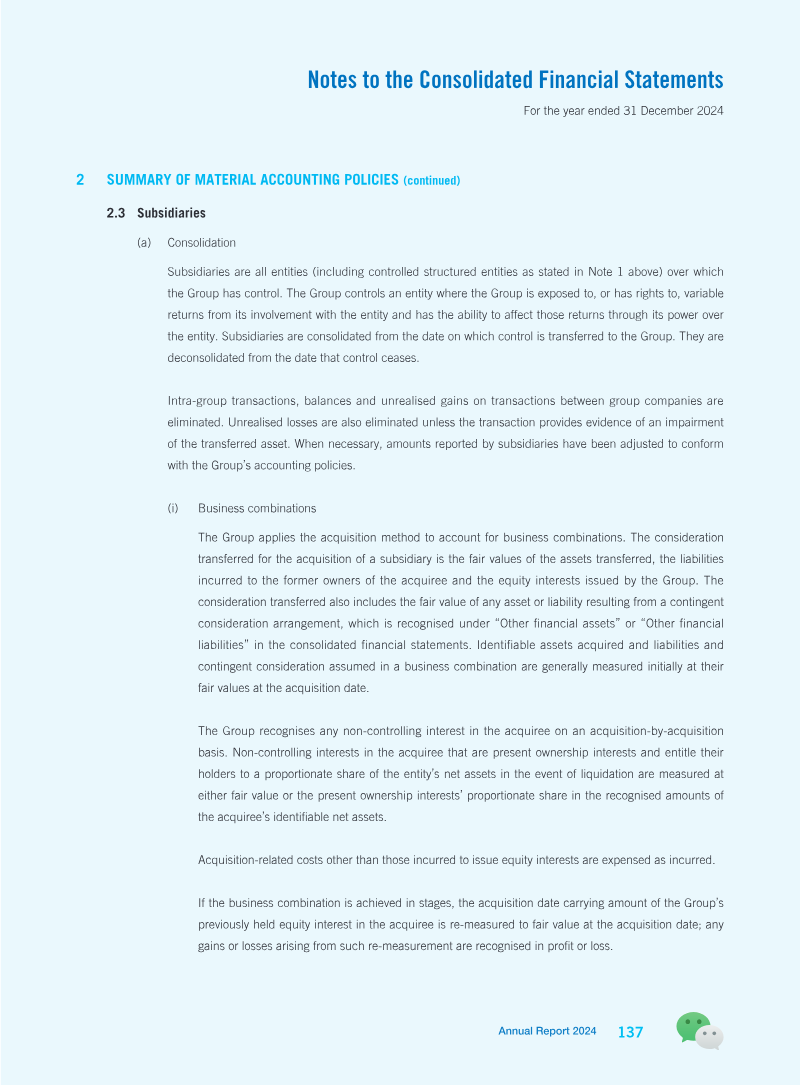
Geographically, the Mainland of China remains the primary market, accounting for roughly 90% of total revenue. To operate within this regulatory environment, the company continues to utilize structured contracts to manage value-added telecommunications and online services, acknowledging the inherent risks associated with potential shifts in Chinese law. Governance remains centered on a board structure that emphasizes diversity and merit-based selection, supported by rigorous internal controls and audit processes. Overall, the 2024 results reflect a transition toward high-margin, technology-led growth, supported by a disciplined approach to capital management and a strategic focus on long-term digital infrastructure.
Pages
Insights
- Tencent achieved RMB 660.26 billion in annual revenue, an 8% increase, while profit attributable to equity holders rose 68% to RMB 194.07 billion.
- Gross margins expanded to 53% due to AI-driven advertising enhancements and cost-optimization initiatives.
- Shareholder returns were prioritized through a 32% increase in the annual dividend to HKD 4.50 per share and HKD 112 billion in share repurchases.
- The company’s gaming segment is anchored by an 'evergreen' portfolio that has grown to 14 titles.
- Mainland China remains the dominant market, accounting for approximately 90% of total revenue.
Unaudited Three months ended